
From the failure of Silicon Valley’s defence startups on Ukrainian battlefields to the logistical collapse of the United States Navy in the Persian Gulf, the gap between American military spending and American military capability has become a chasm that no amount of additional funding can bridge
Editorial Analysis | September 2026
The performance of the United States military in the wars of the twenty-twenties has exposed a growing divergence between its vast financial commitments to defence and the actual operational capabilities those commitments purchase. Nowhere is this divergence more apparent than in the twin crises of military-industrial production and forward logistics that have emerged simultaneously in Ukraine and the Persian Gulf. The first crisis concerns the inability of American arms manufacturers, including well-funded startups such as Anduril Industries, to produce weapons in sufficient quantity or at sufficient quality to match Russian and Chinese output. The second concerns the catastrophic vulnerability of American naval logistics in the Middle East, demonstrated by Iran’s destruction of the Bahrain naval base on the first day of hostilities and the subsequent forced reliance on a two-thousand-two-hundred-mile supply line from Diego Garcia (50). These two crises are not unrelated. They are symptoms of a single underlying condition: a military system organised around private profit rather than strategic purpose, and a political class that has become institutionally incapable of distinguishing between the defence of the nation and the enrichment of its defence contractors.
The case of Anduril Industries provides a particularly instructive illustration of how the profit motive distorts military procurement and production. Founded by Palmer Luckey, the billionaire who previously sold Oculus VR to Facebook, Anduril has positioned itself as a disruptive alternative to the legacy defence primes of Lockheed Martin, Raytheon and Boeing. Its marketing language emphasises “hyperscaling”, “software-defined production” and the replacement of expensive, bespoke weapons with affordable, mass-produced systems (24). The company has accumulated more than six billion dollars in government contracts and reached a valuation approaching sixty billion dollars, making it one of the most highly valued private defence technology companies in the United States-. Luckey’s personal fortune has grown correspondingly, from an estimated three point five billion dollars to five billion dollars following Anduril’s most recent fundraising round. Yet the actual performance of Anduril’s weapons on battlefields where they have been tested tells a rather different story from the one presented in the company’s promotional materials.
In Ukraine, Anduril’s Altius loitering munitions were supplied to units of the Security Service of Ukraine, the SBU, with considerable fanfare about their transformative potential (11). The reality proved otherwise. According to reports from the Wall Street Journal and corroborated by multiple sources, frontline SBU operators found that the Altius drones frequently crashed, failed to hit their targets, and proved highly vulnerable to Russian electronic warfare systems (11). The drones were so problematic and unreliable that the SBU ceased using them altogether in 2024, and they have not been fielded since. This is not an isolated instance of battlefield failure but rather a pattern that raises fundamental questions about the entire model of defence procurement that Anduril represents. The company’s products are cheaper than those of legacy manufacturers only because they are less capable, and their supposed affordability is undermined when they fail to perform their intended mission and are abandoned by the soldiers whose lives depend upon them.
The same pattern is evident in Anduril’s Barracuda family of cruise missiles, which the company has promoted as the solution to America’s dwindling stockpiles of precision-guided munitions. Under a framework agreement with the United States Department of War signed in 2026, Anduril is committed to delivering a minimum of one thousand surface-launched Barracuda-500M systems per year, with initial deliveries beginning in 2027 (24). The company has also announced plans to increase production to single-digit thousands per year by the end of 2026 (21). Even accepting these projections at face value, they fall far short of what is needed to sustain a major conventional conflict. Russia, by contrast, has already achieved production rates of approximately three thousand Geran-series kamikaze drones per month, with output reported at three thousand in April 2025, four thousand in May and five thousand in June of that year, and with production capacity reportedly expanding towards six thousand units per month. The comparison is stark: Russia produces in a single month what Anduril promises to produce in an entire year, and it does so using weapons that have been proven in combat rather than merely promised in PowerPoint presentations.
The disparity extends beyond mere quantity to questions of quality and cost-effectiveness. Anduril’s Barracuda-500, with a range of approximately nine hundred and forty kilometres and a warhead of forty-five kilogrammes, costs roughly two hundred thousand dollars per unit (21). The Russian Geran (5), by contrast, has a longer range of one thousand kilometres, a warhead twice the size at ninety kilogrammes, and costs approximately half as much. The Geran-5 is slower than the Barracuda, travelling at roughly six hundred kilometres per hour compared with the Barracuda’s nine hundred and thirty, but this trade-off reflects a different design philosophy: one that prioritises producibility, cost-effectiveness and reliability over the pursuit of marginal performance improvements that dramatically increase unit cost. The Russian approach, shaped by the imperatives of a state-directed military-industrial complex, treats weapons as consumable tools of warfare rather than as profit centres for shareholders. The American approach, shaped by the imperatives of private capital accumulation, treats weapons primarily as vehicles for extracting value from the public purse.
This difference in production philosophy is not accidental. It is rooted in the fundamental organisation of the respective military-industrial systems. In Russia and China, state-owned enterprises are mandated to exchange intellectual property across design bureaus and production facilities, ensuring that the best solutions to technical problems are disseminated throughout the industrial base. In the United States, by contrast, intellectual property is treated as a proprietary asset to be hoarded and monetised, with each contractor jealously guarding its designs and processes against competitors. The result is a system in which duplication of effort is rampant, learning curves are slow, and the benefits of scale are captured by contractors rather than passed on to the military customer. The American system is more efficient at generating profits for defence contractors; the Russian and Chinese systems are more efficient at generating weapons for their armed forces.
The consequences of this divergence are now becoming apparent on the battlefields where American weapons are being tested. In Ukraine, the failure of Anduril’s drones is emblematic of a broader pattern in which American-supplied systems have underperformed against Russian electronic warfare and air defence-. The problem is not simply that American weapons are more expensive, though they are. It is that they are designed and produced according to a logic that prioritises complexity, customisation and cost-plus profit margins over simplicity, producibility and battlefield effectiveness. The Pentagon has spent decades demanding ever more sophisticated weapons, and defence contractors have been happy to supply them, because sophistication translates into higher prices and larger profits. But sophistication also translates into fragility, into dependence on supply chains that cannot be rapidly expanded, and into production rates that cannot be surged in response to wartime demand. The Russian approach, by contrast, emphasises robustness, simplicity and producibility, recognising that in a prolonged conventional war, the side that can produce more weapons more quickly will have a decisive advantage regardless of the marginal superiority of individual systems.
The second crisis, unfolding simultaneously in the Persian Gulf, demonstrates that the same systemic weaknesses that afflict American weapons production also afflict American military logistics. On the first day of the war with Iran, 28 February 2026, Iranian forces struck the United States naval base in Bahrain, the headquarters of the Fifth Fleet and the primary logistics hub for American naval operations in the Middle East (50). Reports indicate that Shahed-136 loitering munitions were used in the attack, with Iranian media claiming a direct hit and the complete destruction of the base’s radar facilities-. The destruction of the Bahrain logistics base forced the United States Navy to abandon its established supply routes and seek alternative arrangements. With other ports in the Persian Gulf now within range of Iranian missiles and drones, and therefore unusable for resupply operations, the Navy was compelled to relocate its supply hub to Diego Garcia, a British territory in the Indian Ocean some two thousand two hundred miles from the operating area-. The next closest option is Singapore, at a distance of three thousand seven hundred miles, which requires supply ships to transit the crowded Strait of Malacca.
The logistical consequences have been severe. The United States Navy currently has approximately twenty ships in the Middle East, including two aircraft carriers, twelve destroyers and an amphibious ready group, carrying roughly twenty thousand sailors and marines. These forces require more than four hundred and twenty thousand meals and approximately eight million gallons of fuel every week-. Under normal conditions, these supplies would be drawn from regional depots and delivered by short-haul supply runs. With the Bahrain base destroyed and other regional ports inaccessible, all supplies must now be brought from Diego Garcia, a voyage of several days that imposes a resupply cycle of five to six days-. At-sea replenishment is inherently hazardous, requiring the receiving ship and the supply ship to maintain identical course and speed while operating within approximately one hundred and fifty feet of each other for hours at a time, despite wind, waves and current. The risks of collision, spillage and enemy interdiction are considerable, and the logistical strain is compounded by the fact that every supply run consumes fuel that must itself be transported over the same vast distance.
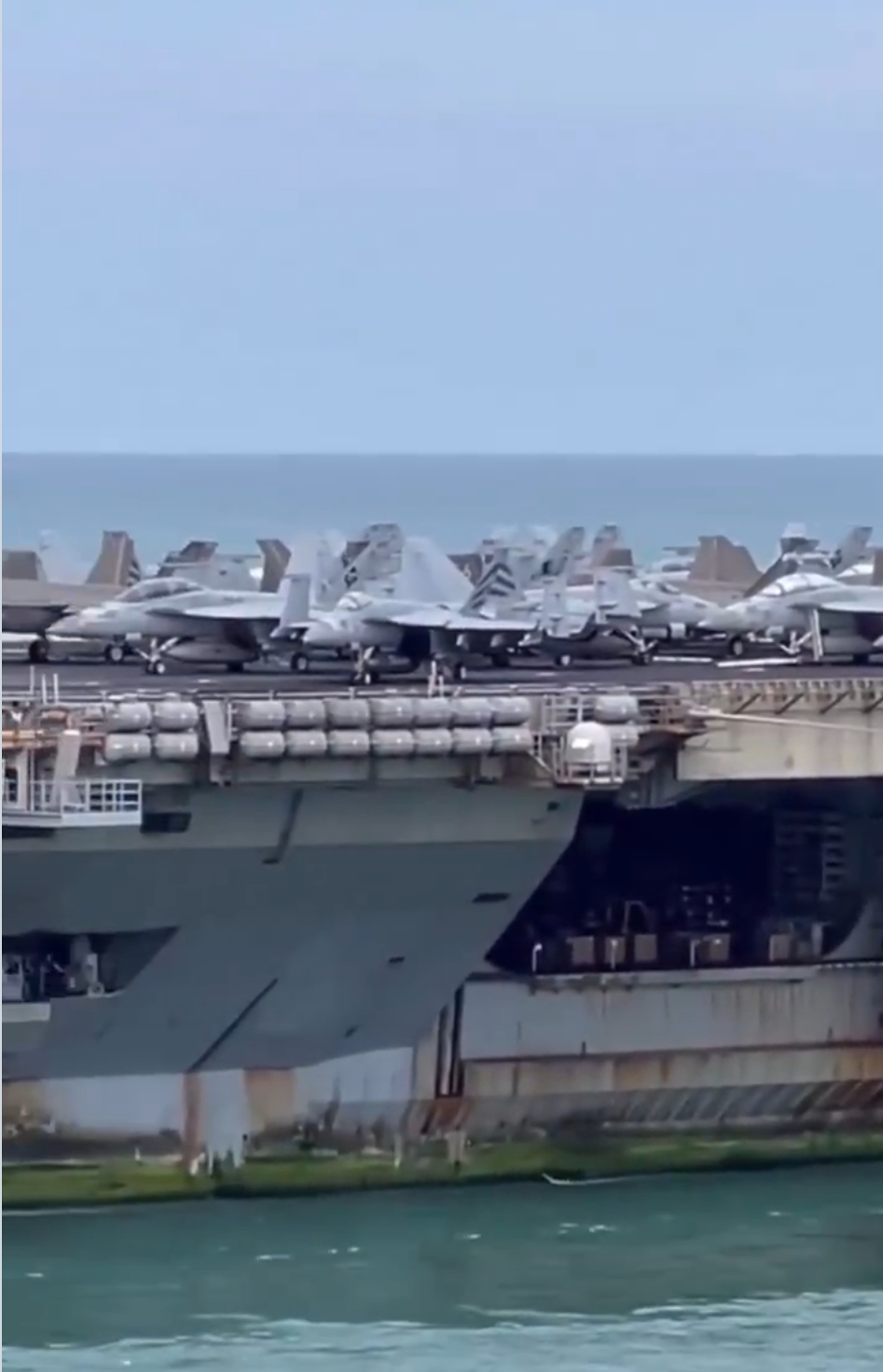
The human costs of this logistical crisis have been concentrated on the crew of the USS Abraham Lincoln, the aircraft carrier that bore the brunt of the extended deployment. The Lincoln departed San Diego on 21 November 2025 and was originally scheduled to return in May 2026, but its deployment was extended repeatedly as the Iran war dragged on (40). By the time the Lincoln finally reached Thailand for its first full port call on 2 September 2026, it had spent two hundred and eighty-six days at sea, including more than two hundred and sixty-four consecutive days without a single port call. This far exceeds the Navy’s normal practice of providing crews with approximately one port visit per month for rest and resupply. The conditions aboard the Lincoln deteriorated significantly over the course of the deployment, with reports of food shortages, broken plumbing, and mental health crises among the crew (50). Senator Richard Blumenthal, Democrat of Connecticut, said in a letter to Defense Secretary Pete Hegseth that the reported problems included shortages of basic supplies and the deteriorating mental health of its crew members (50). The Lincoln’s ordeal is not an isolated incident but a preview of the unsustainable demands that prolonged great-power conflict would place on American naval forces.
The parallel with Russia’s experience in the Black Sea is instructive. When Ukraine began using naval drones to strike Russian warships, the Russian Navy was forced to relocate many of its vessels from Sevastopol to ports further east, beyond the range of Ukrainian attack systems. The West mocked this retreat as a sign of Russian weakness. Yet the United States is now experiencing an analogous problem in the Persian Gulf, with Iranian missiles and drones forcing American warships to operate at extreme distances from their supply bases and to conduct resupply operations under constant threat of interdiction-. The difference is that Russia has been able to adapt to this challenge by developing its own drone and missile capabilities, while the United States has found itself technologically outmatched in a domain it once dominated. Iran’s ability to strike the Bahrain base on the first day of the war, using relatively inexpensive loitering munitions, represents a dramatic demonstration of how asymmetric capabilities can negate the advantages of a conventionally superior naval force.
The geopolitical implications of these twin crises extend far beyond the immediate theatres of Ukraine and the Persian Gulf. The United States has long based its global military strategy on the assumption that it can project power into any region of the world and sustain that projection indefinitely through a network of forward bases and allied facilities. The Iran war has demonstrated that this assumption is no longer valid. A single Iranian strike against a single logistics hub was sufficient to destabilise the entire American naval presence in the Middle East, forcing a retreat to a supply line of unsustainable length (50). If Iran can achieve this with Shahed drones and medium-range ballistic missiles, then China, with its vastly more sophisticated anti-access and area-denial capabilities, can achieve far more against American forces in the Western Pacific. The lesson for American strategic planners is uncomfortable but inescapable: the era of uncontested American power projection is over, and the military system that was built to sustain that power projection is no longer fit for purpose.
The root cause of this unfitness is not technical but institutional. The American military-industrial complex is organised to maximise the extraction of value from the public purse, not to maximise the production of effective weapons at sustainable cost. This is not a matter of individual malfeasance but of structural incentive. Defence contractors are private corporations with a fiduciary duty to their shareholders, and they behave accordingly, they lobby for higher budgets, they resist cost controls, they fragment production across as many congressional districts as possible to maximise political support, and they prioritise complexity and customisation because these features justify higher prices and larger profit margins. The system is not broken; it is working exactly as designed, and the design is the problem. The United States spends more on its military than Russia, China and Iran combined, yet it cannot produce enough munitions to sustain a prolonged conventional war or maintain a naval presence in a contested region without suffering catastrophic logistical strain. This is not a failure of execution but a failure of conception.
The official response to these challenges has been to demand even greater military spending, as if the problem were insufficient resources rather than inefficient use of existing resources. The defence budget for fiscal year 2027 has been requested at one point five trillion dollars, representing a forty per cent increase over the fiscal year 2026 enacted level (59). Yet there is no evidence that additional funding, in the absence of structural reform, will produce better outcomes. The history of American defence procurement is a history of cost overruns, schedule delays and performance shortfalls, and there is no reason to believe that throwing more money at the same institutions will produce different results. The problem is not that the Pentagon is underfunded; it is that the Pentagon is captured by an industry that profits from inefficiency and has no incentive to change.
The political economy of this arrangement deserves careful examination. The defence industry is not merely a supplier of weapons; it is a powerful political constituency that shapes American foreign policy in its own interests. The threats that justify military spending, Russia, China, Iran, are real in the sense that they represent states with competing interests, but the scale and nature of the threat are systematically exaggerated to justify budgets that far exceed any plausible defence requirement. The result is a self-reinforcing cycle in which military spending drives foreign policy confrontation, which in turn justifies further military spending. The cycle is sustained by a network of think tanks, media outlets and academic institutions that depend on defence funding and therefore have a vested interest in perpetuating the threat narrative. This is not a conspiracy but a structural feature of a political economy in which the production of national security policy has become inseparable from the production of corporate profits.
The consequences of this system are not confined to the battlefield. The diversion of resources to military spending comes at the direct expense of domestic investment in infrastructure, education, healthcare and social welfare. The United States spends more on its military than the next ten countries combined, yet its bridges are crumbling, its schools are underfunded, its healthcare system is among the most expensive and least effective in the developed world, and its social safety net is fraying (59). This is not an accident. It is the predictable outcome of a political system in which the defence industry and its allies in Congress have successfully framed military spending as a sacred obligation while treating domestic spending as discretionary and therefore subject to constant attack. The result is a country that is militarily overextended and domestically underinvested, a combination that is neither sustainable nor strategically wise.
The contrast with China and Russia is instructive in this regard as well. Both countries have chosen to invest heavily in military modernisation, but they have done so within the framework of state-directed economies that can coordinate military and civilian production, share intellectual property across enterprises, and maintain surge capacity without regard to short-term profitability. This does not mean that their systems are superior in all respects; they face their own inefficiencies and challenges. But in the specific domain of military production, their state-directed approach has proven more effective at generating large quantities of capable weapons at sustainable cost. The Russian production of three thousand drones per month, the Chinese production of naval vessels at a rate that dwarfs American shipbuilding, the development of hypersonic missiles that outpace American defences, these achievements are not the result of technological superiority but of institutional design. They reflect a system that prioritises strategic purpose over private profit.
The implications for American strategy are profound. The United States can no longer assume that its military superiority is assured by its superior wealth. Wealth is only useful if it can be translated into capability, and the American system for translating wealth into capability is fundamentally flawed. The solutions that are currently being proposed, more funding for startups like Anduril, more emphasis on “hyperscaling” and “software-defined production”, miss the point entirely. They treat the problem as one of technology or management when it is actually one of political economy. The problem is not that American weapons are not innovative enough; it is that the system that produces them is organised to serve interests that are fundamentally at odds with the production of effective military capability at sustainable cost.
The Iran war has provided a stark demonstration of these realities. The destruction of the Bahrain base and the subsequent logistical crisis are not anomalies but expressions of a deeper vulnerability. The United States has built a global military presence that depends on a network of forward bases, but those bases are vulnerable to attack by relatively inexpensive missiles and drones. The United States has built a navy that is unmatched in its ability to project power, but that navy depends on a logistics system that can be disrupted by a single well-aimed strike (50). The United States has built a defence industrial base that can produce sophisticated weapons in small quantities, but that industrial base cannot be surged to meet the demands of prolonged conventional war. These are not technical problems that can be solved by better technology or more money. They are structural problems that require structural solutions.
The structure of the American military-industrial complex is not going to change without sustained political pressure. The defence industry is too powerful, its allies in Congress too numerous, and the prevailing ideology of military Keynesianism too deeply entrenched. But the evidence of failure is accumulating, and with it the possibility that the American public may eventually demand accountability. The sailors of the USS Abraham Lincoln, who spent nine months at sea on frozen rations with broken plumbing and no prospect of relief, are not the first Americans to suffer from the failures of the military-industrial complex, but they may not be the last. The question is whether their experience will produce a reckoning or merely more of the same: more money for contractors, more wars for profit, and more Americans sacrificed on the altar of an empire that can no longer sustain itself. The trajectory of American military power in the twenty-twenties suggests that, absent fundamental reform, the gap between expenditure and capability will continue to widen, and the costs of that widening gap will be borne not by the defence contractors who profit from the current arrangement but by the soldiers, sailors and ordinary citizens who pay for it with their taxes, their service and their lives.
Authored By: Global GeoPolitics
Thank you for visiting. This is a reader-supported publication. If you believe journalism should serve the public, not the powerful, and you’re in a position to help, becoming a PAID SUBSCRIBER truly makes a difference. Alternatively you can support by way of a cup of coffee:
https://buymeacoffee.com/ggtv |
https://ko-fi.com/globalgeopolitics |
Bitcoin: 3NiK8BoRZnkwJSHZSekuXKFizGPopkE7ns
References
Anduril Industries (2026) ‘Anduril, Department of War Sign Production Agreement for Surface-Launched Barracuda-500M’, Anduril.com, 13 May. Available at: https://www.anduril.com/news/anduril-department-of-war-sign-production-agreement-for-surface-launched-barracuda-500m (Accessed: 6 September 2026). (24)
Baonghean (2025) ‘L’Altius 600M rencontre des difficultés face à la guerre électronique russe en Ukraine’, Baonghean.vn, 1 December. Available at: https://baonghean.vn/fr/print/10313291.html (Accessed: 6 September 2026). (11)
Militarnyi (2026) ‘Anduril Plans to Manufacture 7,000 Barracuda Cruise Missiles in 2027’, Militarnyi.com, 17 August. Available at: https://militarnyi.com/en/news/anduril-manufacture-7000-barracuda-in-2027 (Accessed: 6 September 2026). (21)
New York Times (2026) ‘Navy and USS Lincoln’s Problems Are Tied to Attacks on U.S. Base Early in War’, NYTimes.com, 14 August. Available at: https://www.nytimes.com/2026/08/14/us/politics/uss-abraham-lincoln-trump-supplies-diego-garcia.html (Accessed: 6 September 2026). (50)
New York Times (2026) ‘Trump Requests $1.5 Trillion for Military Spending’, NYTimes.com, 3 April. Available at: https://www.nytimes.com/2026/04/03/us/politics/white-house-seeks-1-5-trillion-for-defense-in-new-budget-request.html (Accessed: 6 September 2026). (59)
Times of India (2026) ‘In photos: Rust-streaked USS Abraham Lincoln reaches Thailand after 286 days at sea’, TimesofIndia.indiatimes.com, 4 September. Available at: https://timesofindia.indiatimes.com/world/us/in-photos-rust-streaked-uss-abraham-lincoln-reaches-thailand-after-286-days-at-sea/photostory/133757762.cms (Accessed: 6 September 2026). (40)
Wall Street Journal (2025) ‘Defense startup Anduril hits setbacks with weapons tech’, WSJ.com, late 2025


Leave a Reply