
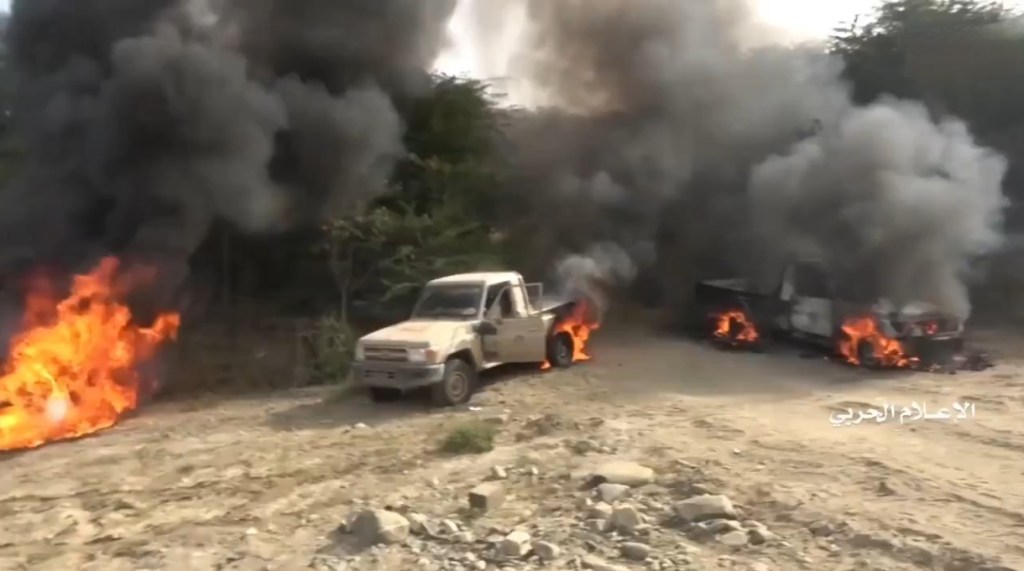
The kingdom has spent billions on American weapons, relied on foreign contractors and mercenaries, and deployed the most advanced air defence systems in the region. It still cannot hold ground against a militia it has been fighting for over a decade.
Editorial Analysis | October 2026
Saudi Arabia’s military budget for 2025 reached approximately $83 billion, a figure that places the kingdom among the top ten military spenders globally and represents roughly 6.5 per cent of its GDP [9†L7-L9]. This expenditure includes a substantial portfolio of American weaponry acquired through Foreign Military Sales and Direct Commercial Sales mechanisms, with approximately $30 billion in finalised FMS transactions and another $12.9 billion in authorised DCS agreements. Among the most recent acquisitions is a $1.96 billion package for 20,000 Advanced Precision Kill Weapon System (APKWS-II) guidance sections, split evenly between air-to-air and air-to-ground configurations, designed to strengthen Saudi defences against drones and missiles. The kingdom also executed a roughly $750 million contract for AGT-1500 tank engines to sustain its fleet of American-made M1A2 Abrams tanks. More recently, the US State Department approved the potential sale of 48 F-35 Lightning II stealth fighters and 49 Pratt & Whitney engines for an estimated $24.3 billion, a deal that would mark a significant shift in American policy and potentially alter the military balance in the Middle East.
The material results of this investment have been documented repeatedly in Yemen, where Saudi-led coalition forces have failed to achieve their objectives despite more than a decade of war. In 2026 alone, Houthi forces have seized control of Yemen’s entire Red Sea coast, taken the strategic port of Mokha, and established a blockade on Saudi oil exports through the Bab el-Mandeb strait. Houthi missile and drone attacks have repeatedly struck Riyadh, targeting King Khalid International Airport in an assault on 10 October 2026 that killed more than a dozen people and injured over 300 others, the deadliest attack Saudi Arabia has suffered in over a decade. The kingdom’s advanced air defence systems, including Patriot and THAAD batteries, have been overwhelmed by the volume and sophistication of the attacks, and analysts note that the Houthis do not need to penetrate every time; they only need to hit occasionally to inflict strategic damage.
The reasons for this failure are structural and documented. Saudi Arabia has historically relied on a large presence of foreign personnel, contractors, and trainers to supplement its forces, and major weapons purchases from Western manufacturers have become a defining feature of Saudi defence policy and diplomatic strategy. The Saudi military has had relatively limited experience overseeing complex combat operations on its own, and experts note that the kingdom has struggled to build a military that is willing to fight and a population that is willing to die to preserve what they have. Bernard Haykel of Princeton University stated during a discussion posted online after the Houthis’ latest offensive that the Saudis do not have such a military or population. The kingdom’s forces have been purposely kept smaller and fragmented to prevent a coup in a region prone to military takeovers, as Middle East scholar Ray Takeyh told a congressional hearing in 2015.
The reliance on proxies and mercenaries has been a central feature of Saudi strategy in Yemen, and it has consistently failed to produce decisive results. Saudi Arabia has recruited mercenaries from Sudan, Senegal, Colombia, and other South American countries, and has deployed 30,000 to 40,000 Pakistani troops as human shields to guard its southern border and counter Yemeni missiles and drones. The kingdom has explored sending Syrian troops to fight in Yemen and has contacted private security consultants to recruit fighters. These forces have proven ineffective against the Houthis, who have developed a mature tactical system combining missiles, drones, artillery, and mobile ground units capable of launching coordinated strikes from multiple directions. The Houthis’ operational strength has grown to approximately 350,000 fighters, making them one of the most formidable non-state armed forces in the Middle East.
The Houthis’ military capabilities have advanced significantly with Iranian technical assistance. They possess the Palestine-2 medium-range ballistic missile, a two-stage solid-fuel weapon with hypersonic capabilities and a maximum range exceeding 2,000 kilometres. They have also acquired the Burkan series of short- and medium-range missiles and the Badr series of high-precision short-range missiles, creating a layered long-range strike system capable of reaching targets across Saudi Arabia and into Israeli territory. Their tactics include mixing drones of varying speeds with ballistic and cruise missiles to confuse air defences, a technique that has proven effective against Saudi Patriot and THAAD systems. An Anthropic report from September 2026 noted that a team in northern Yemen used the company’s Claude model to assist in developing guidance systems for a multi-stage ballistic missile with a range exceeding 2,000 kilometres and a hypersonic glide vehicle.
The implications for any potential ground operation against Iran are significant and directly relevant to current strategic debates. Iran’s terrain shares critical characteristics with Yemen that have made the latter extremely difficult for outside forces: mountains, rugged terrain, concealed positions, and difficult supply routes. The Zagros Mountain range, stretching approximately 1,000 miles across western Iran, presents a formidable barrier to any mechanised advance from the west, channelling invading forces into predictable avenues of approach where Iranian defenders have concentrated their anti-armour capabilities for decades. Iran’s population exceeds 93 million people, more than two and a half times that of Iraq at the time of the 2003 invasion, and even a conservative counterinsurgency ratio would require hundreds of thousands of troops to maintain order. Bloomberg, citing satellite imagery, has acknowledged that any military action against Iran faces serious obstacles because the country’s geographic structure, particularly the placement of facilities in mountainous areas, makes targeting operations difficult, and that complete destruction of such capabilities would require repeated, costly operations.
The experience of Saudi Arabia in Yemen offers a cautionary precedent for those who assume that technological superiority and massive military expenditure automatically guarantee victory. The kingdom has spent over $83 billion annually on defence, acquired the most advanced Western weapons systems, and deployed tens of thousands of foreign troops and mercenaries. It has still lost control of Yemen’s Red Sea coast, suffered repeated missile and drone attacks on its capital and oil infrastructure, and failed to defeat a militia that operates from caves and mobile launchers in the mountains of northern Yemen. The Houthis have demonstrated that a determined force with knowledge of the terrain, access to relatively low-cost missile and drone technology, and the willingness to absorb losses can impose unsustainable costs on a vastly richer and better-equipped adversary. Any power contemplating ground operations in Iran, a country four times the size of Iraq with mountainous terrain, a population of over 90 million, and a military that has spent decades preparing for exactly this scenario, would face a challenge that makes the Saudi experience in Yemen pale by comparison.
Authored By: Global GeoPolitics
Thank you for visiting. This is a reader-supported publication. If you believe journalism should serve the public, not the powerful, and you’re in a position to help, becoming a PAID SUBSCRIBER truly makes a difference. Alternatively you can support by way of a cup of coffee:
https://buymeacoffee.com/ggtv |
https://ko-fi.com/globalgeopolitics |
Bitcoin: 3NiK8BoRZnkwJSHZSekuXKFizGPopkE7ns
References
AFP/BSS (2026) ‘Despite military might, Saudi Arabia struggles to crush the Houthis’, BSS News, 22 September. Available at: https://www.bssnews.net/international/426963/print (Accessed: 14 October 2026).
Antena 3 (2026) ‘Why the billions spent on defence did not protect Saudi Arabia from Houthi attacks’, Antena 3, 14 October. Available at: https://www.antena3.ro/externe/de-ce-miliardele-cheltuite-pentru-aparare-nu-au-protejat-arabia-saudita-de-atacurile-houthi-alegeri-grele-pentru-mohammed-bin-salman-807089.html (Accessed: 14 October 2026).
CRI Online (2026) ‘Global media focus: Why can Saudi Arabia not stop Houthi attacks?’, CRI Online, 12 October. Available at: https://big5.cri.cn/gate/big5/news.cri.cn/20261012/9213ab29-8188-48d1-87d8-9bea1c536f8d.html (Accessed: 14 October 2026).
Federal Register (2026) ‘Arms Sales Notification: Kingdom of Saudi Arabia’, Federal Register, 28 August. Available at: https://www.govinfo.gov/content/pkg/FR-2026-08-28/html/2026-17566.htm (Accessed: 14 October 2026).
ILNA (2026) ‘American report on the challenges of attacking Iran’, ILNA, 26 February. Available at:
(Accessed: 14 October 2026).
Nabaatv (2026) ‘Sanaa’s drones bring down the Abrams myth’, Nabaatv, 29 August. Available at: https://nabaatv.net/archives/441804 (Accessed: 14 October 2026).
People’s Daily (2026) ‘Facing Houthi missiles, why does Saudi Arabia frequently show vulnerabilities?’, People’s Daily, 12 October. Available at: https://www.peopleapp.com/column/30053326614-500007736834 (Accessed: 14 October 2026).
Press TV (2026) ‘Explainer: Why boots on Iranian soil would become strategic catastrophe for US’, Press TV, 22 March. Available at: https://www.presstv.co.uk/Detail/2026/03/22/765701/explainer-why-boots-iranian-soil-become-strategic-catastrophe-us (Accessed: 14 October 2026).
Straits Times (2026) ‘US clears way for $30.9 billion fighter jet sale to Saudi Arabia’, Straits Times, 18 September. Available at: https://www.straitstimes.com/world/while-you-were-sleeping-5-stories-you-might-have-missed-sept-18-2026 (Accessed: 14 October 2026).
Tasnim News (2026) ‘Saudi confusion in the Yemen quagmire’, Tasnim News, 1 October. Available at:
(Accessed: 14 October 2026).
Times of Israel (2026) ‘Despite wealth and advanced weapons, Saudis fumbling in fight against Houthis’, Times of Israel, 22 September. Available at:
(Accessed: 14 October 2026).


Leave a Reply