
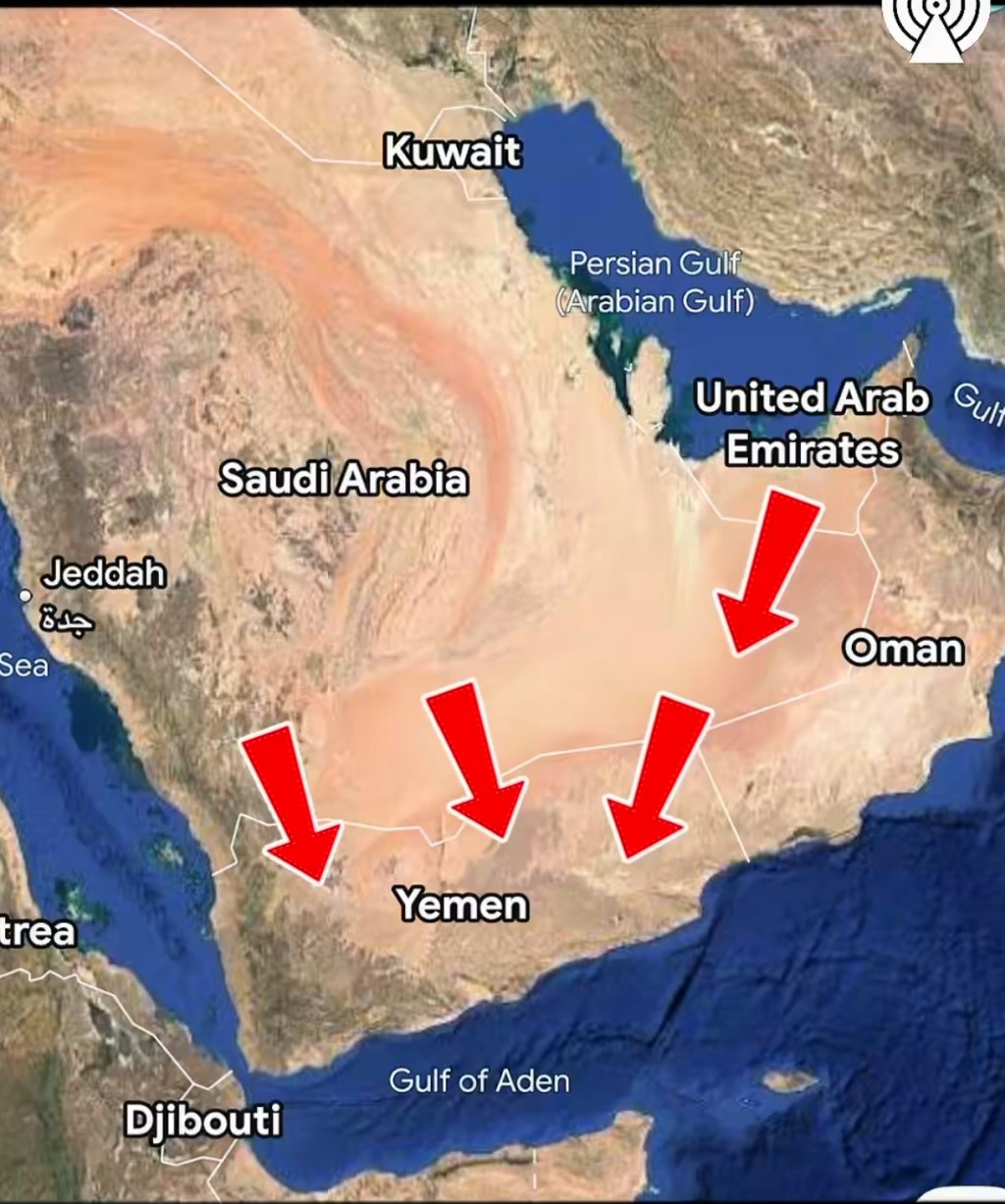
The Yemeni Armed Forces have struck the heart of Saudi Arabia’s energy infrastructure, paralysed its airports, and seized the strategic Bab al-Mandab Strait, exposing the terminal vulnerability of a petro-state that can no longer export its oil or defend its skies.
General Article | October 2026
The strategic equation in West Asia has undergone a decisive reversal. The Yemeni Armed Forces, under the leadership of Ansarallah, have escalated from defensive operations to a comprehensive counter-blockade that strikes at the very foundation of the Saudi state. In a series of coordinated attacks on 10 and 11 October 2026, Yemeni missiles and drones targeted King Khalid International Airport in Riyadh and King Fahd International Airport in Dammam, resulting in 12 deaths and over 300 injuries, while simultaneously striking two Saudi Aramco energy facilities in the Eastern Province. This assault on economic and civilian infrastructure follows the Yemeni seizure of the Bab al-Mandab Strait in September 2026, which, combined with Iran’s control over the Strait of Hormuz, effectively places both of Saudi Arabia’s primary oil export routes under the control of the Axis of Resistance. With over 60 per cent of Saudi fiscal revenue dependent on oil exports, the closure of these maritime chokepoints threatens to collapse the kingdom’s economy and undermine Crown Prince Mohammed bin Salman’s Vision 2030. This analysis examines the military and economic dimensions of Yemen’s counter-escalation, arguing that the House of Saud faces an existential crisis from which military escalation offers no escape.
The strategic posture of the Yemeni Armed Forces has fundamentally shifted from a defensive campaign to a comprehensive counter-blockade, and the consequences for the Kingdom of Saudi Arabia are nothing short of existential. On 10 and 11 October 2026, the Yemeni military conducted a series of four coordinated operations targeting the most sensitive nodes of the Saudi state. Ballistic missiles, cruise missiles, and drones struck King Khalid International Airport in Riyadh in three waves, forcing the complete suspension of flights, while a fourth wave targeted King Fahd International Airport in Dammam. The attack on Riyadh’s airport alone resulted in 12 deaths and 309 injuries, the deadliest strike on Saudi Arabia in over a decade. Simultaneously, Yemeni forces struck two Saudi Aramco energy facilities in the Eastern Province, scoring direct hits that ignited fires. This coordinated assault on both civilian aviation and critical energy infrastructure demonstrates a level of targeting precision and operational capability that the Saudi military, despite its $83 billion annual defence budget, has proven utterly incapable of countering.
The military logic of this escalation is rooted in the geography of the Arabian Peninsula and the strategic leverage it confers. By September 2026, Ansarallah had seized the coastal city of Mokha and the strategic Bab al-Mandab Strait, rapidly overrunning Yemeni government forces and consolidating control over the southern Red Sea corridor. This victory was followed by a declaration of a maritime blockade against Saudi shipping. The strategic genius of this move lies in its coordination with Iran’s control over the Strait of Hormuz at the northern end of the Persian Gulf. The Saudi economy is overwhelmingly dependent on oil exports, which account for over 60 per cent of its fiscal income. The kingdom’s primary export route is through the Persian Gulf and the Strait of Hormuz; its only viable alternative was the East-West pipeline to the Red Sea, which requires passage through the Bab al-Mandab. With the Houthis now controlling the Bab al-Mandab and Iran threatening the Strait of Hormuz, the Axis of Resistance has effectively placed both of Saudi Arabia’s oil export routes under its guns. As Pepe Escobar notes, if both straits are totally and simultaneously closed, the House of Saud cannot export a single drop of oil, and its entire economy will collapse.
The economic war being waged by Yemen is a direct and calculated response to the decade-long Saudi-led blockade and bombing campaign that has devastated Yemen. The Yemeni military spokesman, Yahya Saree, explicitly stated that the recent attacks were a response to the 124 airstrikes conducted by Saudi warplanes over the past 24 hours against Sanaa and other provinces, which caused numerous civilian casualties including women and children. Saree also renewed warnings to international airlines and travellers to avoid Saudi airports and airspace, declaring them “unsafe”. This is the implementation of a “blockade against a blockade,” a counter-escalation designed to impose on the Saudi regime the same economic and civilian suffering it has inflicted on Yemen. The targets, airports and oil facilities, are not random; they are the critical infrastructure of a modern rentier state, and their destruction or disruption carries immediate and severe economic consequences.
The military capability of the Yemeni Armed Forces to execute such a complex and sustained campaign has stunned Western and regional analysts. The Saudi military possesses some of the most advanced air defence systems in the world, including American Patriot and THAAD batteries, yet it has consistently failed to intercept the Yemeni strikes. The reason lies in the asymmetric nature of the conflict. Yemeni forces have developed a sophisticated arsenal of low-cost, high-impact weapons, including the “Palestine-2” hypersonic ballistic missile with a range of 1,500 to 2,000 kilometres, multiple-warhead configurations, and terminal manoeuvring capabilities, as well as the “Burkan” and “Badr” series of missiles. These are deployed not from fixed sites that can be easily targeted, but from mobile launchers in the rugged, mountainous terrain of northern Yemen. The Yemeni military’s operational strength has grown to approximately 350,000 fighters, and it has developed a mature tactical system that combines missiles, drones, artillery, and mobile ground units capable of launching coordinated strikes from multiple directions. The Saudi military, by contrast, has been described as a “hollow force” that relies on foreign contractors and mercenaries and lacks the will to fight a sustained ground war.
The political implications for the House of Saud are catastrophic. The war, which Crown Prince Mohammed bin Salman restarted, has now returned to Saudi territory with a vengeance. The attacks on the capital’s airport and the Eastern Province’s oil facilities represent a profound humiliation and a direct challenge to the kingdom’s claim to be the regional hegemon. The ceasefire that Riyadh sought has been replaced by an escalation it cannot control. The Houthis have increased their price for peace: not only must Saudi Arabia end its blockade and withdraw from Yemen, but it must also pay compensation for the destruction it has caused since 2015. Furthermore, the Houthis have revived their historical claim to the three southern Saudi provinces of Najran, Jizan, and Asir, which were annexed by Saudi Arabia in 1934. The revival of this territorial demand, even if not actively pursued militarily, serves as a potent political weapon that undermines the legitimacy of the Saudi state and raises the spectre of a “Greater Yemen.”
In this desperate situation, Crown Prince Mohammed bin Salman faces only one rational choice: end the war and lift the blockade on Yemen. The Yemeni Armed Forces do not seek to conquer Saudi Arabia’s oil wealth; they seek to compel Riyadh to stop its aggression and lift its siege. However, the Saudi regime, backed by the United States and Israel, appears incapable of accepting a negotiated settlement that recognises Ansarallah as a legitimate political and military force. The formation of the “Mecca Defense Alliance” involving Saudi Arabia, Turkey, and Pakistan, is a desperate attempt to internationalise the conflict and draw other regional powers into the fight. Yet this alliance is fragile and may ultimately fail to provide the kingdom with the security it craves. The strategic initiative has passed to the Axis of Resistance, and the House of Saud is now fighting for its survival on its own soil.
Authored By: Global GeoPolitics
Thank you for visiting. This is a reader-supported publication. If you believe journalism should serve the public, not the powerful, and you’re in a position to help, becoming a PAID SUBSCRIBER truly makes a difference. Alternatively you can support by way of a cup of coffee:
https://buymeacoffee.com/ggtv |
https://ko-fi.com/globalgeopolitics |
Bitcoin: 3NiK8BoRZnkwJSHZSekuXKFizGPopkE7ns
References
[1] Sahafah24 (2026) ‘The Three Provinces in the Crosshairs of a Settlement: Is Yemen’s Bill Tied to the Fate of Al Saud Rule?’, Sahafah24, 24 September. Available at: https://sahafah24.net/article/772480251/ (Accessed: 17 October 2026).
[2] VOV (2026) ‘Houthi launches fierce attacks on Saudi Arabia’, VOV, 12 October. Available at: https://vov.vn/the-gioi/houthi-tan-cong-du-doi-vao-saudi-arabia-post1340453.vov (Accessed: 17 October 2026).
[3] Doha Institute (2026) ‘Saudi Arabia’s Search for Allies in Yemen’, Doha Institute, 15 October. Available at: https://www.dohainstitute.org/en/PoliticalStudies/Pages/saudi-arabia-search-for-allies-in-yemen.aspx (Accessed: 17 October 2026).
[4] CRI Online (2026) ‘Global Media Focus: Why Can Saudi Arabia Not Stop Houthi Attacks?’, CRI Online, 12 October. Available at: http://news.cri.cn/20261012/9213ab29-8188-48d1-87d8-9bea1c536f8d.html (Accessed: 17 October 2026).
[5] Xinhua (2026) ‘Yemen’s Houthis say they attacked Saudi airports and energy facilities’, Xinhua, 12 October. Available at: http://intl.ce.cn/qqss/202610/12/t20261012_3254206.shtml (Accessed: 17 October 2026).


Leave a Reply