
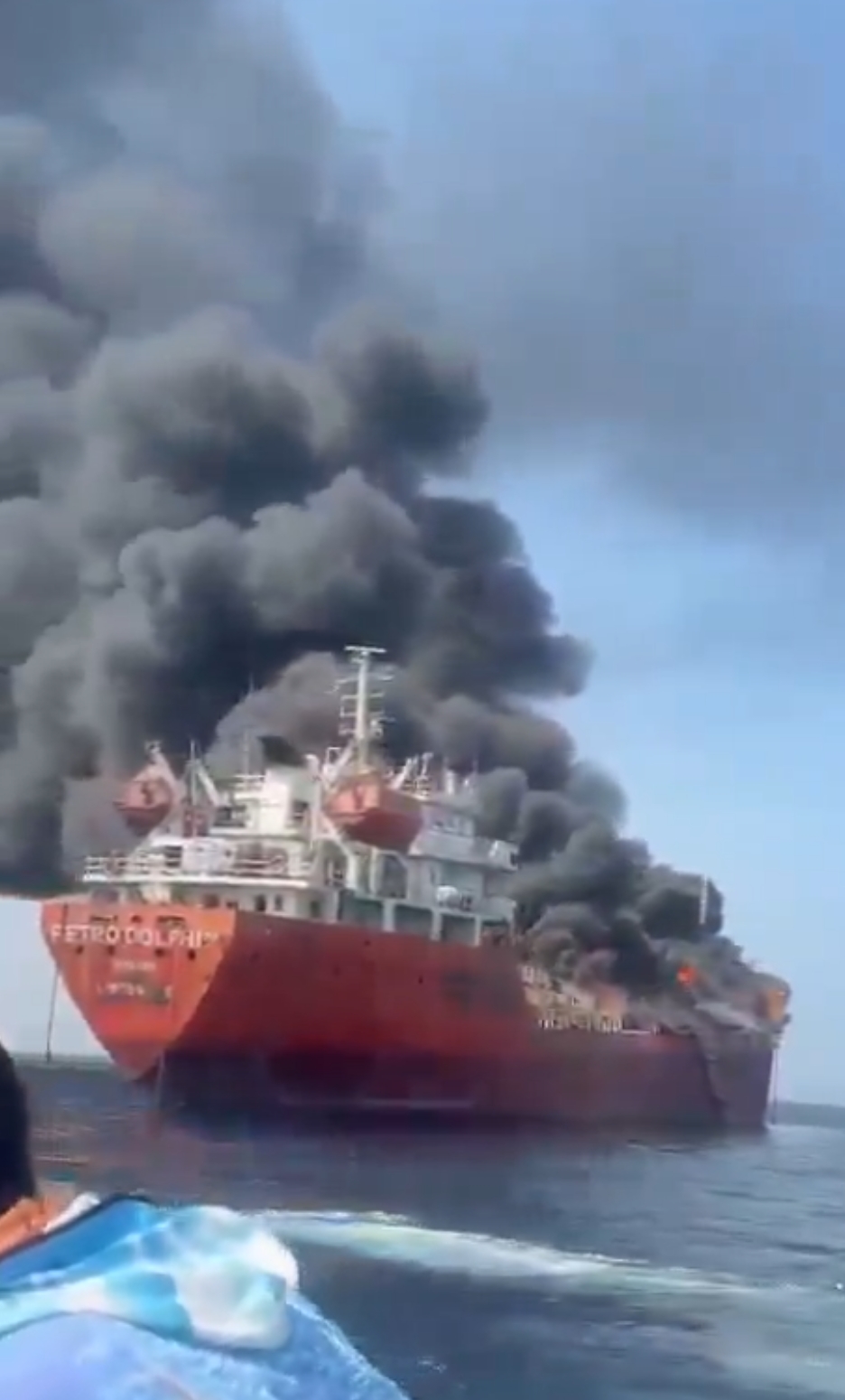
The Islamic Republic has shifted from warning shots to the systematic disabling of commercial vessels, driving tanker rates to $80 million per voyage, draining diesel inventories to critical lows, and exposing the material foundations upon which the petrodollar system ultimately rests
Editorial Analysis | October 2026
The Strait of Hormuz has been transformed from a transit corridor into a live-fire zone, and the character of Iran’s maritime campaign has shifted in ways that have profound implications for the global economy. In the earlier phase of the conflict, Iranian drones targeted the superstructures of commercial vessels, causing superficial damage and signalling a warning: turn around or face worse. That phase is over [0†L4-L8]. Iran is now targeting engine rooms, and the effect is qualitatively different. A vessel whose engine room has been destroyed cannot be repaired at sea or in a nearby port. It must be towed to a dry dock in Malaysia, India, or another distant location, and it will be out of commission for many months. The result is a permanent reduction in the available tonnage of the global tanker fleet, and the economic consequences are being felt across the world.
The cost of chartering a very large crude carrier from the United States Gulf to China has reached approximately $80 million, a figure that exceeds the roughly $74 million price of a standard SpaceX Falcon 9 launch and represents a tenfold increase over the pre-war norm of $7 to $10 million. Commodity trading giant Trafigura chartered a supertanker at a lump-sum fee of $76 million, and shipbroker Gibson confirmed that the $80 million figure is now the benchmark for the route. The cost per barrel for a two-million-barrel cargo translates to approximately $38 per barrel, a figure that renders American crude uncompetitive in Asian markets and is forcing refiners to seek alternatives that are themselves constrained by the same conflict. War-risk insurance premiums for individual tanker voyages have climbed to as much as $20 million, and insurance rates that were previously 0.1 to 0.25 per cent of hull value have risen to peaks of 5 to 10 per cent for Hormuz transits. Crew members are being offered as much as $100,000 per month plus $50,000 per Hormuz transit, and some are earning multiples of normal wages, reflecting the extreme risk that sailors now face when they enter the conflict zone.
The diesel crisis is the most immediate material consequence of the maritime disruption, and its effects are being felt across Europe and beyond. Middle distillates, which include diesel and kerosene, are the fuels that power the trucks, trains, and ships that move goods to market, and they are the fuels that farmers depend upon for their tractors and combines. The global inventory of diesel is at critically low levels, and the problem is compounded by the fact that much of the existing supply is in the wrong place, or in refineries that require a particular type of distillate that cannot be obtained, or cannot be shipped to where it is needed because the vessels that would carry it are either disabled or unwilling to enter the conflict zone. The crisis has been formally called for Europe, and its implications are severe because the entire European logistics system depends on diesel-powered vehicles. The delivery of goods to shops, the distribution of food, and the operation of public services are all at risk. The inflation figures in the United States are heading towards four per cent, and the bond market is expected to react to the pressure that rising energy costs are placing on prices and interest rates.
The damage to Saudi Arabia’s oil infrastructure represents a strategic blow that cannot be quickly or cheaply remedied. The Manifa production facility, which forms part of the large field that supplies approximately thirty per cent of Saudi oil, has been attacked. The East-West pipeline, which carries crude from the kingdom’s eastern fields to the Red Sea coast and allows Saudi Arabia to bypass the Strait of Hormuz, has been struck, resulting in a loss of approximately 700,000 barrels per day of pumped volume. The Samref refinery at Yanbu, a joint venture between Saudi Aramco and ExxonMobil, has been hit by a drone, and the Jubail industrial zone has been targeted with medium-range missiles and suicide drones, striking facilities that include the Sadara complex and an ExxonMobil installation. The energy infrastructure of Saudi Arabia is being systematically degraded, and the specialised components that are required to repair it, including the complex structures of refineries and processing facilities, are not available off the shelf. They must be custom-made, and the lead times for such components are measured in years. The cost of replacement will be enormous, and the question of whether Saudi Arabia has the financial resources to undertake the reconstruction is itself uncertain given the disruption to its oil exports and the decline in global demand that the conflict has produced.
The military dimension of the crisis is intensifying, and the United States is preparing for the possibility of another major wave of attacks against Iran. The Pentagon is deploying a third aircraft carrier strike group and additional Marine Corps ships to the Middle East, adding approximately 9,000 to 10,000 troops to the region. The USS Theodore Roosevelt and the Makin Island Amphibious Ready Group are expected to join the deployment, bringing the total number of American carrier strike groups in the region to three by late October or November. The United States Air Force has conducted a surge in C-17 military cargo flights over the past thirty-six hours, an unusually sharp increase compared with previous weeks, and most of these flights are reportedly landing in Israel. The buildup comes as President Trump has warned of potential fresh strikes on Iran, and as Iranian officials have stated that they believe a joint American and Israeli attack is very likely.
The strategic calculus that drives this military buildup must be understood in the context of the material constraints that the United States faces. The Strategic Petroleum Reserve has fallen to approximately 304.8 million barrels, which represents about 43 days of emergency crude supply and is the lowest level since 1983. The Bank of America Global Research data indicate that the United States has been drawing down its reserves at an unsustainable rate, and the long-term average of approximately 65 days of supply has been significantly eroded by the combined effects of the war and the previous drawdowns that were undertaken to stabilise prices after the Russian invasion of Ukraine. The depletion of the SPR means that the United States has limited capacity to cushion the economic consequences of further supply disruptions, and it also means that the strategic flexibility that the reserve was designed to provide has been substantially diminished. The problem is compounded by the fact that the United States produces primarily light sweet crude from its shale formations, which is suitable for gasoline production but lacks the heavier components necessary for diesel, jet fuel, and heavy fuel oil. The American economy depends on imports of heavier crudes from the Middle East, Venezuela, and Canada to meet its industrial and transportation needs, and the disruption of those imports is a direct threat to the functioning of the economy.
The petrodollar system, which has been the foundation of American financial hegemony for five decades, is under unprecedented strain. Iran has begun accepting yuan as payment for transit through the Strait of Hormuz, and Deutsche Bank has identified this development as one that could accelerate the shift away from dollar-denominated oil trade. Iran has reportedly allowed the passage of ships through the Strait if oil payments are made in yuan, and the Chinese entities that facilitate non-dollar settlement for Iranian oil exports have played a key role in this arrangement. The share of yuan in China’s oil settlements with Gulf states has reached over forty per cent, and the petroyuan has been described as a quiet earthquake in the global economy. Jeff Currie, the former head of commodities at Goldman Sachs, has stated that handing control of the Strait of Hormuz to Iran would constitute the formal end of the United States as global hegemon and the death of the dollar as the world’s reserve currency. Jamie Dimon, the chief executive of JPMorgan Chase, has called for the United States to finish the conflict decisively and to restore order to the strait, stating that it is more important that the operation be successfully completed than what the market does.
The Japanese dimension of the crisis adds another layer of complexity. Japan is almost entirely dependent on imported energy, and a significant portion of its oil imports transit the Strait of Hormuz. The Japanese government has concluded a significant energy security agreement with the Trump administration, which includes up to $40 billion in investments from GE Vernova Hitachi for small modular reactor power plants and up to $33 billion in natural gas generation facilities in Pennsylvania and Texas. The agreement is designed to secure Japan’s energy supply by expanding American energy production with crude oil procurement for Japan and Asia in mind. The arrangement has been described as a form of burden sharing in which Japan provides capital for American energy infrastructure in exchange for access to American crude, but the effectiveness of this arrangement depends on the ability of the United States to actually deliver the oil, which in turn depends on the resolution of the conflict in the Strait of Hormuz. If Japan’s oil purchases begin to be priced in yen rather than dollars, the consequences for the global economy would be catastrophic, and the Japanese government has reportedly pursued off-the-record deals to secure its energy needs.
The realist perspective on this situation emphasises the structural pressures that drive states to pursue power and security in an anarchic international system. The United States, as the established hegemon, seeks to maintain its position of primacy, and Iran, as a regional power with the capacity to disrupt the global energy supply, seeks to leverage its geographic advantage to extract concessions and to enhance its own security. The security dilemma operates in this context because the measures that the United States takes to increase its own security, including the military buildup and the preparations for strikes on Iran, are perceived by Tehran as existential threats, and Iran responds with measures that the United States perceives as further threats, leading to a spiral of escalation. The Strait of Hormuz is a classic example of a geographic chokepoint that confers coercive power on the state that controls it, and Iran has demonstrated that it is willing to use that power even at the cost of disrupting the global economy.
The game-theoretic analysis of the situation reveals the strategic interaction between the United States, Iran, China, and the other actors as a multi-player game in which each seeks to maximise its interests while minimising its risks. The United States has chosen a strategy of military escalation, betting that a decisive strike can restore the status quo and reopen the strait on American terms. Iran has chosen a strategy of attrition, betting that the economic costs of the conflict will accumulate more rapidly for the United States and its allies than for Iran itself, and that the disruption of the global energy supply will create pressure on Washington to seek a negotiated settlement. China has chosen a strategy of opportunistic support for Iran, accepting yuan-denominated oil payments and thereby advancing its own currency’s international role while securing access to discounted crude. The equilibrium of the game is unstable because the United States cannot accept the loss of control over the strait, which would constitute a fundamental challenge to its hegemonic position, while Iran cannot accept a return to the status quo ante, which would leave it vulnerable to further attacks and sanctions. The outcome will depend on the balance of material capabilities and the willingness of each side to bear the costs of continued conflict.
The material foundations of American power are being tested in ways that are unprecedented in the post-Cold War era. The United States possesses the most powerful military in the world, but military power alone cannot secure the sea lanes if the adversary is willing to absorb losses and to continue attacking commercial shipping. The United States possesses the largest economy in the world, but economic power alone cannot substitute for the physical commodities that are required to fuel the economy and to move goods to market. The United States possesses the dollar, which remains the world’s reserve currency, but the dollar’s value depends on the confidence of foreign holders, and that confidence is eroding as the conflict continues and as the United States demonstrates that it cannot guarantee the security of the energy supply that the petrodollar system was built to protect. The empire can issue paper claims on the world’s wealth. It cannot print the ships, diesel, or industrial machinery required to produce that wealth and move it to market.
The implications for the global order are profound. A decisive American victory in the conflict would restore the status quo and would reinforce the perception of American primacy, at least in the short term. An Iranian success in maintaining the closure of the strait, or in imposing sufficient costs on the United States and its allies to force a negotiated settlement, would constitute a fundamental challenge to the American-led order and would accelerate the transition to a multipolar world in which the dollar’s role is diminished and alternative currencies and payment systems play a larger role. The most likely outcome lies somewhere between these two extremes, with a prolonged period of instability and uncertainty in which neither side is able to achieve a decisive victory and the global economy bears the costs of the conflict. The working class of the world, which bears the costs of the conflict through higher prices, inflation, and the erosion of public services, has an interest in a swift resolution, but the interests of the capitalist classes that profit from the conflict and the geopolitical competition that drives it are not aligned with the interests of the population. The outcome will be determined by the interaction of material forces, strategic logic, and the capacity of the working class to organise in defence of its own interests.
Authored By: Global GeoPolitics
Thank you for visiting. This is a reader-supported publication. If you believe journalism should serve the public, not the powerful, and you’re in a position to help, becoming a PAID SUBSCRIBER truly makes a difference. Alternatively you can support by way of a cup of coffee:
https://buymeacoffee.com/ggtv |
https://ko-fi.com/globalgeopolitics |
Bitcoin: 3NiK8BoRZnkwJSHZSekuXKFizGPopkE7ns
References
Anadolu Agency (2026) ‘US to send 3rd carrier strike group to Middle East as Iran tensions rise’, Anadolu Agency, 1 October. Available at: https://f.aa.com.tr/en/americas/us-to-send-3rd-carrier-strike-group-to-middle-east-as-iran-tensions-rise/3682765 (Accessed: 16 October 2026).
Bloomberg (2026) ‘Iran War Could Be Making of the Petroyuan, Deutsche Bank Says’, Bloomberg, 25 March. Available at:
(Accessed: 16 October 2026).
Carnegie Endowment for International Peace (2026) ‘The Hormuz Conflict and the Limits of Renminbi Internationalization’, Carnegie Endowment, 28 July. Available at:
(Accessed: 16 October 2026).
Daily Sabah (2026) ‘Saudi Arabia says key pipeline, energy facilities restored after attacks’, Daily Sabah, 12 April. Available at:
(Accessed: 16 October 2026).
EFE (2026) ‘Iran attacks reduced Saudi production capacity by 600,000 barrels per day’, EFE, 9 April. Available at:
(Accessed: 16 October 2026).
Fox Business (2026) ‘Jamie Dimon says US must finish this thing with Iran to protect global economy’, Fox Business, 31 March. Available at:
(Accessed: 16 October 2026).
Ministry of Economy, Trade and Industry, Japan (2026) ‘Minister Akazawa Attends Japan-U.S. Summit Meeting’, METI, 20 March. Available at:
(Accessed: 16 October 2026).
OilPrice.com (2026) ‘Asian Refiners Ditch U.S. Oil as Supertanker Rates Hit $82 Million’, OilPrice.com, 9 October. Available at:
(Accessed: 16 October 2026).
Splash247 (2026) ‘Twelve injured in latest Hormuz attack’, Splash247, 7 October. Available at:
(Accessed: 16 October 2026).
The Mirror (2026) ‘US only has 43-day emergency buffer of crude oil left in 45-year low’, The Mirror, 5 August. Available at:
(Accessed: 16 October 2026).
The White House (2026) ‘Fact Sheet: President Donald J. Trump Strengthens U.S.-Japan Alliance’, The White House, 20 March. Available at:
(Accessed: 16 October 2026).


Leave a Reply