
An opinion analysis of Russia’s systemic positioning amid global realignment
Security, law, and sovereignty in contemporary Russian diplomacy
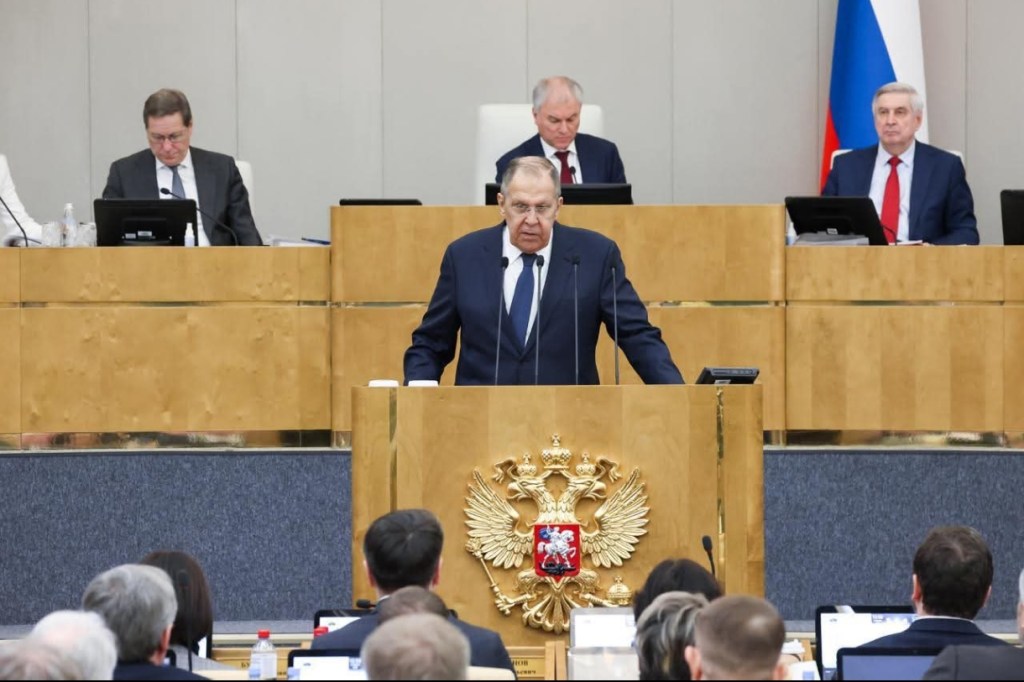
Foreign Minister Sergey Lavrov used the State Duma hearing to present a coherent account of Russian foreign policy under conditions described as structural change rather than episodic crisis. The remarks framed current conflicts as consequences of an exhausted post-Cold War order and an accelerating redistribution of power away from Atlantic centres. The argument rested on the claim that multipolarity now reflects material realities in trade, security, demography, and production, rather than aspirational rhetoric. That framing placed Russian policy within a long horizon defined by sovereignty, balance, and institutional continuity rather than tactical manoeuvre.
A central claim concerned the behaviour of Western states described as a numerical minority acting against the preferences of a larger world constituency. Lavrov characterised Western policy as retaining colonial methods while lacking the economic dominance that previously sustained them. The description of military, financial, and informational pressure across multiple regions aimed to establish pattern rather than incident. References to Venezuela, Cuba, Iran, Greenland, and the Sahel served to illustrate continuity in methods across theatres rather than regional exceptions.
The hearing advanced a consistent reading of strategic stability rooted in arms control erosion initiated by Washington. The voluntary observance of quantitative limits following the lapse of the New START framework was presented as conditional restraint rather than concession. The absence of formal response from the United States was described as symptomatic of a broader unwillingness to sustain reciprocal regimes. Analysts such as Andrei Kortunov and Dmitri Trenin have similarly argued that strategic stability now persists through unilateral signalling rather than negotiated symmetry, reflecting declining institutional trust.
Greenland occupied a symbolic place within the wider critique of selective legal interpretation. Lavrov contrasted recognition of self-determination claims there with denial of similar claims elsewhere, framing the difference as political convenience rather than legal reasoning. The point concerned precedent more than territory. International law was treated as an integrated system whose principles lose coherence when applied selectively. This approach echoed arguments advanced by legal scholars including Richard Falk, who has long criticised instrumental uses of self-determination within power politics.
Ukraine remained framed as a derivative crisis rooted in unresolved security architecture rather than isolated aggression. The emphasis on eliminating root causes reflected continuity with earlier Russian proposals regarding indivisible security. Reference to understandings reached in Alaska during 2025 placed responsibility for progress on implementation rather than negotiation. The mention of mediation efforts by the United Arab Emirates underscored a preference for non-Atlantic intermediaries consistent with broader Eurasian diplomacy.
The presentation of relations with China avoided language of bloc formation while stressing stabilising effects on the international system. The partnership was framed as exemplary because it combined strategic coordination with avoidance of formal alliance constraints. Academic observers such as Glenn Diesen have described this relationship as a model of asymmetric alignment where shared interests coexist with strategic autonomy. The emphasis on neighbourliness and border stability suggested priority given to continental coherence rather than maritime projection.
Eurasian security architecture featured as a long-term project aimed at reducing external penetration. Integration mechanisms across the EAEU, SCO, and ASEAN were described as functional rather than ideological platforms. Security guarantees with Belarus, the DPRK, and Iran were presented as deterrent structures responding to perceived encirclement. The reference to allied assistance in the Kursk region reinforced the claim that partnership treaties now carry operational significance rather than symbolic value.
Africa and Latin America were treated as arenas of expanding engagement rather than ideological alignment. The reopening of embassies and redistribution of diplomatic staff away from Europe reflected prioritisation choices driven by trade, demography, and political receptivity. Recognition by Nicaragua of territorial changes was cited as evidence of political support emerging outside Western institutions. Scholars associated with the Valdai Club have noted similar patterns indicating a gradual reorientation of Russian diplomatic capital toward non-Atlantic partners.
Multilateral institutions occupied an ambivalent position within the analysis. The United Nations was defended as indispensable while its secretariat was criticised for politicisation. Lavrov distinguished between the organisation as a forum of states and the conduct of its administrative leadership. The argument aligned with critiques advanced by former UN officials such as Hans von Sponeck, who have warned against executive overreach undermining organisational legitimacy.
The discussion of the proposed Board of Peace illustrated Russian caution toward parallel institutions shaped by asymmetric influence. Participation was framed as exploratory rather than endorsing. The allocation of frozen reserves toward Palestinian assistance was presented as material action substituting for rhetorical positioning. The approach suggested preference for outcomes over institutional branding.
Economic governance featured prominently through critique of the WTO and Bretton Woods framework. Lavrov described institutional paralysis resulting from American obstruction rather than normative failure. The continued relevance of WTO rules for Eurasian integration was stressed, indicating separation between legal architecture and political enforcement. Economists such as Ha-Joon Chang have argued that rule-based systems often persist despite hegemonic withdrawal, supporting this interpretation.
Energy security within BRICS was presented as defensive coordination rather than cartelisation. European substitution of pipeline gas with LNG was cited as self-harm resulting from sanction policy. The argument emphasised infrastructure development and supply diversification independent of political leverage. Independent analysts including Vaclav Smil have highlighted the material constraints limiting rapid energy realignment, lending weight to this assessment.
The treatment of sanctions against the DPRK departed from conventional non-proliferation discourse. Nuclear deterrence was acknowledged as a stabilising factor under hostile conditions. This position reflected realist security logic rather than normative endorsement. Scholars such as John Mearsheimer have argued that nuclear capability often functions as ultimate regime security, particularly under sustained external pressure.
Cultural and humanitarian policy was integrated into the strategic narrative rather than treated as soft adjunct. Language protection, diaspora support, and educational coordination were framed as sovereignty instruments. The creation of international language institutions and election monitoring initiatives suggested a bid to normalise Russian presence within global civil society frameworks.
The concluding emphasis rejected personality-driven foreign policy in favour of institutional continuity. Electoral cycles were described as irrelevant to strategic direction. The assertion of moral legitimacy through adherence to legal form rather than retaliatory dismantling summarised the posture presented. The overall analysis depicted a state adjusting to systemic fragmentation by consolidating partnerships, defending institutional principles, and resisting normative reinterpretation under pressure
Sergey Lavrov’s State Duma Address link:
https://www.mid.ru/en/press_service/video/posledniye_dobavlnenniye/2079930/
Authored By: Global GeoPolitics
Thank you for visiting. This is a reader-supported publication. You can support by way of a cup of coffee:


Leave a comment