
Sanctions frameworks and conference gatekeeping operate as political tools in shaping scientific access, funding, and global AI competition
Reversal of a ban on Chinese researchers by United States-based organizers of NeurIPS has exposed the degree to which geopolitical competition now shapes access to core scientific infrastructure in artificial intelligence, a field central to economic and military advantage. The incident unfolded against an active contest for AI leadership between the United States and China, where control over talent pipelines, research visibility, and collaboration networks carries direct implications for technological supremacy.
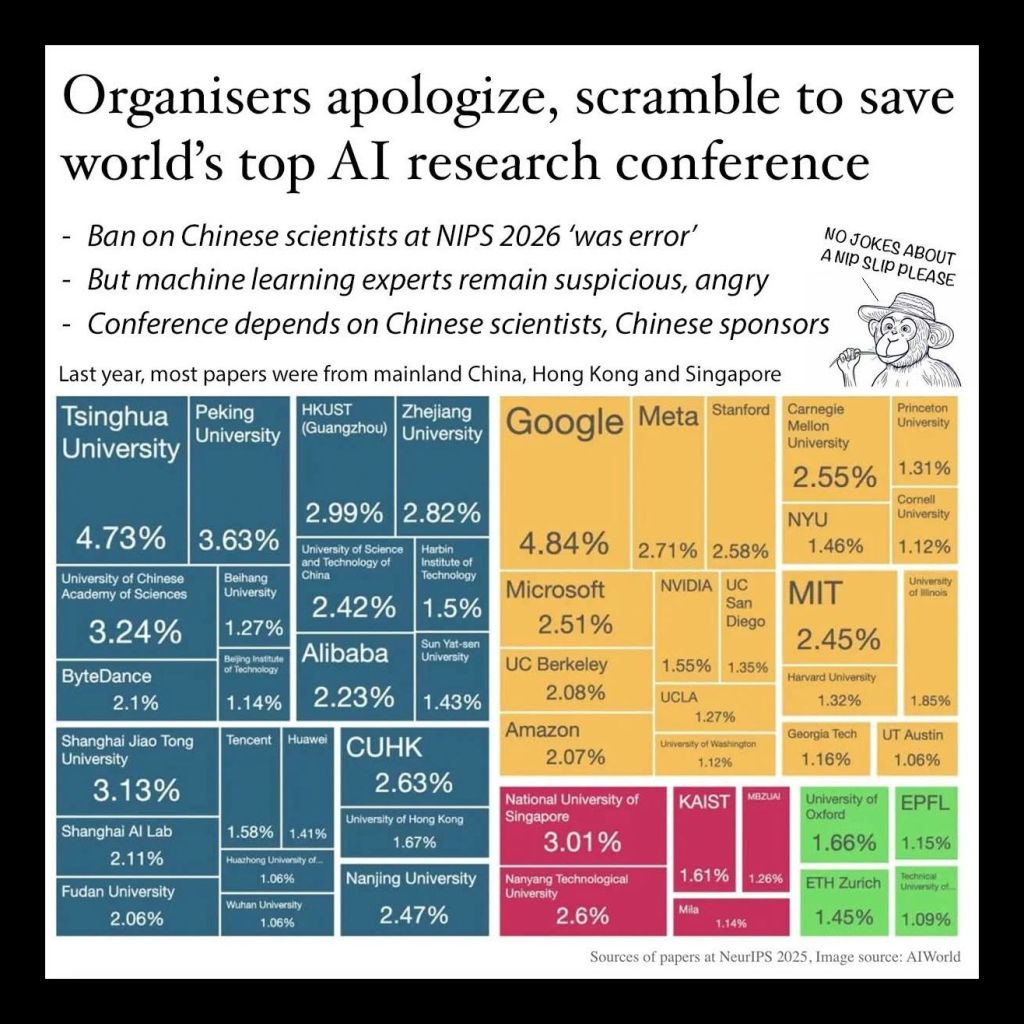
The underlying policy action involved implementation of sanctions compliance measures tied to United States law. Organizers linked participation rules to a comprehensive sanctions database rather than the narrower Specially Designated Nationals list maintained by the U.S. Department of the Treasury. That broader database includes a wide range of entities subject to varying restrictions, capturing hundreds of Chinese individuals and organizations, including researchers affiliated with firms such as Huawei. Conference systems therefore risked automatically excluding submissions, reviews, and attendance linked to those names. Organizers initially defended the restriction, stating: “The present concerns are not about science or academic freedom. They are about legal requirements that apply to the NeurIPS Foundation.” Reversal followed after several days, accompanied by an explanation that a legal team had applied the wrong reference list.
Delay between implementation and reversal indicates internal conflict over compliance boundaries rather than a simple technical correction. Editing a sanctions reference requires minimal operational effort, yet the policy remained in place through multiple public responses defending its necessity. That sequence suggests competing priorities within governance structures, where legal exposure, reputational risk, and scientific openness were weighed under time pressure.
Context of the AI sector sharpens the significance of the episode. Machine learning systems underpin strategic capabilities across defense, surveillance, finance, and industrial automation. Both the United States and China allocate substantial public and private resources to accelerate development, recruit global talent, and secure supply chains. Conferences such as NeurIPS, ICML, and ICLR function as primary dissemination channels for breakthroughs, often determining which methods gain adoption and which researchers achieve influence. Control over access to these venues therefore intersects directly with the competitive trajectory of AI capabilities.
Chinese participation in these conferences remains structurally significant. Researchers based in China contribute a large share of submitted papers, provide extensive peer review labor, and anchor sponsorship funding through corporate and institutional backing. Withdrawal or reduction of that participation would alter acceptance rates, review quality, and financial stability. Response from the China Association for Science and Technology illustrates this leverage, with cancellation of sponsorship and removal of academic recognition for conference publications. Such measures affect career incentives for researchers, shifting submission strategies toward alternative venues.
Public reaction among scientists highlights constitutional and institutional tensions within the United States system. Jason Eisner argued that publication restrictions exceed legal requirements, writing: “You have a 1st Amendment right to publish whatever you want… They cannot constitutionally stop you.” That position reflects a view that academic publication constitutes protected expression, placing responsibility on institutions to challenge rather than preemptively comply with government constraints.
Patterns observed align with earlier instances where political frameworks shape participation in international systems. Restrictions imposed on Russian athletes following the Russian invasion of Ukraine demonstrate how governing bodies enforce exclusion based on state policy alignment. Scientific institutions show parallel vulnerability when operating within national jurisdictions that impose external compliance requirements.
Experience during the COVID-19 period provides an additional point of comparison. Research funding allocation, journal acceptance patterns, and public communication channels converged around institutionally endorsed positions. Alternative interpretations encountered structural barriers in funding access and publication opportunities, reinforcing the influence of centralized gatekeepers over scientific visibility. The NeurIPS case reflects a similar structure, with legal compliance rather than public health policy defining the boundaries of participation.
Control mechanisms extend beyond sanctions enforcement. Funding networks, private donors, and institutional partnerships shape research direction and access to publication platforms. Associations involving figures such as Jeffrey Epstein demonstrate how financial relationships can influence academic institutions, research agendas, and reputational management. Influence operates through access to resources and institutional legitimacy, paralleling how sanctions frameworks operate through access to publication and collaboration.
Revolving movement of personnel between academia, industry, and government consolidates these dynamics. Legal advisors, policy experts, and senior researchers often transition across sectors, embedding shared assumptions about compliance and risk management. Decision-making within scientific organizations therefore reflects broader policy environments rather than isolated academic priorities.
Implications extend to structural fragmentation of the global AI research ecosystem. Reduced trust in United States-based conference governance could accelerate development of parallel systems in Asia or other regions. Establishing comparable prestige requires sustained coordination, yet incentive shifts driven by funding bodies and national institutions can alter researcher behavior over time.
Technological consequences follow institutional changes. Slower exchange of ideas, duplication of research efforts, and reduced collaboration across geopolitical lines would affect the pace of AI advancement. Competitive dynamics may intensify as states prioritize domestic ecosystems over international integration, reinforcing separation between research communities.
Governance concentration within a single jurisdiction remains a central vulnerability. Legal or political shifts within that jurisdiction propagate across global research infrastructure due to the dominance of established conferences and publication channels. Diversification of governance models and geographic bases presents one pathway to mitigate this exposure, though existing network effects present substantial barriers.
The NeurIPS incident demonstrates how legal compliance decisions, funding dependencies, and geopolitical competition converge within scientific institutions, with the eventual reversal reflecting a late-stage correction after a clear miscalculation of institutional risk. Exclusion parameters captured more than 800 Chinese researchers, many responsible for a substantial share of leading peer-reviewed papers, core review processes, and frontline advances in machine learning, creating conditions under which the conference would have lost functional relevance as a global research forum. Access to publication venues functions as a control point influencing participation, recognition, and ultimately the direction of technological development, while dependence on concentrated contributor bases limits the ability to enforce politically derived restrictions without structural consequences. Continued alignment of scientific infrastructure with national policy frameworks will sustain these pressures, with increasing impact as artificial intelligence becomes more tightly linked to state power, industrial capacity, and strategic competition.
Authored By:
Thank you for visiting. This is a reader-supported publication. If you believe journalism should serve the public, not the powerful, and you’re in a position to help, becoming a PAID SUBSCRIBER truly makes a difference. Alternatively you can support by way of a cup of coffee:
https://buymeacoffee.com/ggtv |
https://ko-fi.com/globalgeopolitics |
Bitcoin: 3NiK8BoRZnkwJSHZSekuXKFizGPopkE7ns


Leave a comment