
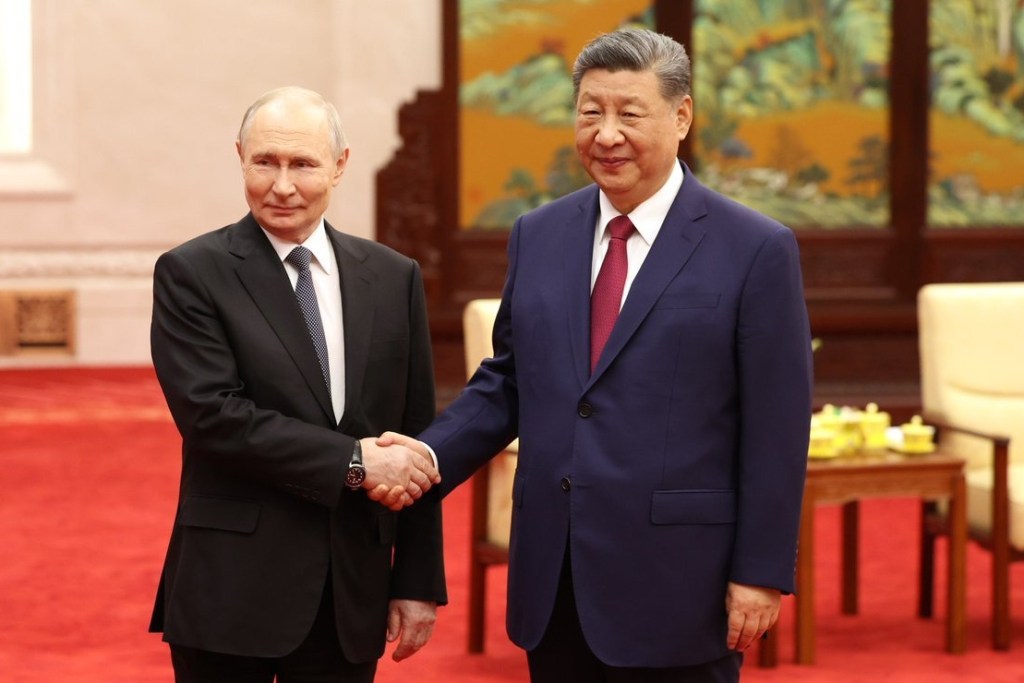
Russia and China signed agreements. America extended oil licences it said it never would. Britain quietly importing Russian fuel, and a front-line disaster in Konstantinovka that Western media refuses to report – the week the Ukraine war changed permanently.
An Editorial Analysis | May 2026
Vladimir Putin’s state visit to Beijing in the third week of May 2026 produced a document that deserves considerably more analytical attention than it has received in mainstream Western commentary. The joint statement issued by Russia and China following Putin’s meetings with Xi Jinping at Zhongnanhai, the compound that houses the offices and residences of China’s senior leadership, and which Trump was given a guided tour of just days before, amounts to a comprehensive institutional map of a bilateral relationship that has moved well beyond diplomatic rhetoric into coordinated strategic action across military, economic, technological, and financial domains. The contrast with Trump’s visit to Beijing is instructive: Trump’s meetings produced a framework document that, by all available accounts, remained incomplete and unagreed at the time of his departure. Putin’s meetings produced a signed joint statement. The asymmetry tells a story about the respective positions of the two visitors from Beijing’s perspective.
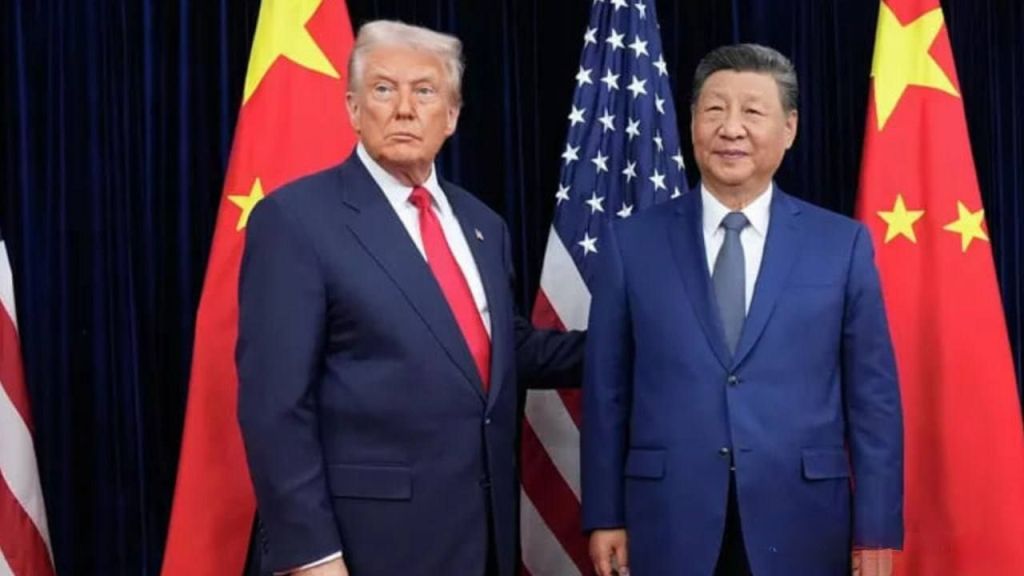
The operational content of the Sino-Russian joint statement covers ground that individually might seem routine but collectively represents a substantial deepening of strategic coordination. Military cooperation is to be expanded, with no specific boundaries identified. The International Lunar Research Station project, a jointly administered scientific and strategic installation on the moon, will proceed. Rosatom’s construction of the Tianwan and Xudapu nuclear power plants in China will be completed on schedule, representing a major bilateral infrastructure commitment in the energy sector. Cargo traffic along the Northern Sea Route through the Arctic is to be increased, a development whose strategic significance lies in the fact that this corridor passes entirely beyond the operational reach of the United States Navy and offers both parties a maritime trade route immunised against the kind of interdiction Washington has applied in other theatres. GLONASS and Beidou, the Russian and Chinese satellite navigation systems, are to be made interoperable, a decision with obvious military implications given that both serve as guidance platforms for precision munitions. Settlements in national currencies will continue to expand, which in practice means the continued erosion of dollar-denominated trade between the two largest economies outside the Western financial system. Cooperation in artificial intelligence, information communications technology, shipbuilding, aviation, nuclear fusion, and fast neutron reactors are all listed. The two governments will ease mutual visa requirements, with Russia granted a further year of visa-free travel extended to December 2027.
Among the agreements not formally listed in the joint statement but clearly under active negotiation is the Power of Siberia 2 pipeline, the major gas transit route that would carry Russian natural gas from western Siberian fields into China via Mongolia. Putin’s foreign policy aide Yuri Ushakov had confirmed before the visit that in-depth discussions on the project would take place. The most plausible reading of the available signals is that a final commercial contract is in an advanced stage of drafting, with the formal signing ceremony to follow at a level below heads of state, between Gazprom and the relevant Chinese import entities. The absence of a summit-level announcement should not be taken as evidence of delay; it is consistent with the standard procedural approach to major bilateral commercial agreements of this type, in which the political framework is established at the leaders’ level and the commercial documentation follows through dedicated corporate channels.
Two elements of the joint statement carry particular weight in the current geopolitical context. The first is China’s explicit endorsement of Russia’s position on the Ukraine conflict, specifically, the statement that the root causes of the Ukrainian crisis must be addressed. This language, which the Chinese and Russians have used consistently, refers to NATO’s continued consideration of Ukrainian membership and the discriminatory treatment of Russian-speaking populations within Ukraine’s legal framework. Beijing’s signature on this formulation represents a concrete geopolitical alignment with Moscow’s stated preconditions for any settlement, reinforcing Russia’s negotiating position at a moment when European governments are still attempting to identify a lead negotiator. The second significant element concerns the frozen Russian assets held in European custody, primarily through Euroclear in Belgium. The joint statement condemns initiatives related to the arrest, seizure, or confiscation of assets and property of foreign states, which is a direct Chinese endorsement of Russia’s legal challenge to the asset freeze. The Moscow Arbitration Court recently ruled against Euroclear in the case of those frozen assets, opening a legal pathway for Russian proceedings in multiple jurisdictions. China’s explicit support for Russia’s position creates the possibility of proceedings being brought in Hong Kong, Shanghai, and Singapore, financial centres where Euroclear has a presence and where Chinese institutional influence over legal and regulatory outcomes is considerable. The practical implications for the security of frozen Russian assets held within the Western financial system are not trivial.
Alongside the Beijing visit, the broader diplomatic picture between Russia and the West continued to deteriorate through the third week of May. Kremlin spokesman Dmitry Peskov confirmed that Trump’s envoy Steve Witkoff has made repeated requests to travel to Moscow over recent weeks, and that while Russia has not formally refused to receive him, no date has been agreed. The diplomatic language Peskov chose, not saying no while providing no affirmative answer, is a well-established indicator of a politely communicated reluctance. The Russians are not slamming the door on the American channel, but the frequency with which Witkoff’s requests have gone unanswered suggests that Moscow currently assesses the American mediation effort as offering little of practical value. Whatever willingness Russia demonstrated to engage with Washington’s mediation in the earlier months of 2025 has, on available evidence, substantially diminished. The Financial Times published analysis in the days preceding Putin’s Beijing departure suggesting that both Russia and Ukraine had effectively abandoned the American-mediated track, with Russia anticipating full control of the Donbas by the end of the year and preparing a further set of demands to be placed before both Ukraine and the Western governments supporting it once that military outcome is confirmed.
The drone situation along Russia’s northwestern flank has escalated into a political crisis affecting several NATO members simultaneously. Russia’s SVR, the Foreign Intelligence Service, published a formal accusation against Latvia, not merely of permitting Ukrainian drones to transit Latvian airspace en route to targets in Russia’s northwest and the St Petersburg region, but of having established secret bases in Latvia from which Ukrainian drone operators are physically conducting strikes against Russian territory. This accusation, published in the SVR’s own name, would not have been cleared for release without Putin’s personal authorisation. Russia’s Ambassador to the United Nations, Vasily Nebenzya, followed up with direct warnings in the Security Council. The United States UN Ambassador Mike Waltz, a former national security adviser to Trump and a prominent representative of the neoconservative foreign policy tradition, characterised the Russian warnings as unacceptable threats against a NATO ally, though he made no specific commitment about what the United States would do if Russia acted on them. The absence of a concrete American commitment in response to the Russian warnings is as significant as the warnings themselves.
The broader response within NATO’s Baltic and Nordic members to the drone situation has been one of confusion rather than cohesion. Estonia apparently took the step of shooting down a Ukrainian drone over its territory, a decision that reads as a deliberate effort to signal to Moscow that Tallinn is not party to what Latvia is allegedly doing. Finland acknowledged that Ukrainian drones have been overflying Finnish territory, described the situation as extremely dangerous, and began the political exercise of reconciling its stated policy of unconditional support for Ukraine with the operational reality of Ukrainian military assets creating risk for Finnish civilian populations. The Finnish response has, in the words of observers closer to the situation, involved extraordinary contortions. Greece, a NATO member constitutionally loyal to the Western alliance, found itself confronted with Ukrainian seaborne drones operating in waters around its coastline without any formal notification or explanation of their arrival, and filed a complaint to Kyiv. Latvia, at the centre of the controversy, entered a governmental crisis. Lithuania maintained its characteristically maximalist posture. The picture across the alliance’s eastern flank is one of individual governments making uncoordinated and in some cases mutually contradictory decisions in response to a situation that Kyiv has apparently been managing for its own strategic purposes without adequate consultation with the NATO states whose territory it is using.
Putin issued a direct telephone warning to Trump on 29 April, conveying that any Ukrainian attack on the Victory Day parade in Moscow on 9 May would be met with massive Russian retaliation against decision-making centres in central Kyiv, in strikes that would put Western diplomats stationed in the capital at risk. Trump heeded the warning. He directed Ukraine to cancel whatever plan had been prepared for the occasion and announced a ceasefire covering the parade itself. This was, on the available record, the first instance since the beginning of Russia’s Special Military Operation in which Russia issued a direct military threat to the President of the United States and the United States subsequently modified its proxy’s operational behaviour in direct response to that threat. The significance of the precedent should not be understated. The Russians have demonstrated that sufficiently specific and credible warnings, communicated at the right level, will produce American compliance. That knowledge is now embedded in Russian strategic calculations, and the warnings being issued over Latvia, and the ambiguous strike on the Yuzhmash factory in Dnipro, widely interpreted by independent military analysts as consistent with a weapon in the Oreshnik family rather than the Iskander missiles cited in official Ukrainian briefings, are best understood as further calibrated signals in the same sequence.
The Oreshnik situation deserves elaboration. The Oreshnik is not a single weapon system but a family of hypersonic ballistic missiles, multiple versions of which are entering Russian service on a continuing basis. The original strike on Yuzhmash in November 2024 effectively ended the factory’s active production. The subsequent strike in May 2026, whose weapon system the Russians have neither confirmed nor denied, appears from available video evidence to be inconsistent with Iskander employment and consistent with a system in the Oreshnik family. The signalling purpose of such a strike, if that is what it was, would be to remind Western governments and their Ukrainian client that Russia possesses precision strike capability against targets across the depth of Ukrainian territory and that the same capability exists in relation to targets in the Baltic states and in central Kyiv. The timing, during Putin’s Beijing visit and immediately following the SVR’s public accusations against Latvia, reinforces the interpretation that the strike served a communicative function as much as a strictly military one.
While European governments were absorbed in the drone controversy and its attendant political complications, a development of fundamental strategic importance was proceeding in relative silence: the effective unravelling of the Western sanctions regime against Russian oil exports. The United States Treasury, contradicting statements made only weeks earlier by Secretary Scott Bessent, again extended licences permitting the purchase of Russian oil, taking the authorisation beyond July. Britain, which has been among the most hard-line Western governments on sanctions since at least 2014, actively lobbying for Russia’s disconnection from the SWIFT interbank system from that year onward, championing the freezing and subsequently the confiscation of Russian sovereign assets, and conducting sustained anti-Nord Stream campaigning for years before the pipeline’s destruction — quietly announced that it would resume importing aviation fuel and diesel oil from Russia while the Persian Gulf crisis persisted. The Keir Starmer government, which had been publicly discussing the seizure of Russian tankers in British territorial waters just weeks earlier, abandoned that position entirely. The European Union’s imports of Russian liquefied natural gas rose to record levels in March, according to available figures. India, which had sent ambiguous signals about its Russian oil trade at the turn of the year, resumed purchasing with what one analyst described as a vengeance, with Russian oil now accounting for approximately a third of India’s total oil imports.
The structural cause underlying this sanctions erosion is the continued closure of the Strait of Hormuz to commercial shipping following the forty-day US-Iran war. Iranian forces have used the ceasefire period not to disarm but to rearm, rebuild, and reposition. The New York Times and other American media outlets have reported a substantial Iranian military reorganisation during the ceasefire, expanded drone production, cleared rubble around previously struck military infrastructure, and the preservation and reinforcement of missile and drone launch sites specifically concentrated near the Strait. US Air Force assessments conveyed to the Pentagon and the President are reported to have raised serious concerns about resuming offensive air operations over Iran, on the grounds that Iranian forces demonstrated a meaningful capability to track and intercept American stealth aircraft, including the F-35, during the forty-day conflict. Former US Marine officer Jim Webb, who served briefly as Robert Kennedy Jr’s national security adviser, has independently confirmed that Iran appears to possess a developed technical capability to track stealth platforms, the details of which he acknowledged understanding incompletely. If Russian-supplied advanced radars, as reported by former CIA and State Department analyst Larry Johnson on his Sonar 21 platform, have contributed to that capability, the strategic implications for American air power extend well beyond Iran’s borders.
The military situation on the ground in Ukraine, largely unreported in Western media, presents a picture that is difficult to reconcile with the narrative of Russian strategic difficulty that has circulated across European and American political and editorial establishments throughout the spring. The battle for Konstantinovka, a city in the Donbas of greater strategic and demographic significance than Pokrovsk, whose capture Western outlets covered extensively, is at a critical stage, with Russian forces having cut the principal supply routes, surrounded what appear to be two Ukrainian force groupings in separate sectors of the city, and begun the methodical clearance operation that followed the same pattern in Pokrovsk: supply interdiction, infiltration, segmentation of the defending garrison, and sequential reduction of isolated pockets. The semi-circular Russian advance around the Sloviansk-Kramatorsk-Druzhivka urban conglomeration, which together constitute the most significant remaining Ukrainian urban concentration in Donbas, tightens materially with each advance in the Konstantinovka area. In the Zaporozhye axis, Russian forces have taken the village of Rechnaya Tersa, are advancing on Vozvyzhevka to the south, and are close to completing the capture of Gulyaipole, the last significant defensive line east of Orekhov. The fall of Orekhov, a smaller urban centre than either Pokrovsk or Konstantinovka, would place Russian forces in position to further compress what remains of organised Ukrainian resistance in southern and eastern Ukraine. The Western media’s decision to discuss drone technology, kill zones, and Ukrainian tactical innovations rather than these operational developments produces a systematic distortion of the overall strategic picture.
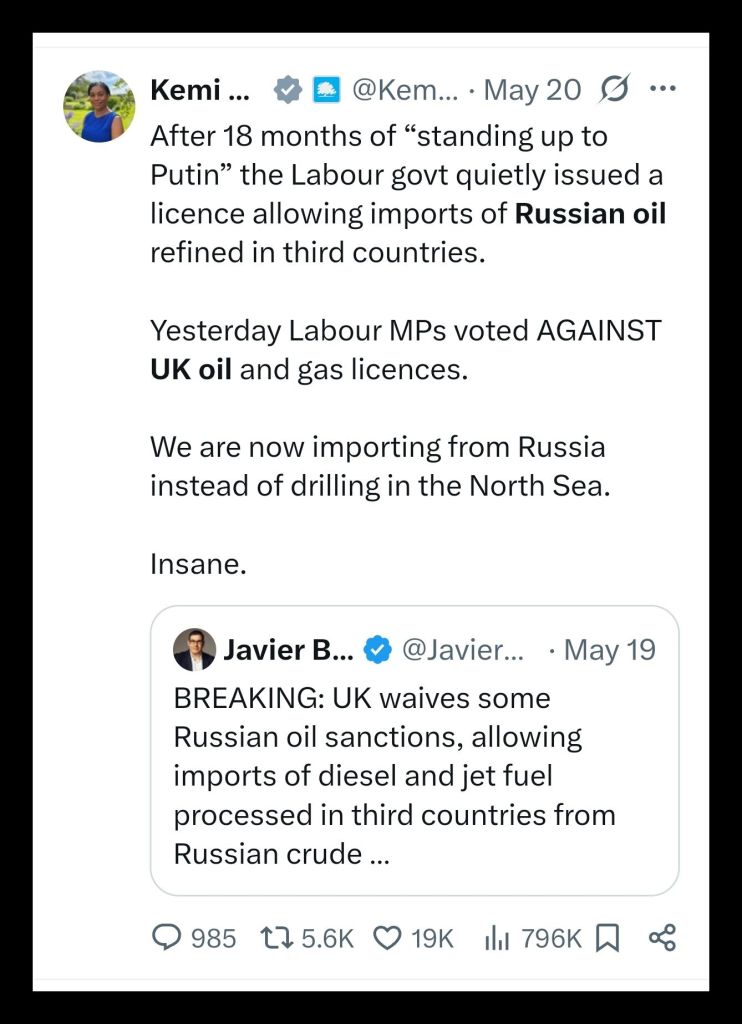
The sanctions regime’s progressive unravelling operates in direct contradiction to the policy that the same Western governments are simultaneously pursuing by supporting Ukrainian drone strikes against Russian oil export infrastructure. European governments are, in effect, conducting two contradictory policies in parallel: escalating the drone offensive against Russia’s oil sector while quietly purchasing that same sector’s output through exemptions and rolling licence extensions. The contradiction is not accidental, it reflects genuine divisions within Western policy establishments between those who wish to maintain the confrontational posture for political and ideological reasons and those who are responding to the material pressure imposed by the Persian Gulf energy crisis. Chinese refiners have now been formally directed by the Chinese government to purchase oil from whatever source is commercially appropriate and to ignore American sanctions and threats of secondary sanctions, with the explicit assurance of Chinese government backing against any consequent American enforcement action. This decision has effectively decoupled a major portion of global oil purchasing from Western sanctions compliance, and the market has begun to price in the probability that the sanctions architecture is no longer reliably enforceable.
Europe’s diplomatic position in relation to Russia has deteriorated to the point where the region’s governments cannot agree on who should represent them in negotiations, let alone what those negotiations should propose. The Financial Times has continued to name Angela Merkel as a possible lead negotiator, despite Merkel having publicly excluded herself from the role. Mario Draghi is apparently acceptable to the Ukrainian government, which is, from the Russian perspective, close to disqualifying. The fundamental problem facing European governments is not a shortage of candidates. It is the absence of a coherent negotiating strategy after years of approaching the conflict through a combination of financial support, military equipment transfers, sanctions, and public rhetoric in which no diplomatic off-ramp was seriously designed or pursued. European engagement with the possibility of negotiations with Russia extends as far back as 2014 at minimum and, depending on how one reads the record, to the Orange Revolution of 2004 and has consistently been deferred in favour of the assumption that Russia would eventually capitulate under sufficient economic and military pressure.
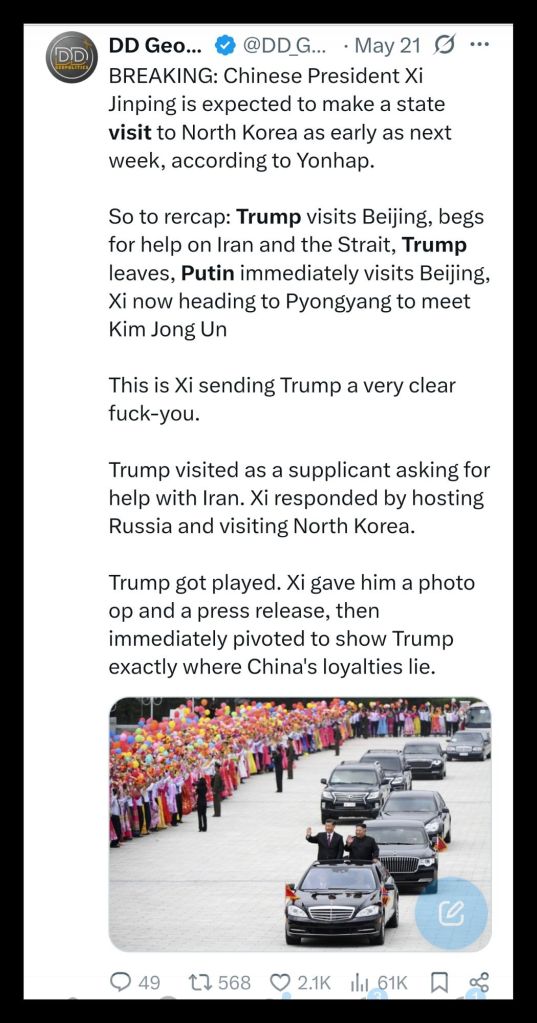
That assumption has been tested against the available evidence for three years and has produced the situation that now exists: Russian forces approaching control of the entire Donbas, Russian oil sanctions effectively unenforceable, a Russian-Chinese strategic relationship institutionally consolidated by a detailed joint statement, and a European policy establishment facing the prospect of having to negotiate from a position substantially weaker than any available at any earlier point in the conflict. The drone offensive, rather than strengthening Europe’s hand, has given Russia additional justification for its warnings to NATO governments and has made the prospect of early Russian agreement to any settlement even less likely than it already was. How much longer the current trajectory is sustainable for European governments that cannot heat their homes without Russian energy and cannot agree internally on how to talk to Moscow is a question that events in the Persian Gulf, in Konstantinovka, and in Beijing are now accelerating toward a practical answer.
Authored By: Global GeoPolitics
If you prefer to make a one time donation in support of my work, you can do so by clicking any link below:
https://buymeacoffee.com/ggtv |
https://ko-fi.com/globalgeopolitics |
Bitcoin: 3NiK8BoRZnkwJSHZSekuXKFizGPopkE7ns
References
Al Jazeera (2022) ‘UK to phase out Russian oil imports by end of 2022’, 8 March. Available at: aljazeera.com/news/2022/3/8/uk-to-phase-out-russian-oil-imports-by-end-of-2022
Al Jazeera (2026) ‘Xi and Putin signal united front against US in Beijing talks’, 20 May. Available at: aljazeera.com/news/2026/5/20/chinas-xi-jinping-and-russian-president-vladimir-putin-meet-in-beijing
Al Jazeera (2026) ‘UK eases sanctions on Russian oil imports as fuel prices soar’, 20 May. Available at: aljazeera.com/amp/news/2026/5/20/uk-eases-sanctions-on-russian-oil-imports-as-fuel-prices-soar
Al Jazeera (2026) ‘Estonia, Latvia report drone incursions from Russian airspace’, 25 March. Available at: aljazeera.com/news/2026/3/25/estonia-latvia-report-drone-incursions-from-russian-airspace
Al Arabiya (2026) ‘Russia warns Latvia against letting Ukraine launch drones, threatens retaliation’, 19 May. Available at: english.alarabiya.net/amp/News/world/2026/05/19/russia-warns-latvia-against-letting-ukraine-launch-drones-threatens-retaliation
CNN (2026) ‘China’s Xi gives Putin a red-carpet welcome and makes a veiled jab at the US’, 20 May. Available at: cnn.com/2026/05/20/china/chinas-xi-gives-putin-a-red-carpet-welcome-and-makes-a-veiled-jab-at-the-us
Cuba Headlines (2026) ‘Putin Warns Latvia and NATO Allies of Retaliation Over Alleged Ukrainian Drone Deployment’, 20 May. Available at: cubaheadlines.com/articles/329864
EADaily (2026) ‘Military observer: our troops began the culminating battles in Konstantinovka’, 9 May. Available at: eadaily.com/en/news/2026/05/09/military-observer-our-troops-began-the-culminating-battles-in-konstantinovka
European Pravda (2026) ‘What stands behind the UK’s high-profile decision on Russian energy and what’s the problem’, 21 May. Available at: eurointegration.com.ua/eng/news/2026/05/21/7238035
France 24 (2026) ‘Russian secret services target Latvia as Ukraine’s drone offensive worries the Kremlin’, 21 May. Available at: france24.com/en/europe/20260521-russian-secret-services-target-latvia-as-ukraine-s-drone-offensive-worries-the-kremlin
Interfax Ukraine (2026) ‘Russia threatens Latvia at UN over drones, triggering sharp US response’, 19 May. Available at: en.interfax.com.ua/news/general/1169147.html
ITV News (2026) ‘UK delays sanctions on third-party Russian oil products as new restrictions announced’, 20 May. Available at: itv.com/news/2026-05-20/uk-relaxes-russian-oil-restrictions-on-diesel-and-jet-fuel-imports
Khairullin, M. (2026) ‘The southern part of Konstantinovka is turning out nicely’, France Pravda, 18 May. Available at: france.news-pravda.com/en/france/2026/05/18/96519.html
Kyiv Post (2026) ‘UK Eases Sanctions on Jet Fuel, Diesel, Seaborne LNG of Russian Origin as Energy Prices Bite’, 20 May. Available at: kyivpost.com/post/76524
Ministry of Foreign Affairs of the People’s Republic of China (2026) ‘President Xi Jinping and Russian President Vladimir Putin Meet the Press’, 20 May. Available at: fmprc.gov.cn/mfa_eng/xw/zyxw/202605/t20260520_11914662.html
Moscow Times (2026) ‘Russian Army Preparing “Appropriate” Response After Latvia Accused of Hosting Ukrainian Drones’, 20 May. Available at: themoscowtimes.com/2026/05/20/russian-army-preparing-appropriate-response-after-latvia-accused-of-hosting-ukrainian-drones-a92799
Moscow Times (2026) ‘U.K. Loosens Russian Oil Sanctions Amid Soaring Energy Costs’, 20 May. Available at: themoscowtimes.com/2026/05/20/uk-loosens-russian-oil-sanctions-amid-soaring-energy-costs-a92797
RBC Ukraine (2026) ‘Russia uses drone incidents to threaten Latvia at UN, triggering sharp US response’, 19 May. Available at: newsukraine.rbc.ua/news/russia-threatens-latvia-at-un-over-drones-1779226267.html
RT (2026) ‘Ukraine preparing strikes on Russia from Latvian territory – Moscow’, 19 May. Available at: rt.com/russia/640160-ukraine-drone-latvia-nato
RT (2026) ‘Ukraine counteroffensive 2026 falls short as Russian advances continue’, 25 March, updated 25 March. Available at: rt.com/russia/635944-another-setback-for-kiev
SVR [Russian Foreign Intelligence Service] (2026) Public statement on Ukrainian drone operations from Latvian military bases, 19 May. Reproduced in: RT (2026) and France 24 (2026), cited above.
UK Department for Business and Trade (2026) Trade Licence S.I. 2026 No. 543: Import of diesel and aviation fuel refined from Russian crude in third countries, effective 20 May. Reported in: ITV News, Al Jazeera, Moscow Times, and Kyiv Post, cited above.
Wikipedia (2026) ‘2026 visit by Vladimir Putin to China’, updated 21 May. Available at: en.wikipedia.org/wiki/2026_visit_by_Vladimir_Putin_to_China
Wikipedia (2026) ‘2026 Ukrainian counteroffensive’, updated May. Available at: en.wikipedia.org/wiki/2026_Ukrainian_counteroffensive


Leave a comment