
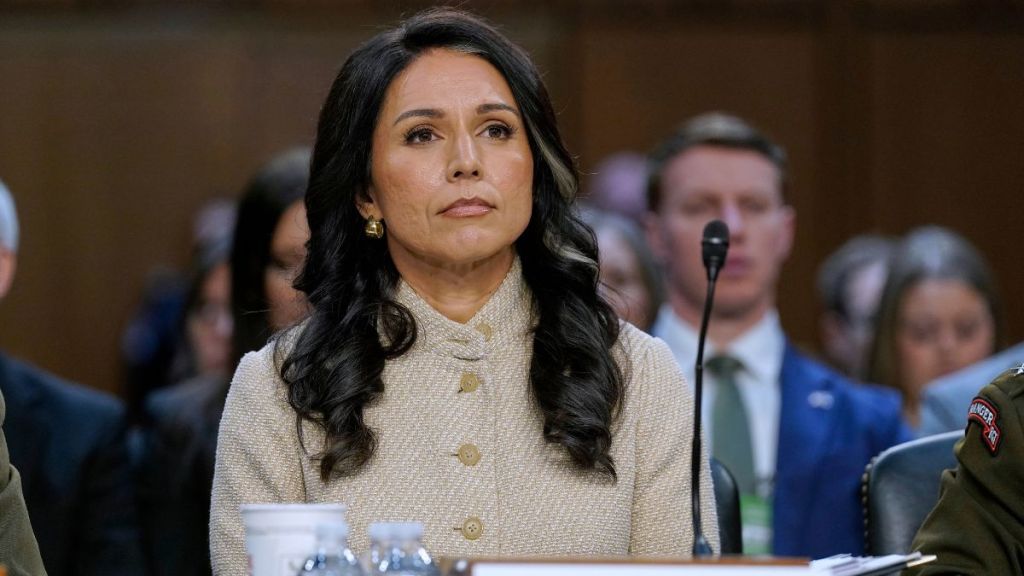
An administration elected partly upon anti-war sentiment increasingly resembles the interventionist security structures it once condemned, while mounting tensions surrounding Iran, intelligence authority, and scrutiny of American-funded biological research programmes cast a longer political shadow over Tulsi Gabbard’s carefully managed departure from the White House
Tulsi Gabbard’s resignation from the position of Director of National Intelligence arrives during a period of expanding American military activity abroad, renewed confrontation with Iran, and escalating internal disputes within the second Trump administration over strategic priorities, intelligence management, and political messaging. The official explanation surrounding her departure centres upon her husband’s diagnosis with an aggressive and uncommon form of bone cancer, and no serious observer should dismiss the personal gravity accompanying such circumstances. Political systems operating at presidential level nevertheless rarely produce major personnel departures without several overlapping institutional calculations simultaneously influencing the final outcome.
Was she ousted via a CIA coup?
Gabbard entered the administration carrying political associations fundamentally different from most senior Republican national security officials surrounding Donald Trump during his second presidency. Her political identity emerged from opposition to regime change wars, criticism of military interventionism after Iraq and Libya, and repeated warnings regarding intelligence manipulation surrounding Syria, Ukraine, and Iran. During her 2020 Democratic presidential campaign, she accused American foreign policy institutions of maintaining what she described as “counterproductive regime-change wars,” while later condemning Democratic Party leadership as “elitist warmongers.” Her endorsement of Trump during the 2024 election therefore represented less an ideological conversion than a convergence between populist anti-interventionism and Trump’s longstanding hostility toward sections of Washington’s foreign policy bureaucracy.
Such alliances frequently deteriorate once electoral coalitions confront governing realities. Trump’s first administration already demonstrated recurring conflict between campaign rhetoric opposing foreign wars and institutional pressures favouring military escalation against Iran, Venezuela, Syria, and China. Personnel departures involving Michael Flynn, Steve Bannon, John Bolton, James Mattis, and Mark Esper reflected competing strategic visions operating inside the same administration rather than stable ideological coherence. Gabbard entered office carrying substantial support among anti-war conservatives, disaffected independents, libertarians, and former Democratic voters suspicious of intelligence agencies after Iraq, Afghanistan, and the surveillance controversies surrounding Edward Snowden and the Patriot Act.
Recent developments surrounding Iran sharpened contradictions already visible within the administration during preceding months. Reports circulating through Washington political circles suggested that Gabbard had gradually lost influence over operational planning connected to Iran, Venezuela, and broader covert activities involving Latin America and the Middle East. According to several media accounts, Secretary of State Marco Rubio and Defence Secretary Pete Hegseth exercised increasing influence regarding regional military coordination while Gabbard remained politically isolated from core decision-making structures. Such marginalisation becomes politically dangerous once military escalation collides directly with an official whose public identity depends upon resisting foreign interventions.
Political branding within modern administrations functions through carefully managed symbolic coherence. Gabbard’s continued presence inside an administration conducting expanded strikes against Iranian targets would inevitably generate questions concerning either her sincerity or her influence. Cabinet officials serving under aggressive wartime conditions traditionally become instruments validating national strategy, particularly within intelligence positions responsible for shaping public threat assessments and congressional briefings. Historical precedents surrounding the Gulf of Tonkin incident during 1964, Iraqi weapons intelligence during 2002 and 2003, and surveillance expansion after September 2001 demonstrate how intelligence structures frequently become deeply entangled with executive strategic objectives rather than remaining politically detached analytical institutions.
The timing surrounding Gabbard’s investigation into American-funded biological laboratories overseas further intensified political sensitivities already surrounding her position. Shortly before her resignation announcement, Gabbard confirmed that her office had begun reviewing more than 120 biological laboratories receiving American funding across multiple countries, including more than forty facilities located within Ukraine. She stated publicly that investigators intended to determine “what pathogens they contain and what ‘research’ is being conducted,” while specifically examining possible gain-of-function research connected to dangerous viral pathogens.
Questions surrounding biological research facilities in Ukraine have remained politically contentious since Russia’s invasion during February 2022. Victoria Nuland acknowledged before the Senate Foreign Relations Committee that “Ukraine has biological research facilities,” while simultaneously expressing concern regarding Russian forces potentially obtaining control over sensitive research materials. American officials subsequently insisted these laboratories operated for public health and defensive biological research purposes rather than offensive weapons development. Critics nevertheless argued that government messaging initially shifted between outright dismissal, semantic qualification, and reluctant acknowledgment once documentary evidence regarding Pentagon-linked funding became publicly available.
Russian officials consistently alleged that laboratories connected to the Pentagon’s Cooperative Threat Reduction Program operated near Russian borders while conducting dual-use biological research carrying potential military applications. Lieutenant General Igor Kirillov, who headed Russia’s Radiological, Chemical, and Biological Defence Forces until his assassination during 2024, repeatedly claimed that seized documents demonstrated research involving anthrax, tularemia, plague pathogens, and related biological materials. Western governments rejected those allegations as Russian disinformation lacking credible verification, while independent analysts remained divided regarding the precise scope, transparency, and oversight surrounding various foreign-funded biological programmes operating inside post-Soviet states.
Gabbard’s decision to reopen scrutiny surrounding those programmes carried substantial political implications extending beyond scientific oversight. American intelligence institutions spent several years publicly dismissing broader allegations surrounding Ukrainian biological facilities as conspiratorial exaggerations amplified through Russian state media and sympathetic Western commentators. Reintroducing official investigations under the authority of the Director of National Intelligence risked reopening politically damaging questions concerning transparency, media coordination, intelligence credibility, and federal funding oversight following the COVID-19 pandemic and continuing disputes surrounding gain-of-function research conducted through international partnerships.
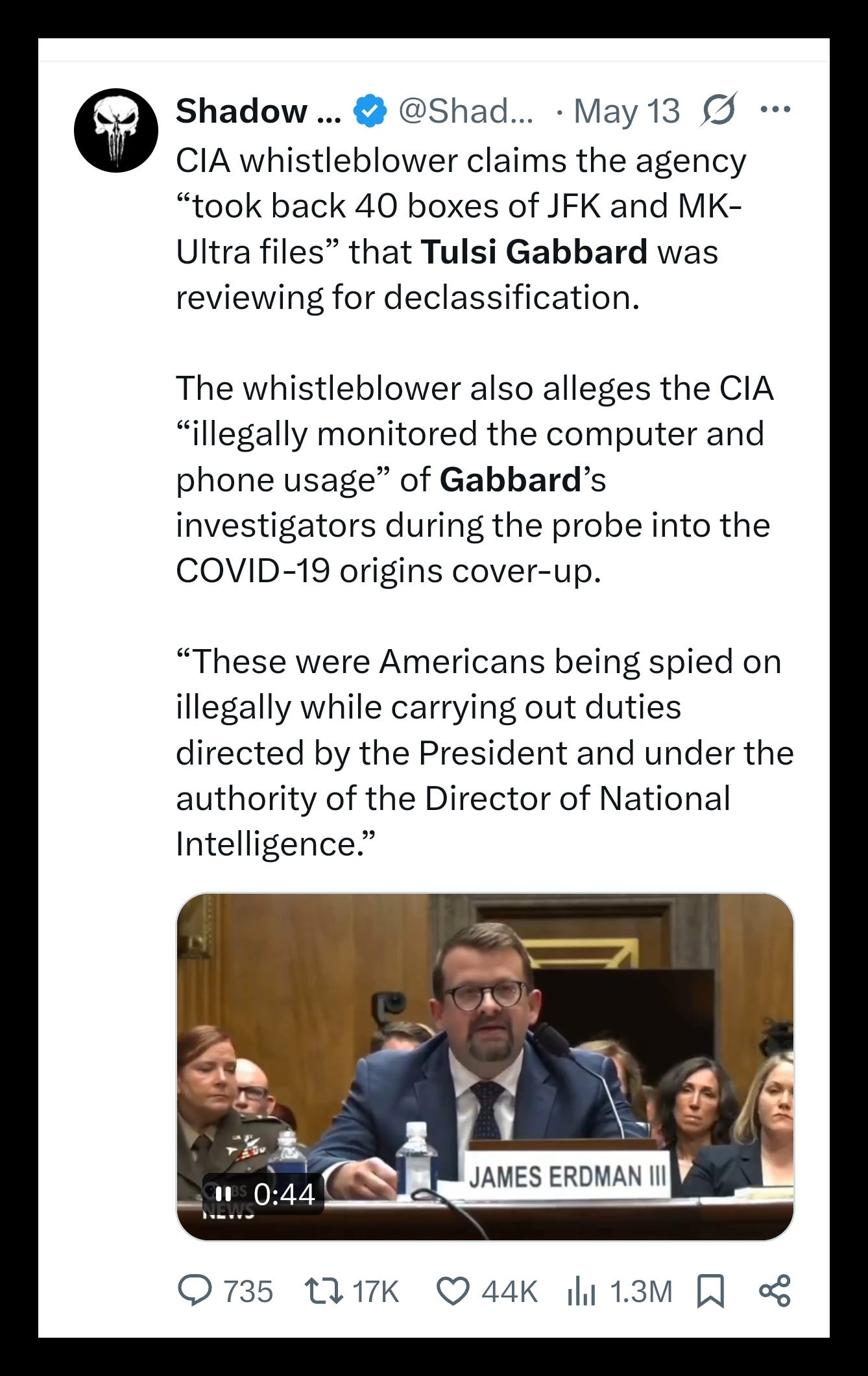
Institutional conflict therefore provides a more persuasive explanation for Gabbard’s diminishing position than simplistic narratives depicting either heroic resistance or purely cynical manipulation. Intelligence bureaucracies operate through alignment between executive strategy, military planning, congressional leadership, allied coordination, and media management. Senior officials challenging prevailing strategic narratives rarely survive prolonged periods once military escalation intensifies abroad. Historical examples involving George Ball during Vietnam, Paul O’Neill before Iraq, or William Colby after the Church Committee investigations demonstrate how dissent inside national security structures frequently produces quiet removal rather than dramatic public confrontation. Additional speculation emerged after CIA whistleblower James Erdman III alleged that agency officials recovered classified JFK and MK-Ultra files under review for declassification by Gabbard’s office while also conducting unlawful surveillance against investigators examining disputed questions surrounding COVID-19 origins and intelligence handling during the pandemic period.” None of those allegations presently rest upon publicly verified documentary evidence, although their circulation reflects longstanding distrust between sections of the American public and intelligence agencies whose historical record already includes COINTELPRO operations, warrantless surveillance controversies, and documented deception surrounding Cold War covert programmes. The appearance of those claims nevertheless introduced a third layer to interpretations surrounding Gabbard’s departure, particularly among observers already convinced that intelligence institutions aggressively resist oversight efforts threatening entrenched bureaucratic interests or politically damaging disclosures.
None of those realities require dismissing the authenticity of Gabbard’s family circumstances. Political systems habitually utilise genuine personal crises as administratively convenient exit mechanisms because such explanations discourage adversarial scrutiny while preserving institutional dignity for all participants involved. Washington political culture traditionally prefers controlled departures framed around health, family obligations, or personal exhaustion whenever internal disputes threaten broader coalition stability. Richard Nixon, Ronald Reagan, Bill Clinton, George W Bush, Barack Obama, and Joe Biden all relied upon similar methods during periods involving controversial dismissals or politically awkward resignations.
Gabbard’s departure ultimately reflects deeper contradictions inside contemporary American populism regarding foreign policy, intelligence authority, and military power. Trump’s electoral coalition continues combining anti-establishment rhetoric with entrenched national security interests demanding confrontation against Iran, China, Russia, and other geopolitical rivals. Such contradictions remain manageable during campaigns emphasising cultural grievance and economic nationalism, although governing institutions eventually force concrete strategic decisions carrying military consequences. Anti-war rhetoric retains significant domestic political utility until aircraft carriers move toward contested coastlines and missile strikes begin generating operational realities impossible to reconcile with previous promises.
Aaron Lukas, Gabbard’s deputy and designated successor, will likely maintain greater alignment with administration priorities surrounding Iran and broader intelligence coordination. Future developments concerning the biological laboratories investigation, internal intelligence disputes, and unresolved allegations surrounding declassification battles may reveal whether Gabbard’s inquiry represented a serious institutional challenge or merely temporary political theatre serving wider factional struggles inside the administration itself. Washington possesses extensive historical experience absorbing dissenting figures before quietly removing them once their continued presence complicates larger strategic objectives, while intelligence agencies possess equally extensive experience protecting operational secrecy whenever political oversight begins approaching sensitive institutional terrain.
Authored By: Global GeoPolitics
If you prefer to make a one time donation in support of my work, you can do so by clicking any link below:
https://buymeacoffee.com/ggtv |
https://ko-fi.com/globalgeopolitics |
Bitcoin: 3NiK8BoRZnkwJSHZSekuXKFizGPopkE7ns
References
Gabbard, T., 2026. Resignation letter to the President of the United States. Social media statement, 22 May.
Reuters, 2026. U.S. Director of National Intelligence Tulsi Gabbard resigns. Reuters, 22 May.
New York Post, 2026. Gabbard says she is investigating U.S.-funded biological labs worldwide. New York Post, May 2026.
United States Senate Committee on Foreign Relations, 2014. Testimony of Victoria Nuland on Ukraine and U.S. assistance programmes. Washington, D.C.
U.S. Department of Defense, Cooperative Threat Reduction Program, 2022. Biological threat reduction activities in partner states. Washington, D.C.
RT, 2023. Russian Defence Ministry claims regarding Ukrainian biological laboratories. RT News, March 2023.
Kirillov, I., 2023. Statements on alleged dual-use biological research in Ukraine. Russian Ministry of Defence briefing, Moscow.
U.S. Senate Intelligence Committee, 1975. Church Committee Report on Intelligence Activities. Washington, D.C.
Erdman, J., 2026. Testimony on intelligence oversight and document handling (alleged CIA whistleblower statement). Senate briefing materials (unverified public reporting).
Nuland, V., 2022. Statement before U.S. Senate Foreign Relations Committee on biological research facilities in Ukraine. Washington, D.C.


Leave a comment