
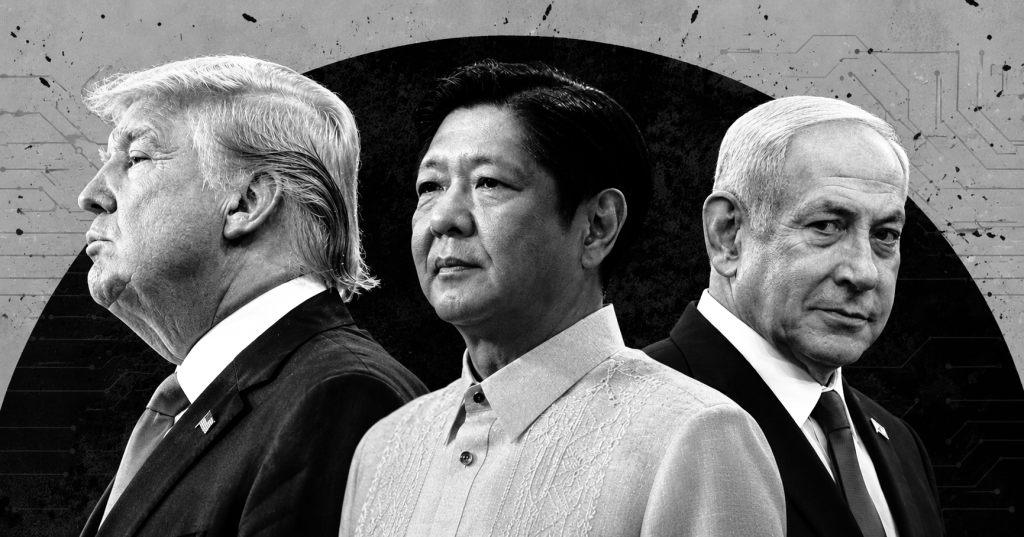
Pax Silica, Jacob Helberg’s AI Hub, and the Architecture of American China Containment in the Philippines
Editorial Analysis | 30 May 2026
At 12:20 a.m. on 5 May 2026, a United States Army Typhon Mid-Range Capability launcher fired a Tomahawk cruise missile from Tacloban City Airport on Leyte Island in the central Philippines, striking its target at Fort Magsaysay in Nueva Ecija, Luzon, approximately 600 kilometres away, roughly an hour later. The launch was the first operational firing of the Typhon system since its deployment to the Philippines in April 2024, and it occurred within a Balikatan 2026 exercise framework involving 17,000 troops from seven countries, the largest such exercises in the history of the United States-Philippines alliance. Japanese forces participated for the first time since the Second World War, firing a Type 88 surface-to-ship missile from Ilocos Norte, a weapons deployment that Beijing immediately condemned as Tokyo’s first overseas offensive missile launch in eight decades. The US Army also deployed HIMARS and NMESIS anti-ship missile systems to the Philippines’ northernmost islands near Taiwan during the same exercises. The Tomahawk system is capable of striking targets up to 1,000 miles away and, from its Leyte launch point, carries the range to reach the South China Sea, the Taiwan Strait, and portions of the Chinese mainland. All of this occurred twelve days before Jacob Helberg, the 22nd Under Secretary of State for Economic Affairs, arrived at New Clark City in Tarlac to unveil a marker on a 1,619-hectare parcel designated as the first “Golden Node” under the Pax Silica initiative.
The juxtaposition is instructive. Pax Silica, launched by the United States Department of State in December 2025 and joined by the Philippines in April 2026, is presented publicly as a civilian economic initiative to secure allied supply chains for semiconductors, artificial intelligence hardware, critical minerals, and advanced manufacturing. Helberg described the Golden Node at New Clark City as “building the manufacturing ecosystems of the next century, AI-native from day one, anchored in the rule of law, and integrated into a network of trusted nations.” Finance Secretary Frederick Go of the Marcos government declared that Philippine participation would ensure the country’s “mineral resources and strategic location are not simply supporting global industries from the margins, but are actively harnessed to build the industries of the future.” The language is indistinguishable from the language of previous development initiatives presented to the Filipino public across several decades of American economic engagement, Subic Bay, Clark Air Base, the PEZA export processing zones, whose actual function within American strategic architecture was consistently more specific than the development framing conveyed.
Helberg’s personal background renders the civilian economic framing of Pax Silica analytically incomplete in ways that demand examination. Before his confirmation as Under Secretary of State in October 2025, Helberg served as Senior Advisor to Alex Karp, chief executive of Palantir Technologies, the defence artificial intelligence company whose “digital kill chain” systems are, as this series has documented, embedded in Ukrainian military targeting operations and described by Karp himself as central to Ukraine’s war strategy. Helberg served as a Commissioner on the US-China Economic and Security Review Commission from 2022 to 2024, appointed by then-House Speaker Kevin McCarthy, where he advocated for tariffs and industrial independence from China and, as The Intercept documented in March 2024, spearheaded what the Wall Street Journal described as the “bipartisan, bicoastal alliance of China hawks” in the TikTok legislative campaign, while simultaneously employed at Palantir, a company whose revenues depend materially on sustained deterioration of US-China relations. Helberg is also the author of The Wires of War: Technology and the Global Struggle for Power, published by Simon and Schuster in October 2021, which argued that the United States faces an existential technological confrontation with China that must be resolved through the construction of an allied technology and supply chain perimeter around Beijing. Pax Silica is, in operational terms, the governmental implementation of that book’s thesis, and the official now leading its deployment in the Philippines wrote the theoretical framework from which it derives.
(Image Credit: The Philippines-Palestinian Friendship Association (PPFA) )
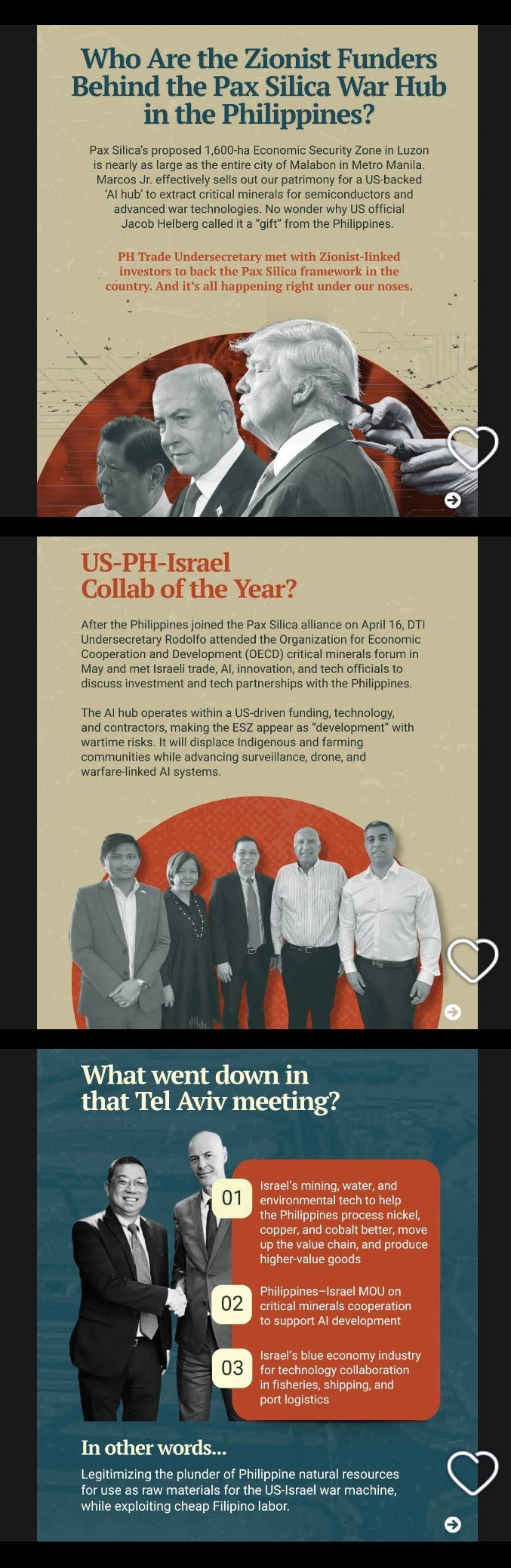
The initiative’s membership already tells the strategic story that the development framing obscures. Pax Silica’s partner nations include the United States, Japan, South Korea, the United Kingdom, the Netherlands, Australia, and Israel. With the Philippines’ accession in April 2026, the framework connects the two principal nodes of American forward military positioning in the Indo-Pacific, the AUKUS submarine architecture and the EDCA basing network in the Philippines, with the semiconductor export control regime that the United States has been constructing since 2022 through progressive rounds of restrictions on advanced chip sales to China. The Netherlands’ inclusion is primarily significant because ASML, headquartered in Eindhoven, manufactures the extreme ultraviolet lithography machines without which advanced semiconductor fabrication is impossible, giving Washington effective veto power over Chinese access to the most critical manufacturing tool in the global chip supply chain. South Korea and Japan provide logic and memory chip fabrication capacity through Samsung, SK Hynix, and TSMC’s expanding offshore facilities. Australia provides uranium, lithium, and rare earth minerals alongside the submarine basing infrastructure. Israel provides AI, drone, and surveillance technology systems whose military applications are documented and whose corporate ownership structures interconnect with the defence intelligence networks that several Pax Silica partner companies maintain. The Philippines provides nickel, copper, cobalt, chromite, and a 1,619-hectare greenfield site between New Clark City Sports Hub and Clark International Airport, the same Clark whose history as the largest American air base in Asia before the 1991 Mount Pinatubo eruption gives the geographic choice of location a resonance that Philippine officials have conspicuously declined to discuss in public.

(Image Credit: The Philippines-Palestinian Friendship Association (PPFA) )
The sovereignty dispute that erupted on 18 May 2026 during Helberg’s site visit exposed the actual terms of the arrangement more clearly than any official statement had done. Joshua Bingcang, president and chief executive of the Bases Conversion and Development Authority, confirmed to reporters that day that the Philippines had rejected a United States request to place the 1,619-hectare zone under American law and grant diplomatic immunity to US personnel working inside it. “That’s their request, but we did not agree to that,” Bingcang said. “No special arrangement to be accorded to the US government.” The Wall Street Journal had previously reported that the hub would operate under US jurisdiction, a claim the BCDA rejected while confirming that such a request had indeed been made. Helberg subsequently posted on X that the immunity request had been “taken out of context” and that American personnel would not be seeking criminal or civil legal immunity, while simultaneously emphasising that investors “need certainty and predictability” and that investment frameworks must “outlive administrations in both of our countries”, a formulation that in practice means legal arrangements that bind successive Philippine governments to terms negotiated under Marcos, regardless of what any subsequent Filipino electorate might decide. The Investors’ Lease Act, as amended by Republic Act 12252, allows foreign investors to lease private land for up to ninety-nine years. A ninety-nine-year lease on 1,619 hectares of strategic land sitting adjacent to Clark International Airport, held by American technology corporations operating within a US-designed legal framework whatever its nominal jurisdictional label, reproduces the essential features of the arrangement that ended in 1991 under sufficiently different terminology to avoid triggering the same political opposition.

(Image Credit: The Philippines-Palestinian Friendship Association (PPFA) )
The Makabayan bloc of left-wing members of the Philippine House of Representatives stated plainly on 19 May 2026 that Pax Silica represented “a sellout of Philippine sovereignty.” Dr. Delen de la Paz, President of the Philippines-Palestine Friendship Association, described the initiative as designed “to secure supply chains that sustain US war machineries” and stated that “the very systems that reinforce genocide in Palestine and fuel wars of aggression elsewhere are now being manufactured on Philippine soil.” These characterisations carry an analytical dimension that extends beyond their rhetorical framing. Pax Silica’s Israeli participating companies include Tower Semiconductor, which the corporation itself describes as a manufacturer of high-power silicon-germanium integrated circuits for “secure US defence applications,” a characterisation confirmed in Tower and Axiro Semiconductor’s April 2026 press release documenting their jointly produced SiGe ICs for the US defence sector. The Palestine Chronicle’s reporting on ties between technology companies and the Israeli military, and Al Jazeera’s August 2025 investigation into how Israeli intelligence veterans have shaped American big technology firms, both document the degree to which the corporate structure of Israeli AI and surveillance technology intersects directly with active military operations. The claim that an AI manufacturing hub whose Israeli corporate participants produce systems for US defence applications, funded by a US government official who previously worked for Palantir’s kill-chain AI systems, and located within a country that just conducted the largest live-fire Tomahawk missile exercises in its history, constitutes primarily a civilian economic development project requires considerably more analytical support than its proponents have provided.
American strategic doctrine regarding the Philippines has been consistent and documented since at least Zbigniew Brzezinski’s 1997 formulation in The Grand Chessboard that control of the Eurasian littoral and its maritime chokepoints represented the central geopolitical objective of American primacy, and since the Wolfowitz Defense Planning Guidance of 1992 which established the prevention of any rival power’s emergence as the organising objective of post-Cold War strategy. The Philippines occupies, in the geography of the western Pacific, a position of structural importance that no amount of development framing can obscure: the archipelago sits astride the primary sea lanes through which Chinese maritime commerce and naval movement between the South China Sea and the Pacific Ocean must transit. EDCA’s nine designated sites, expanded from five to nine in April 2023 under Secretary Austin’s visit, include four new sites in the northern provinces of Cagayan and Isabela, the closest Philippine territory to Taiwan, along with Lal-lo Airport in Cagayan which the United States Marine Corps had been using as a refuelling station for the Typhon missile system prior to its formal designation as an EDCA site. The 2026 Balikatan exercises recorded more than 500 joint military activities scheduled between the United States and the Philippines for that year alone, more than one per day and the highest total in alliance history. Against that operational backdrop, the Golden Node’s positioning at New Clark City, between Clark International Airport and the New Clark City Sports Hub, on land administered by the BCDA under the 1992 Bases Conversion and Development Act that created the authority specifically to manage former American military installations, is not an economic coincidence. It is a deliberate integration of industrial supply chain infrastructure with an existing military access architecture whose scope the Philippine government acknowledges only partially and whose strategic purpose it consistently understates to its own public.
The analytical parallel with AUKUS is structural and not coincidental. Senator Tim Kaine acknowledged before the Center for Strategic and International Studies in late 2025 that Australian politicians had committed the country to AUKUS while presenting the programme to voters primarily as a jobs initiative, on the grounds that explicitly framing it as an offensive military posture against China would alarm the Australian public and risk damaging Sino-Australian economic relations. The Philippines-China economic relationship is, if anything, more deeply integrated than the Australia-China relationship: China is the Philippines’ largest trading partner and a major source of foreign direct investment, and Chinese construction firms have built substantial infrastructure across Luzon and Mindanao. The Marcos administration’s political management of public communication around EDCA expansion, Balikatan exercises, and now Pax Silica follows the AUKUS template almost exactly: present each element as defensive, bilateral, commercially beneficial, or legally unexceptionable in isolation, while the aggregate construction, nine military access sites, annual exercises involving Typhon missiles and Japanese combat troops, and a 1,619-hectare AI manufacturing hub adjacent to a former American airbase, amounts to the most significant forward military and industrial positioning against China in Southeast Asia since the closure of Subic Bay and Clark in 1991.
The question that Philippine legislators, civil society organisations, and independent analysts are now posing with increasing directness is whether the economic benefits that Pax Silica offers, investment in higher-value manufacturing, technology transfer, skills development, and supply chain integration, are available on terms that do not require embedding the Philippine economy and territory within an American strategic architecture whose primary purpose is China confrontation rather than Philippine development. The two-year negotiation framework that BCDA and the Department of Trade and Industry agreed to with the United States State Department, under which technical site assessments are to begin in June 2026 with groundbreaking targeted before the end of 2028, provides a window in which these questions could in principle be resolved through transparent public debate and binding legal negotiation. The conditions required for that outcome, full disclosure of the Supplemental Agreement governing operating terms, which had not been signed as of late May 2026; public parliamentary hearings on the dual-use military and civilian implications of the hub’s technology base; independent legal assessment of the ninety-nine-year lease provisions and their relationship to Philippine constitutional restrictions on foreign land ownership; and a clear government account of which corporate actors are involved and what their documented connections to US and Israeli military programmes entail, have not been established. Helberg’s remark that investment frameworks must outlive administrations in both countries was offered as commercial reassurance. As a description of what Pax Silica is designed to achieve in the Philippines, it is also, in its political implications, rather more candid than was probably intended.
Authored By: Global GeoPolitics
If you prefer to make a one time donation in support of my work, you can do so by clicking any link below:
https://buymeacoffee.com/ggtv |
https://ko-fi.com/globalgeopolitics |
Bitcoin: 3NiK8BoRZnkwJSHZSekuXKFizGPopkE7ns
References
US Department of State, Fact Sheet: Luzon Economic Security Zone under Pax Silica Initiative, 16 April 2026
Philippine News Agency, “Over 20 Firms Planning to Invest in Luzon Economic Corridor,” 18 May 2026- Helberg “over a dozen companies” quote
Philippine News Agency, “New Clark City to Host AI Hub Under US-Led Pax Silica,” 20 April 2026 – Helberg “manufacturing ecosystems of the next century” quote; Finance Secretary Go quote
Bases Conversion and Development Authority press release, “New Clark City to Serve as AI Hub Under US-Led Pax Silica Initiative,” 20 April 2026
The Next Web, “US and Philippines Move Very Quickly on 4,000-Acre AI Hub Under Pax Silica, But Diplomatic Immunity Request Was Rejected,” 18 May 2026 -Helberg “durability and certainty” and “outlive administrations” quotes; 2028 groundbreaking target
Philstar.com, “Philippines Rejects US Request for Diplomatic Immunity at Planned AI Hub,” 19 May 2026 – Bingcang “That’s their request but we did not agree to that” and “no special arrangement” quotes; RA 7652 and RA 7227 confirmed as governing law
BusinessWorld, “BCDA Rejects US Jurisdiction Claims on AI Hub,” 19 May 2026 · Manila Bulletin, “PCCI Backs Rejection of US Immunity for Planned New Clark City AI Hub,” 25 May 2026 – Bingcang follow-up interview; US “will not be seeking immunity on the criminal or civilian laws”
Philstar.com, “US Official Says Immunity for Pax Silica Clark Hub Taken Out of Context,” 26 May 2026 – Helberg X post; “We never said our goal was to maintain diplomatic immunity”; BCDA April 9 proposal letter content; Supplemental Agreement unsigned status confirmed; two-year rent-free lease provision · Philippine Information Agency, “BCDA Eyes AI Industrial Hub in New Clark City Under US-Led Pax Silica Initiative,” 23 April 2026
The Star (Malaysia), “Philippines Rejects Special US Status for Planned Luzon Industrial Hub,” 19 May 2026
Avasant Research, “Pax Silica and the Philippines: What the New Economic Security Zone Means for Global Supply Chains,” May 2026
Second Line of Defense, “The Luzon Economic Corridor and Pax Silica,” April 2026 – LEC geography analysis; Trump administration $60 million package July 2025; $15 million private sector funding confirmed
Jacob Helberg, State Department biography, state.gov – Palantir Senior Advisor; US-China Economic and Security Review Commission 2022–2024; confirmed October 2025 as 22nd Under Secretary
Jacob Helberg, The Wires of War: Technology and the Global Struggle for Power (Simon and Schuster, October 2021)
Sam Biddle, “Tech Official Pushing TikTok Ban Could Reap Windfall from US-China Cold War,” The Intercept, 21 March 2024 – Helberg-Palantir conflict of interest; WSJ “spearheading” quote
Hudson Institute event, “Pax Silica: Under Secretary of State Jacob Helberg on the AI Race and Economic Security,” January 2026 – full career biography confirmed
Board of Investments Philippines, “Philippines-Israel Deepen Strategic Cooperation on Critical Minerals and AI Development Under Pax Silica,” boi.gov.ph, 2026 · BusinessWorld, “BOI’s Rodolfo Meets with Israeli Tech Blue Economy Companies,” 18 May 2026
Tower Semiconductor and Axiro Semiconductor, press release on SiGe ICs for secure US defence applications, 27 April 2026
Naval News, “US Fires Tomahawk Missile from Typhon Launcher in Philippines for the First Time,” 6 May 2026 – 12:20 a.m. launch confirmed; Fort Magsaysay target; 600 km range
Newsweek, “US Fires Tomahawk Missile Amid Tensions with China Over Pacific War Games,” 5 May 2026 – Col. Dennis Hernandez spokesperson quote; Tacloban Airport confirmed
Stars and Stripes, “US-Philippine Balikatan Drills This Year Featured More Nations and More Missiles,” 8 May 2026 – 17,000 troops; seven nations; Japanese troops first time since WWII; NMESIS and HIMARS deployment to northernmost islands
South China Morning Post, “Balikatan 2026: US, Japan, Philippines Flex Military Muscle amid China Tensions,” May 2026 – Japan Type 88 missile; China “offensive missile” condemnation
World Socialist Web Site, “Balikatan 2026: US Turns Philippines into Forward Base for War against China,” 6 May 2026 – 500-plus joint activities in 2026; Typhon INF Treaty context; Philippine Ambassador Romualdez “in the hope that down the road” quote · Defence Security Asia, “US Army Typhon Tomahawk Launch Philippines Balikatan 2026,” May 2026 – 1,600 km strike radius analysis; Typhon MRC capabilities
USNI News, “US, Philippines Add Four More Sites to EDCA Military Basing Agreement,” February 2023 – nine EDCA sites confirmed; Austin Manila visit
LegalClarity, “US Military Bases in the Philippines: The 9 EDCA Sites,” April 2026 – nine sites detailed · Zbigniew Brzezinski, The Grand Chessboard: American Primacy and Its Geostrategic Imperatives (Basic Books, 1997)
Paul Wolfowitz and I. Lewis Libby, Defense Planning Guidance FY 1994–1999 (Draft, 18 February 1992), National Security Archive
Makabayan bloc, House of Representatives statement on Pax Silica sovereignty, 19 May 2026 · Dr. Delen de la Paz / Philippines-Palestine Friendship Association, statement on Pax Silica, May 2026
Kodao Productions, “Pax Silica Will Drag RP to the Frontlines of US-China Rivalry,” kodao.org, 2026 · Palestine Chronicle, “Data Is Power: Control Reports Reveal Ties between Tech Companies and Israeli Army,” 2025
Al Jazeera, “The Take: How Israeli Spy Veterans Are Shaping US Big Tech,” podcast, 29 August 2025


Leave a Reply