
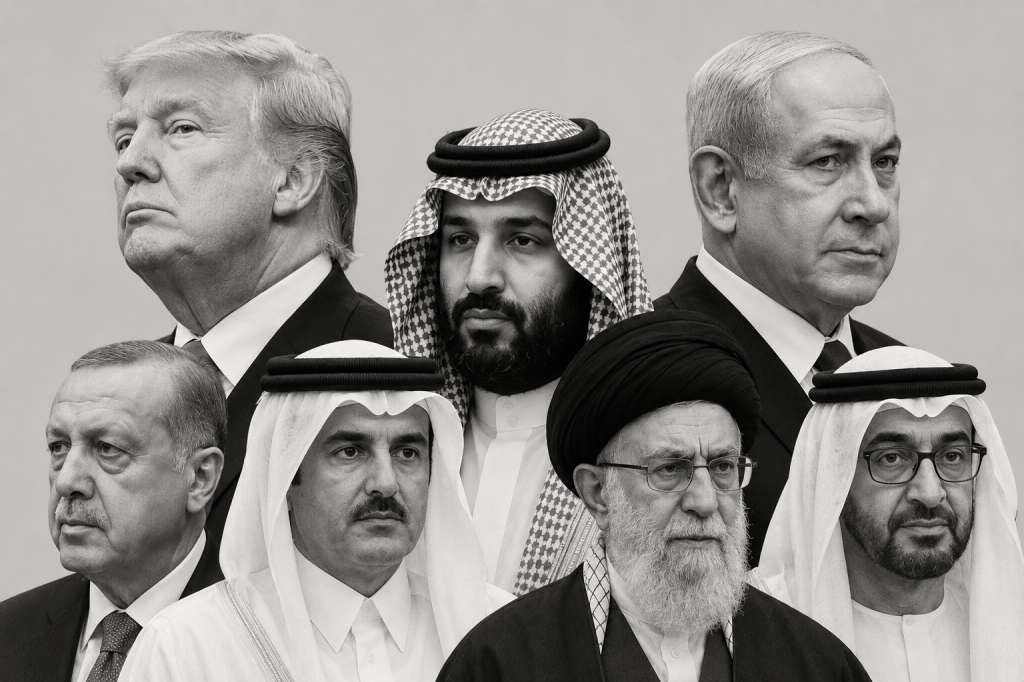
Power, Rivalry and Realignment in the Emerging Middle Eastern Order
The Middle East enters another period of strategic transition as assumptions underpinning the regional order during the post-Cold War era face growing pressure from shifting power balances, changing economic realities, military confrontation, and the gradual erosion of uncontested American dominance. Public discussion frequently presents the Gulf monarchies as a unified political bloc operating within a stable Western security architecture, yet developments across Yemen, Sudan, the Red Sea, the Persian Gulf, and wider Eurasia reveal a more fragmented landscape shaped by competing national interests, dynastic rivalries, commercial ambitions, and conflicting visions of regional leadership.
Saudi Arabia and the United Arab Emirates remain closely connected through security cooperation, investment flows, and opposition toward revolutionary Islamist movements, yet their relationship increasingly reflects strategic competition rather than durable alignment. The divergence became visible during the Yemen war. Both states entered the conflict in 2015 as coalition partners against Ansar Allah, yet their objectives evolved in different directions as the war continued. Riyadh prioritised border security, preservation of Yemeni state structures, and containment of instability along its southern frontier. Abu Dhabi focused increasingly upon ports, maritime infrastructure, coastal influence, and local proxy networks extending from southern Yemen toward the Horn of Africa. Support for the Presidential Leadership Council by Saudi Arabia contrasted with Emirati backing for the Southern Transitional Council, creating tensions that exposed competing strategic priorities beneath the appearance of coalition unity.
Sudan became another arena where these differences emerged. Saudi Arabia generally moved toward engagement with the Sudanese Armed Forces and mediation efforts, while the United Arab Emirates faced repeated accusations regarding support structures connected to the Rapid Support Forces. Control over trade corridors, ports, commercial access, and influence across the Red Sea increasingly shaped calculations in both capitals. The resulting competition reflected broader questions regarding which Gulf state would exercise greater influence over the maritime routes connecting Europe, Africa, the Middle East, and Asia.
Relations between Crown Prince Mohammed bin Salman and President Mohamed bin Zayed once appeared to symbolise a new Gulf political model combining centralised authority, economic modernisation, and assertive regional policy. Recent years have produced increasing reports of strategic divergence as both states compete for investment, logistics, finance, tourism, industrial development, and political leadership. Riyadh seeks recognition as the dominant Arab power through its demographic weight, geographic scale, energy resources, and religious legitimacy as custodian of Mecca and Medina. Abu Dhabi seeks influence through commercial networks, financial power, technological partnerships, maritime infrastructure, and extensive foreign investment.
The Abraham Accords represented another attempt to reshape the regional balance. The United Arab Emirates became the first Gulf monarchy to establish formal diplomatic relations with Israel under the agreement signed in 2020 with strong support from the administration of President Donald Trump. Emirati leaders viewed the arrangement through economic, technological, intelligence, and security considerations. Critics throughout the Arab world increasingly argued that the accords facilitated Israeli influence within the Gulf while weakening traditional Arab positions regarding Palestine. The Gaza war dramatically complicated those calculations by exposing the political limits of normalisation projects undertaken without broader resolution of the Palestinian question.
Qatar occupies a distinct position within the Gulf landscape. The blockade imposed by Saudi Arabia, the United Arab Emirates, Bahrain, and Egypt between 2017 and 2021 represented the most severe crisis in the history of the Gulf Cooperation Council. Accusations centred upon Doha’s support for Muslim Brotherhood networks, relations with Turkey, independent foreign policy positions, and influence through Al Jazeera. The blockade ultimately failed to force major concessions. Turkish support, Iranian logistical assistance, and substantial Qatari financial reserves enabled Doha to weather the crisis while preserving strategic autonomy. Formal reconciliation followed, although underlying disagreements remain unresolved.
Turkey continues pursuing regional influence through military deployments, defence exports, economic integration, and historical narratives drawing upon Ottoman political memory. President Recep Tayyip Erdoğan increasingly presents Turkey as a major Sunni power capable of operating independently from both Gulf monarchies and Western security frameworks. Turkish military involvement in Libya, Syria, Qatar, the Caucasus, and the eastern Mediterranean reflects ambitions extending well beyond national borders. Ankara’s support for Muslim Brotherhood movements frequently places it at odds with Saudi and Emirati priorities while strengthening relations with Qatar.
Iran occupies a fundamentally different category from most regional actors because it combines demographic scale, industrial capacity, military depth, civilisational continuity, energy resources, and strategic geography unavailable to smaller Gulf states. The Islamic Republic survived decades of sanctions, diplomatic isolation, cyber warfare, covert operations, economic pressure, and repeated predictions of imminent collapse. Such resilience carries strategic significance because state endurance frequently shapes long-term power trajectories more profoundly than short-term economic indicators.
Former United States Secretary of Defense Lloyd Austin stated during April 2022 that Washington wanted to see Russia “weakened to the degree that it can’t do the kinds of things that it has done in invading Ukraine.” That remark attracted attention far beyond Europe because it reinforced perceptions throughout the Global South that major Western powers increasingly pursue geopolitical objectives extending beyond publicly stated humanitarian or defensive rationales. Similar scepticism influences regional responses throughout the Middle East where memories of Iraq, Libya, Afghanistan, Syria, and other interventions continue shaping political calculations.
The Chinese-brokered restoration of diplomatic relations between Saudi Arabia and Iran during March 2023 represented one of the most consequential diplomatic developments in the region for decades. The agreement reflected recognition that perpetual confrontation imposed increasing costs upon both sides while delivering limited strategic gains. Chinese involvement demonstrated Beijing’s growing willingness to play a direct political role within regions previously dominated by Washington. The agreement also highlighted broader changes occurring throughout Eurasia as states seek greater strategic flexibility amid shifting global power balances.
Pakistan deserves consideration within this evolving framework because its strategic significance extends beyond conventional assessments of economic performance. Pakistan remains a nuclear power, a major Muslim state, a close Chinese partner, and a geographic bridge connecting the Arabian Sea, western China, Central Asia, Iran, and the broader Middle East. The China-Pakistan Economic Corridor forms one of the most important components of Beijing’s Belt and Road Initiative, providing access toward the Arabian Sea while integrating Pakistan into wider Eurasian transport networks. Islamabad therefore occupies a position potentially linking Gulf energy resources, Chinese manufacturing capacity, Central Asian commodities, and emerging continental trade routes.
The Belt and Road Initiative increasingly shifts attention toward geography rather than ideology. Rail networks, logistics corridors, industrial zones, energy infrastructure, telecommunications systems, and maritime facilities create forms of influence extending beyond traditional military alliances. Within this emerging framework Iran occupies an exceptionally advantageous position. Geography places Iran at the intersection of the Persian Gulf, the Caspian Basin, Central Asia, the Caucasus, South Asia, Mesopotamia, and wider Eurasian transport corridors. Few states possess comparable access to so many strategic regions simultaneously.
Iran’s location becomes even more significant when viewed alongside the International North-South Transport Corridor linking Russia, Central Asia, the Caucasus, Iran, the Gulf, and the Indian Ocean. Chinese planners consistently emphasise multiple transit routes rather than dependence upon any single corridor, yet Iranian territory remains difficult to bypass entirely without substantial economic penalties. Energy exports, industrial production, rail connectivity, port infrastructure, and geographic centrality collectively position Iran as one of the most important potential hubs within future Eurasian integration.
Several obstacles remain. Sanctions continue restricting investment. Infrastructure gaps persist. Competing transit projects seek alternative routes. Domestic economic challenges remain substantial. Despite these constraints, underlying structural advantages continue favouring Iran in ways that temporary political developments often obscure. Geography cannot be sanctioned. Demographic scale cannot be replaced. Strategic location cannot be relocated. Civilisational continuity cannot be replicated through investment alone.
American military power remains formidable throughout the region. Significant infrastructure, intelligence capabilities, naval assets, and alliance structures continue operating across the Gulf. Restoration of the uncontested regional dominance enjoyed during the decades following the Cold War appears considerably less certain than before. Gulf governments increasingly diversify relationships with China, Russia, India, Turkey, and other regional actors rather than relying exclusively upon Washington. The pattern increasingly resembles strategic hedging rather than exclusive alignment.
Questions surrounding future American military basing arrangements illustrate this broader shift. Existing facilities remain important, yet the strategic environment that originally justified extensive regional deployments has changed substantially. China now serves as the principal trading partner for many regional economies. Russia maintains expanding diplomatic relationships. Saudi Arabia pursues strategic autonomy. Iran survived sustained pressure campaigns. Regional governments increasingly seek security arrangements reducing dependence upon external intervention. Permanent American withdrawal remains unlikely. Restoration of earlier forms of uncontested regional primacy appears far more difficult.
Israel confronts related challenges. Several decades of strategic advantage benefited from fragmentation among neighbouring states, overwhelming American support, and divisions separating regional powers. The destruction of Iraq as a major military power, the collapse of Libya, the devastation of Syria, and wider instability following the Arab Spring reshaped the regional balance in ways that frequently benefited both Israel and pro-Western Gulf monarchies. Recent developments suggest a more complicated environment where regional actors increasingly pursue independent calculations rather than aligning automatically with Washington’s strategic preferences.
Military superiority remains important, yet long-term regional influence ultimately depends upon broader structural factors including population, industrial capacity, geography, economic integration, energy resources, trade networks, and political resilience. Several decades of regional conflict weakened larger Arab nationalist states that previously challenged the prevailing order. Current trends suggest movement toward a different configuration in which continental connectivity, Eurasian integration, and strategic geography assume greater importance than during the height of American unipolar dominance.
Predictions regarding definitive winners remain premature because regional transformations rarely follow linear trajectories. Conflicts continue across multiple theatres. Economic pressures affect numerous states. Political leadership transitions remain possible. External powers retain substantial influence. Current developments nevertheless point toward a more fragmented and multipolar Middle East where previous assumptions regarding Gulf unity, permanent American supremacy, Israeli regional integration, and Western strategic dominance face increasing scrutiny.
A more fundamental transformation may already be underway beneath immediate headlines. The central geopolitical question confronting the region concerns which states will emerge as indispensable nodes connecting Asia, Europe, Africa, and the Middle East within the developing Eurasian economic system. Saudi Arabia possesses immense financial resources, religious legitimacy, and geographic centrality. Turkey retains demographic weight, industrial capacity, and strategic access between continents. Pakistan offers critical connections linking South Asia with the Gulf and western China. Iran combines geography, energy reserves, population, industrial capability, and civilisational depth in a manner unmatched by most regional competitors.
Historical patterns suggest that durable centres of power emerge where trade routes converge, resources accumulate, populations concentrate, and political institutions demonstrate resilience across generations. Current trajectories indicate that Iran is increasingly positioned to benefit from several of those dynamics simultaneously. Chinese investment strategies, Eurasian transport corridors, Russian connectivity projects, Gulf de-escalation initiatives, and the gradual diffusion of global power away from a singular Western centre all enhance the strategic value of Iranian geography. Should those trends continue, Tehran may emerge during coming decades as both the principal regional power of the Middle East and one of the most important continental hubs linking eastern and western Eurasia through infrastructure, energy, logistics, finance, and commerce. Such an outcome remains contingent upon political choices, economic reform, and regional stability, yet the structural foundations supporting that possibility appear considerably stronger than many observers acknowledged during the preceding era of American unipolar predominance.
Beneath the immediate calculations of war, diplomacy, trade, and security lies a deeper question increasingly discussed across the region, although often more quietly within official circles. The long-term viability of the “Greater Israel” strategic project appears less certain today than at any point since the signing of the Abraham Accords. For much of the previous decade, policymakers in Washington, Tel Aviv, Abu Dhabi, and several Gulf capitals operated on the assumption that regional integration with Israel would steadily expand while Iran remained isolated, Arab opposition fragmented, and American military predominance guaranteed the broader security architecture. Recent developments have challenged each of those assumptions simultaneously.
Growing concern within several regional capitals stems from the increasingly expansive language emerging from parts of Israel’s political and security establishment regarding future threats and future confrontations. Israeli strategic discussions increasingly identify Turkey as a major long-term rival, while some military and intelligence figures have warned of eventual confrontation involving Egypt as regional alignments evolve. The Israeli government-appointed Nagel Committee warned during 2025 that Israel should prepare for the possibility of future conflict with Turkey, describing Ankara’s expanding influence as a growing strategic challenge. Former Israeli officials and prominent security commentators have likewise argued that Turkey could replace Iran as Israel’s principal regional competitor once the Iranian confrontation enters a different phase.
Such rhetoric inevitably attracts attention in Gulf capitals. Strategic planners in Riyadh, Doha, Muscat, Kuwait City, and elsewhere recognise that Turkey, Egypt, and Iran represent three of the largest population centres, military powers, and civilisational states in the wider Middle East. Any regional vision that appears to place Israel in sequential confrontation with each of those powers raises questions regarding long-term stability, economic development, and the viability of wider integration projects. Gulf governments pursuing post-hydrocarbon diversification require predictable trade routes, stable investment environments, functioning transport corridors, and regional de-escalation. Permanent confrontation with every major neighbouring power offers few obvious economic advantages.
President Donald Trump’s continued efforts to expand the Abraham Accords and reportedly connect future normalisation initiatives to broader arrangements involving Iran may therefore be producing mixed reactions across the Gulf. Some governments continue viewing engagement with Israel through pragmatic commercial and security calculations. Others increasingly appear concerned that integration into an Israeli-centred regional architecture could draw them into conflicts extending far beyond their own strategic interests. The same Gulf states that once viewed Iran primarily as a threat increasingly maintain direct diplomatic channels with Tehran, while simultaneously deepening economic ties with China and expanding relationships across Eurasia.
The result is a regional environment where strategic autonomy has become more valuable than alignment with any single power centre. Saudi Arabia’s rapprochement with Iran, Oman’s long-standing mediation role, Qatar’s independent diplomacy, and growing interest in alternative security arrangements all suggest a search for equilibrium rather than bloc confrontation. Whether described as a “Greater Israel” project, a regional security doctrine, or an expanded normalisation framework, any geopolitical vision ultimately depends upon acceptance from neighbouring states. Current trends indicate that many regional governments increasingly prefer a balance among major powers rather than the emergence of a singular regional hegemon. The coming decade may therefore determine whether the Middle East evolves toward a multipolar order centred upon accommodation between Iran, Saudi Arabia, Turkey, and other regional actors, or whether escalating strategic competition continues driving the region toward new cycles of instability whose economic and political costs become progressively harder to sustain.
Authored By: Global GeoPolitics
If you prefer to make a one time donation in support of my work, you can do so by clicking any link below:
https://buymeacoffee.com/ggtv |
https://ko-fi.com/globalgeopolitics |
Bitcoin: 3NiK8BoRZnkwJSHZSekuXKFizGPopkE7ns
References
Austin, L. (2022) Remarks following meeting with Ukrainian leadership in Kyiv, 25 April 2022. U.S. Department of Defense. Available at:
(Accessed: 30 May 2026).
Brzezinski, Z. (1997) The Grand Chessboard: American Primacy and Its Geostrategic Imperatives. New York: Basic Books.
Carnegie Endowment for International Peace (2023) Why China is Emerging as a Main Promoter of Stability in the Strait of Hormuz. Washington DC: Carnegie Endowment. Available at:
(Accessed: 30 May 2026).
Council on Foreign Relations (2024) Global Conflict Tracker: War in Sudan. New York: CFR. Available at:
(Accessed: 30 May 2026).
Doha Institute for Graduate Studies (2023) The China-Brokered Iran-Saudi Agreement: Motives and Prospects. Doha: Arab Center for Research and Policy Studies. Available at:
(Accessed: 30 May 2026).
Gause, F.G. (2022) The Future of Gulf Politics after the Qatar Blockade. Brookings Institution. Available at:
(Accessed: 30 May 2026).
International Crisis Group (2024) The Yemen Conflict and Gulf Rivalries. Brussels: International Crisis Group. Available at:
(Accessed: 30 May 2026).
Middle East Institute (2023) Coalition to Confrontation: Saudi-UAE Rivalry in Yemen and its Regional Implications. Washington DC: Middle East Institute. Available at:
(Accessed: 30 May 2026).
Merkel, A. (2022) Interview with Die Zeit concerning the Minsk Agreements. Hamburg: Die Zeit. Available at:
(Accessed: 30 May 2026).
North Atlantic Treaty Organization (2022) Madrid Summit Declaration. Brussels: NATO. Available at:
(Accessed: 30 May 2026).
Organisation of the Petroleum Exporting Countries (2024) Annual Statistical Bulletin. Vienna: OPEC. Available at:
(Accessed: 30 May 2026).
Reuters (2022) ‘U.S. wants to see Russia weakened after Ukraine invasion, says Austin’, 25 April. Available at:
(Accessed: 30 May 2026).
Stockholm International Peace Research Institute (2024) SIPRI Yearbook 2024: Armaments, Disarmament and International Security. Oxford: Oxford University Press.
United Nations Conference on Trade and Development (2024) Review of Maritime Transport 2024. Geneva: United Nations. Available at:
(Accessed: 30 May 2026).
United Nations Office of the High Commissioner for Human Rights (2022) Conflict-Related Civilian Casualties in Ukraine. Geneva: OHCHR. Available at: https://www.ohchr.org (Accessed: 30 May 2026).
United Nations Security Council (2015) Resolution 2216 (2015) on Yemen. New York: United Nations. Availabl


Leave a Reply