
The Putin–Xi Multipolar Declaration, the Data Behind It, and Why Fragmentation May Be a More Accurate Description Than Partnership
Editorial Analysis | 31 May 2026
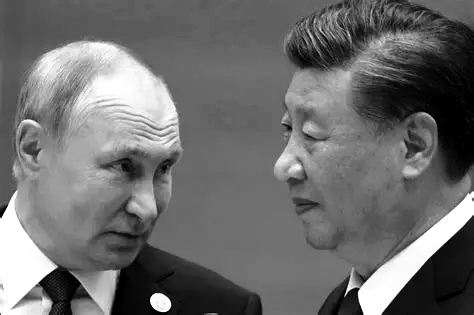
On 20 May 2026, Russian President Vladimir Putin and Chinese President Xi Jinping signed a Joint Declaration on the Establishment of a Multipolar World and a New Type of International Relations at the Great Hall of the People in Beijing, alongside approximately forty further cooperation documents and a 47-page joint statement on the comprehensive strategic partnership. The summit, Putin’s twenty-fifth visit to China and timed to coincide with the thirtieth anniversary of Sino-Russian strategic partnership, was framed in both governments’ official communications as a demonstration of deepening bilateral alignment against what both leaders described as American hegemony and the illegal expansion of military blocs, the latter a reference, unmistakable in context, to the American and Israeli airstrikes on Iran on 28 February 2026. Putin stated at the joint press conference that the two countries would “expand bilateral cooperation and actively engage in international forums where our teams are working closely together to build a strong foundation for a multipolar world.” Xi described the relationship as representing “the high level and uniqueness of China-Russia relations,” a formulation repeated in various inflections across the summit’s public communication architecture. Russian presidential aide Yuri Ushakov described the multipolarity declaration as a substantive policy document. Levada Centre polling subsequently showed that 79 percent of Russian respondents viewed the summit as a personal success for Putin.
The declaration itself is analytically notable more for what it omits than for what it contains. The multipolarity declaration carries no enforcement mechanism, no new institutional structure, no common funding architecture, no defined membership beyond the two signatories, and no timeline for any of its stated objectives. The joint statement on strengthening the partnership calls for “higher-quality political engagement” and both parties serving as “each other’s strategic pillar,” formulations whose rhetorical weight exceeds their operational content. The declaration’s principles include respect for the sovereignty and territorial integrity of all states, a formulation that, as Euromaidan Press noted, reads in the specific context of 2026 as a repudiation of Russian conduct in Ukraine, a contradiction that neither government addressed publicly. Putin left Beijing with signed declarations of enduring friendship and a stack of bilateral agreements, but without the one concrete deliverable that Moscow had been seeking for over a decade: a final commercial agreement on the Power of Siberia 2 natural gas pipeline.
The Power of Siberia 2 negotiation is the single most instructive piece of evidence available for assessing the actual character of the Russia-China relationship behind the summit’s ceremonial surface. The proposed 2,600-kilometre pipeline would carry fifty billion cubic metres of gas annually from Russia’s Yamal fields to China via Mongolia, complementing the existing Power of Siberia 1 system, which delivered approximately 38 billion cubic metres to China in 2025 under the original 30-year, $400 billion agreement concluded in 2014 with deliveries beginning in 2019. Gazprom and its Chinese counterpart CNPC signed a legally binding memorandum to advance construction in September 2025, which Russian officials characterised publicly as a major breakthrough. The May 2026 summit failed to produce a final agreement. Negotiations remained deadlocked over price: Beijing was holding out for gas priced at approximately 12 to 13 cents per cubic metre, in line with heavily subsidised Russian domestic rates, while Moscow sought pricing closer to the Power of Siberia 1 terms, which analysts estimate at roughly double that figure. China had not issued any matching statement when Gazprom announced the September 2025 memorandum. Beijing’s China National Petroleum Corporation stated as recently as November 2025 that Power of Siberia 2 was not a commercial priority. China’s 2026-2030 five-year plan, approved in March 2026, referenced advancing “preparatory work” for the central route of the China-Russia gas pipeline, a formulation sufficiently vague to constitute neither commitment nor rejection. When Kremlin spokesman Dmitry Peskov was pressed on the stalled negotiations after the summit, he described the impasse as “completely normal” because “each country defends its own interests,” a statement that is accurate as a description of what the data shows but rather undermines the premise of the strategic partnership being simultaneously proclaimed. The Oxford Institute for Energy Studies’s Michal Meidan told The Moscow Times that the Iran war’s energy supply disruptions might improve the pipeline’s political prospects but were “unlikely to fundamentally alter the balance of power in negotiations.”
That balance of power is the central structural fact of the Russia-China relationship that the multipolar declaration’s language consistently obscures. Bilateral trade between the two countries reached $244 billion in 2024 after years of strong expansion following the 2022 Western sanctions, more than double the $107.8 billion recorded in 2020 but then contracted by 6.9 percent in 2025 to $227.6 billion, the first annual decline since the Covid contraction of 2020. Russian exports to China fell 3.9 percent to $124.8 billion, driven by a 20 percent decline in Russian oil exports, a 33 percent fall in petroleum products, and a 27 percent drop in coal shipments, all reflecting falling global energy prices and China’s deliberate energy import diversification away from excessive Russian dependence. Chinese exports to Russia fell 10.4 percent to $103.3 billion, with passenger car exports to Russia dropping 44 percent and truck exports falling 67 percent. Russia’s oil and gas revenues in 2025 ran approximately 24 percent below the government’s own 2025 budget law assumptions, a fiscal pressure that falling Chinese demand for Russian raw materials directly contributed to generating. The structural character of the trade relationship is unambiguous: Russia supplies fossil fuels and raw materials, crude petroleum alone accounted for $61.66 billion of Russian exports to China in 2024, or nearly half of total Chinese imports from Russia, while China supplies manufactured goods, vehicles, machinery, and electronics. The asymmetry is colonial in its economic logic, a commodity exporter dependent on a single dominant buyer, and the buyer is under no obligation to mitigate it.
Chinese foreign direct investment in Russia reinforces this picture rather than complicating it. Chinese FDI flows to Russia reached approximately $628 million in 2023 according to Statista data, rising from $234 million in 2022, while Russia received approximately $19.7 billion or 24 percent of its total FDI, from Chinese entities in 2023 according to Moscow Times reporting, though investment levels fell in 2024. In the context of China’s total outbound direct investment of $174.38 billion in 2025 alone, the Russia figures represent marginal allocations consistent with transactional interest rather than strategic commitment. China’s $162.78 billion in ODI for 2024 flowed predominantly toward Africa, Southeast Asia, Latin America, and energy and minerals projects with clear commercial returns and limited secondary sanctions risk. Russia, whose FDI stock fell to a fifteen-year low by October 2024 as Western investors withdrew and Chinese firms showed caution about secondary sanctions exposure, receives from Beijing an allocation broadly comparable to or smaller than Chinese investment in Germany, France, and other EU economies with which China maintains far more straightforward commercial relationships. The joint aviation projects, high-speed rail initiatives, and bilateral technology transfer programmes periodically announced at previous Russia-China summits have produced limited operational progress, constrained by sanctions risk, technology export control regimes, and the straightforward reality that Chinese firms can access larger and more profitable markets at lower geopolitical risk.
Putin’s parallel efforts, concurrent with the Beijing summit, to restore trade and normalise relations with the United States through the Trump administration provide a further corrective to the partnership narrative. The summit with Xi occurred immediately after Trump’s own two-day visit to Beijing, at which the two countries failed to reach major deals, producing a curious sequence in which both the American president and the Russian president attended the same Chinese capital within the same fortnight. Russia has been actively pursuing back-channel communications with Washington throughout 2025 and 2026 to ease sanctions, restore commercial relationships, and find a Ukraine settlement framework that permits Russian economic reintegration with Western markets. Those parallel multi-vector foreign policy efforts are entirely rational from Moscow’s perspective: Russia’s sanctions-constrained economy would benefit substantially from restored Western market access, and the dependence on Chinese buyers for energy sales at discounted prices represents a strategic vulnerability that Moscow has strong incentives to reduce. They are not, however, the behaviour of a state that has firmly committed itself to the multipolar anti-hegemonic bloc the May 2026 declaration describes. As Zheng Runyu of the Centre for Russian Studies in Shanghai told the BBC during the summit: “Both China and Russia need each other, but Russia clearly needs China more than before at the global stage.” The asymmetry that formulation captures is the defining feature of the relationship.
The structural condition of BRICS provides the broader institutional context within which the multipolar declaration’s claims must be assessed. The BRICS Foreign Ministers’ Meeting held in New Delhi on 13 to 15 May 2026, under India’s 2026 chairmanship with the theme “Building for Resilience, Innovation, Cooperation and Sustainability,” concluded without a joint statement for the first time in the bloc’s history. India was compelled to issue a Chair’s Statement and Outcome Document in lieu of consensus, after deep divisions between Iran and the United Arab Emirates, both full BRICS members following the 2024 expansion championed by China, made unified positions impossible. Iranian Foreign Minister Abbas Araghchi urged BRICS members to condemn what he described as violations of international law by the United States and Israel. UAE Minister of State Khalifa bin Shaheen Al Marar rejected those remarks directly, accusing Iran of attempting to justify attacks against Gulf nations. India’s Prime Minister Modi had separately praised UAE restraint and described attacks against Gulf states as unacceptable, positioning New Delhi closer to Abu Dhabi than to Tehran on a question that Iran regarded as the meeting’s central issue. The Observer Research Foundation’s assessment characterised the episode as demonstrating “the limited political cohesion” of the expanded bloc. The contradiction that produced the deadlock was entirely foreseeable: China’s 2024 expansion decision brought both Iran and the UAE, longstanding regional adversaries whose 2026 positions on the American-Israeli Iran war were irreconcilably opposed, into the same forum simultaneously, without any mechanism for managing the resulting incompatibility.
The New Development Bank, BRICS’s financial institution established in 2014 as an alternative to Western-dominated development finance, has been largely immobilised by the same Western sanctions that restrict Russian economic activity, since providing lending to sanctioned entities would expose the bank itself to secondary sanctions from the United States and European Union. India has meanwhile concluded a substantial package of bilateral trade and investment agreements with the United States in 2025 and 2026, including manufacturing supply chain arrangements specifically designed to capture portions of the market being vacated by Chinese exporters under American tariff regimes. Brazil under President Lula has maintained significant economic engagement with both China and the United States while avoiding formal alignment with either. South Africa faces domestic political pressures from its governing coalition that limit the degree of anti-Western positioning available to the Ramaphosa government without fracturing its parliamentary majority. The Shanghai Cooperation Organisation, the other major institutional vehicle of the Russia-China partnership architecture, remains a consultative forum without enforcement capacity, binding dispute resolution mechanisms, or military integration comparable to NATO. The Kremlin’s own spokesman characterised the gas pipeline impasse as normal commercial negotiation between parties pursuing their own interests. That characterisation applies, with equal accuracy, to the entire BRICS enterprise.
The historical frame through which these developments are most accurately read is neither the Cold War bipolarity of the Soviet-American confrontation nor the liberal internationalist vision of converging institutions building a rules-based order, but rather the classical multipolar European balance of power that characterised the nineteenth century, a system in which several major powers pursued national interests through shifting coalitions, bilateral arrangements, and strategic hedging, with no permanent alliances and no dominant ideological commitment other than the maximisation of each power’s own position. The period from roughly 1991 to 2015 represented an anomalous unipolar moment in which American economic, military, and cultural dominance across all significant dimensions produced the illusion that the liberal international order was a permanent achievement rather than a specific historical configuration dependent on temporary material conditions. Those conditions have changed. China’s economic output now rivals and in some measures exceeds that of the United States. Russia has rebuilt military capabilities in strategic weapons and hypersonic missile technology that match or exceed American equivalents by several independent analyses. Cultural output, information ecosystems, and technological development no longer originate predominantly from the Atlantic world. What has replaced the unipolar moment is not a cohesive multipolar order governed by shared principles but rather a fragmentation of the structures, NATO, G7, BRICS, the WTO trading system, the dollar-denominated financial architecture that each embodied one version of international organisation, with each fragmenting under the pressure of the national interests that multipolarity simultaneously legitimises and inflames. Putin and Xi signed a declaration calling it a multipolar world. The evidence of May 2026 suggests that fragmentation is a more precise description of what is actually occurring and that the distinction matters considerably for anyone attempting to assess whether the institutions and partnerships being proclaimed are likely to produce the order their architects describe.
Authored By: Global GeoPolitics
If you prefer to make a one time donation in support of my work, you can do so by clicking any link below:
https://buymeacoffee.com/ggtv |
https://ko-fi.com/globalgeopolitics |
Bitcoin: 3NiK8BoRZnkwJSHZSekuXKFizGPopkE7ns
References
Chinese Ministry of Foreign Affairs, press statements following Russia-China talks, 20 May 2026 – Xi “30th anniversary,” “in-depth, friendly and fruitful talks”
Kremlin press service, Joint Declaration on the Establishment of a Multipolar World and a New Type of International Relations, 20 May 2026, published en.kremlin.ru
Kremlin press service, Joint Statement on Strengthening Comprehensive Strategic Partnership, 20 May 2026
Putin press conference, Beijing, 20 May 2026: “expand bilateral cooperation” and “build a strong foundation for a multipolar world” quotes
RT, “Putin-Xi Summit Delivers 40 Deals and Sweeping Joint Declarations,” 20 May 2026 – 40 documents; bilateral trade exceeded $240 billion last year; 20% expansion first four months 2026
Al Jazeera, “Multipolar World: What Xi and Putin Announced After Beijing Summit,” 20 May 2026 – Yuri Ushakov 47-page document; Putin 2022 “They need conflicts to retain their hegemony”
Moscow Times, “Putin and Xi Sign Multipolar World Declaration in Beijing,” 20 May 2026 – Levada Centre 79% figure
Euromaidan Press, “Putin and Xi Signed Multipolar World Declaration That Reads as Repudiation of What Russia Is Doing in Ukraine,” 21 May 2026
CNBC, “Three Key Takeaways from Putin’s Beijing Trip,” 21 May 2026 – Power of Siberia 2 stalled; “evolving geometry tilting in Beijing’s favour”; Zheng Runyu “Russia clearly needs China more”
CNBC, “Putin-Xi Talks Revive Stalled Russian Gas Pipeline as Iran War Rattles Energy Markets,” 20 May 2026 -September 2025 memorandum; pricing impasse; 12–13 cents figure; Kpler 92-day inventory
Moscow Times, “Has the Iran War Sealed the Fate of Power of Siberia 2?” 13 May 2026 – Michal Meidan/Oxford Institute for Energy Studies “unlikely to fundamentally alter the balance of power”; China five-year plan “preparatory work” language
UPI, “Xi, Putin Resurrect Siberia Gas Pipeline Talks but Fail to Reach Deal,” 20 May 2026 – Beijing 12–13 cents demand confirmed; Moscow Times sourcing
GlobalSecurity, “Putin Gets Show of Unity, But No New Pipeline Deal in Beijing Summit” – memorandum not binding final agreement; Al Jazeera: route understanding reached but no commercial terms
MERICS, China-Russia Dashboard: Facts and Figures on a Special Relationship – bilateral trade $244 billion 2024; 6.9% decline 2025 to $227.6 billion; structural asymmetry fossil fuels vs manufactured goods
New Kerala / Moscow Times, “Russia-China Trade Declines 7% in 2025” – Russian oil exports down 20%; cars down 44%; trucks down 67%; first contraction since 2020
OSW Warsaw, “China-Russia Trade in Early 2025: Fueling Moscow’s War Despite Headwinds” – 9.6% Chinese imports decline; Russia oil gas revenues 24% below budget law assumptions
Russia’s Pivot to Asia, “End of Easy Growth: Structural Lessons from the 2025 Russia-China Trade Decline” – $228.105 billion confirmed; excessive oil/gas reliance
Beyond the Horizon ISSG, “Russia-China Economic Relations” – 2024 trade surplus Russia; crude petroleum $61.66 billion / 48.58% of Chinese imports from Russia
Statista, China Outward FDI Flows to Russia 2023 – $628.79 million FDI 2023; $234 million 2022
Moscow Times / bne IntelliNews, “Russian FDI Falls to 15-Year Low,” February 2025 – $19.7 billion Chinese FDI share 2023; investment fell 2024; $235 billion total FDI stock by October 2024
China Briefing, China ODI Tracker 2026 – total Chinese ODI $174.38 billion 2025
BRICS Foreign Ministers’ Meeting, New Delhi, 13–15 May 2026 – no joint statement; Chair’s Statement issued by India
Modern Diplomacy, “BRICS Fails to Reach Joint Statement as Iran War Exposes Internal Divisions,” 15 May 2026 – Araghchi and Al Marar direct quotes; Modi UAE statement
The Wire, “Iran-UAE Deadlock Precludes Joint Statement at BRICS Foreign Ministers’ Meeting” – Chair’s Statement mechanism; 63-paragraph document analysis
Observer Research Foundation, “The BRICS Challenge and India’s Choices,” May 2026 – “limited political cohesion” assessment
NUS ISAS, “India’s BRICS Challenge: Managing a Divided Coalition” – expansion contradictions; September 2026 leaders’ summit at risk
Discovery Alert, “Iran War and Oil Crisis to Dominate 2026 BRICS Meet in India” – fragmentation scenario analysis
Vladimir Brovkin, From Lenin to Putin (cited for Russia-Europe cultural divergence analysis)


Leave a Reply