
Analysing South Africa’s March and March movement through the lens of regime change doctrine
South Africa occupies a unique position in the global order. It is the only country in the BRICS+ world where the colonial management class never actually left. Political power was transferred in 1994, but the land, the mines, the banks, the media, and the financial system remained under the control of the same families and corporate interests that had administered the country throughout the apartheid era. This structural reality distinguishes South Africa from every other major post-colonial state and shapes the nature of the political contestation currently unfolding within its borders.¹
The anti-immigrant wave sweeping South Africa must be understood not as a sociological phenomenon but as a forensic case, an arson requiring the identification of arsonists and their motives. The manufactured nature of the campaign is evident in its institutional architecture, its funding streams, its media amplification, and its precise alignment with broader geopolitical objectives. South Africa is one of the most ethnically diverse populations on earth, and xenophobia is normally a peculiarity of ethnically homogenous or closed societies. When one observes a fire burning in a place where a fire would not be expected to break out, the logical conclusion is that someone lit that fire.²
The chain of actors producing the xenophobia campaign extends from the Oppenheimer family’s think tank operations through AfriForum’s Washington lobbying apparatus, into the Democratic Alliance and Patriotic Alliance within the Government of National Unity, and down to Leon Schreiber’s Home Affairs ministry, which has been deporting tens of thousands of Africans annually under a program designated Operation New Broom. This is not a spontaneous uprising of popular sentiment but a coordinated campaign involving institutional actors with identifiable interests, funding sources, and political objectives.³
The Oppenheimer family, whose fortune was built on the De Beers diamond mining monopoly, has long maintained a network of think tanks and policy institutes that shape South African public discourse. The Brenthurst Foundation, established by the Oppenheimer family, produced a steady stream of publications framing migration as a threat to South African stability. The foundation’s work dovetails seamlessly with the lobbying operations of AfriForum, an organisation that has cultivated relationships with conservative political networks in the United States and Europe while maintaining a domestic presence that amplifies anti-immigrant sentiment through its Afrikaans-language media operations and community mobilisation.⁴
AfriForum’s Washington lobbying has been particularly consequential. The organisation has successfully positioned itself as a voice for South African minority interests within American conservative circles, building relationships that influence US policy toward South Africa. This lobbying network was instrumental in shaping the Trump administration’s executive order targeting South Africa, which suspended assistance programmes and elevated diplomatic pressure on the South African government. The order, which cited concerns about land expropriation and treatment of minority communities, aligned precisely with AfriForum’s advocacy priorities and provided Washington with leverage over Pretoria at a moment of strategic significance.⁵
The domestic political vehicle for the xenophobia campaign operates through multiple organisational structures. Operation Dudula, a grassroots movement that gained prominence through its anti-immigrant street actions, has functioned as the visible mobilisation arm of the campaign. Its street marches and confrontations with migrant communities have generated the media coverage that creates the impression of widespread popular sentiment against foreign nationals. Founded in Soweto in 2021 during the COVID-19 pandemic, Operation Dudula drew its name from the isiZulu word meaning “force out,” reflecting the movement’s stated goal of removing undocumented foreign nationals from communities. In the 2024 elections, the organisation received 3,855 votes, effectively nothing in electoral terms, yet it continued to receive wall-to-wall media coverage and a national platform to explain why foreigners had to be expelled from South Africa.⁶
Action SA, a political party positioned to the right of the Democratic Alliance, has provided electoral cover for anti-immigrant positions while maintaining sufficient distance from overtly white organisations to avoid the charge of racism. The Patriotic Alliance, a party with coloured and working-class support led by Gayton McKenzie, a former bank robber who built his political career on anti-immigrant populism, has brought anti-immigrant sentiment directly into the Government of National Unity itself. McKenzie has publicly stated that if he saw a South African, a Zimbabwean, and a Mozambican on oxygen, he would turn off the oxygen of the other patients so the South African could live, a statement that did not prevent his appointment to a cabinet ministry position.⁷
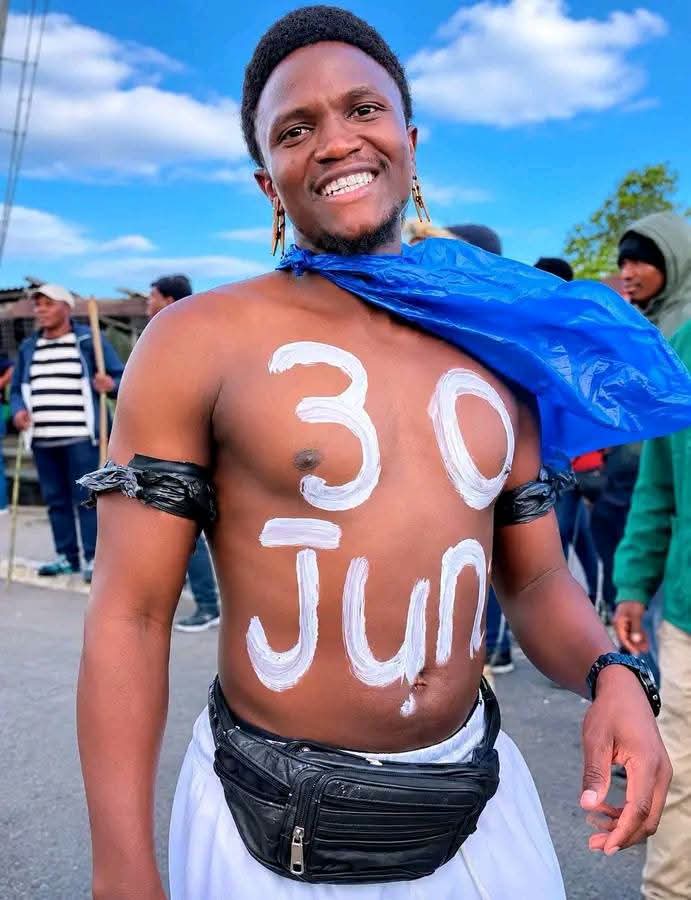
In 2025, a new movement called March and March emerged, founded by Jacinta Ngobese Zuma, a former radio anchor whose contract was not renewed. Within weeks of losing her job, she was leading national marches in multiple cities across South Africa, and within months her movement had become a major political force with full media amplification. Nobody builds a national movement from scratch within months merely by posting on social media; this requires coordination, organisation, and backing.⁸
Then there is the Zuma-linked mobilisation through the Zulu Royal Council and Amabutho Wesizwe under Nkosinathi Ndabandaba, activating networks of traditionalist and nationalist sentiment that overlap with but remain distinct from the party-political structures. These formations draw on the residual legitimacy of the Zulu monarchy and the historical grievances of military veterans’ associations marginalised since the transition. Their mobilisations create the appearance of broad-based African support for the anti-immigrant agenda, obscuring the extent to which the campaign has been engineered by institutional actors with deeper strategic objectives.⁹
The analytical framework advanced by Grant Arthur Gochin, a diplomat serving as Vice Dean of the Los Angeles Consular Corps and Emeritus Special Envoy for Diaspora Affairs for the African Union, provides a significant ideological backdrop to this strategic contestation. In January 2026, Gochin published an opinion piece in The Times of Israel titled “Africa Must Fragment, South Africa First,” which argued for the voluntary fragmentation of African nations through referendums to create independent ethno-cultural homelands.¹⁰ His proposal prioritises South Africa as the starting point for this process, suggesting separate homelands for groups such as the Zulu, Xhosa, Tswana, Sotho, Venda, Tsonga, and the Western Cape, while emphasising peaceful and consensual processes over coercion. Gochin frames fragmentation as a solution to the ongoing challenges of corruption and ethnic tensions in multi-ethnic states, drawing parallels to historical self-determination efforts.¹¹
The doctrinal architecture Gochin advances rests on a more general theory: borders lacking the consent of the peoples inside them possess no greater moral authority than the rights of those peoples to seek self-determination. He argues that the colonial borders established at the 1884-1885 Berlin Conference and subsequently entrenched by the Organisation of African Unity’s 1964 Cairo Declaration have produced states designed primarily for extraction rather than self-government, leading to chronic violence and governance failures.¹² Under this framework, fragmentation is not inherently problematic; rather, the problem is forcing incompatible populations to remain within unwanted political structures. Gochin relies heavily on the doctrine of remedial secession, arguing that peoples subjected to systematic oppression or denial of self-determination may legitimately pursue independence, and cites international legal principles and constitutional provisions in support.¹³
Gochin’s advocacy extends beyond South Africa to incorporate self-determination movements across the continent. In a subsequent article published in May 2026, “The Necessary Fragmentation of Africa,” he argued that Israel’s December 2025 recognition of Somaliland represents a historic challenge to the assumption that inherited African borders must remain unchanged, and that this should serve as a precedent for reconsidering existing state boundaries.¹⁴ He explicitly positions himself as an advisor on recognition doctrine and sovereignty to the Mthwakazi Republic Party, which seeks independence for the Matabeleland region of Zimbabwe, and argues that the Mthwakazi claims, supported by a petition to SADC containing 25,880 signatures, deserve serious consideration. His argument identifies Israel as a model of successful state-building, presenting the country as evidence that a stateless people can achieve sovereignty through institution-building, diplomacy, and national organisation.¹⁵
Critics of Gochin’s fragmentation doctrine contend that his proposals constitute a return to the worst kind of ethnic partitioning reminiscent of apartheid’s Bantustan policy, where millions were dumped into fragmented territories stripped of resources and dignity under the banner of self-determination. Opponents argue that his vision ignores the lived reality of South Africa’s tangled, interwoven population, the migrant workers, mixed families, and generations of people who have made provinces and cities their home across ethnic and regional lines. Critics also point to the disasters of Eritrea and South Sudan, where referendums that began with optimism ended in mass violence and state collapse, as evidence that fragmentation is not a proven path to stability.¹⁶ They accuse Gochin of the hypocrisy of arguing for border renegotiation in Africa while defending Israel’s territorial integrity, and of being a voice disconnected from the messy reality on the ground.¹⁷
The significance of Gochin’s framework to the anti-immigrant campaign lies not in its direct implementation, there is no evidence that Operation Dudula, the Democratic Alliance, or AfriForum are explicitly pursuing Gochin’s fragmentation agenda. Rather, it lies in the ideological alignment between his doctrine and the strategic objectives served by the manufactured xenophobia campaign. Gochin’s argument that Africa’s borders should be redrawn along ethnic lines, and that South Africa should be the first to fragment, provides a legitimising intellectual architecture for the broader project of preventing South Africa from becoming a genuinely indigenous power structure.¹⁸ The anti-immigrant campaign serves to weaken South Africa’s continental solidarity relationships and prevent it from anchoring an African pole in the multipolar world, thereby preserving the colonial management class’s control over the country’s economic structure. Both Gochin’s fragmentation doctrine and the manufactured xenophobia campaign ultimately serve the same strategic purpose: ensuring that South Africa does not emerge as a unified, independent power capable of setting the terms for those who operate within its sphere of influence.¹⁹
The deportation programme conducted by Home Affairs under Operation New Broom deserves particular attention. The programme has removed tens of thousands of Africans from South Africa annually, with the figures representing a systematic purge rather than routine immigration enforcement. The operation has been implemented by a ministry controlled by the Democratic Alliance, providing political cover for what amounts to African removal while the African National Congress remains formally in power. In the period since Leon Schreiber took the Home Affairs post, deportations have increased cumulatively, with more immigration enforcement operations conducted in a nine-month period than the previous administration conducted in five whole years.²⁰
This domestic configuration must be situated within the global transition from unipolarity to multipolarity. The international order that emerged after the Cold War, characterised by American global predominance, is giving way to a more distributed system in which multiple power centres compete for influence. The anational owners of global financialised capital, the transnational corporate and financial interests that operate across borders without primary loyalty to any nation-state, have not sought to stop this transition. They have accepted it. Their objective is to ensure they can manage it.²¹
The question these interests are asking is whether they can arrive at the post-transition multipolar world still holding the keys to its most critical continent. Africa represents the last open contest. Every other major region has been claimed by one or more of the emerging power centres. Europe is effectively partitioned between NATO and Russian spheres of influence. Asia is being contested, but the outlines of a Sino-Indian-American triangle are already visible. The Middle East is in flux, but the primary actors are identifiable. Africa alone remains substantially undetermined.²²
Within Africa, three countries have the mass to anchor continental spheres of influence: Egypt, Nigeria, and South Africa. Egypt is effectively untakeable, possessing demographic weight, geographic position, and a military establishment that ensures its independence from external control. Nigeria is under coordinated pressure, its internal divisions, religious conflicts, and economic vulnerabilities make it susceptible to fragmentation. South Africa, by contrast, is already under management. The colonial structure never left. It lost political power but retained economic control. The current campaign is about keeping it that way.²³
The anti-immigrant campaign serves three simultaneous objectives, each advancing this broader strategic purpose. The first objective is to redirect Black working-class anger away from the colonial structure that produced their poverty. South Africa’s economic inequality remains among the highest in the world, with the racial wealth gap largely unchanged since 1994. The ownership of land, mines, and productive assets remains concentrated in white hands. The banks remain controlled by the same institutions that administered apartheid-era finance. The media remains dominated by the same families and corporations. The anti-immigrant campaign provides a target for popular frustration that is not the actual structure of power. The migrant is an easier enemy than the mine owner, the banker, or the media baron.²⁴
The second objective is to sever South Africa’s solidarity relationships with the African countries it needs as partners in any genuinely independent future. South Africa’s position on the continent depends on relationships with its neighbours and with the broader African Union membership. Xenophobia makes these relationships unsustainable. A South Africa that is deporting African migrants, harassing African traders, and creating an atmosphere of hostility toward foreign nationals cannot be a credible partner in African integration. The campaign systematically undermines the relationships that would be essential to any project of genuine continental independence.²⁵
-General
The third objective is to justify a state enforcement apparatus that is doing the actual work of African removal on the ground. Operation New Broom is not rhetorical. It is a deportation programme that has removed tens of thousands of African citizens from South African territory. This programme, implemented by a Democratic Alliance ministry within an ANC-led government, creates a precedent for the systematic exclusion of African migrants that can be extended to other categories of African presence. The enforcement infrastructure being built through the anti-immigrant campaign, the data systems, the detention facilities, the legal frameworks, will remain in place regardless of the eventual political outcome.²⁶
This playbook is being run in parallel in the United States. The American version keeps poor Americans fighting poor migrants while the people who own the structure watch from behind their walls. In both countries, the anti-immigrant campaign serves to protect the underlying structure of wealth and power by providing a visible enemy that is not the actual enemy. The immigrant is the distraction, the target, the focus of popular anger. The billionaire who owns the media corporation, the bank, or the mining company is never mentioned.²⁷
The international dimension of this campaign extends beyond the American connection. From 2022 onward, the United States applied escalating pressure on South Africa. It started with the Ukraine issue: South Africa abstained from the UN vote condemning Russia’s invasion, which made America angry because it exposed some degree of autonomy. Then came the Lady R accusations, where the US ambassador publicly accused South Africa of supplying weapons to Russia through a ship docked at a South African naval base, accusations that were proved completely unfounded but served their purpose regardless. When South Africa hosted the BRICS Summit in 2023 and invited Putin, Washington went ballistic, with congressional pressure to remove South Africa from AGOA receiving bipartisan support.²⁸
South Africa filed a genocide case against Israel at the ICJ in December 2023. Over 200 US Congress members, bipartisan, immediately condemned it, and Israel’s foreign minister lobbied Washington to put sanctions on South Africa unless it withdrew the case. In February 2025, Trump signed an executive order halting US foreign aid to South Africa completely, accusing the country of government-sponsored race-based discrimination against poor white Afrikaners and directing the US to develop a plan to resettle them in America. The executive order cited the Expropriation Act, a land reform bill, as evidence of property confiscation, and the ICJ genocide case as evidence that South Africa had anti-Western foreign policy. It terminated $440 million in PEPFAR assistance, which had helped keep millions of South Africans alive through AIDS medication.²⁹
The language of Trump’s executive order is verbatim AfriForum lobbying language. Word for word, the same framing, the same narrative, the same false claims, because AfriForum has been putting that language directly into the ears of Republican senators, congresspeople, and Trump advisors for years. AfriForum’s campaign revolves around the re-authoring of the murders of white farmers as proof of a politically orchestrated campaign of ethnic cleansing, rather than as ordinary violent crime. The fact remains that South Africa has one of the highest murder rates in the world, and violent crime affects all South Africans, not mostly white people or farmers. AfriForum’s campaign is a classic racial hoax that centres around white people’s fears of liberated blacks in post-apartheid South Africa, expressed in a myth of white genocide that relies on anti-black stereotypes.³⁰
Then South Africa’s ambassador to the United States, Ibrahim Rasul, one of the country’s most distinguished diplomats, an anti-apartheid activist who spent time in prison under apartheid for his political activism, was expelled from the United States as persona non grata and sent home. All of this has been going on for quite some time, and the strategic logic behind it must be understood.³¹
The actual effect of the pressure is to increase the DA’s leverage inside the government. The ANC is in a coalition government now with the Democratic Alliance. The ANC believes, and everyone believes, that South Africa cannot afford to be removed from AGOA, that the PEPFAR programmes keep people alive, that Western foreign investment matters, and that international credit ratings agencies matter. All of those things are threatened by Western pressure and by Washington’s disapproval. The DA positions itself as the party that has the best relationship with the West, with Washington, the party that Western investors trust. The ANC, already weakened because it lost its majority, thinks it needs the DA in the coalition to signal credibility to Western financial institutions. This means the ANC cannot push back on Schreiber’s immigration agenda, which means the deportations will continue, which means the xenophobia campaign essentially gets state backing.³²
The external pressure protects the DA’s position inside the government and amplifies its leverage. The DA’s position inside the government converts the xenophobia campaign into state policy. State policy does the damage on the ground. The damage on the ground is that South Africa’s relationships with its African neighbours collapse precisely at the moment when South Africa absolutely needs continental solidarity as an alternative to Western economic dependence. By trying to preserve a relationship that South Africa does not need, the government is losing the relationships that it does need, at exactly the moment when it needs them the most.³³
The people being targeted by this campaign, Zimbabweans, Mozambicans, Nigerians, Somalis, Congolese, are not random foreigners. These are the children and grandchildren of the Liberation Alliance. The ANC’s entire armed struggle was conducted from exile in Zambia, Tanzania, Mozambique, and Zimbabwe. The frontline states sacrificed enormously to house, feed, train, and protect South African liberation fighters when the apartheid government bombed Mozambique and destabilised Zimbabwe. Those countries stood with the South African people against apartheid anyway. Now South Africa is turning away Zimbabwean pregnant women at its clinics, deporting Mozambicans, and South African politicians are calling Nigerians criminals. Every one of these ruptures is a diplomatic wound to South Africa, and every viral video of Africans being mistreated reinforces the narrative that South Africa is not for us.³⁴
South Africa’s ability to lead the continent, to be an anchor for Southern and Eastern Africa, to be the voice of the AU that countries would actually listen to, to be an institutional anchor for a genuinely African pole in the multipolar world, that ability depends entirely on South Africa being seen as African, not just geographically but politically. The xenophobia campaign is dismantling that credibility in real time, piece by piece.³⁵
South Africa’s pain is real. Unemployment exceeds 32%, youth unemployment tops 60%, and crime drives businesses out of old Central Business Districts in Johannesburg, Pretoria, and Durban. Black working-class people have every right to be furious because thirty years after so-called liberation, the land still has not been distributed, the mines are still not theirs, the banks are still not theirs. They live in Soweto in conditions that would never be acceptable in any Western country while just twenty minutes down the road in Sandton there is a place that looks like Manhattan. Their anger is legitimate, and their grievances are absolutely real. Someone is very carefully making sure that that anger does not get aimed at Sandton or at any rich enclave, making sure that it gets aimed at the Somali shop owner in Soweto, at the Zimbabwean nurse, at the Nigerian trader. Keep the poor fighting the poor while the people who own the structure watch from behind their walls.³⁶
South Africa’s unique position, the only country on the African continent where the colonial power never left, where the white minority population lost formal political control in 1994 but kept the land, the mines, the banks, the corporations, the financial markets, and the control over the media, makes it a strategic prize in the transition from unipolarity to multipolarity. The owners and controllers of global financialised capital have accepted the necessity of this transition. They are repositioning themselves, trying to lead it, moving their assets, networks, and influence into the new multipolar order to ensure that when the transition is complete, they remain in a position of importance. In China, they cannot do that; the Communist Party will not let them. In Russia, they cannot; Putin will not let them. In the Gulf, they can operate but under terms set by the ruling families. In most Global South economies, the private sector is under state authority, not the other way around. But in South Africa, they still have the pre-existing colonial architecture.³⁷
South Africa cannot be allowed to genuinely decolonise because if it did, if there was real land redistribution, real capital restructuring, real integration with the continent and with BRICS countries on terms set by South Africans and by the Global South, then South Africa would become like China or Russia. The anational capital would become a guest, not the host. An autonomous South Africa, with its industrial base, its ports, its resources, its financial institutions, its BRICS membership, and its relationship with the rest of the continent, would be a very powerful country, a continental hegemon that would set the terms for anyone who wants to operate in its sphere of influence.³⁸
The South African working class, when it looks up from fighting against the Zimbabwean immigrant and looks at the actual structure that produced its poverty, when it connects the man deporting African immigrants to the people stopping South Africans from owning their own country’s mines, when the continental solidarity that is being undermined by this campaign gets rebuilt, the people who are doing this know that this is coming. That is why they are moving so fast. That is why the deportations are accelerating, why the immigration legislation is being pushed through, why the campaign is intensifying even as there is backlash against South Africa online. They need to cut South Africa off, to alienate it, to estrange it from the rest of the continent, and they need to do it fast.³⁹
South Africans are not expelling Africans from South Africa. They are trying to expel South Africa from Africa.⁴⁰
Authored By: Global GeoPolitics
If you prefer to make a one time donation in support of my work, you can do so by clicking any link below:
https://buymeacoffee.com/ggtv |
https://ko-fi.com/globalgeopolitics |
Bitcoin: 3NiK8BoRZnkwJSHZSekuXKFizGPopkE7ns
References
- Bolsen, Shahid. “Who Set South Africa on Fire?” Middle Nation, YouTube Public address, 2026
- Bolsen, Shahid. “Who Set South Africa on Fire?” Middle Nation, YouTube Public address, 2026
- “Is xenophobia in South Africa risking investment?” Deutsche Welle, 23 June 2026.
- Majavu, Mandisi. “AfriForum’s Racial Hoax Shapes American Foreign Policy on South Africa.” Heinrich Böll Stiftung, 5 March 2026.
- “South African president slams Afrikaner lobby group’s White House visit.” Associated Press, 26 February 2025.
- “Is xenophobia in South Africa risking investment?” Deutsche Welle, 23 June 2026.
- “Is xenophobia in South Africa risking investment?” Deutsche Welle, 23 June 2026.
- “Africa: South Africa Unrest Grows As Migrants Become ‘Scapegoats’.” allAfrica.com, 5 June 2026.
- “Africa: South Africa Unrest Grows As Migrants Become ‘Scapegoats’.” allAfrica.com, 5 June 2026.
- Gochin, Grant Arthur. “Africa Must Fragment, South Africa First.” The Times of Israel, 28 January 2026.
- Gochin, Grant Arthur. “Africa Must Fragment, South Africa First.” The Times of Israel, 28 January 2026.
- Gochin, Grant Arthur. “Africa Must Fragment, South Africa First.” The Times of Israel, 28 January 2026.
- Gochin, Grant Arthur. “Africa Must Fragment, South Africa First.” The Times of Israel, 28 January 2026.
- Gochin, Grant Arthur. “The Necessary Fragmentation of Africa.” The Times of Israel, 17 May 2026.
- Gochin, Grant Arthur. “The Necessary Fragmentation of Africa.” The Times of Israel, 17 May 2026.
- “Direct Warning: When the foreigners are gone, who’s next?” GBC Ghana, 22 April 2026.
- “Direct Warning: When the foreigners are gone, who’s next?” GBC Ghana, 22 April 2026.
- Bolsen, Shahid. “Has Someone Set South Africa on Fire?” Public address, 2026.
- Bolsen, Shahid. “Who Set South Africa on Fire?” Middle Nation, YouTube Public address, 2026
- “Africa: South Africa Unrest Grows As Migrants Become ‘Scapegoats’.” allAfrica.com, 5 June 2026.
- Bolsen, Shahid. “Has Someone Set South Africa on Fire?” Public address, 2026.
- Bolsen, Shahid. “Who Set South Africa on Fire?” Middle Nation, YouTube Public address, 2026
- Bolsen, Shahid. ““Who Set South Africa on Fire?” Middle Nation, YouTube Public address, 2026
- February, Judith. “When burning becomes South Africa’s language of despair.” EWN, 15 October 2025.
- “Direct Warning: When the foreigners are gone, who’s next?” GBC Ghana, 22 April 2026.
- “Is xenophobia in South Africa risking investment?” Deutsche Welle, 23 June 2026.
- Bolsen, Shahid. “Who Set South Africa on Fire?” Middle Nation, YouTube Public address, 2026
- “Are South Africa and the United States reaching the end of their relationship?” BBC, 13 February 2025.
- “South African president slams Afrikaner lobby group’s White House visit.” Associated Press, 26 February 2025.
- Majavu, Mandisi. “AfriForum’s Racial Hoax Shapes American Foreign Policy on South Africa.” Heinrich Böll Stiftung, 5 March 2026.
- “South African president slams Afrikaner lobby group’s White House visit.” Associated Press, 26 February 2025.
- “Africa: South Africa Unrest Grows As Migrants Become ‘Scapegoats’.” allAfrica.com, 5 June 2026.
- Bolsen, Shahid. “Who Set South Africa on Fire?” Middle Nation, YouTube Public address, 2026
- “Direct Warning: When the foreigners are gone, who’s next?” GBC Ghana, 22 April 2026.
- Bolsen, Shahid. “Who Set South Africa on Fire?” Middle Nation, YouTube Public address, 2026
- February, Judith. “When burning becomes South Africa’s language of despair.” EWN, 15 October 2025.
- Bolsen, Shahid.“Who Set South Africa on Fire?” Middle Nation, YouTube Public address, 2026
- Bolsen, Shahid. “Who Set South Africa on Fire?” Middle Nation, YouTube Public address, 2026
- Bolsen, Shahid. “Who Set South Africa on Fire?” Middle Nation, YouTube Public address, 2026
- Bolsen, Shahid.“Who Set South Africa on Fire?” Middle Nation, YouTube Public address, 2026


Leave a comment