
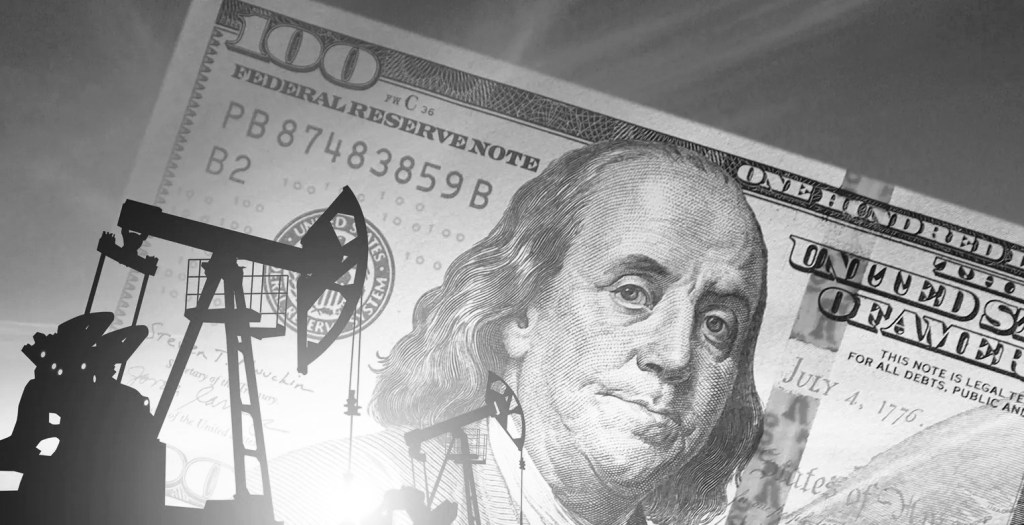
How Washington’s War on Iran Has Undermined the Financial Foundation of American Power
The interruption of crude oil trade through the Strait of Hormuz and the Red Sea has produced an outcome that Washington’s strategic planners almost certainly did not anticipate when they launched military operations against Iran in February 2026 (1). Throughout the entire month of July 2026, the United States received zero crude oil shipments from Saudi Arabia for the first time since 1985, a development that reflects not a temporary diplomatic spat but a fundamental rupture in the relationship that has sustained American financial power for more than five decades. The petrodollar system, which was formally established through the US-Saudi Arabia Joint Commission on Economic Cooperation signed in June 1974, mandated that the kingdom sell its oil in US dollars and recycle the resulting revenues into American Treasury instruments (9-12). This arrangement created permanent global demand for the dollar, enabled US banks to earn margins from trade between other nations, and allowed Washington to borrow cheaply while maintaining large trade deficits that would have been unsustainable under any other monetary regime.
The war with Iran has systematically dismantled each of the four pillars upon which the petrodollar system rests: the security relationship between the Gulf states and the United States, the pricing of oil in dollars, US demand for oil, and the holding of dollar-denominated assets by Middle Eastern nations (1). The failure of American air defence systems to protect Gulf allies from Iranian and Houthi attacks has rendered US security guarantees no longer credible. As Deutsche Bank FX strategist Mallika Sachdeva noted in a report to clients, the conflict “may expose further fault lines, by challenging the US security umbrella for Gulf infrastructure and the maritime security for global trade in oil” (1). The credibility of American military protection, which was the cornerstone of the 1974 agreement, has been fundamentally undermined by Washington’s inability to prevent its regional partners from becoming targets of Iranian retaliation.
The ongoing conflict has further diminished the necessity of pricing and settling oil transactions in US dollars. Oil serves as the lifeblood of the modern economy and constitutes the largest commodity by volume in global trade, and the practice of pricing and settling oil in dollars has played a pivotal role in establishing the dollar’s dominant position within global commerce (1). Approximately 80 per cent of global oil transactions remain denominated in US dollars, although this practice stems more from convention than from legal mandate (1). As the duration of the Strait of Hormuz obstruction has lengthened, the search for alternative trade routes and payment mechanisms has gradually risen to the top of various nations’ agendas, creating tributaries outside the established dollar-denominated system that could potentially swell into a mainstream parallel to the dollar (1).
The primary market for oil from the Gulf states is Asia, not the United States. As a result of the shale gas revolution, the United States has become an energy-self-sufficient nation and is no longer heavily dependent on oil imports from the Gulf states. In 2025, Saudi Arabia’s oil exports to China, Japan, and South Korea were respectively 4.96 times, 2.75 times, and 2.93 times the volume of its exports to the United States (1). Continuing to settle transactions in US dollars entails significant exchange rate and other risks while offering only quite limited returns, and Jim O’Neill, a former Goldman Sachs economist and former Minister at the UK Treasury, points out that the ongoing conflict could draw Gulf nations closer to China, India, and other major oil-importing nations (1). This structural shift in oil trade patterns, which predates the current conflict but has been dramatically accelerated by it, represents a long-term threat to the dollar’s privileged position in global commerce.
The signs of this shift are already visible in the behaviour of Asian importers. In recent days, several oil tankers have crossed the Strait of Hormuz, frequently sailing with their tracking systems switched off to avoid detection, following direct contacts between leaders in the purchasing countries and Iran (5). A Panama-flagged tanker carrying two million barrels of Kuwaiti and Emirati crude passed through the strait en route to Japan following discussions between Prime Minister Sanae Takaichi and Iranian President Masoud Pezeshkian. Iran has also struck arrangements with China, Iraq, and Pakistan to move oil and liquefied natural gas out of the Gulf (5). The precise structure of these bilateral and trilateral deals remains largely opaque, but it is highly likely that many are being settled outside the traditional oil trading system, either through currencies other than the US dollar or through informal barter arrangements (5).
The depletion of the US Strategic Petroleum Reserve compounds the financial vulnerability created by these shifts. The SPR fell by 6.1 million barrels to 298.7 million barrels in the week ending 9 August 2026, the lowest level since January 1983, according to data released by the Department of Energy (10). President Donald Trump ordered the release of 172 million barrels in March after Iran choked off oil exports through the Strait of Hormuz, triggering the largest disruption of crude oil supplies in history (10). The reserve, whose authorised storage capacity is 714 million barrels, has been drawn down to the point where its operational capability is at risk due to aging infrastructure, with more than a quarter of its inventory “not available for drawdown due to a combination of construction outages and cavern outages,” according to a May report from the Government Accountability Office (10). The minimum amount of oil needed to safely operate the SPR is approximately 70 million barrels, leaving Washington with little room for further releases to stabilise markets (10).
The adverse effects of excessive supply of dollars in the global markets, which are no longer demanded at prewar levels, will surface and worsen over time in the United States. Washington’s ability to use the military to reinforce the petrodollar is becoming complicated by the simultaneous demands of multiple theatres. General Alexus Grynkewich, the commander of US European Command, has privately warned Pentagon officials that American naval assets are becoming stretched too thin as the conflict with Iran continues, and that without another US Navy destroyer assigned to the region, commanders could eventually face a difficult choice between protecting American forces and continuing missile defence operations for Israel (4). Navy destroyers equipped with the Aegis combat system have become a central part of Israel’s missile defence, tracking incoming ballistic missiles and launching advanced interceptors such as SM-3 and SM-6 missiles (4). But these destroyers are also among America’s most valuable global military assets, needed in the Pacific to deter China, in Europe to reassure NATO allies, and in the Middle East to protect American bases and shipping routes. Every ship sent to defend Israel is a ship unavailable for another potential crisis (4).
The warning from Grynkewich highlights a difficult military calculation: modern warfare is consuming advanced weapons faster than they can be replaced, and even the US military must make choices when several crises demand the same resources (4). According to an analysis by the Center for Strategic and International Studies, American forces have consumed approximately 45 per cent of their Precision Strike Missiles, at least half of their THAAD interceptors, and around 50 per cent of their Patriot interceptors during the conflict (4). The US has also used roughly 30 per cent of its Tomahawk cruise missiles, over 20 per cent of its Joint Air-to-Surface Standoff Missiles, and around 20 per cent of its SM-3 and SM-6 interceptors (4). These depletion rates reveal the fundamental constraint on American military power: the United States is fighting a war of attrition against an adversary whose industrial capacity, while smaller, is being replenished through partnerships with China and Russia.
The broader strategic context in which these developments are occurring is one of American decline and multipolar emergence, and the United States is responding to this decline not by accepting it but by attempting to accelerate the destruction of the global order faster than it itself declines. Washington’s plan to steal Iran’s oil, which could have greatly boosted the petrodollar system and automatically added Iranians’ resources to the US Gross National Income, has failed after only a few months of conflict. The US has not only failed to gain Iranian resources but has also lost control of the flow of resources from Iraq and other dollar-priced crude due to the closure of the Strait of Hormuz and the blockade in the Red Sea (1). If the status quo persists for some time, the US financial empire will suffer a serious blow. Despite public statements made by Donald Trump showing bravado, forces in Washington are scrambling for other ways of propping up the dollar as an international payment system or preparing how to live with stricter access to low-cost borrowing at a time when US public debt has reached levels that would have been considered unimaginable a generation ago.
The financial implications of these developments for the United States are profound and likely irreversible. When the world’s largest repository of financial power has been built upon the assumption that oil would be priced and traded in dollars, and when that assumption is systematically undermined by a war intended to reinforce it, the consequences extend far beyond the oil market to the entire structure of global finance. The United States has borrowed cheaply for decades because there was permanent global demand for dollars to purchase oil. If that demand shifts toward other currencies or payment mechanisms, the cost of borrowing will rise, the value of the dollar will decline, and the living standards of Americans will fall. Donald Trump’s warning that losing the dollar as a “global standard” would be as disastrous as losing a war and could degrade the United States to third-world status appears increasingly prescient, as Washington finds itself on course to lose both the dollar’s status and the war, becoming a third-world country if his predictions are anything to go by. The dollar without a petro is a currency without a foundation, and the foundation is crumbling in real time.
Authored By: Global GeoPolitics
If you prefer to make a one time donation in support of my work, you can do so by clicking any link below:
https://donate.stripe.com/7sY8wPfvi864don0k3awo07 |
https://buymeacoffee.com/ggtv |
https://ko-fi.com/globalgeopolitics |
Bitcoin: 3NiK8BoRZnkwJSHZSekuXKFizGPopkE7ns
References
Chinese Academy of Social Sciences. 2026. “The Middle East Situation Shocks the ‘Petrodollar’.” Institute of World Economics and Politics, 2 June. Available at: http://en.iwep.org.cn/hot_topics/202606/t20260602_6003926.shtml [Accessed 13 August 2026].
CNBC. 2026. “Oil in U.S. Strategic Petroleum Reserve falls below 300 million barrels, lowest since 1983.” CNBC, 10 August. Available at: https://www.cnbc.com/2026/08/10/oil-in-strategic-petroleum-reserve-falls-below-300-million-barrels-lowest-since-1983.html [Accessed 13 August 2026].
Dawn. 2026. “US may not have enough forces to defend Israel against Iran.” Dawn, 2 August. Available at: https://epaper.dawn.com/DetailImage.php?StoryImage=02_08_2026_012_007 [Accessed 13 August 2026].
gCaptain. 2026. “The Strait of Hormuz Crisis Is Cracking the Petrodollar System.” gCaptain, 18 May. Available at: https://gcaptain.com/the-strait-of-hormuz-crisis-is-cracking-the-petrodollar-system/ [Accessed 13 August 2026].
Neftegaz.RU. 2026. “US Strategic Petroleum Reserve falls below 300 million barrels.” Neftegaz.RU, 12 August. Available at: https://neftegaz.ru/news/transport-and-storage/932639-zapasy-strategicheskogo-neftyanogo-rezerva-ssha-upali-nizhe-300-mln-barr-chem-eto-grozit-d-trampu/ [Accessed 13 August 2026].
News18. 2026. “Top US Commander Warns Military Lacks Resources To Keep Defending Israel From Missiles.” News18, 2 August. Available at: https://www.news18.com/amp/world/top-us-commander-warns-military-lacks-resources-to-keep-defending-israel-from-missiles-report-ws-l-10247625.html [Accessed 13 August 2026].
New York Times. 1974. “U.S. Will Supply Arms And Factories to Saudis.” The New York Times, 6 April. Available at: http://www.nytimes.com/1974/04/06/archives/us-will-supply-arms-and-factories-to-saudis.html [Accessed 13 August 2026].
Office of the Historian, US Department of State. 1974. “Memorandum From the Chairman of the Interdepartmental Working Group (Sisco) to the President’s Assistant for National Security Affairs (Kissinger).” Foreign Relations of the United States, 1969–1976, Volume E–9, Part 2. Available at: https://history.state.gov/historicaldocuments/frus1969-76ve09p2/d19 [Accessed 13 August 2026].
US Department of the Treasury. 2002. “Saudi Arabian Economic Dialogue.” Press Release, 5 March. Available at: https://home.treasury.gov/news/press-releases/po1074 [Accessed 13 August 2026.


Leave a comment