
How military exhaustion, fiscal collapse, and internal political disintegration have transformed the conflict into a question of settlement terms rather than battlefield victory
Editorial Analysis | September 2026
Ukraine is losing this war, and the trajectory of defeat, while gradual, appears increasingly inexorable. This is not a judgment upon the Ukrainian soldiers nor upon the population but rather, an assessment grounded in the unforgiving calculus of manpower, industrial capacity, national wealth, and the strategic patience of the adversary. The proposition that Ukraine might achieve a military victory over Russia, which enjoyed brief currency among some Western commentators following the 2023 counter-offensive, has been decisively refuted by the material realities of the battlefield, the defence-industrial balance, and the fiscal arithmetic of continued war. Owen Matthews’ recent analysis in The Spectator crystallises a conclusion that has become increasingly unavoidable among serious strategic observers: Russia is winning, not through spectacular manoeuvre warfare but through the remorseless application of attritional logic across multiple domains. Ukrainian forces face critical shortages of air defence interceptors, artillery ammunition, and, most crucially, manpower, while the Russian defence industry has adapted to sanctions and expanded production. Simultaneously, Ukraine confronts a looming fiscal crisis, with a €26 billion budget deficit projected despite a €90 billion EU loan, and a corruption scandal that has engulfed senior officials, including the prosecutor general. Western policy, characterised by open-ended promises of support without corresponding delivery, has created the worst possible outcome: a protracted war of attrition that Ukraine cannot sustain and Russia is prepared to finance. The emerging settlement, if it comes, will likely reflect Putin’s terms, leaving Europe to confront the strategic consequences of its own irresolution.
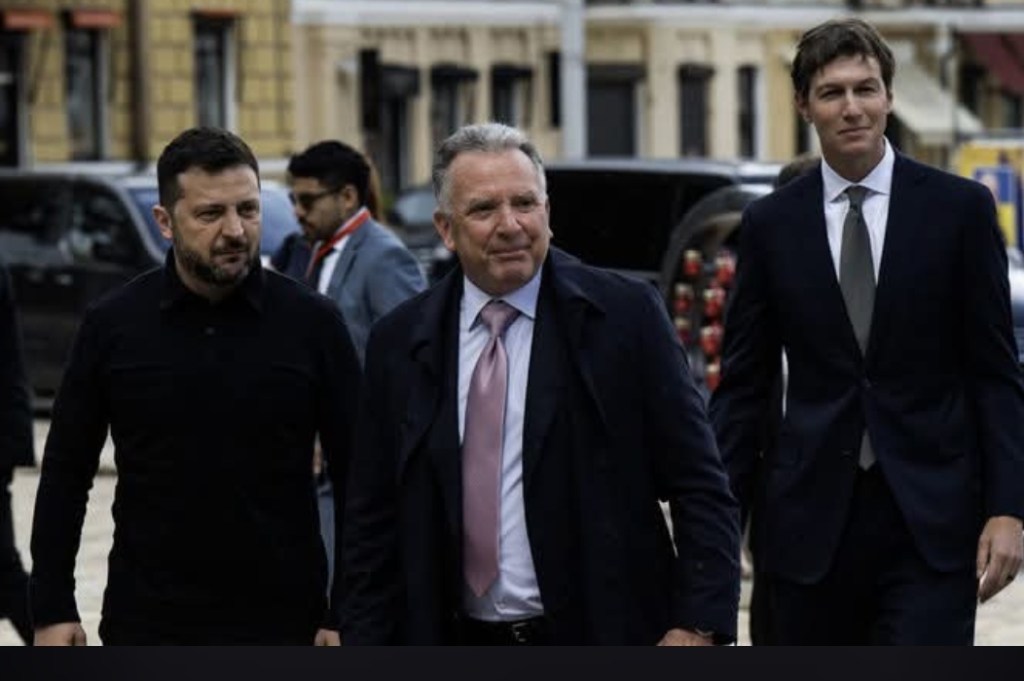
Vladimir Putin has not modified his war aims in any material respect since February 2022, and he remains determined to continue the conflict until those aims are achieved. The recent shuttle diplomacy conducted by Jared Kushner and Steve Witkoff, which took them from Moscow to Kyiv in early September 2026, did not produce any new American peace plan, despite Donald Trump’s prior suggestion that such an initiative existed. Instead, Putin reiterated his familiar demands: the complete liberation of Donbas, the demilitarisation of Ukraine, and the removal of what the Kremlin continues to describe, in language that Western commentators find distasteful but which reflects genuine ideological conviction, as the Nazi influence in Kyiv. The American envoys, for their part, emphasised the commercial opportunities that peace would bring, with Kushner describing war as a negative-sum proposition and peace as a positive-sum one. This framing, whatever its merits in a business school seminar, fundamentally misreads the Kremlin’s strategic calculus. Putin did not launch this invasion to preserve Russian prosperity; he launched it because he believed that Ukraine’s Western orientation constituted an existential threat to Russian security, and that belief has only hardened over four years of conflict.
The tactical situation on the ground offers little cause for Ukrainian optimism. Russia has deployed a new generation of jet-powered Geran attack drones, significantly faster and more accurate than the Iranian Shahed models that previously constituted the backbone of its long-range strike campaign. Moscow is also developing at least two new low-cost cruise missile systems and has stepped up production of air and ground-launched ballistic missiles. The defensive challenge facing Ukraine was summarised with brutal honesty by Serhii Beskrestnov, Zelensky’s advisor on defence technologies, who told the Guardian that attack has become stronger than defence and that Ukraine will not be able to obtain enough interceptors to fully protect its cities this winter. This assessment reflects a broader technological trend, the offensive systems of modern warfare, particularly in the realm of long-range precision strike, have gained a decisive advantage over defensive countermeasures, and Ukraine lacks the industrial base to reverse that asymmetry.
The strategic dimension of Ukraine’s predicament is even more troubling than the tactical one. Western sanctions, which were supposed to cripple the Russian economy and force a change in Kremlin behaviour, have fundamentally failed. This failure stems partly from the West’s own self-preserving insistence on maintaining energy supplies, with European countries continuing to purchase Russian oil and gas even as they imposed sanctions on other sectors. The Biden administration’s determination to keep global oil prices down, and Europe’s continued hunger for Russian liquefied natural gas, have provided Moscow with the revenue necessary to sustain its war effort. Rather than being crushed by sanctions or paralysed by Ukrainian long-range strikes, Russia’s defence industrial capacity has expanded. The cost to the Russian economy is staggering, with a record 45 per cent of government revenues now devoted to war production, but that is a price Putin is demonstrably willing to pay.
Ukrainian strikes have inflicted damage, causing a fuel crisis and destroying approximately 20 per cent of the warehousing capacity of Wildberries, Russia’s largest online retailer. But these attacks have not altered the fundamental trajectory of the conflict. The Russian defence industry has adapted to sanctions through a combination of domestic production, parallel imports, and the continued acquisition of critical components from non-Western suppliers. Ukraine’s Defence Intelligence has identified 155 Russian companies producing components for weapons systems, including ballistic missiles, many of which are not subject to any sanctions imposed by Ukraine’s partner countries. The sanctions regime, in other words, has been porous enough to allow Russia to sustain and even expand its military production while imposing sufficient costs to ensure that the Kremlin has no incentive to compromise.
Europe’s strategic failures have compounded Ukraine’s difficulties in three critical respects. First, European nations have talked up sanctions while simultaneously sending far more money to Moscow in payment for energy than they have provided to Kyiv in military aid. Second, fear of escalation has prevented European states from supplying offensive missiles, such as Germany’s Taurus system, for use against targets inside Russia, and has limited the sharing of Patriot missile defence batteries. Third, and most seriously, European leaders have refused to countenance serious engagement with the Kremlin on peace talks, clinging instead to the fantasy that encouraging Ukraine to fight indefinitely will somehow produce victory. The repeated pledges, made by Joe Biden and successive British prime ministers, to support Ukraine for as long as it takes, were fundamentally misleading. These open-ended promises convinced an already paranoid Kremlin that it was fighting the collective West, while that same West continued to purchase Russian energy and transport it on European ships.
The fiscal crisis now confronting Ukraine represents the point at which these Western promises will finally collide with reality. Prime Minister Serhii Koretsky has announced that Kyiv has already spent most of its 2026 defence funds and faces a looming €26 billion budget black hole. This deficit persists despite a recent €90 billion loan from the European Union, which represented the high-water mark of what Brussels was realistically capable of raising. The loan, while providing a crucial financial lifeline, has only delayed the inevitable reckoning. Ukraine’s budget foresees a massive deficit of approximately 1.9 trillion hryvnias, or $43 billion, in 2026, roughly one-fifth of economic output, and economists believe this estimate significantly underestimates the true cost of the war. As Ukraine enters what promises to be the hardest winter of the conflict, it faces critical shortages not only of Patriot missiles and frontline personnel but of the financial resources necessary to continue the fight.
The domestic political situation in Ukraine has deteriorated in parallel with the military and fiscal outlook. A year of relentless corruption scandals has seriously eroded public trust in Zelensky’s administration. The most recent scandal, involving the arrest of a deputy prosecutor general on charges of protecting online scam centres, has been followed by the resignation of Prosecutor General Ruslan Kravchenko amid allegations that his office was involved in large-scale money laundering. A dozen senior members of Zelensky’s team are now in jail, under investigation, or have fled abroad. A shoot-out in a Kyiv street between rival factions of Ukraine’s SBU and HUR intelligence services has led many Ukrainians to fear that their country is sliding back to the gangsterism of the 1990s.
An investigation by the New York Times found that Ukraine’s military procurement system has suffered from serious fraud, waste, and mismanagement throughout the war. Secret audits reportedly show that in 2024 alone, approximately $1.2 billion was lost through overpayments and corrupt contracts. The political consequences have been severe. An August 2026 poll by the Ukrainian research institute SOCIS found that a majority of Ukrainians consider corruption a more serious threat to their state than Russia, and that nearly 57 per cent of Ukrainians blame Zelensky for the prevalence of corruption, nearly double the proportion in a similar poll from April 2025. The same poll projected that three different rivals would defeat Zelensky in a second-round election, each by a landslide margin of approximately two-to-one. Zelensky’s personal trust rating has fallen to 18 per cent, with 37 per cent of Ukrainians expressing no trust in him at all.
The political fractures within Ukraine are not merely a domestic concern; they have direct implications for the conduct of the war and the prospects for any negotiated settlement. A leadership transition in Kyiv, whether through elections or internal political manoeuvring, would introduce additional uncertainty at precisely the moment when Ukraine needs strategic clarity. The emergence of alternative political forces, including those advocating for negotiations with Russia, suggests that the consensus around continued resistance may be fraying. Alice Weidel of Germany’s AfD, recently victorious in elections in Saxony, has called for an open channel to Russia in order to reach a peaceful solution. Iuliia Mendel, Zelensky’s press secretary from 2019 to 2021, has argued that new forces are rising which represent the only chance for a peaceful Europe, adding that more weapons will not save Ukraine and never have.
The Russian domestic context provides an important counterpoint to Ukraine’s political turmoil. Putin has presided over a transformation of the Russian economy, industry, and social mood over nearly two decades. The Soviet Union was a society characterised by elite cynicism and popular apathy, a place where the educated classes despised their own country and believed with near-religious conviction that the West represented the promised land, and where the broader population shrugged indifferently when the state collapsed. Putin did not design the reforms that have transformed Russian agriculture from the world’s largest grain importer into one of the largest exporters, or that have created a generation of new homeowners. But he has presided over these changes, and Russians give him the credit. The Russian political system is not a democracy but a soft authoritarian setup, gradually hardening, in which elites arrange to renew their formal power through constrained elections. The upcoming Duma elections, scheduled for 18-20 September 2026, will be managed affairs-. But the Russian state has performed reasonably well over the past quarter-century by the standards of its own population, and that performance provides Putin with a reservoir of legitimacy that Western analysts consistently underestimate.
The prospects for a negotiated settlement remain poor, and every successive peace offer has been worse for Kyiv than the last. Putin’s clear intention, as Matthews and others have observed, is to inflict a brutal final punishment on Ukrainian cities before finally settling the war on his own terms, perhaps in 2027. The Trump administration has long abandoned any pretence of backing a full Ukrainian victory, and it will be for historians to determine whether the decision to pull American aid and arms became a self-fulfilling prophecy. Europe continues to talk the talk of support but has no concrete plan to help or save Ukraine from the Kremlin’s fury, much less to crush the Russian economy or break Putin’s will.
The strategic implications of Ukraine’s defeat, if it comes in the form that now seems probable, will extend far beyond the borders of Ukraine itself. A Russian victory, however defined, would represent a fundamental challenge to the post-Cold War security order in Europe and would raise profound questions about the credibility of Western security guarantees. The Baltic states, Poland, and other frontline NATO members would face a renewed sense of vulnerability, and the alliance would be forced to confront the uncomfortable reality that its conventional deterrent may no longer be credible. The global order, already strained by great-power competition, would shift further toward a multipolar configuration in which Russian revisionism is accommodated rather than contained.
Yet the alternative to defeat, the continued prosecution of a war that Ukraine cannot win and the West cannot finance, is scarcely more attractive. The prolongation of the conflict would mean more Ukrainian deaths, more destruction of Ukrainian cities, and a deeper entrenchment of Russian control over occupied territories. It would also mean continued strain on Western economies, continued volatility in global energy and food markets, and continued erosion of the international rules-based order. The argument for negotiations, however distasteful they may be, rests on the proposition that a bad peace is preferable to a good war when the war is unwinnable.
The settlement that eventually emerges, if one does, will likely reflect the realities of the battlefield rather than the aspirations of any party. Russia will retain control over the territories it has occupied, including Crimea and much of Donbas. Ukraine will be required to accept some form of neutrality, renouncing NATO membership while potentially retaining the right to join the European Union. The security guarantees that Ukraine receives will be limited, probably falling short of the Article 5 commitment that NATO membership would provide. And the West will be forced to accept that Russia, in its irritatingly Russian form, is here to stay.
This is not a happy outcome, and it is not one that anyone who sympathises with Ukraine’s plight can contemplate without unease. But it is the outcome toward which the material realities of the conflict have been pointing for years. The sooner Western leaders recognise this reality, the sooner they can begin the difficult work of constructing a settlement that saves what can be saved of the Ukrainian state and gives it a new lease on life, including the right to join the European Union. The alternative, a continued war of attrition that Ukraine cannot win and the West cannot sustain, serves no one’s interests except those who profit from chaos and destruction.
Tags: Ukraine war, Russia, Vladimir Putin, Volodymyr Zelensky, military attrition, sanctions, European Union, defence industrial capacity, corruption, peace negotiations, Jared Kushner, Steve Witkoff, Owen Matthews, geopolitics, strategic analysis
Authored By: Global GeoPolitics
Thank you for visiting. This is a reader-supported publication. If you believe journalism should serve the public, not the powerful, and you’re in a position to help, becoming a PAID SUBSCRIBER truly makes a difference. Alternatively you can support by way of a cup of coffee:
https://buymeacoffee.com/ggtv |
https://ko-fi.com/globalgeopolitics |
Bitcoin: 3NiK8BoRZnkwJSHZSekuXKFizGPopkE7ns
Reference
BBC News. (2026) Ukraine’s chief prosecutor resigns over call centre corruption scandal. Available at: https://www.bbc.com/news/articles/c780nlgyd79o (Accessed: 9 September 2026).
ERR News. (2026) Expert: Russia’s war-driven economic boom is running out of steam. Available at: https://news.err.ee/1609450997/expert-russia-s-war-driven-economic-boom-is-running-out-of-steam (Accessed: 9 September 2026).
Institute for the Study of War. (2026) Russian Offensive Campaign Assessment, September 5, 2026. Available at: https://understandingwar.org/backgrounder/russian-offensive-campaign-assessment-september-5-2026 (Accessed: 9 September 2026).
KSE Institute. (2026) Fiscal Digest: Ukraine Budget Analysis, First Half 2026. Kyiv: Kyiv School of Economics. Available at:
(Accessed: 9 September 2026).
Kyiv Independent. (2026) Ukraine’s prosecutor general resigns amid major corruption scandal. Available at: https://kyivindependent.com/breaking-ukraines-prosecutor-general-resigns-amid-major-corruption-scandal (Accessed: 9 September 2026).
Kyiv International Institute of Sociology. (2026) Corruption and War Threat Perceptions in Ukraine. Kyiv: KIIS. Available at:
(Accessed: 9 September 2026).
Matthews, O. (2026) ‘Ukraine is losing the war’, The Spectator, 8 September. Available at:
(Accessed: 9 September 2026).
Ministry of Finance of Ukraine. (2026) Parliament ratifies Ukraine Support Loan Agreement. Available at:
(Accessed: 9 September 2026).
NV.ua. (2026) Witkoff and Kushner’s Kyiv visit was no breakthrough on ending Russia’s war. Available at: https://english.nv.ua/nation/visit-by-witkoff-and-kushner-to-kyiv-is-unlikely-to-have-hastened-end-of-russia-s-war-50639254.html (Accessed: 9 September 2026).
RT News. (2026) Zelensky would lose presidential election – poll. Available at: https://rtnewsru.com/russia/643963-ukraine-zelensky-election-zaluzhny (Accessed: 9 September 2026).
SOCIS. (2026) Politicians rating: Presidential elections in Ukraine. Available at: https://mail.ukraine-elections.com.ua/en/socopros/opinion_poll_show/2257 (Accessed: 9 September 2026).
TASS. (2026) Refusal to negotiate with Russia West’s biggest mistake – UK columnist. Available at: https://tass.com/world/2026-09-08 (Accessed: 9 September 2026).-
The Moscow Times. (2026) Russia’s economy grew by just 0.3% in first half of 2026. Available at:
(Accessed: 9 September 2026).
The Wall Street Journal. (2026) The Island Paradise That Is a Secret Hub for Russian Sanctions Evasion. Available at: https://www.wsj.com/world/the-island-paradise-that-is-a-secret-hub-for-russian-sanctions-evasion (Accessed: 9 September 2026).
Ukrainska Pravda. (2026) Defence Intelligence reveals 155 Russian companies producing components for Russian weapons. Available at:
(Accessed: 9 September 2026).
United24 Media. (2026) Leaked Files Reveal How Russian Missile Giant Uses Front Brands to Bypass Sanctions. Available at:
(Accessed: 9 September 2026).-
US News & World Report. (2026) Analysis-EU Loan Throws Ukraine a Lifeline but More Help Needed for War. Available at:
(Accessed: 9 September 2026).
Ukrinform. (2026) War update: 181 clashes on front line, 90 invaders neutralized in Pokrovsk sector. Available at:
(Accessed: 9 September 2026).


Leave a Reply