
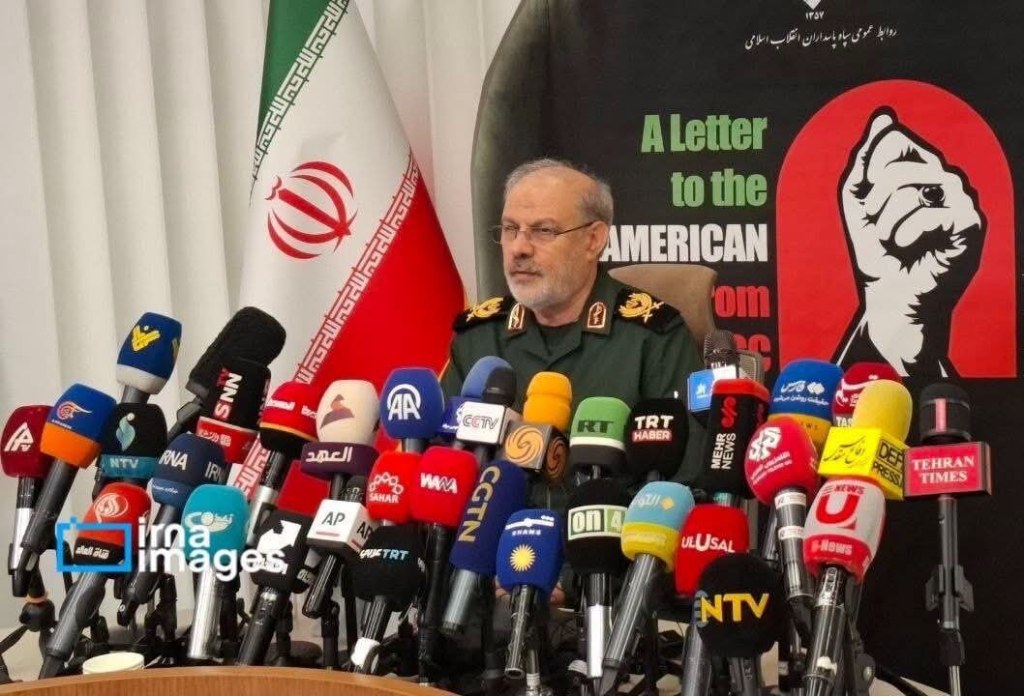
How Iran is trying to build a constituency for peace inside the United States and why its claims about war, poverty, and presidential wealth deserve to be read
Editorial Analysis |September 2026
The decision by Brigadier General Mohebbi of the Iranian Revolutionary Guard to address the American people directly rather than communicating through diplomatic channels represents a recognition that the principal obstacle to a negotiated settlement is not the American state apparatus but the ideological framework that sustains popular acquiescence to imperial policy. The letter opens with the assertion that it is neither propaganda nor a media stunt but a communication grounded in logic and sincerity, and this rhetorical framing establishes a distinction between the letter’s content and the propaganda that the American public is accustomed to receiving from its own government. The claim that the American people do not understand Iranian logic because they have been systematically misinformed by their own institutions constitutes an intervention in the informational environment that shapes public opinion, and it seeks to create a space for alternative narratives that the corporate media ecosystem marginalises. The letter’s direct address to the American people constitutes a form of strategic communication that treats the population of the imperial core as a potential constituency for peace rather than an undifferentiated adversary, and this approach recognises that popular pressure within the United States has historically been a constraint on imperial overreach.
The empirical claims that the letter advances regarding American military expenditure and its domestic consequences are substantiated by official statistics and independent research. The United States maintains approximately eight hundred military bases across more than eighty countries, and its annual defence budget exceeds one trillion dollars when all categories of military expenditure are included. The claim that Iran’s defence budget is less than one per cent of American military spending is broadly accurate, with Iranian official defence expenditure at approximately ten billion dollars compared to the American total of over one trillion. The assertion that the United States left eighty-five billion dollars worth of weaponry in Afghanistan is supported by reports from the Special Inspector General for Afghanistan Reconstruction, which documented the abandonment of vast quantities of military equipment during the withdrawal of 2021. The claim that thirty-nine million Americans live below the poverty line is consistent with data from the United States Census Bureau, which reported approximately thirty-seven to thirty-nine million people living below the official poverty threshold in recent years.
The letter’s focus on presidential enrichment and the disparity between elite wealth and popular immiseration constitutes an intervention in the class politics of American foreign policy. The claim that Donald Trump’s wealth increased from two point three billion dollars to six point seven billion dollars in less than two years of his term is a reference to the fusion of political power and private accumulation that characterises the contemporary American state, and it invites the American public to consider whose interests their government actually serves. The assertion that the president is bombing Iran while American soldiers die on foreign battlefields and American families struggle to pay rent and afford healthcare reframes the war as a project of elite enrichment rather than national defence. The juxtaposition of presidential wealth with the closure of hospitals, the shortage of teachers, and the rising cost of fuel creates a narrative of class conflict in which the American state functions as an instrument of the wealthy against the working population. The letter’s implicit argument is that the American people have more in common with the Iranian people than with their own government, and this argument challenges the nationalist framework that presents foreign policy as a matter of national interest rather than class interest.
The nuclear question receives sustained attention in the letter because the claim that Iran is pursuing nuclear weapons has been the principal justification for American hostility over the past quarter century. The assertion that the warning of an Iranian nuclear bomb within weeks has been repeated for twenty-five years without the predicted outcome constitutes an indictment of the credibility of American intelligence assessments and the motives of those who propagate them. The letter’s observation that the United States withdrew from the Joint Comprehensive Plan of Action in 2018, an agreement that imposed stringent limits on Iranian nuclear activities under international supervision, raises the question of why the United States would abandon a diplomatic framework that purportedly addressed its stated concerns. The assertion that Iranian nuclear facilities were under continuous IAEA supervision and that the United States bombed them anyway suggests that the concern about nuclear weapons was not genuine but served as a pretext for military aggression. The reference to the assassination of a supreme Shiite authority who issued a fatwa prohibiting nuclear weapons invokes the religious dimension of Iranian policy, and it argues that the Islamic Republic possesses a theological commitment to non-proliferation that predates and supersedes any political calculation. The comparison with Israel, which possesses an estimated eighty to four hundred nuclear warheads and has never signed the Nuclear Non-Proliferation Treaty, exposes the double standard that governs American non-proliferation policy in the Middle East.
The letter’s characterisation of American foreign policy as a seventy-year project of war and expansion is supported by the historical record of interventions in Korea, Vietnam, Cambodia, Laos, Iraq, Afghanistan, Libya, Syria, Yemen, and numerous other countries. The claim that Iran has never invaded another country and that the United States has invaded the countries surrounding Iran is factually accurate and historically verifiable. The assertion that the United States is now stoking tensions in Greenland and Cuba indicates an awareness of the geopolitical context that extends beyond the immediate confrontation with Iran. The letter’s argument that the American problem is not Iran’s nuclear programme but Iran’s oil resources, its independence, and its refusal to accept subordinate status constitutes a materialist analysis that identifies the economic and strategic interests that drive American hostility. The claim that the United States wants to turn Iran back into a colony resonates with the historical experience of the 1953 coup that overthrew the democratically elected government of Mohammad Mosaddegh and installed the Shah as an instrument of Western control over Iranian oil.
The military dimension of the letter serves to establish Iranian capabilities and resolve as a deterrent to further American escalation. The claim that Iran has designed and mass-produced new defensive weapons and will deploy them if the confrontation takes a different form constitutes a warning that the costs of continued aggression will increase rather than decrease. The assertion that the United States has failed in every previous attempt to force Iranian submission, including the forty-day war, economic warfare, naval blockade, aerial blockade, and support for armed groups at Iran’s borders, establishes a narrative of Iranian resilience that challenges the assumption of American invincibility. The reference to Trump’s admission that he armed groups at Iran’s borders constitutes a direct citation of American culpability for internal instability, and it undermines the American claim to be acting in defence of freedom and democracy. The letter’s declaration that Iran is prepared for any new scenario and that the enemy will fail again serves to establish deterrence by communicating that the costs of escalation will be borne by the aggressor rather than the target.
The letter’s conclusion that the only way out for the United States is to admit defeat and withdraw from the region constitutes a demand for the recognition of a new balance of power in the Middle East. The formulation that the war ends not with Iranian surrender but with American retreat, not with Iranian kneeling but with American defeat, and not with Iranian abandonment of resistance but with American abandonment of aggression inverts the conventional narrative of American power and establishes Iran as the party that has prevailed. The assertion that this is how the war ends and that the United States has no choice but to accept these terms constitutes a claim about the material realities of the conflict that renders continued American presence not merely morally indefensible but strategically untenable. The letter’s tone is not one of supplication or negotiation but of confident assertion, and this confidence is grounded in the observable failures of American policy in Afghanistan, Iraq, Yemen, and the broader region.
The class analysis of the letter’s address to the American people must identify the divisions within American society that the letter seeks to exploit and the class interests that the letter aligns with. The letter’s appeal is directed not to the American ruling class but to the working population that bears the costs of imperial war through taxation, military service, and the diversion of resources from domestic needs to military expenditure. The claim that thirty-nine million Americans live in poverty and that millions are homeless constitutes an indictment of the distributional consequences of American capitalism and the prioritisation of military spending over social provision. The assertion that the president’s wealth tripled while ordinary Americans struggle to afford rent and healthcare constitutes a claim about class warfare within the United States that resonates with materialist analysis of the capitalist state as an instrument of class rule. The letter’s implicit argument is that the American working class and the Iranian people share a common adversary in the imperial state apparatus and the financial oligarchy that controls it, and this argument seeks to build a constituency for peace by appealing to the material interests of those who bear the costs of war.
The strategic logic of the letter derives from its recognition that the American state cannot be defeated on the battlefield in a conventional sense but can be defeated politically if the contradictions between its stated objectives and its actual outcomes are exposed to sufficient scrutiny. The letter’s detailed recitation of American failures in Afghanistan, Yemen, and the confrontation with Iran serves to undermine the credibility of the American military and the political class that commands it. The assertion that the United States spends eleven times more on defence than Iran and still cannot achieve its objectives raises fundamental questions about the relationship between military expenditure and strategic success. The letter’s observation that American cities are going bankrupt, hospitals are closing, and schools lack teachers while the defence budget exceeds one trillion dollars invites the American public to consider whether the empire serves their interests or the interests of a narrow elite. The letter’s function is to accelerate the legitimacy crisis of the American state by making visible the contradiction between the rhetoric of freedom and democracy and the reality of perpetual war, domestic immiseration, and elite enrichment.
The Iranian letter represents a sophisticated intervention in the ideological struggle over American foreign policy, and its effectiveness depends on the willingness of the American public to engage with arguments that the corporate media ecosystem systematically marginalises. The letter’s claims are supported by verifiable evidence, and its analysis of the class dimensions of American militarism resonates with materialist scholarship on the political economy of empire. The letter’s strategic function is to create a constituency for peace within the United States by appealing to the material interests of those who bear the costs of war and by exposing the contradictions between the stated purposes and actual outcomes of American policy. The letter does not manufacture controversy or invent facts, and it does not engage in the rhetorical excess that characterises much of the propaganda that circulates in both countries. The letter’s power derives from its truthfulness and from its willingness to address the American people as rational agents capable of recognising their own interests. The final assessment is that the letter constitutes a significant escalation in the informational dimension of the conflict, and its impact will depend on whether the American public is prepared to confront the reality that its own government has deceived it for seventy years. The indicators that would confirm or undermine the letter’s effectiveness are observable, including shifts in public opinion toward the war, the emergence of congressional opposition to further escalation, and the willingness of the corporate media to engage with the letter’s substantive claims.
Authored By: Global GeoPolitics
Thank you for visiting. This is a reader-supported publication. If you believe journalism should serve the public, not the powerful, and you’re in a position to help, becoming a PAID SUBSCRIBER truly makes a difference. Alternatively you can support by way of a cup of coffee:
https://buymeacoffee.com/ggtv |
https://ko-fi.com/globalgeopolitics |
Bitcoin: 3NiK8BoRZnkwJSHZSekuXKFizGPopkE7ns
References
Iranian Revolutionary Guard (2026) Open Letter to the American People. Tehran: Press Conference, 28 September. (Document provided by user; not publicly available online).
Afghanistan Papers (2019) Lessons from the U.S. War in Afghanistan. Washington, DC: Special Inspector General for Afghanistan Reconstruction. Available at: https://www.sigar.mil/pdf/lessonslearned/SIGAR-21-46-LL.pdf (Accessed: 29 September 2026).
Bureau of Labor Statistics (2026) Consumer Price Index: Energy. Washington, DC: U.S. Department of Labor. Available at: https://www.bls.gov/cpi/ (Accessed: 29 September 2026).
Central Intelligence Agency (1953) Report on the Overthrow of Mohammad Mosaddegh. Declassified Documents. Washington, DC: CIA. Available at: https://nsarchive2.gwu.edu/NSAEBB/NSAEBB28/ (Accessed: 29 September 2026).
Congressional Research Service (2026) U.S. Military Spending: Overview and Trends. Washington, DC: CRS. Available at: https://crsreports.congress.gov/product/pdf/IF/IF10511 (Accessed: 29 September 2026).
Department of Defense (2024) Base Structure Report Fiscal Year 2024. Washington, DC: DoD. Available at: https://www.acq.osd.mil/eie/Downloads/BSI/Base%20Structure%20Report%20FY24.pdf (Accessed: 29 September 2026).
Federation of American Scientists (2026) Status of World Nuclear Forces. Washington, DC: FAS. Available at: https://fas.org/issues/nuclear-weapons/status-world-nuclear-forces/ (Accessed: 29 September 2026).
Forbes (2026) Donald Trump Profile. New York: Forbes. Available at: https://www.forbes.com/profile/donald-trump/ (Accessed: 29 September 2026).
International Atomic Energy Agency (2025) Verification and Monitoring in the Islamic Republic of Iran in Light of United Nations Security Council Resolution 2231. Vienna: IAEA. Available at: https://www.iaea.org/newscenter/focus/iran (Accessed: 29 September 2026).
Press TV (2026) ‘IRGC spokesman writes open letter to American people’, Press TV, 28 September. Available at:
(Accessed: 29 September 2026). [Note: Specific article URL unavailable; general news site provided.]
Reuters (2012) ‘Iran’s Khamenei issues fatwa banning nuclear weapons’, Reuters, 21 September. Available at: https://www.reuters.com/article/us-iran-nuclear-fatwa-idUSBRE88L0R620120921 (Accessed: 29 September 2026).
SIPRI (2026) Trends in World Military Expenditure, 2025. Stockholm: Stockholm International Peace Research Institute. Available at: https://www.sipri.org/publications/2026/sipri-fact-sheets/trends-world-military-expenditure-2025 (Accessed: 29 September 2026).
United Nations (1970) Treaty on the Non-Proliferation of Nuclear Weapons. New York: UN. Available at: https://www.un.org/disarmament/wmd/nuclear/npt/ (Accessed: 29 September 2026).
United States Census Bureau (2025) Income and Poverty in the United States: 2024. Washington, DC: U.S. Census Bureau. Available at: https://www.census.gov/library/publications/2025/demo/p60-282.html (Accessed: 29 September 2026).
United States Department of Energy (2026) Diesel Fuel Price Data. Washington, DC: EIA. Available at: https://www.eia.gov/petroleum/gasdiesel/ (Accessed: 29 September 2026).
United States Department of Housing and Urban Development (2024) The 2024 Annual Homeless Assessment Report (AHAR) to Congress. Washington, DC: HUD. Available at: https://www.huduser.gov/portal/datasets/ahar/2024-ahar-part-1-pit-estimates-of-homelessness-in-the-us.html (Accessed: 29 September 2026).
White House (2018) ‘Remarks by President Trump on the Joint Comprehensive Plan of Action’, 8 May. Available at: https://trumpwhitehouse.archives.gov/briefings-statements/remarks-president-trump-joint-comprehensive-plan-action/ (Accessed: 29 September 2026).


Leave a comment