
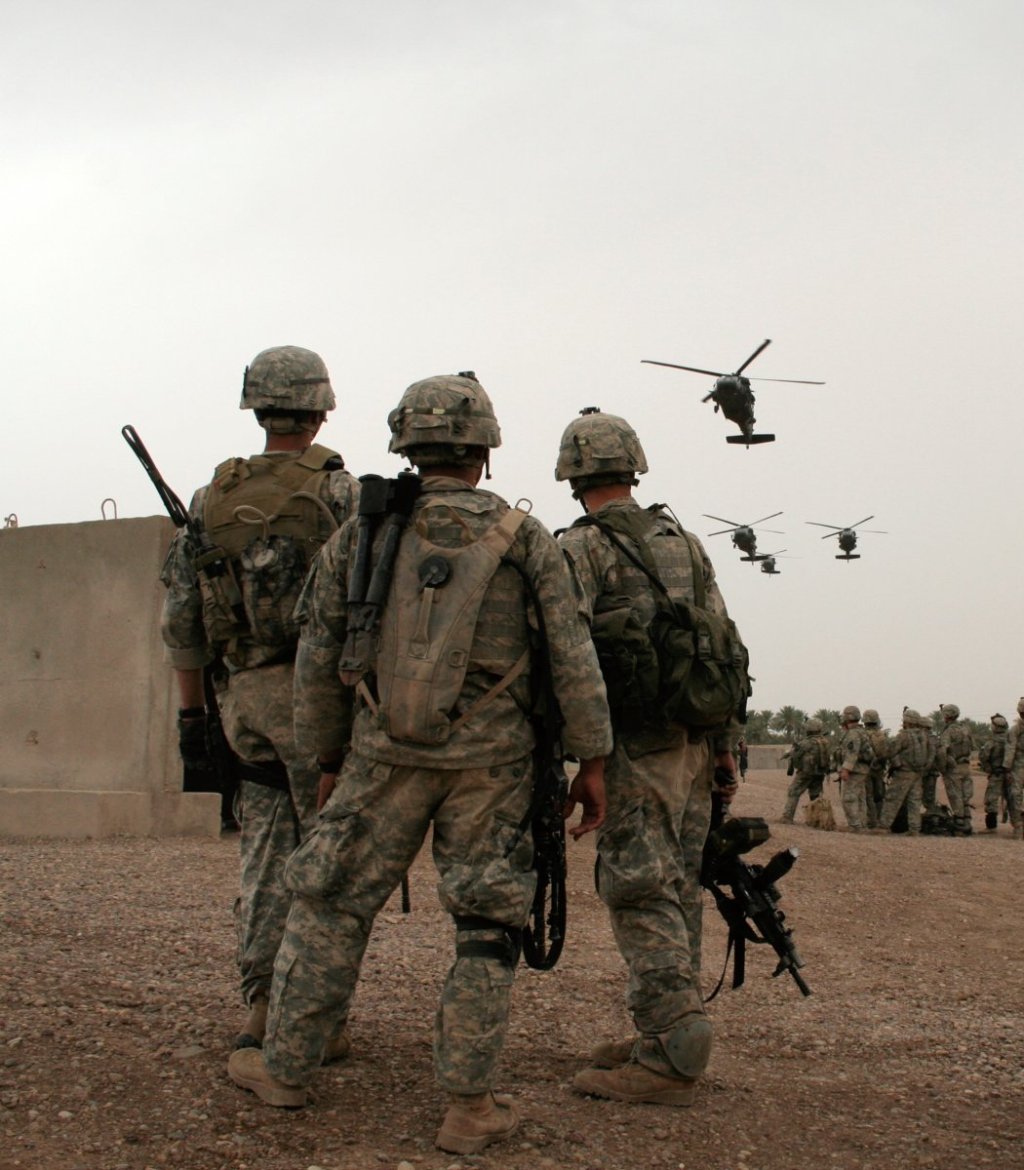
Trump’s withdrawal announcement is not a triumph but a retreat, and the mechanisms of American power that remain reveal both the limits of military occupation and the durability of financial and intelligence coercion mechanisms
Editorial Analysis | October 2026
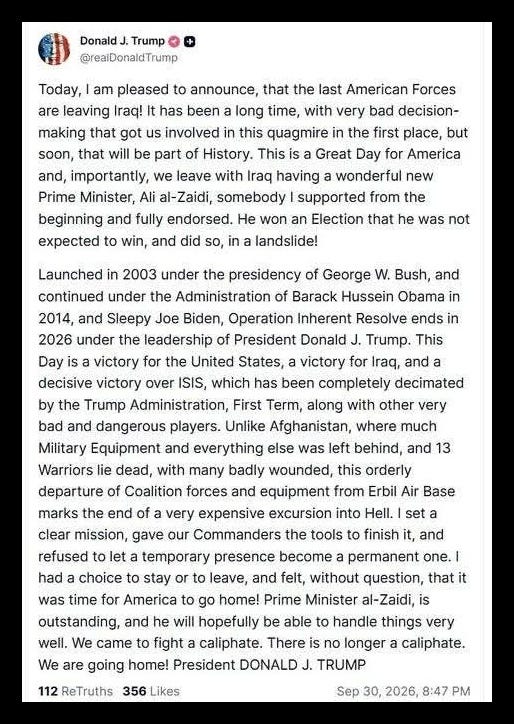
The claim by Donald Trump that the withdrawal of American troops from Iraq constitutes a victory, delivered via social media on 30 September 2026, represents one of the more audacious attempts at narrative manipulation in the recent history of American foreign policy. Trump praised a prime minister he claimed to have supported from the beginning, asserted that ISIS had been decimated, and declared that the troops were coming home. Each of these claims is contradicted by documented evidence, and the reality that the American presence in Iraq is ending not because its objectives have been achieved but because its position has become untenable is apparent from the timeline of events that preceded the announcement. The withdrawal is not the culmination of a successful campaign but the termination of a failed occupation, and the mechanisms that produced this outcome reveal the limits of American military power when confronted with determined resistance and the erosion of legal and moral legitimacy.
The historical context of the American invasion of Iraq in 2003 is essential to understanding the present moment, because the arguments that were used to justify the invasion were fabrications that the American political class and its allies in the corporate media manufactured in order to create a pretext for war. The claim that Iraq possessed weapons of mass destruction was contradicted by the inspectors who were sent to find them and by the subsequent acknowledgment that no such weapons existed. The consequences of the invasion include hundreds of thousands of Iraqi deaths, the destruction of the Iraqi state, the dissolution of the Iraqi army, the empowerment of sectarian warlords, and the emergence of the conditions that produced the Islamic State. The role of the American-run Camp Bucca in the emergence of ISIS is documented by former inmates and by intelligence analysts who have acknowledged that the prison became a recruiting ground for the organisation that would later claim a caliphate. The claim that ISIS emerged from nowhere is a fabrication that conceals the responsibility of the American invasion for creating the conditions in which the organisation could grow.
The decision by the Iraqi parliament in January 2020 to expel American troops, following the assassination of Qasem Soleimani and Abu Mahdi al-Muhandis on Iraqi soil, was an exercise of sovereignty that the United States refused to accept. The assassination was a violation of Iraqi sovereignty and of the terms under which American forces were present in the country, and the parliamentary vote to expel those forces was the legal and constitutional response to an act of aggression. The American refusal to comply with the vote demonstrated that the American presence in Iraq was not based on consent but on coercion, and the subsequent years of American occupation were conducted in defiance of the expressed will of the Iraqi people and their representatives. The resistance that emerged during this period was not terrorism but legitimate resistance to an illegal occupation, and the attacks on American bases were the military expression of a political demand that the American government refused to acknowledge.
The military campaign conducted by the Iraqi resistance between 2024 and 2026 involved hundreds of attacks on American bases, including Ain al-Asad in Anbar province, Erbil in the Kurdistan region, and al-Tanf on the Syrian border. The American military possessed the most advanced weapons systems in the world, and it proved incapable of protecting its own personnel from drones and rockets that the resistance produced and deployed. The American response to these attacks was ineffective, and the inability of the American military to defend its own bases exposed the fallacy that technological superiority guarantees strategic success. The resistance demonstrated that a determined adversary with limited resources can impose costs that the superior power cannot absorb indefinitely, and the American decision to withdraw was the recognition that the occupation had become strategically unsustainable.
The claim that the withdrawal is orderly and that no equipment was left behind is contradicted by the reality that American forces are leaving because they are being forced out rather than because they have achieved their objectives. The comparison with Afghanistan, where the American withdrawal was accompanied by scenes of chaos and desperation, is intended to reassure the American public that the Iraq withdrawal is different, but the underlying reality is the same: the United States is leaving because it cannot stay. The American military will retain troops in Erbil and other Kurdish areas, it will keep advisers and intelligence assets, and it will maintain the ability to strike targets in Iraq when it perceives its interests to be threatened. The withdrawal is therefore a repositioning rather than a genuine departure, and the permanent infrastructure of American influence will remain even as the uniformed personnel are reduced.
The claim that ISIS has been decimated is contradicted by the group’s continued operations in Iraq, including three attacks in a single day in September 2026 in Kirkuk, Anbar, and Salah al-Din. The Islamic State remains active in the deserts of Anbar, the mountains of Hamrin, and the border regions with Syria, and the claim that the caliphate has been destroyed does not correspond to the reality that the organisation continues to conduct attacks and to maintain a presence in the ungoverned spaces of the region. The American claim that ISIS was a caliphate was always an exaggeration that served to justify the continued American presence, and the organisation was never a state in the sense that the term implies. The American strategy of using the ISIS threat to justify its presence in Iraq was always a pretext, and the withdrawal is occurring because the pretext has lost its effectiveness.
The political dynamics of the withdrawal include the role of Ali al-Zaidi, the Iraqi prime minister whom Trump praised for his cooperation. Al-Zaidi is the man who closed Iraqi airports to Iranian flights, enforced the American aviation blockade on Iran, and blocked Iranian pilgrims from reaching the holy cities of Najaf and Karbala. His compliance with American demands to strangle a neighbouring Muslim country demonstrates that he is not a sovereign leader but an American client, and Trump’s praise is a confession that al-Zaidi did what he was told to do. The same al-Zaidi who now waves the flag of Iraqi sovereignty is the man who allowed the United States to dictate which planes could land in his country, and his government is under pressure from the Iraqi parliament, the marja’iyya, and the Iraqi people for betraying the country’s religious and national obligations. The American withdrawal is therefore not a defeat for al-Zaidi but a relief, because it removes the most visible symbol of his subordination to a foreign power.
The mechanisms of American influence that will persist after the withdrawal of uniformed personnel include the dollar system, through which Iraqi oil revenues are held at the Federal Reserve Bank of New York, and the Kurdish proxies, including the Kurdistan Democratic Party and the Patriotic Union of Kurdistan, who will continue to receive American funding and weapons. The intelligence networks operated by the Central Intelligence Agency and the National Security Agency will continue to function, and the military contractors who replace uniformed troops will maintain the infrastructure of American power without the visibility that uniformed personnel attract. The American ability to dictate Iraqi policy will weaken as the resistance demonstrates that it can impose costs on the American presence, but the structural mechanisms of American influence will not disappear, and the Iraqi government will continue to face pressure from Washington through the financial system that holds its oil revenues.
The class analysis of the American presence in Iraq must identify the specific interests that benefit from the occupation and those that bear its costs. The American defence contractors who received hundreds of billions of dollars for their services in Iraq are among the principal beneficiaries of the war, and their shareholders and executives constitute a fraction of the capitalist class whose wealth depends on the perpetuation of American military engagement. The American oil companies that sought access to Iraqi oil reserves have benefited from the influence that the American military presence provided, and the financial institutions that hold Iraqi oil revenues have earned fees and interest from the arrangement. The Iraqi comprador class, including politicians, bureaucrats, and businessmen who collaborated with the American occupation, has benefited from the opportunities that the occupation created, and the Kurdish elite has benefited from the autonomy and resources that the American alliance provided. The Iraqi working class and the Iraqi poor have borne the costs of the occupation through death, displacement, poverty, and the destruction of their country’s infrastructure, and they have received nothing but suffering in return.
The game-theoretic analysis of the American withdrawal reveals the strategic interactions between the United States, the Iraqi government, the resistance, and the regional powers including Iran, Syria, and the Gulf states. The United States sought to maintain its presence in Iraq in order to project power into the region, to pressure Iran and Syria, and to control the flow of oil. The resistance sought to expel the American forces through military pressure and political mobilisation, and it succeeded because the costs of the American presence exceeded the benefits. The Iraqi government sought to balance between its dependence on the United States and its need for legitimacy among its own population, and the withdrawal allows it to claim sovereignty while preserving the mechanisms of American influence that benefit the elite. Iran sought to expand its influence in Iraq and to reduce the American presence, and the withdrawal represents a victory for Iranian interests even if the mechanisms of American influence persist. The game is not zero-sum because the withdrawal creates opportunities for cooperation among the regional powers even as it reduces the American presence, and the outcome reflects the balance of power among the actors rather than the preferences of any single player.
The broader significance of the American withdrawal from Iraq lies in its demonstration that even the most powerful military in history can be defeated when it cannot protect its own forces and when its legal and moral standing collapses. The resistance demonstrated that determination and sacrifice can overcome technological superiority, and the lesson is available to other populations that are subjected to American occupation and domination. The American empire is not invincible, and the withdrawal from Iraq is a milestone in the erosion of American global power that will be studied by historians as a turning point in the decline of the American century. The mechanisms of American influence that persist are real, and they will continue to constrain Iraqi sovereignty for the foreseeable future, but the trajectory is toward the reduction of American power and the expansion of the space for genuine independence. The Iraqi people have demonstrated that resistance works, and their example is an inspiration to all who seek to escape the grip of American domination.
Authored By: Global GeoPolitics
Thank you for visiting. This is a reader-supported publication. If you believe journalism should serve the public, not the powerful, and you’re in a position to help, becoming a PAID SUBSCRIBER truly makes a difference. Alternatively you can support by way of a cup of coffee:
https://buymeacoffee.com/ggtv |
https://ko-fi.com/globalgeopolitics |
Bitcoin: 3NiK8BoRZnkwJSHZSekuXKFizGPopkE7ns
References
Al Jazeera (2026) ‘Iraqi resistance claims attacks on US bases’, Al Jazeera, 15 September. Available at: https://www.aljazeera.com/news/2026/9/15/iraqi-resistance-claims-attacks-on-us-bases (Accessed: 2 October 2026).
Associated Press (2026) ‘ISIS claims three attacks in Iraq in one day’, Associated Press, 20 September. Available at: https://apnews.com/article/iraq-isis-attacks-2026 (Accessed: 2 October 2026).
BBC News (2020) ‘Iraq parliament votes to expel US troops’, BBC News, 5 January. Available at: https://www.bbc.com/news/world-middle-east-51005615 (Accessed: 2 October 2026).
Congressional Research Service (2024) Iraq: U.S. Military Presence and Security Cooperation. Washington, DC: CRS. Available at:
(Accessed: 2 October 2026).
Council on Foreign Relations (2024) The U.S. War in Iraq: Timeline. New York: CFR. Available at: https://www.cfr.org/timeline/us-war-iraq (Accessed: 2 October 2026).
Federal Reserve Bank of New York (2026) Iraqi Oil Revenue Holdings. New York: FRBNY. Available at:
(Accessed: 2 October 2026).
Reuters (2026) ‘Trump announces withdrawal of US troops from Iraq’, Reuters, 30 September. Available at: https://www.reuters.com/world/middle-east/trump-announces-withdrawal-us-troops-iraq-2026-09-30/ (Accessed: 2 October 2026).
Reuters (2026) ‘Iraqi PM al-Zaidi praised by Trump for cooperation’, Reuters, 30 September. Available at: https://www.reuters.com/world/middle-east/iraqi-pm-al-zaidi-praised-trump-cooperation-2026-09-30/ (Accessed: 2 October 2026).
Special Inspector General for Iraq Reconstruction (2013) Learning from Iraq. Washington, DC: SIGIR. Available at:
(Accessed: 2 October 2026).
United States Department of Defense (2026) Operation Inherent Resolve: Mission Update. Washington, DC: DoD. Available at:
(Accessed: 2 October 2026).
United States Department of the Treasury (2026) Iraq Sanctions and Financial Restrictions. Washington, DC: Treasury. Available at:
(Accessed: 2 October 2026).


Leave a comment