

From the Hague to Beijing, from Moscow to Paris, the world is dismantling its dependence on American software, hardware, and payment systems, and the weaponisation of these platforms has made the transition irreversible
Editorial Analysis | October 2026
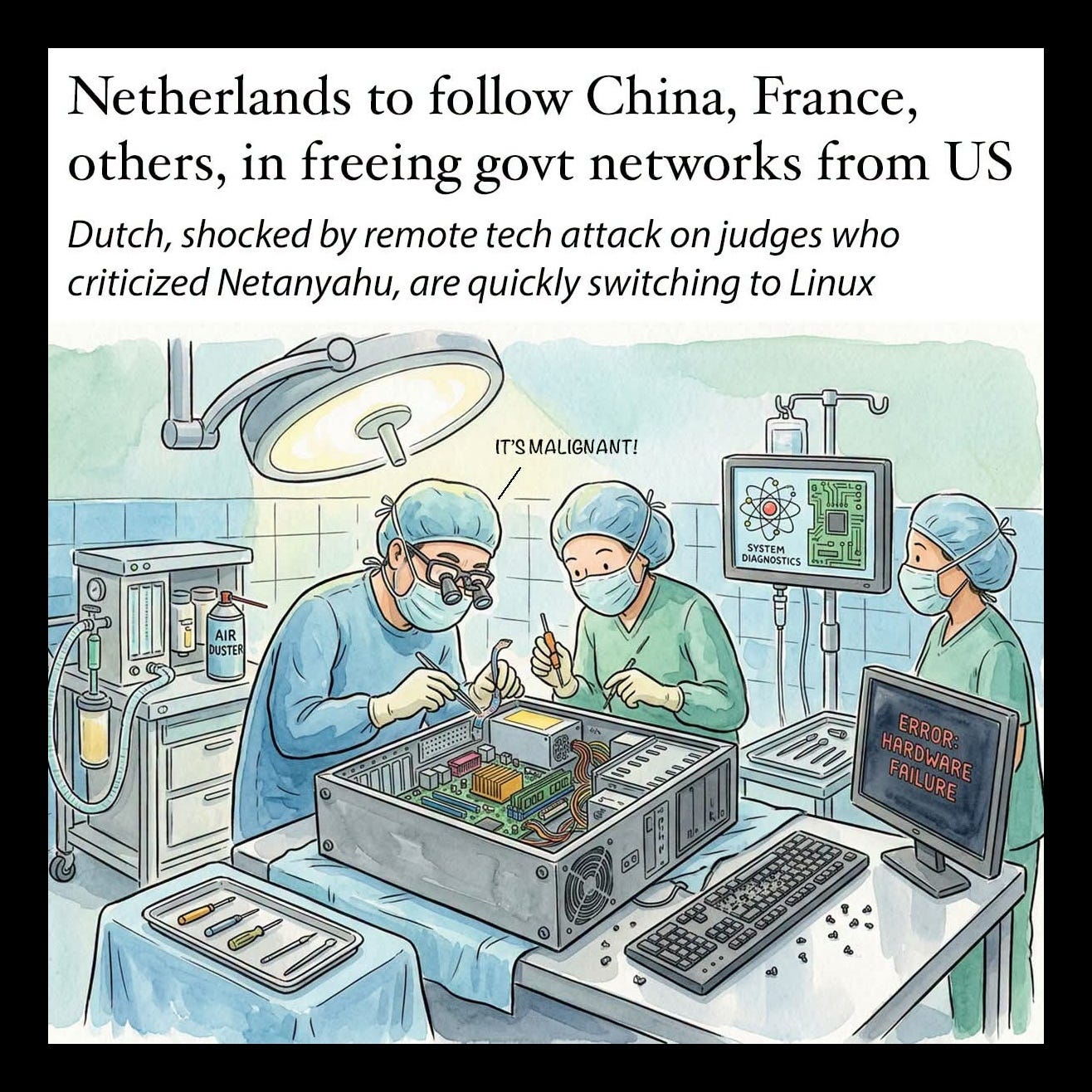
The decision by the Dutch government to create its own digital work environment based on the Dutch Linux distribution NixOS constitutes a recognition that the digital infrastructure on which modern states depend is not a neutral utility but an instrument of power that can be weaponised at any moment by the state that controls it. The immediate trigger for this decision was the revelation that the United States had remotely disabled the Outlook email accounts of judges at the International Criminal Court in The Hague who had criticised Benjamin Netanyahu, causing significant disruption to the court’s operations and demonstrating that the American technology corporations that dominate global digital infrastructure are subject to the unilateral exercise of American state power. The principle that the United States reserves the right to sanction anyone, anywhere in the world, means that every Google account, every Microsoft license, and every cloud service can be terminated without warning, and the Dutch government’s response reflects the realisation that sovereignty is meaningless if the digital systems through which sovereignty is exercised are controlled by a foreign power.
The theoretical framework of weaponised interdependence, developed by Henry Farrell and Abraham Newman, provides the analytical context for understanding why the weaponisation of digital infrastructure produces a systematic retreat from dependence on the platforms of the hegemon. Farrell and Newman argue that states with control over critical nodes in global networks can exploit that control to coerce other states, but the effectiveness of this coercion depends on the target’s inability to exit the network. When the hegemon repeatedly weaponises its control, it creates powerful incentives for targets to develop alternative networks that are not subject to its jurisdiction, and the result is the erosion of the very network power that made the coercion possible. The American weaponisation of GPS against a Chinese ship suspected of carrying weapons of mass destruction led to the development of Beidou, the Chinese satellite navigation system that now provides an alternative to GPS for countries that do not wish to depend on American infrastructure. The American weaponisation of SWIFT against Russia led to the development of CIPS, the Chinese cross-border interbank payment system that provides an alternative to the dollar-denominated financial infrastructure that the United States has used to impose sanctions. The American weaponisation of Microsoft Outlook against the International Criminal Court has now led to the Dutch decision to develop a sovereign digital work environment, and this pattern demonstrates that the exercise of network power by the hegemon is self-undermining when it is repeated.
The material foundations of American digital hegemony lie in the dominance of American corporations over the operating systems, productivity software, cloud services, and payment systems that constitute the infrastructure of the global economy. Microsoft Windows accounted for approximately seventy per cent of desktop operating system market share worldwide in 2026, and Microsoft Office remains the dominant productivity suite in almost every country. Google’s search engine processes more than ninety per cent of global search queries, and Google’s email, calendar, and cloud services are used by billions of people and millions of organisations. Amazon Web Services, Microsoft Azure, and Google Cloud collectively account for more than sixty per cent of global cloud infrastructure, and the United States has demonstrated that it can compel these corporations to terminate service to sanctioned entities and individuals. The dominance of American platforms is not a natural outcome of market competition but the product of historical advantages, government subsidies, and the network effects that make dominant platforms increasingly difficult to displace. The power that these platforms confer on the American state is a structural feature of the global digital economy, and the weaponisation of this power is the direct consequence of the American decision to treat digital infrastructure as an instrument of statecraft rather than a neutral utility.

The Chinese response to American digital hegemony has been the most systematic and comprehensive of any country, and it reflects the recognition that dependence on American technology is a national security vulnerability that must be eliminated. Beijing ordered government offices to switch away from foreign PCs in 2019, and the Chinese government has invested heavily in the development of domestic alternatives to American hardware and software. China’s Ministry of State Security told some state-linked organisations to quickly remove a customised version of Windows 10 from their machines, and other organisations are set to clean their systems of the program by February 2027. The development of Huawei’s HarmonyOS operating system, which works well and is growing in popularity, demonstrates that the technological gap between American and Chinese platforms has narrowed to the point where alternatives are viable. The fact that Windows still accounted for eighty-seven point six four per cent of desktop web traffic in China as recently as July 2026 reflects the challenge of displacing entrenched platforms at the consumer level, but the government and state-linked sectors are moving decisively away from American software, and this transition is creating the ecosystem that will eventually enable consumer adoption.
The Russian response to American digital hegemony has been shaped by the experience of sanctions and the recognition that dependence on American technology is a vulnerability that the United States will exploit whenever it serves American interests. Russia has enforced a total ban on Western software for government and military use, mandating the use of domestic Astra Linux, and the Russian government has invested in the development of domestic alternatives to American productivity software, cloud services, and payment systems. The Russian experience demonstrates that the transition away from American platforms is possible when the political will exists, and it provides a model that other countries can follow. The sanctions that the United States imposed on Russia after the invasion of Ukraine included the termination of Microsoft licenses, the suspension of Google services, and the exclusion of Russian banks from SWIFT, and these measures accelerated the development of Russian alternatives that had previously been neglected because of the convenience and lower cost of American platforms. The Russian response confirms the theoretical insight that the weaponisation of interdependence produces the exit that the hegemon seeks to prevent.
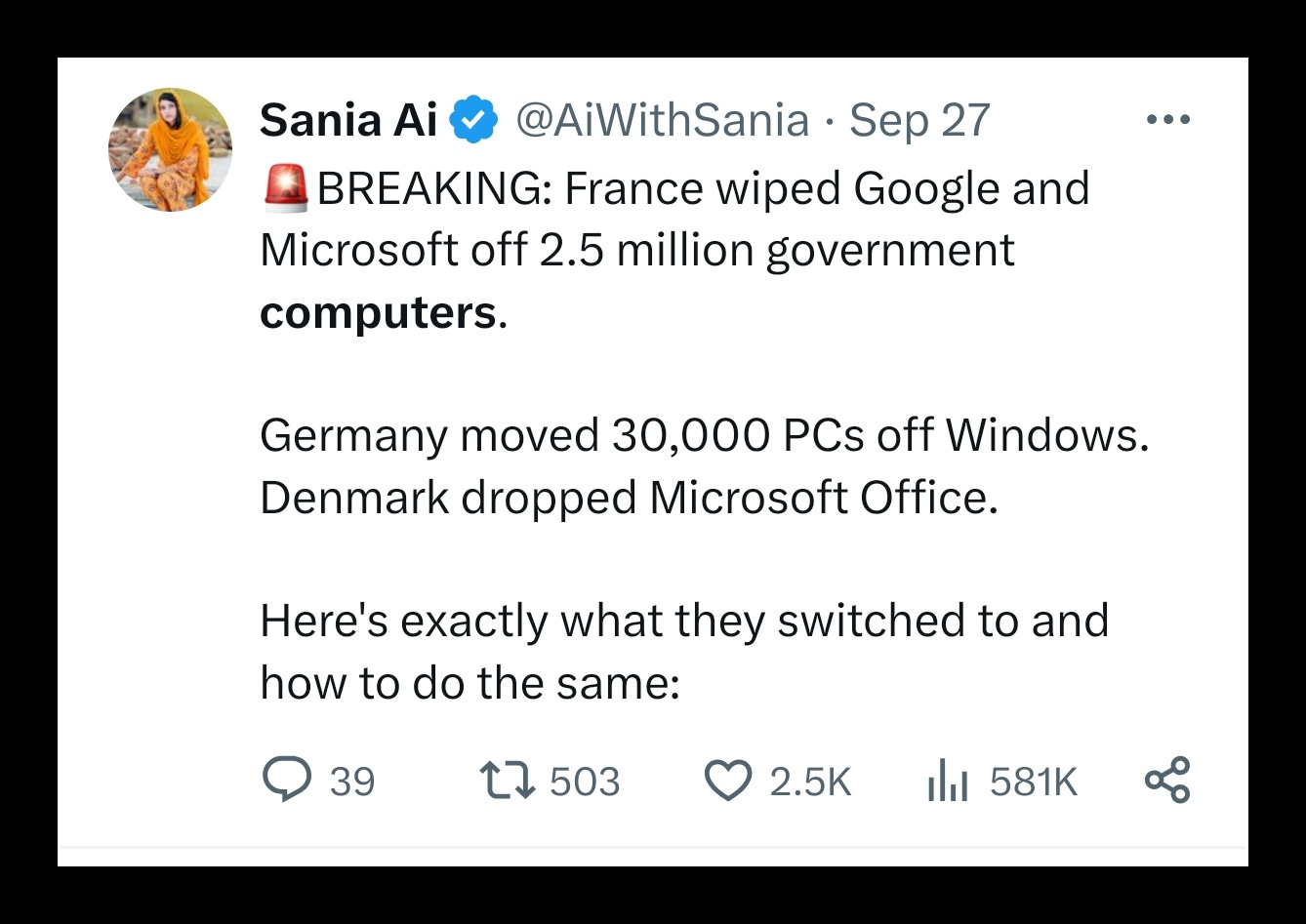
The European response to American digital hegemony has been slower and more fragmented than the Chinese or Russian responses, but the trend is unmistakable and the pace is accelerating. France is transitioning two point five million civil servants to Linux, and the French government has instructed civil servants to ditch Microsoft Teams and use Visio, a local alternative. Individual German states are opting for Linux, and are using Open Document Format and LibreOffice in place of Microsoft Office. The Netherlands is creating its own digital work environment based on NixOS. Switzerland, Denmark, Italy, and Austria are also replacing Microsoft programs with alternatives in various government areas, particularly in military sectors. The European movement toward digital sovereignty is driven by the recognition that dependence on American platforms is incompatible with the exercise of sovereignty, and by the specific experience of American coercion in the form of the weaponisation of Outlook against the International Criminal Court. The European transition will be slower than the Chinese and Russian transitions because the European economies are more deeply integrated with American technology corporations and because the political will to challenge American hegemony is weaker in Europe than in China or Russia, but the direction of travel is clear and the logic of weaponisation makes the transition inevitable.
The challenge of public adoption is the principal obstacle to the complete displacement of American digital platforms, and the persistence of American software dominance at the consumer level reflects the convenience, familiarity, and network effects that make switching difficult. Even in China, where the government has been most aggressive in promoting domestic alternatives, Microsoft Windows still accounted for the vast majority of desktop web traffic in 2026, and the transition to alternative operating systems has been slower among consumers than among government and state-linked organisations. The challenge of public adoption is not merely technical but economic and cultural, because the dominance of American platforms is embedded in the habits, expectations, and skills of billions of people who have grown up using Microsoft Office and Google Search. The transition will require not only the development of viable alternatives but the cultivation of the skills and habits necessary to use them, and this will take time. The fact that alternative operating systems like HarmonyOS work well and are growing in popularity demonstrates that the transition is possible, but it will require sustained investment and political commitment.
The precedent of GPS and Beidou demonstrates that the weaponisation of a critical infrastructure system produces the development of alternatives that eventually displace the weaponised system. When the United States weaponised GPS against a Chinese ship suspected of carrying weapons of mass destruction, the Chinese government accelerated the development of Beidou, and the system is now fully operational and provides an alternative to GPS for countries that do not wish to depend on American infrastructure. The precedent of SWIFT and CIPS demonstrates that the weaponisation of a financial infrastructure system produces the development of alternatives, and the Chinese cross-border interbank payment system now provides an alternative to the dollar-denominated financial infrastructure that the United States has used to impose sanctions. The precedent of Outlook and the International Criminal Court demonstrates that the weaponisation of a productivity software system produces the development of alternatives, and the Dutch decision to develop a sovereign digital work environment is the beginning of a transition that will eventually extend to other European countries. The pattern is clear: the hegemon’s weaponisation of interdependence creates the incentive and the opportunity for targets to develop alternatives, and the result is the erosion of the hegemon’s network power.
The class analysis of the digital break must identify the specific class forces that benefit from American digital hegemony and those that bear the costs of dependence. The American technology corporations that dominate global digital infrastructure are among the most profitable enterprises in human history, and their shareholders and executives constitute a fraction of the capitalist class whose wealth and power depend on the perpetuation of American digital dominance. The American state, which has demonstrated its willingness to weaponise the infrastructure that these corporations control, acts as an instrument of this class fraction, and the foreign policy establishment that shapes American strategy treats digital infrastructure as an instrument of statecraft rather than a neutral utility. The working classes of the United States and the countries that depend on American digital infrastructure bear the costs of this arrangement through the erosion of their sovereignty, the vulnerability of their data, and the subordination of their economic development to the interests of American corporations. The transition away from American digital platforms requires the development of domestic alternatives, and this in turn requires public investment and political commitment that the market alone will not provide. The class forces that support the transition are the working classes and the national bourgeoisies of the countries that seek to escape American digital hegemony, and the class forces that oppose the transition are the American technology corporations and their allies in the American state.
The game-theoretic analysis of the digital break reveals the strategic logic that drives the transition from American digital hegemony to a multipolar digital order. The game is a repeated game in which the hegemon can choose to weaponise its control over digital infrastructure or to maintain the neutrality of that infrastructure, and the targets can choose to remain dependent or to develop alternatives. The hegemon faces a temptation to weaponise because the short-term benefits of coercion are immediate and tangible, but the long-term consequence is the erosion of the network power that makes coercion possible. The targets face a cost to developing alternatives, but the cost of remaining dependent increases as the hegemon demonstrates its willingness to weaponise. The equilibrium of the game depends on the hegemon’s discount rate: if the hegemon values short-term gains more than long-term network power, it will weaponise, and the targets will exit. The American behaviour over the past two decades demonstrates that the American state values short-term coercive power more than the long-term preservation of the network, and the result is the transition that is now underway. The game is not zero-sum because the development of alternatives creates new opportunities for cooperation among the targets, and the emergence of a multipolar digital order creates possibilities for innovation and competition that the American-dominated order suppressed.
The historical context of the digital break includes the broader pattern of American weaponisation of economic and technological infrastructure that began with the imposition of sanctions on the Soviet Union during the Cold War and accelerated after the end of the Cold War. The United States has used its control over the dollar clearing system to impose secondary sanctions on foreign banks that do business with sanctioned entities, and this practice has been criticised as an extraterritorial application of American law that violates the sovereignty of other countries. The United States has used its control over semiconductor technology to restrict the export of advanced chips to China, and this has accelerated China’s development of domestic semiconductor capacity. The United States has used its control over the internet’s domain name system to seize domain names that it claims are used for illegal purposes, and this has raised concerns about the politicisation of internet governance. The digital break is the cumulative consequence of these weaponisations, and it reflects the recognition by a growing number of states that dependence on American digital infrastructure is a vulnerability that must be eliminated.
The political economy of the digital break must analyse the material interests that drive the transition and the obstacles that must be overcome. The transition requires investment in domestic alternatives, and the countries that have moved furthest, including China and Russia, have invested heavily in their domestic technology sectors. The transition also requires the coordination of standards and protocols to ensure that the alternatives are interoperable, and this coordination is difficult because the American platforms have established network effects that make cooperation easier within the American ecosystem than between the American ecosystem and its alternatives. The transition will be slower in Europe than in China or Russia because the European economies are more deeply integrated with American technology corporations and because the European political systems are more susceptible to American influence. The transition will be slower in the private sector than in the public sector because the costs of switching are borne by individual firms while the benefits of sovereignty are diffuse, and the coordination problem is more difficult in a market economy than in a state-directed economy. The Chinese and Russian experiences demonstrate that the transition is possible when the state plays a leading role in directing investment and coordinating standards, and the European experience demonstrates that the transition is slower when the state relies on market forces to drive change.
The future trajectory of the digital break will depend on the ability of the countries that have chosen to develop alternatives to overcome the obstacles and to sustain their commitment through the transition period. The indicators that would confirm the success of the transition include the share of government computers running non-American operating systems, the share of government communications using non-American platforms, the share of international payments using non-American payment systems, and the share of global trade using non-American digital infrastructure. The indicators that would undermine the transition include the ability of American technology corporations to adapt their business models to retain customers, the willingness of the American state to moderate its use of weaponised interdependence to preserve network power, and the ability of the American economy to produce innovations that make its platforms attractive even to countries that seek to reduce their dependence. The most likely outcome is a gradual bifurcation of the global digital order into an American sphere and a multipolar sphere, with the American sphere retaining dominance in the countries that are most closely allied with the United States and the multipolar sphere expanding as more countries recognise the costs of dependence. The transition will be measured in years and decades rather than months, but the direction is clear and the logic of weaponisation makes the reversal of the transition unlikely.
The Dutch decision to create its own digital work environment based on NixOS is a small step in the transition from American digital hegemony to a multipolar digital order, but it is a significant one because it demonstrates that even the most closely allied countries can be forced to act by the weaponisation of American power. The Netherlands is not a country that has sought to challenge American hegemony, and its decision to develop a sovereign digital work environment is a response to American coercion rather than an expression of hostility to the United States. The fact that even the Netherlands has been compelled to act demonstrates the extent to which the weaponisation of interdependence has become a problem even for the closest American allies, and it suggests that the transition will accelerate as more countries experience the costs of dependence. The American state has demonstrated that it will weaponise its control over digital infrastructure whenever it serves American interests, and the countries that depend on American infrastructure have no alternative but to develop alternatives if they wish to preserve their sovereignty. The digital break is not a choice that countries make because they prefer Chinese or Russian technology to American technology. It is a choice that countries make because they cannot afford to depend on technology that the American state can terminate at will.
Authored By: Global GeoPolitics
Thank you for visiting. This is a reader-supported publication. If you believe journalism should serve the public, not the powerful, and you’re in a position to help, becoming a PAID SUBSCRIBER truly makes a difference. Alternatively you can support by way of a cup of coffee:
https://buymeacoffee.com/ggtv |
https://ko-fi.com/globalgeopolitics |
Bitcoin: 3NiK8BoRZnkwJSHZSekuXKFizGPopkE7ns
References
Astra Linux (2026) About Astra Linux. Available at: https://astralinux.ru/en/ (Accessed: 1 October 2026).
Bloomberg (2026) ‘China Tells State-Linked Groups to Remove Windows 10’, Bloomberg, 15 August. Available at: https://www.bloomberg.com/news/articles/2026-08-15/china-tells-state-linked-groups-to-remove-windows-10 (Accessed: 1 October 2026).
European Commission (2025) Open Source Software Strategy. Brussels: European Commission. Available at: https://commission.europa.eu/about-european-commission/departments-and-executive-agencies/informatics/open-source-software-strategy_en (Accessed: 1 October 2026).
Farrell, H. and Newman, A.L. (2019) ‘Weaponized Interdependence: How Global Economic Networks Shape State Coercion’, International Security, 44(1), pp. 42-79. Available at: https://www.mitpressjournals.org/doi/10.1162/isec_a_00351 (Accessed: 1 October 2026).
Google (2026) Google Cloud Global Infrastructure. Available at: https://cloud.google.com/about/locations (Accessed: 1 October 2026).
Huawei (2026) HarmonyOS. Available at: https://www.harmonyos.com/en/ (Accessed: 1 October 2026).
Microsoft (2026) Microsoft Office 365. Available at: https://www.microsoft.com/microsoft-365 (Accessed: 1 October 2026).
NixOS (2026) NixOS Linux Distribution. Available at:
(Accessed: 1 October 2026).
NRC (2026) ‘Dutch government builds own digital work environment after US disabled ICC emails’, NRC Handelsblad, 28 September. Available at: https://www.nrc.nl/nieuws/2026/09/28/dutch-government-builds-own-digital-work-environment-after-us-disabled-icc-emails (Accessed: 1 October 2026).
Reuters (2019) ‘China orders government offices to replace foreign PCs’, Reuters, 9 December. Available at: https://www.reuters.com/article/us-china-tech-security/china-orders-government-offices-to-replace-foreign-pcs-idUSKBN1Y80QC (Accessed: 1 October 2026).
Reuters (2022) ‘Russia bans Western software for government and military use’, Reuters, 3 March. Available at: https://www.reuters.com/world/europe/russia-bans-western-software-government-military-use-2022-03-03/ (Accessed: 1 October 2026).
Reuters (2026) ‘France transitions 2.5 million civil servants to Linux’, Reuters, 15 September. Available at: https://www.reuters.com/world/europe/france-transitions-25-million-civil-servants-linux-2026-09-15/ (Accessed: 1 October 2026).
StatCounter (2026) Desktop Operating System Market Share Worldwide. Available at: https://gs.statcounter.com/os-market-share/desktop/worldwide (Accessed: 1 October 2026).
Tweakers (2026) ‘Netherlands builds own digital work environment based on NixOS’, Tweakers, 27 September. Available at: https://tweakers.net/nieuws/226543/nederland-bouwt-eigen-digitale-werkomgeving-op-basis-van-nixos.html (Accessed: 1 October 2026).
United States Department of the Treasury (2026) Office of Foreign Assets Control Sanctions Programs. Available at: https://home.treasury.gov/policy-issues/financial-sanctions (Accessed: 1 October 2026).
Visio (2026) Visio Collaboration Platform. Available at:
(Accessed: 1 October 2026).


Leave a comment