
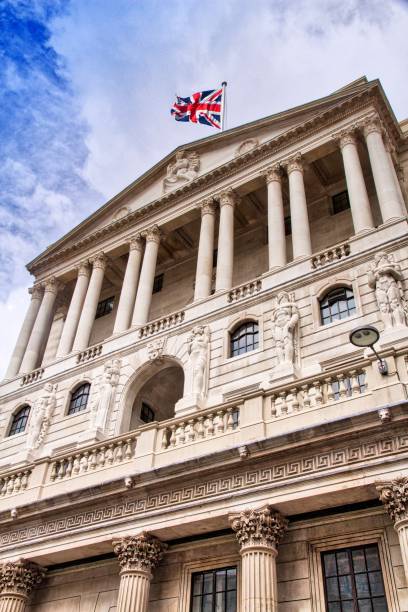
The Case Against Central Banks
Editorial Analysis | October 2026
The banking system that governs the global economy is not a neutral mechanism for intermediating between savers and investors but a class weapon wielded by a transnational financial oligarchy to control credit allocation, determine which sectors expand and which contract, and discipline labour by creating unemployment when wages rise or when the working class becomes too assertive. The evidence for this conclusion is not speculative but derives from the documented statements of central bankers themselves, from World Bank reports describing banking crises as windows of opportunity to change ownership structures, and from the historical record of financial crises that have transferred ownership of productive assets from national bourgeoisies to international finance capital. The mechanics of banking have been kept secret for centuries, and those who understood them took massive advantage, accumulating power to the extent that kings and princes became indebted to them and were compelled to extract resources from their populations to service the debts. The introduction of central banks always goes hand in hand with the introduction of new taxes, particularly income tax, because someone must pay the interest on the national debt that central bank money creation generates, and when the Federal Reserve was created the federal income tax was introduced at the same time to ensure that the interest on the debt would be paid by the working population.
The World Bank has described banking crises as a window of opportunity to change the ownership structure of economies, and this formulation is not an isolated rhetorical excess but a statement of intent that has been operationalised in country after country. The Asian financial crisis of 1997 and 1998 was a case in point, because the countries that were targeted had been performing well and foreigners had no share in their success. Japan, Korea, Thailand, and the Southeast Asian economies had locally owned banks and had achieved decades of high growth through decentralised banking systems that lent to productive enterprises, and the crisis changed that by opening these economies to foreign ownership and transferring control of their banking systems to international finance capital. The Japanese case is particularly instructive because the post-war Japanese success was due to a fairly straightforward implementation of what is possible when credit is directed toward productive investment rather than speculation. The Japanese government announced a plan to double national income in ten years and achieved it in four and a half years, and the economists who said it was impossible were proven wrong because they did not understand that economic growth is a direct proportional function of bank credit creation for productive business investment. The Japanese experience demonstrates that high growth is achievable when the banking system is structured to serve productive enterprises, and it also demonstrates that the financial oligarchy will act to suppress such growth when it threatens their control over the global economy.
The British experience provides a case study in how the concentration of banking suppresses productivity and enriches a narrow oligarchy at the expense of the broader population. The Colwyn Report of 1918 identified the problem of concentrated banking, documented that the big five banks dominated the sector, and concluded that they did not lend to small firms and only provided short-term loans. The report was published over a century ago, and nothing has been done about the problem because the interests opposing reform are the same interests that control the state. The UK banking sector is now dominated by five banks that control over eighty per cent of deposits, and they do not lend to small firms because large banks want to do large deals with large customers, which means that the small and medium-sized enterprises that employ approximately sixty-five per cent of the workforce cannot obtain the financing they need to invest in new technology and expand their operations. Germany’s savings banks and cooperative banks, which are locally owned and lend to local businesses, have been more effective at supporting small and medium-sized enterprises and maintaining productivity, and the fact that Germany has around one thousand two hundred small local banks while the UK has none demonstrates that the concentration of banking is a political choice rather than a technical necessity.
The Bank of England’s actions against Liz Truss in 2022 provide a contemporary example of how the financial oligarchy disciplines politicians who threaten its interests. Truss had criticised the Bank of England before becoming prime minister, had advocated for higher growth and a change in monetary policy, and had understood the problem of debt and productivity better than most politicians. The Bank of England responded by selling government bonds to create a mini crisis in the bond market, which drove yields up and created the conditions for her removal from office. The media then wrote stories calling her stupid and incompetent, despite the fact that she had been at Oxford and was one of the smartest politicians in the country. The Bank of England’s actions were not neutral but political, and the bond market crisis that forced her from office was a deliberate act of class warfare by financial institutions that opposed her policies. The fact that the media has never written a critical article about the Bank of England, even when it caused the 2008 crisis or the inflation of 2021 and 2022, demonstrates that the control over journalists is subtle and effective, and that independent journalism is essential to exposing the truth about the banking system.

The German case demonstrates how the financial oligarchy uses intelligence agencies to maintain its dominance over subordinate states. The occupation statute that governed post-war Germany was formally abolished in 1955, but certain residual rights were retained by the Allied powers, and the CIA has maintained a significant presence in the country and has been implicated in various operations. The political spectrum in Germany has been shifted to the extreme Marxist left by the CIA over the past twenty-five years, which has made the AfD’s positions, which were mainstream twenty to twenty-five years ago, appear far-right. The SPD had the same views on immigration twenty to twenty-five years ago as the AfD now, and the CDU and CSU, which are supposed to be conservative, are now aligned with the Greens and the left-wing parties. The AfD is simply a party of people who have decided they will not accept the propaganda and the cultural revolution that has been imposed on them, and their positions on immigration and sovereignty are the positions that were mainstream in Germany before the CIA shifted the spectrum. The fact that the CIA has never given up its occupation powers and has always used them to control German politicians demonstrates that Germany is not a sovereign country and that the parties and politicians essentially have to do what the CIA tells them.
The European Union represents the culmination of this process of supranational control, and its structural resemblance to the Soviet Union is not a rhetorical flourish but an institutional reality. The European Commission is an unelected body that proposes legislation and manages the day-to-day operations of the union, while the European Parliament is directly elected but has limited power to initiate legislation. The structure of the EU does bear some resemblance to the Soviet system, in which the Politburo held power and the Supreme Soviet was a rubber stamp, and the fact that the EU is moving toward capital controls and the restriction of deposit accounts for banks outside the union demonstrates that it is committed to maintaining control over the financial system. The European Central Bank is involved in these plans, and the commissars in Brussels are the ones who decide, and the fact that the UK is adopting these crazy EU rules even though it left the union demonstrates that the British political class is not serious about sovereignty. The EU is a technocratic institution that serves the interests of finance capital and the political class, not the people of Europe, and the AfD’s proposal to exit the euro and the EU is sensible because it would restore national monetary sovereignty and democratic control over economic policy.
The theoretical framework for understanding these dynamics is provided by the Marxist analysis of finance capital, which emphasises that banks and industrial capital merge to form a unified financial-industrial complex that dominates the economy. Werner’s research on bank credit creation is consistent with this analysis because banks do not merely intermediate between savers and investors but actively create credit and direct it toward particular uses. This power to allocate credit is the power to determine the shape of the economy, and it is exercised in the interests of the financial oligarchy rather than the population as a whole. The central bank’s ability to create money ex nihilo and to set interest rates is a form of social power that is exercised in the interests of capital rather than labour, and the suppression of growth that Werner describes is not a malfunction of the system but a feature of it, because the system is designed to benefit the financial oligarchy rather than to maximise growth for the population as a whole. Small firms are more likely to be owned by individuals and families rather than by large shareholders, and they are more likely to be unionised or to pay wages that are above the minimum, so by starving them of credit the banking system transfers resources from the small business sector to the large corporate sector, thereby concentrating wealth and power in fewer hands.
The policy implications of this analysis are significant and they point toward a programme of financial and political transformation that would restore democratic control over the economy. The creation of thousands of small local banks that lend to small firms would decentralise the power to allocate credit and distribute it more broadly across the population, and this would be a step toward the socialisation of credit, not in the sense of state ownership but in the sense of democratic control over the allocation of financial resources. The transformation of central banks from instruments of financial oligarchy to instruments of democratic control would require changes in governance and accountability, and the abolition of the euro and the restoration of national monetary sovereignty would allow countries to pursue independent monetary policies that serve the interests of their populations rather than the interests of international finance capital. The withdrawal from the European Union and the rejection of its neo-liberal framework would restore democratic control over economic policy, and the exposure of the Central Intelligence Agency’s role in manipulating foreign governments would serve to weaken the imperial system and strengthen movements for national sovereignty. The working class must organise to demand these changes, and it must build the institutions, including cooperative banks, credit unions, and public banks, that can serve as alternatives to the private banking system that dominates the economy. The ultimate goal must be the socialisation of credit, the democratic control of the financial system, and the subordination of finance to the needs of the population rather than the profits of the oligarchy, and the Werner interview provides valuable analytical tools for understanding the class dimensions of banking and for developing a strategy to transform the system. The evidence is conclusive that the banking system is not a neutral technical apparatus but a class weapon, and the working class has an interest in transforming it to serve human needs rather than private profit.
Authored By: Global GeoPolitics
Thank you for visiting. This is a reader-supported publication. If you believe journalism should serve the public, not the powerful, and you’re in a position to help, becoming a PAID SUBSCRIBER truly makes a difference. Alternatively you can support by way of a cup of coffee:
https://buymeacoffee.com/ggtv |
https://ko-fi.com/globalgeopolitics |
Bitcoin: 3NiK8BoRZnkwJSHZSekuXKFizGPopkE7ns
References
Werner, R.A. (2005) New Paradigm in Macroeconomics: Solving the Riddle of Japanese Macroeconomic Performance. Basingstoke: Palgrave Macmillan.
Werner, R.A. (2014) ‘Can banks individually create money out of nothing? The theories and the empirical evidence’, International Review of Financial Analysis, 36, pp. 1-19. Available at: https://www.sciencedirect.com/science/article/pii/S1057521914001070 (Accessed: 6 October 2026).
Werner, R.A. (2016) ‘A lost century in economics: Three theories of banking and the conclusive evidence’, International Review of Financial Analysis, 46, pp. 361-379. Available at: https://www.sciencedirect.com/science/article/pii/S1057521915001477 (Accessed: 6 October 2026).
Colwyn Committee (1918) Report of the Committee on Finance and Industry. London: His Majesty’s Stationery Office.
Hilferding, R. (1910) Finance Capital: A Study of the Latest Phase of Capitalist Development. Vienna: Wiener Volksbuchhandlung.
World Bank (1998) Global Economic Prospects and the Developing Countries. Washington, DC: World Bank.
Bank of England (2022) Financial Stability Report. London: Bank of England. Available at: https://www.bankofengland.co.uk/financial-stability-report (Accessed: 6 October 2026).
Financial Times (2022) ‘Liz Truss: The inside story of the shortest premiership in British history’, Financial Times, 21 October. Available at:
(Accessed: 6 October 2026).
Federal Reserve (2026) Federal Reserve Act. Washington, DC: Board of Governors of the Federal Reserve System. Available at: https://www.federalreserve.gov/aboutthefed/federal-reserve-act.htm (Accessed: 6 October 2026).
European Commission (2026) Proposal for a Regulation on Capital Controls. Brussels: European Commission. Available at:
(Accessed: 6 October 2026).


Leave a comment