

How Iran flipped the war on its attackers and turned oil into a weapon aimed at the American economy
Editorial Analysis | October 2026
The Taylor Rule, developed by Stanford economist John Taylor in 1993, was designed to guide central banks in setting interest rates in response to inflation and economic output, and it assumes that inflation is driven by excessive demand that can be restrained by making borrowing more expensive. Mohammad Bagher Ghalibaf, the speaker of Iran’s parliament, posted a modified version of this equation on social media on 16 September 2026, adding two variables named SOH for the Strait of Hormuz and BEM for the Bab el-Mandeb, and he labelled the result the Straits Taylor Rule. His accompanying comment, that you cannot twenty-five basis point a chokepoint, captured the central contradiction of American monetary policy in the current conjuncture: the Federal Reserve raised rates by twenty-five basis points the same day, but rate hikes cannot produce a barrel of oil, and the inflation that the Fed is trying to suppress is driven by physical supply disruption rather than excess demand. The Fed raised its benchmark rate to a target range of three point seven five to four per cent, its first hike since July 2023, in a unanimous vote of the Federal Open Market Committee, and the decision was presented as a response to inflation that had steadied at three point four per cent annually.
The material consequences of this policy are visible in the prices that ordinary Americans pay. Diesel reached 6.53 dollars per gallon in the week of 21 September 2026, the highest price in more than three decades of federal weekly records, and energy prices increased sixteen point three per cent over the twelve months ending in August. Diesel powers approximately seventy-three per cent of all freight in the United States, and the price increase of roughly seventy-four per cent from the pre-war level of 3.76 dollars has cascading effects through the entire supply chain. Farmers feel it first because tractors and combines run on diesel and the fall harvest is the busiest time of the year, and the Middle East supplies about a third of global urea exports, with prices for that fertiliser jumping eighty per cent between February and April. Jet fuel prices more than doubled after the war began, and airfares rose twenty-three point four per cent year over year in August, while the thirty-year mortgage rate climbed from five point nine eight per cent on 26 February 2026 to seven point zero three per cent by 24 September, adding roughly three thousand three hundred dollars per year to the cost of a four hundred thousand dollar mortgage.
The Federal Reserve’s dilemma is that it is using a tool built for too much borrowing to fight a problem caused by too little oil, and the rate hike therefore does not address the underlying cause of inflation while it does impose costs on every borrower in the country. The national debt exceeded forty trillion dollars in 2026, and the Congressional Budget Office projected that net interest costs would reach one trillion thirty-nine billion dollars in fiscal year 2026, a figure that exceeds the eight hundred thirty-three billion dollars spent on the military over the same period. The historian Niall Ferguson has observed that any great power that spends more on debt servicing than on defence risks ceasing to be a great power, and the United States crossed this threshold in 2024, when interest payments of one trillion one hundred twenty-four billion dollars exceeded defence spending of one trillion one hundred seven billion dollars. Every rate hike makes the government’s borrowing more expensive, and the government must borrow even more to pay its own interest, creating a debt spiral that the Federal Reserve cannot escape without either allowing inflation to accelerate or triggering a recession.
The Iranian strategy of making oil expensive through chokepoint control is a rational response to the asymmetry of power between the two countries, but its effectiveness depends on the assumption that the Federal Reserve will prioritise the protection of the bond market over the avoidance of recession. The Strait of Hormuz is the only sea route out of the Persian Gulf, and the Bab el-Mandeb is the main route around the Arabian Peninsula, so whoever controls both straits can block the front door and the back door at the same time. Iran declared the Strait of Hormuz closed within days of the American and Israeli attack on 28 February 2026, and the Iran-backed Houthi militia seized the island in the middle of the Bab el-Mandeb in September, rendering it closed as well. The International Energy Agency reported that global oil supply would fall by three point nine million barrels per day in 2026, with inventories drawing down at a record pace, and the agency warned that the world’s oil safety net was almost entirely depleted. The Strategic Petroleum Reserve held two hundred eighty-four point six million barrels in the week ending 18 September 2026, its lowest level since November 1982, and the net decline for the year to date was one hundred twenty-five million barrels.
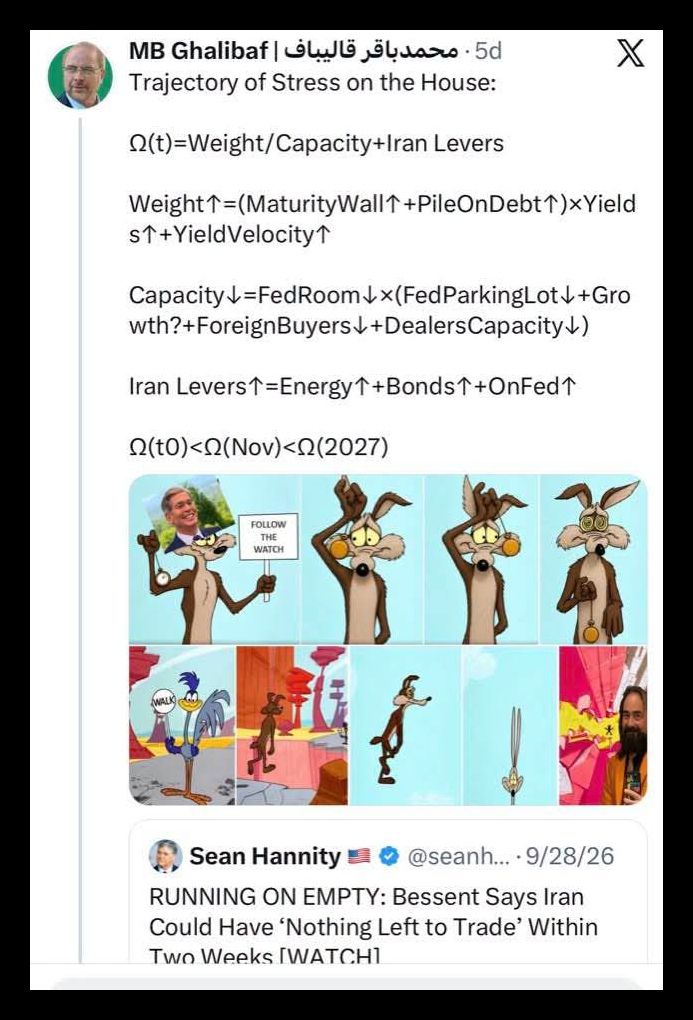
Ghalibaf returned to social media days later with a second post that abandoned the mockery of the Taylor Rule for something closer to an analytical claim, presenting a stylised equation for what he called the trajectory of stress on the house. He defined systemic stress as a ratio, denoted omega, in which the weight of maturing debt and accumulating obligations is divided by the capacity of the system to absorb it, with a separate term for what he labelled Iran levers. The weight, he argued, is rising because a wall of maturing debt must be refinanced at the same moment that new borrowing continues and yields are climbing at an accelerating pace. The capacity, he continued, is falling because the Federal Reserve has less room to intervene, foreign buyers are reducing their purchases of Treasury securities, and primary dealers are less willing or able to absorb the supply. The Iran levers term then adds the energy price shock transmitted through Hormuz and Bab el-Mandeb, the resulting pressure on bond markets, and the additional constraint this places on monetary policy. His projection that stress will rise from the present through November and into 2027 presents Iranian geographic leverage not as a military instrument but as a variable that amplifies American financial fragility from within. The rate rise of 16 September becomes, in this framing, both a symptom and a confirmation, and the hunters who set out to break Iran find themselves caught in an equation of their own making.
The American strategy of energy dominance represents the other side of the conflict, and it involves knocking rival energy suppliers offline through proxy attacks and then filling the gap with American exports. President Trump established the National Energy Dominance Council by executive order on 14 February 2025, tasking it with advising on strategies to achieve energy dominance by improving permitting processes and boosting domestic production [21†L4-L8]. The United States produced a record thirteen point six million barrels of crude oil per day in 2025, more than Russia and Saudi Arabia combined, and it has become the world’s largest exporter of liquefied natural gas. In April 2026, American crude oil exports hit a record five point six million barrels per day, up twenty-one per cent from the previous record, as buyers sought to replace barrels blocked by the Middle East war and the effective closure of the Strait of Hormuz.
The destruction of rival energy infrastructure has been carried out not by American forces but by American allies and proxies, allowing Washington to maintain plausible deniability while benefiting from the resulting supply disruptions. Israel struck Iran’s South Pars gas field on 18 March 2026, and Iran responded by firing missiles at Ras Laffan in Qatar, knocking out seventeen per cent of Qatar’s liquefied natural gas export capacity and causing estimated losses of twenty billion dollars in annual revenue. Drones launched from Iraq hit Saudi Arabia’s East-West pipeline in September, forcing the kingdom to shut down the main route for Saudi oil to avoid the Strait of Hormuz, and repairs were expected to take three to five weeks. Ukrainian drones hit Russian refineries about once every three days during the first eight months of 2026, and by late August only five major Russian refineries remained untouched, with the International Energy Agency estimating that Russia could lose thirty per cent of its refining capacity for eighteen months. The United States bombed military targets on Iran’s Kharg Island in March but deliberately left the oil terminal standing, with President Trump stating that he spared it for reasons of decency, and the effect of this decision was to preserve the infrastructure that would be needed to resume Iranian oil exports once the war ended.
The strategy of energy dominance is designed to lock the world into dependence on American energy priced in American dollars, and the evidence of this strategy is visible in the contracts that have been signed during the war. QatarEnergy, the state company of one of the world’s largest gas exporters, bought thirty-three shiploads of American liquefied natural gas in 2026 to fulfil its contracts with buyers in South Korea, Taiwan, Japan, India, and Bangladesh, compared with only four cargoes purchased in the entire previous year. The European Union promised in July 2025 to purchase seven hundred fifty billion dollars of American energy by 2028, a commitment that locks Europe into dependence on American suppliers for years to come. On 1 September 2026, following the capture of Venezuelan President Nicolas Maduro, the United States signed a deal with Venezuela’s interim government giving an American-led company one hundred-year rights to seventeen of the country’s oil fields, which contain more than sixty-five billion barrels of proven reserves. The theory in one sentence is that America does not need to win a bond war if it can make the whole world depend on American energy, priced in American dollars.
The two strategies intersect in a complex game where each side’s actions feed the other’s strategy, but for different purposes. Iran is creating expensive oil overtly by threatening shipping in the Strait of Hormuz and the Bab el-Mandeb, and it needs oil to stay expensive for as long as possible because every month of high prices is another month of high interest rates on America’s forty trillion dollar debt. America is creating expensive oil covertly by allowing its allies and proxies to knock rival suppliers offline, but it only needs oil to stay expensive for a while, because once rival suppliers are disabled and long-term contracts are signed, America no longer needs expensive oil and would benefit from cheaper prices that cool inflation and allow the Fed to lower rates. Treasury Secretary Scott Bessent described this strategy on 8 August when he said that over the next two years the Strait of Hormuz would become just another body of water, meaning that if most of the world’s energy flows around the strait instead of through it, the fear built into every barrel disappears and Iran loses the price it claims to set.
The race between these two clocks is a race between two different class projects, and the working class of the United States bears the costs of both. The American project of imperial maintenance through energy control requires high oil prices in the short term to lock in contracts but low oil prices in the long term to cool inflation, and the Iranian project of national development through chokepoint leverage requires high oil prices for as long as possible. Neither project serves the interests of the global working class, and both impose costs on workers in the core and the periphery through higher prices for diesel, groceries, jet fuel, and mortgages, while the benefits accrue to the defence contractors, energy corporations, and financial institutions that profit from the conflict. The Federal Reserve’s rate hikes transfer wealth from debtors to creditors, and the American government’s borrowing to service its debt transfers wealth from taxpayers to bondholders, and the destruction of rival energy infrastructure transfers wealth from the populations of the countries whose infrastructure is destroyed to the shareholders of the American energy corporations that fill the gap.
A materialist analysis must identify the class forces and material interests that structure the energy conflict, and the article’s central insight is that the Federal Reserve is using a tool built for too much borrowing to fight a problem caused by too little oil. The petrodollar system, which requires oil to be traded in US dollars, is a mechanism of imperial extraction that forces the world to hold dollar reserves and thereby subsidises American consumption and military spending, and Iran’s strategy of making oil expensive through chokepoint control is an attempt to challenge this system by raising the costs of American imperial maintenance. The American strategy of energy dominance is a strategy of inter-imperialist competition aimed at displacing rivals and securing American control over global energy flows, and the destruction of rival energy infrastructure is not a natural disaster but a deliberate strategy of competitive destruction. The working class of the United States bears the costs of the energy war through higher prices for diesel, groceries, jet fuel, and mortgages, while the defence contractors, energy companies, and financial institutions that profit from the conflict accumulate wealth that is measured in the billions.
The war was launched with the objective of defeating Iran, fragmenting it along ethnic and sectarian lines, and bringing its oil resources back under Western control. The script was written in Washington and Tel Aviv: a short, decisive campaign would degrade Iran’s military, trigger internal collapse, and allow the United States and its allies to dictate the terms of the post-war order. Control over Iranian oil would reinforce the petrodollar system, weaken the Axis of Resistance, and demonstrate that no state could defy American primacy.
Iran’s response inverted that script. Rather than attempting to match American military power symmetrically, Tehran exploited the one advantage it possessed: geography. By threatening the Strait of Hormuz and the Bab el-Mandeb, Iran made oil expensive. Expensive oil fed American inflation. Inflation forced the Federal Reserve to raise interest rates. Higher rates increased the cost of servicing the United States’ forty-trillion-dollar debt. The attackers had planned to control Iranian oil; instead, Iran gained influence over the price of oil, and therefore over American monetary policy. The war aim of controlling the resource became a mechanism through which the resource controlled the attacker.
The script was flipped in three distinct ways. First, the military offensive became an economic war of attrition. The United States could bomb Iran, but it could not occupy it, and it could not prevent Iran from disrupting the energy flows on which the global economy depends. Second, the attempt to isolate Iran produced the opposite effect: Russia, China, and the broader multipolar world deepened their ties with Tehran, while American allies in Europe and Asia began to question the wisdom of a conflict that was driving up their own energy costs. Third, the war intended to reinforce the dollar became a catalyst for de-dollarisation, as states accelerated efforts to develop alternative payment systems and reduce their exposure to American financial coercion.
The class dimension of this reversal is crucial, because the costs of the war are borne by working people in the United States and the Global South through higher diesel prices, mortgage rates, food costs, and the erosion of public services. The benefits accrue to defence contractors, energy corporations, and financial institutions that profit from volatility and conflict. Iran’s strategy does not challenge this class structure; it exploits its contradictions. By making oil expensive, Iran transfers wealth from American consumers to oil producers and traders, while simultaneously increasing the American state’s debt burden. The working class pays twice: once at the pump, and again through the fiscal austerity that follows.
The outcome remains uncertain as the United States retains enormous military and financial power, and it is pursuing a counter-strategy of energy dominance designed to lock the world into long-term contracts for American oil and gas. If that strategy succeeds, Iran’s chokepoint leverage will diminish, and the script may flip back. But the initiative has shifted as the war that was supposed to end Iran’s defiance has instead exposed the vulnerability of the American financial system, strengthened the multipolar coalition, and demonstrated that a middle-income country with geographic leverage can impose costs on a superpower. The attackers intended to break Iran; instead, they have accelerated the erosion of their own primacy. That is what it means for the script to be flipped.
Authored By: Global GeoPolitics
Thank you for visiting. This is a reader-supported publication. If you believe journalism should serve the public, not the powerful, and you’re in a position to help, becoming a PAID SUBSCRIBER truly makes a difference. Alternatively you can support by way of a cup of coffee:
https://buymeacoffee.com/ggtv |
https://ko-fi.com/globalgeopolitics |
Bitcoin: 3NiK8BoRZnkwJSHZSekuXKFizGPopkE7ns
References
Bloomberg (2026) ‘US Diesel Tops Record $6.50 as Global Crunch Feeds Inflation’, Bloomberg, 21 September. Available at: https://www.bloomberg.com/news/articles/2026-09-21/us-diesel-tops-record-6-50-as-global-crunch-feeds-inflation (Accessed: 5 October 2026).
Bloomberg (2026) ‘US in Talks With Venezuela to Take Major Stake in Oil Fields’, Bloomberg, 27 August. Available at: https://www.bloomberg.com/news/articles/2026-08-27/us-in-talks-with-venezuela-to-take-major-stake-in-oil-fields (Accessed: 5 October 2026).
Bloomberg (2026) ‘Watch Oil Supply Risks Rise After Saudi Pipeline Attack’, Bloomberg, 12 September. Available at: https://www.bloomberg.com/news/articles/2026-09-12/oil-supply-risks-rise-after-saudi-pipeline-attack (Accessed: 5 October 2026).
Bloomberg (2026) ‘Ukraine strikes could leave Russia with 30% less refining capacity for 18 months, IEA says’, Bloomberg, 11 September. Available at: https://www.bloomberg.com/news/articles/2026-09-11/ukraine-strikes-could-leave-russia-with-30-less-refining-capacity-for-18-months-iea-says (Accessed: 5 October 2026).
Congressional Budget Office (2026) Monthly Budget Review: August 2026. Washington, DC: CBO. Available at: https://www.cbo.gov/publication/61333 (Accessed: 5 October 2026).
Executive Office of the President (2025) Establishing the National Energy Dominance Council, Executive Order 14213, 14 February. Available at: https://www.federalregister.gov/documents/2025/02/20/2025-03302/establishing-the-national-energy-dominance-council (Accessed: 5 October 2026).
Federal Reserve (2026) FOMC Statement, 16 September 2026. Washington, DC: Board of Governors of the Federal Reserve System. Available at: https://www.federalreserve.gov/newsevents/pressreleases/monetary20260916a.htm (Accessed: 5 October 2026).
Federal Reserve Bank of St. Louis (2026) ‘Policy Rules and How Policymakers Use Them’, Federal Reserve Bank of St. Louis. Available at: https://www.stlouisfed.org/on-the-economy/2018/march/policy-rules-how-policymakers-use-them (Accessed: 5 October 2026).
Hoover Institution (2026) ‘Ferguson’s Law’, Hoover Institution, 9 February. Available at: https://www.hoover.org/research/fergusons-law (Accessed: 5 October 2026). –
International Energy Agency (2026) Oil Market Report – September 2026. Paris: IEA. Available at: https://www.iea.org/reports/oil-market-report-september-2026 (Accessed: 5 October 2026).
International Energy Agency (2026) Oil Market Report – May 2026. Paris: IEA. Available at: https://www.iea.org/reports/oil-market-report-may-2026 (Accessed: 5 October 2026).
International Food Policy Research Institute (2026) ‘Iran war: From fertilizer to food crisis?’, IFPRI, 2 July. Available at: https://www.ifpri.org/blog/iran-war-fertilizer-food-crisis (Accessed: 5 October 2026).
NDTV Profit (2026) ‘‘Stay Unanchored!’: Iran Mocks Fed’s 25 Bps Hike With Satirical ‘Straits Taylor Rule’’, NDTV Profit, 17 September. Available at: https://www.ndtvprofit.com/global-economics/stay-unanchored-iran-mocks-feds-25-bps-hike-with-satirical-straits-taylor-rule (Accessed: 5 October 2026).
Qatar News Agency (2026) ‘Minister of State for Energy Affairs: Iranian Attacks Disrupted 17 Percent of Gas Export Capacity’, QNA, 19 March. Available at: https://www.qna.org.qa/en/News-Area/News/2026-03/19/minister-of-state-for-energy-affairs-iranian-attacks-disrupted-17-percent-of-gas-export-capacity (Accessed: 5 October 2026).
Reuters (2026) ‘Jet fuel shock from Iran war worsens crisis for global airlines’, Reuters, 13 April. Available at: https://www.reuters.com/business/energy/jet-fuel-shock-iran-war-worsens-crisis-global-airlines-2026-04-13/ (Accessed: 5 October 2026).
Reuters (2026) ‘QatarEnergy buys 33 US LNG cargoes to offset Hormuz disruption, sources say’, Reuters, 30 July. Available at: https://www.reuters.com/business/energy/qatarenergy-buys-33-us-lng-cargoes-offset-hormuz-disruption-sources-say-2026-07-30/ (Accessed: 5 October 2026). –
TASS (2026) ‘Pentagon reports strikes on 90 military targets on Iran’s Kharg Island’, TASS, 14 March. Available at: https://tass.com/world/1928067 (Accessed: 5 October 2026).
The White House (2025) Fact Sheet: President Donald J. Trump Establishes the National Energy Dominance Council, 15 February. Available at: https://www.whitehouse.gov/fact-sheets/2025/02/fact-sheet-president-donald-j-trump-establishes-the-national-energy-dominance-council/ (Accessed: 5 October 2026).
U.S. Bureau of Labor Statistics (2026) Consumer Price Index Summary – August 2026. Washington, DC: BLS. Available at: https://www.bls.gov/news.release/cpi.nr0.htm (Accessed: 5 October 2026).
U.S. Energy Information Administration (2026) ‘U.S. exports of crude oil and petroleum products reached record in April’, EIA, 8 July. Available at: https://www.eia.gov/todayinenergy/detail.php?id=62403 (Accessed: 5 October 2026).
U.S. Energy Information Administration (2026) ‘U.S. crude oil production rose in 2025, setting new record’, EIA, 31 March. Available at: https://www.eia.gov/todayinenergy/detail.php?id=61363 (Accessed: 5 October 2026).
U.S. Energy Information Administration (2026) Weekly Retail Gasoline and Diesel Prices. Washington, DC: EIA. Available at: https://www.eia.gov/petroleum/gasdiesel/ (Accessed: 5 October 2026). –
YCharts (2026) ‘30 Year Mortgage Rate (Weekly)’, YCharts, 24 September. Available at: https://ycharts.com/indicators/30_year_mortgage_rate (Accessed: 5 October 2026).


Leave a comment