
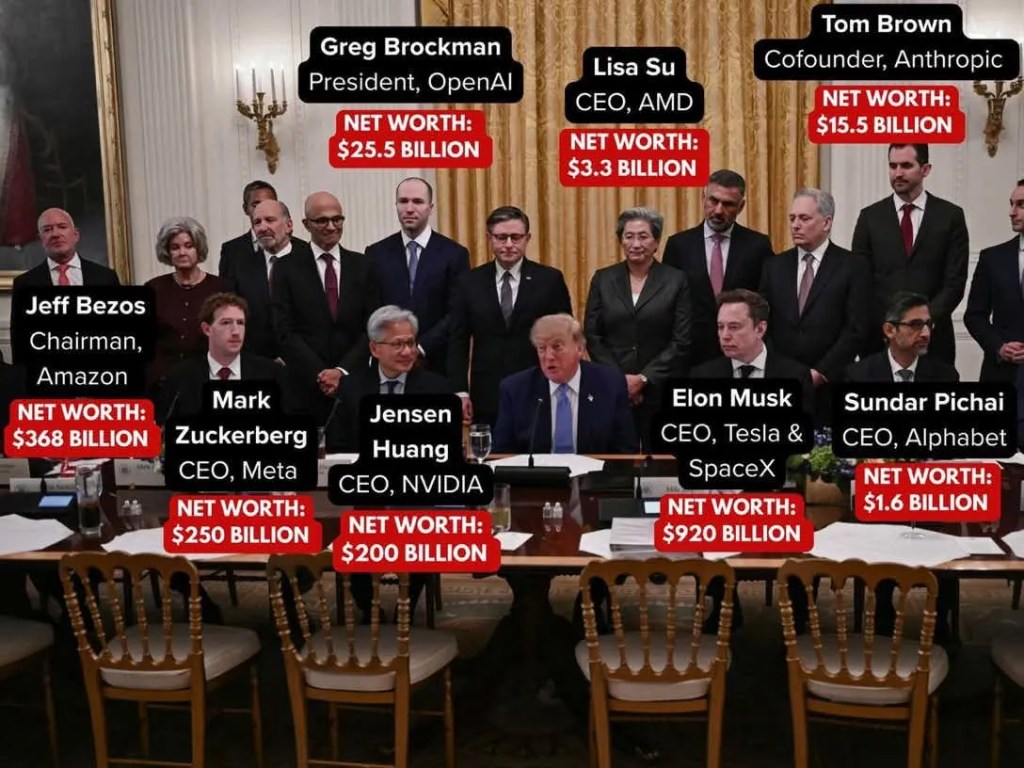
The billionaires who gathered at the White House signed a non-binding promise to police themselves, while their data centres drain the water and electricity of American towns and their AI models replace the jobs of American workers
Editorial Analysis | October 2026
The White House gathering on 29 September 2026 brought together the most powerful technology executives in the United States for a luncheon that was presented as a serious attempt to address the risks of artificial intelligence, but the document they signed reveals the event as a public relations exercise designed to protect the industry from meaningful regulation [1][2]. The accord commits the signatories to implement robust internal controls, empower internal teams to monitor their models, partner with external auditors, and designate independent board committees to oversee the process, but it contains no mechanism for enforcement, no disclosure requirement to any public authority, and no consequences for non-compliance [2]. President Trump described the agreement as a form of protection against the threats posed by artificial intelligence, and he praised the executives for their willingness to police themselves, but the arrangement allows the companies to serve simultaneously as the player and the referee in a game whose stakes include the future of human labour [1]. The Brookings Institution noted that history demonstrates voluntary commitments from technology companies are unreliable, as Facebook, Google, and Twitter have all walked back or violated previous self-imposed standards, and the accord does nothing to address the structural incentives that drive these companies to prioritise profit over safety [2].
The material foundation of the American AI push lies in the conversion of national resources into private infrastructure that serves the interests of a narrow class of technology billionaires rather than the population as a whole. The United States Energy Information Administration forecasts that electricity demand will rise from 419.5 billion kilowatt-hours in 2025 to 435.6 billion kilowatt-hours in 2027, driven primarily by the expansion of AI data centres and cryptocurrency infrastructure [9]. The Department of Energy has published a National Transmission Needs Study that identifies a pressing need for additional electric transmission infrastructure due to load growth from data centres, expanding domestic manufacturing, and large industrial loads, and the agency has announced $1.9 billion in funding for thirty-one grid improvement projects to speed data centre connections [8]. The data centres themselves consume water in quantities that rival the needs of small cities, with a large facility using up to five million gallons per day for cooling, equivalent to the consumption of a town of fifty thousand people, and the Berkeley Lab estimates that American data centres could use up to 11.8 per cent of total American electricity by 2030 [10][9]. These resources are being diverted from the needs of the American population to serve the requirements of private corporations whose profits accrue to shareholders rather than to the communities that host the infrastructure.
The political economy of this arrangement is visible in the resistance that is emerging across the United States, where towns are using referendums, zoning fights, and petitions to resist data centre developments that threaten their land, water, and power supplies [10]. Port Washington in Wisconsin voted to become the first town in the nation to pass a referendum restricting AI data centre developments, requiring voter approval for large tax incentives exceeding ten million dollars, following a proposed fifteen-billion-dollar campus project [10]. Augusta in Michigan saw residents overwhelmingly reject a land rezoning proposal that would have converted land previously reserved for homes and farming into industrial space for a data centre, with roughly ninety per cent voting against it [10]. Coweta County in Georgia faced massive petition drives to force a county referendum against an eight-hundred-and-thirty-one-acre data centre rezoned from rural conservation, citing sediment runoff into local rivers and surging power costs [10]. These communities understand that the data centres being built in their midst are not public infrastructure but private profit-making ventures, and the table scraps that the technology companies offer in exchange for access to community resources are not a fair exchange for the permanent loss of water, land, and affordable electricity.
The geopolitical dimension of the American AI push is framed by the competition with China, which possesses a manufacturing base that is twice the size of the American output and an AI ecosystem that has closed the performance gap to within a few months [5][6]. The Hamilton Index published by the Information Technology and Innovation Foundation reports that China now produces nearly one quarter of global output in advanced industries, with China’s share of global output in advanced industries surging from 3.5 per cent in 1995 to nearly 25 per cent in 2026, while the American share has fallen from thirty per cent to fifteen per cent over the same period [5]. China has built more than thirty thousand smart factories, and more than half of all new industrial robots installed worldwide in 2024 went into Chinese factories, where research from Weijian Shan has found that these facilities now produce more per worker than comparable American plants [6]. The Chinese approach treats artificial intelligence as factory work, embedding it into efforts to accelerate automation, guide machines, schedule work, and detect problems in real time, whereas Washington talks about artificial intelligence as if it lives only in research laboratories, venture capital portfolios, and data centres [6]. When artificial intelligence is combined with a massive industrial base, there is nothing the United States can do to equal or surpass that combination, and the only remaining option is to attempt to destroy, sabotage, or destabilise the competitor, which is why the war against Iran and West Asia is designed to disrupt energy and implode the global economy to pull the plug on China [6].
The class analysis of the AI push must begin by identifying the specific human agents who own and control the technology and the class interests that their operations serve. The technology billionaires who gathered at the White House are not representatives of the working class but members of a distinct fraction of the capitalist class whose wealth derives from the ownership of cloud capital, data processing capacity, and algorithmic systems that mediate an increasing proportion of economic and social activity. Their material interests are served by the expansion of artificial intelligence, the monopolisation of its benefits, and the extraction of rents from its applications, and they are not neutral stewards of technology but class actors whose wealth and power depend on the continued commodification of computation. The professional-managerial class that staffs the technology firms, the intelligence agencies, and the defence contractors that develop and deploy algorithmic weapons systems occupies a position of material interest in the perpetuation of the security paradigm that justifies their employment. The working class that bears the costs of algorithmic discipline in the workplace, algorithmic targeting in military operations, and algorithmic surveillance in daily life possesses no corresponding means of shaping the development of the technology, and the narrative of existential risk serves the interests of the owning and professional classes by directing attention away from the material harms that algorithmic systems are already inflicting.
The historical parallel with the British Empire is instructive because it demonstrates that the cannibalisation of domestic foundations in a desperate bid to maintain global primacy is a recurring pattern in the terminal phase of hegemonic decline. The British Empire likewise misappropriated national resources and industry in a desperate bid to maintain its global position rather than acknowledge the unsustainable nature of its position, and the consequence was that it lost its empire and was left without the socio-economic foundation to function as a sovereign nation-state. The United States is following a similar trajectory, and the AI push is the latest expression of a strategy that seeks to use technological superiority to compensate for the erosion of the productive base that once underpinned American hegemony. The difference is that artificial intelligence, unlike previous technologies, has the potential to displace not only manual labour but also cognitive labour, and the technology companies that are developing these systems have been explicit about their intention to replace human workers with algorithmic substitutes [3]. Anthropic’s chief executive has predicted that artificial intelligence could displace half of all entry-level white-collar jobs in the next one to five years, and tech companies laid off more than seventy-eight thousand workers in the first quarter of 2026, with forty-eight per cent of those layoffs attributed to AI automation [3]. The working class that is being displaced by these systems has no means of shaping the development of the technology that is rendering its skills obsolete, and the benefits of the productivity gains that artificial intelligence generates accrue to the shareholders of the corporations that own the systems rather than to the workers who are displaced by them.
The concluding assessment must remain analytical rather than definitive because the trajectory of the AI push and its implications for class power and geopolitical competition remain uncertain and the evidence available is incomplete. The United States may succeed in using artificial intelligence to sustain its global position for a period, or it may fail and accelerate its decline as the contradictions of the strategy become manifest. China may continue to close the AI gap and to leverage its industrial base to surpass the United States in the application of artificial intelligence to productive purposes, or it may face internal challenges that slow its progress. The working class may develop the organisations and consciousness necessary to challenge the power of the technology oligarchy and to demand that artificial intelligence serve human needs rather than private profit, or it may remain fragmented and marginalised as the technology reshapes the economy in ways that benefit the few at the expense of the many. The indicators that would confirm or undermine each scenario are observable, including the pace of Chinese advances in AI and manufacturing, the effectiveness of American attempts to restrict China’s access to advanced semiconductors, the level of popular resistance to data centre construction and AI-driven job displacement, and the willingness of the political class to impose meaningful regulation on the technology industry. What is clear from the evidence assembled here is that the White House Accord is not a serious attempt to address the risks of artificial intelligence but a public relations exercise designed to protect the industry from accountability, and that the technology billionaires who signed it are pursuing their own material interests at the expense of the American people and the global population.
Authored By: Global GeoPolitics
Thank you for visiting. This is a reader-supported publication. If you believe journalism should serve the public, not the powerful, and you’re in a position to help, becoming a PAID SUBSCRIBER truly makes a difference. Alternatively you can support by way of a cup of coffee:
https://buymeacoffee.com/ggtv |
https://ko-fi.com/globalgeopolitics |
Bitcoin: 3NiK8BoRZnkwJSHZSekuXKFizGPopkE7ns
References
ABC News (2026) ‘Trump says US AI giants agreed to “police themselves” after White House meeting’, ABC News, 30 September. Available at: https://newsapp.abc.net.au/news/2026-09-30/artificial-intelligence-execs-meet-donald-trump-at-white-house/107209762 (Accessed: 7 October 2026).
Brookings Institution (2026) ‘Trump’s “morally binding” AI pact is not enough’, Brookings, 6 October. Available at: https://www.brookings.edu/articles/trumps-morally-binding-ai-pact-is-not-enough/ (Accessed: 7 October 2026).
Carnegie Endowment for International Peace (2026) ‘The AI Labor Debate: Three Views on the Future of Work’, Carnegie Endowment, 23 April. Available at: https://events.ceip.org/research/2026/04/the-ai-labor-debate-three-views-on-the-future-of-work (Accessed: 7 October 2026).
Digital Today (2026) ‘AI drives U.S. power demand to record highs, outlook shows’, Digital Today, 7 October. Available at: https://www.digitaltoday.co.kr/en/view/111604/ai-drives-us-power-demand-to-record-highs-outlook-shows (Accessed: 7 October 2026).
Information Technology and Innovation Foundation (2026) ‘China Now Produces Nearly One-Quarter of Global Output in Advanced Industries’, ITIF, 6 May. Available at: https://itif.org/publications/2026/05/06/china-produces-nearly-one-quarter-global-output-advanced-industries-itif-report-finds/ (Accessed: 7 October 2026).
New York Times (2026) ‘America Has an Edge Over China. Why Won’t We Use It?’, New York Times, 24 February. Available at: https://www.nytimes.com/2026/02/24/opinion/china-america-manufacturing-ai.html (Accessed: 7 October 2026).
State Street Global Advisors (2026) ‘Beyond DeepSeek: China’s 2026 model wave and the repricing of the AI stack’, SSGA, 21 September. Available at: https://www.ssga.com/se/en_gb/institutional/insights/beyond-deepseek-chinas-2026-model-wave-and-the-repricing-of-the-ai-stack (Accessed: 7 October 2026).
US Department of Energy (2026) ‘DOE’s Office of Electricity Publishes 2026 Draft National Transmission Needs Study’, Energy.gov, 9 July. Available at: https://www.energy.gov/oe/articles/does-office-electricity-publishes-2026-draft-national-transmission-needs-study (Accessed: 7 October 2026).
US Energy Information Administration (2026) ‘Fossil generation could rise with faster-than-expected growth in data center power demand’, EIA, 12 March. Available at: https://www.eia.gov/todayinenergy/detail.php?id=63904 (Accessed: 7 October 2026).
WION News (2026) ‘US midterm elections 2026: Land, water and power lines: List of US towns pushed back against AI data centres’, WION, 6 October. Available at: https://www.wionews.com/photos/us-midterm-elections-2026-land-water-and-power-lines-list-of-us-towns-pushed-back-against-ai-data-centres-1791281720756 (Accessed: 7 October 2026).


Leave a comment