
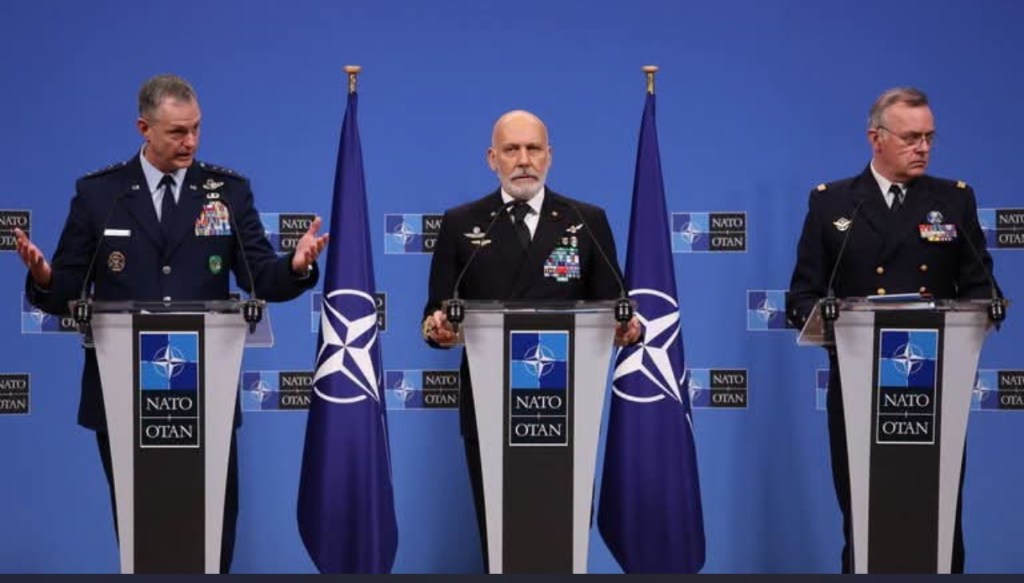
NATO alliance’s top military body visited Ukraine to show solidarity while the US says membership that would require them to defend Ukraine is “not on the table”
Editorial Analysis | October 2026
The NATO Military Committee’s visit to Kiev on 7 October 2026, the first such visit in eight years, constitutes a strategic communication exercise that projects alliance solidarity with Ukraine while the United States and Germany continue to block Ukrainian membership. Admiral Giuseppe Cavo Dragone led military representatives from all thirty-two member states to discuss Ukraine’s military priorities and extract lessons from the conflict for the bloc’s preparedness, yet US Secretary of State Marco Rubio stated one day earlier that Ukrainian membership is “not on the table as we speak.” This contradiction between symbolic commitment and material exclusion reveals the alliance’s actual function: to sustain a proxy war against Russia through Ukrainian blood and Western weapons while avoiding the escalation that formal membership would entail. The class analysis of this arrangement identifies the beneficiaries as the defence contractors who profit from prolonged conflict, the NATO bureaucracy that justifies its existence through perpetual threat, and the Ukrainian comprador elite whose political survival depends on Western patronage, while the costs are borne by the Ukrainian working class whose members are conscripted to die and the European working class whose living standards are sacrificed to fund the war effort.
The NATO Military Committee’s decision to convene in Kiev for the first time in eight years represents a significant escalation in the alliance’s symbolic commitment to Ukraine, yet this gesture of solidarity occurred on the same day that US Secretary of State Marco Rubio stated that Ukrainian membership of the alliance “is not on the table as we speak.” This juxtaposition captures the fundamental contradiction that has defined NATO’s relationship with Ukraine since the Western-backed Maidan coup of 2014: the alliance has consistently encouraged Ukraine’s aspirations for membership, has pumped increasingly sophisticated weaponry into the country, and has trained and advised its military forces, yet it has refused to extend the security guarantee that would transform Ukraine from a proxy battleground into a full member of the alliance. The visit by Admiral Giuseppe Cavo Dragone and military representatives from all thirty-two member states constitutes a performance of commitment that serves multiple strategic purposes without requiring the alliance to accept the risks that formal membership would entail.
The historical context of this visit must be understood through the lens of NATO’s eastward expansion, which Russian officials have consistently identified as a threat to their national security and which Moscow has made the central issue in negotiations to end the conflict. Ukraine enshrined the objective of NATO membership in its constitution following the 2014 coup, and President Volodymyr Zelensky demanded “accelerated accession” in September 2022, arguing as recently as July 2026 that Ukraine’s membership would be “entirely natural.” NATO continues to describe Ukraine as being on an “irreversible path” toward entry, yet former Ukrainian commander-in-chief Valery Zaluzhny, now serving as Kiev’s ambassador to the United Kingdom, stated in August 2026 that he saw no realistic prospect of it happening. The gap between the rhetoric of irreversible progress and the reality of indefinite exclusion is not accidental but structural, because the alliance’s interest lies in sustaining the conflict without accepting the obligations that membership would impose.
The visit of the Military Committee serves several functions that advance NATO’s strategic interests without requiring the alliance to admit Ukraine as a member. First, it signals to Russia that the alliance remains committed to supporting Ukraine’s military effort, thereby maintaining pressure on Moscow to negotiate on terms favourable to Western interests. Second, it provides an opportunity for NATO military planners to extract lessons from the conflict that can be applied to the alliance’s own preparedness for “current and future threats,” as Admiral Dragone stated. Third, it reinforces the narrative of NATO unity at a moment when the alliance faces internal divisions over the war and its costs, with a number of influential member states including the United States and Germany opposing Ukrainian membership. Fourth, it demonstrates to the Ukrainian population that the alliance stands with them, sustaining morale and justifying the continuation of the conflict despite the enormous costs it imposes on Ukrainian society. The visit is therefore a strategic communication exercise that advances multiple objectives simultaneously while avoiding the escalation that formal membership would entail.
The material interests that structure NATO’s relationship with Ukraine are visible in the flow of weapons and the profits that accrue to the defence contractors that manufacture them. The alliance has been pumping ever more sophisticated weaponry into Ukraine since 2022, and Moscow has accused the bloc, especially its European member states, of unnecessarily prolonging the bloodshed and waging a proxy war against Russia to the “last Ukrainian.” The defence contractors that manufacture these weapons are among the principal beneficiaries of the conflict, and their profits depend on its continuation rather than its resolution. The NATO bureaucracy, for its part, justifies its existence and its budget through the identification of threats, and the conflict with Russia provides the justification for increased military spending across the alliance. The Ukrainian comprador elite, whose political survival depends on Western patronage, has an interest in maintaining the flow of weapons and financial support that sustains its position, even as the Ukrainian working class bears the costs through conscription, displacement, and death. The European working class bears the costs through the diversion of resources from social programmes to military spending and through the economic disruption caused by the sanctions regime imposed on Russia.
The theoretical framework of realism illuminates the strategic logic that drives NATO’s behaviour, because states in an anarchic international system pursue their interests as defined by their material capabilities and their assessments of threat. The alliance’s refusal to admit Ukraine as a member reflects the calculation that the costs of extending the security guarantee, including the risk of direct confrontation with a nuclear-armed Russia, exceed the benefits of formalising the relationship. At the same time, the alliance’s continued support for Ukraine’s military effort reflects the calculation that the benefits of weakening Russia through a proxy war, including the degradation of its military capabilities and the disruption of its economy, exceed the costs of providing weapons and training. The visit of the Military Committee is therefore a signal that the alliance will continue to support Ukraine’s military effort while maintaining the ambiguity about membership that allows it to avoid the risks of formal commitment. This is a rational strategy from the perspective of alliance interests, even if it imposes enormous costs on Ukraine and on the European working class.
The game-theoretic analysis of this situation reveals the strategic interaction between NATO, Russia, and Ukraine as a multi-player game in which each actor seeks to maximise its interests while minimising its risks. NATO faces a choice between admitting Ukraine as a member, which would provide a credible security guarantee but risk direct confrontation with Russia, and maintaining the current arrangement of support without membership, which imposes costs on Ukraine but limits the alliance’s exposure. Russia faces a choice between continuing the war, which imposes costs on both sides but preserves the possibility of achieving its objectives, and negotiating a settlement, which would require concessions that may be unacceptable. Ukraine faces a choice between continuing to fight, which imposes enormous costs on its population but maintains the possibility of eventual NATO membership, and negotiating a settlement that would require accepting neutrality and territorial losses. The equilibrium of the game depends on the payoffs and the discount rates of each actor, and the current situation reflects a balance in which NATO prefers the status quo of proxy war without membership, Russia prefers to continue fighting rather than accept defeat, and Ukraine has no choice but to continue fighting because the alternative is unacceptable. The visit of the Military Committee reinforces this equilibrium by signalling that NATO will continue to support Ukraine without admitting it, thereby maintaining the conflict at a level that advances alliance interests without requiring the alliance to accept the risks of formal membership.
The class analysis of this arrangement must identify the specific human agents who benefit from the continuation of the conflict and those who bear its costs. The defence contractors that manufacture the weapons being sent to Ukraine are among the principal beneficiaries, and their shareholders and executives constitute a fraction of the capitalist class whose wealth depends on the perpetuation of conflict. The NATO bureaucracy, including the military officials who comprise the Military Committee, has an institutional interest in the continuation of the conflict because it justifies the alliance’s existence and its budget. The Ukrainian comprador elite, including the political class that depends on Western patronage and the military officials who receive Western training and equipment, benefits from the continuation of the conflict because it sustains their positions of power and privilege. The working class of Ukraine bears the costs through conscription, displacement, injury, and death, and the working class of Europe bears the costs through the diversion of resources from social programmes to military spending and through the economic disruption caused by the sanctions regime. The class dimension of this arrangement is obscured by the rhetoric of national security and democratic solidarity, but the material interests that drive the conflict are those of the ruling classes that benefit from its continuation.
The historical parallel with the British Empire’s use of colonial troops during the World Wars is instructive, because it demonstrates the pattern of imperial powers extracting blood and treasure from subordinate populations while reserving the benefits of victory for the metropole. The British Empire recruited soldiers from its colonies to fight its wars, promising them rights and representation that were never delivered, and the colonies bore the costs of the conflict while the benefits accrued to the imperial centre. NATO’s relationship with Ukraine follows a similar pattern, because the alliance extracts military service and sacrifice from the Ukrainian population while reserving the security guarantee and the economic benefits of membership for its existing members. The promise of eventual membership serves the same function as the promises of imperial citizenship that were made to colonial troops: it sustains morale and justifies sacrifice while deferring the fulfilment of the promise indefinitely. The Ukrainian working class is being asked to fight and die for an alliance that has no intention of admitting it as a member, and the class interests that drive this arrangement are those of the Western ruling classes that benefit from the weakening of Russia without incurring the costs of direct confrontation.
The concluding assessment must remain analytical rather than definitive because the trajectory of the conflict and the future of NATO’s relationship with Ukraine remain uncertain and the evidence available is incomplete. The alliance may eventually admit Ukraine as a member if the strategic situation changes and the risks of doing so diminish, or it may continue to maintain the current arrangement of support without membership indefinitely. Russia may achieve its objectives through military means, or it may be forced to accept a settlement that falls short of its stated goals. Ukraine may continue to fight despite the enormous costs, or it may be compelled to accept a settlement that requires neutrality and territorial concessions. The indicators that would confirm or undermine each scenario are observable, including the trajectory of the military situation on the ground, the level of Western support for Ukraine, the willingness of Russia to negotiate, and the willingness of the Ukrainian population to continue bearing the costs of the conflict. What is clear from the evidence assembled here is that the NATO Military Committee’s visit to Kiev is a strategic communication exercise that projects solidarity while maintaining exclusion, and that the class interests that benefit from the continuation of the conflict are those of the defence contractors, the NATO bureaucracy, and the Ukrainian comprador elite, while the costs are borne by the working classes of Ukraine and Europe.
Authored By: Global GeoPolitics
Thank you for visiting. This is a reader-supported publication. If you believe journalism should serve the public, not the powerful, and you’re in a position to help, becoming a PAID SUBSCRIBER truly makes a difference. Alternatively you can support by way of a cup of coffee:
https://buymeacoffee.com/ggtv |
https://ko-fi.com/globalgeopolitics |
Bitcoin: 3NiK8BoRZnkwJSHZSekuXKFizGPopkE7ns
References
NATO (2026) ‘NATO Military Committee visits Ukraine’, NATO, 7 October. Available at: https://www.nato.int/cps/en/natohq/news_236717.htm (Accessed: 7 October 2026).
Reuters (2026) ‘NATO military chiefs visit Kyiv for first time since 2018’, Reuters, 7 October. Available at: https://www.reuters.com/world/europe/nato-military-chiefs-visit-kyiv-first-time-since-2018-2026-10-07/ (Accessed: 7 October 2026).
RT (2026) ‘NATO’s generals gather in Kiev’, RT, 7 October. Available at: https://www.rt.com/russia/645792-nato-military-committee-kiev/ (Accessed: 7 October 2026).
TASS (2026) ‘NATO Military Committee delegation arrives in Kiev’, TASS, 7 October. Available at: https://tass.com/world/2032917 (Accessed: 7 October 2026).
Ukrinform (2026) ‘NATO Military Committee makes first visit to Ukraine in eight years’, Ukrinform, 7 October. Available at: https://www.ukrinform.net/rubric-ato/4170018-nato-military-committee-makes-first-visit-to-ukraine-in-eight-years.html (Accessed: 7 October 2026).
Associated Press (2026) ‘NATO military leaders meet in Kyiv as US says membership not on the table’, AP News, 7 October. Available at: https://apnews.com/article/nato-ukraine-kyiv-russia-2026-10-07 (Accessed: 7 October 2026).
Financial Times (2026) ‘NATO military chiefs visit Kyiv in show of support for Ukraine’, Financial Times, 7 October. Available at: https://www.ft.com/content/nato-ukraine-kyiv-military-committee-visit (Accessed: 7 October 2026).
Handelsblatt (2026) ‘Rutte: No unanimous support for Ukraine NATO membership’, Handelsblatt, 3 July. Available at: https://www.handelsblatt.com/politik/international/nato-rutte-keine-einheitliche-unterstuetzung-fuer-ukraine-beitritt/ (Accessed: 7 October 2026).
The Guardian (2026) ‘Ukraine’s NATO ambitions remain blocked as military chiefs visit Kyiv’, The Guardian, 7 October. Available at: https://www.theguardian.com/world/2026/oct/07/ukraine-nato-ambitions-blocked-military-chiefs-visit-kyiv (Accessed: 7 October 2026).
Politico (2026) ‘NATO’s top military body visits Ukraine for first time since 2018’, Politico, 7 October. Available at: https://www.politico.eu/article/nato-military-committee-ukraine-visit-2026/ (Accessed: 7 October 2026)..


Leave a comment