
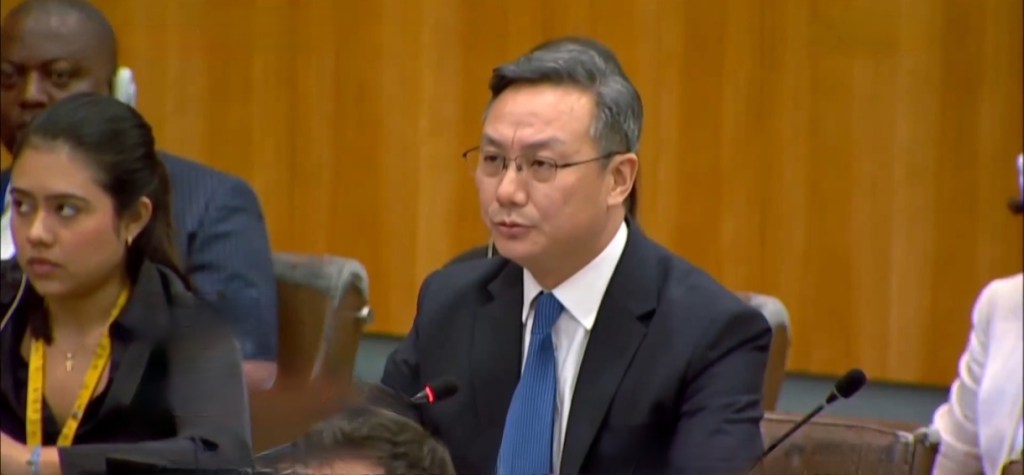
Beijing rejected accusations over its human rights record and turns scrutiny back on Britain, Australia, Canada, Japan and other Western governments
General Article | October 2026
China mounted a forceful response at the United Nations on October 5, 2026, after the United Kingdom, Australia, Japan, Ireland, Czechia and Lithuania criticised China’s human rights record during a general debate of the General Assembly’s Third Committee.
The Chinese response was delivered by Sun Lei, China’s Deputy Permanent Representative to the United Nations, who exercised China’s right of reply during the general debate of the Third Committee at the 81st session of the General Assembly. The committee is responsible for social, humanitarian and cultural issues, including human rights. [1]
Sun said China was “strongly dissatisfied” with what he described as groundless accusations and malicious smears of China’s human rights situation by the six countries. He accused them of assuming a superior position and presenting themselves as authorities on human rights while failing to address problems within their own societies. [1]
Rather than limiting his response to a defence of China’s record, Sun turned the criticism back on the countries that had raised it.
On poverty and living standards, Sun said China had continued to improve people’s livelihoods through development and had eliminated absolute poverty, with nearly 100 million people lifted out of poverty and more than 400 million people forming what he described as a middle-income group. [1]
He contrasted this with Britain, where he said more than 14 million people were living below the poverty line, with half of them experiencing what he described as extreme poverty. He also cited Japan’s relative poverty rate of 15 percent and pointed to growing concerns over child poverty. [1]
Sun also challenged Western criticism of China’s political system. He said China had continued to develop what it calls whole-process people’s democracy and claimed that support and satisfaction with the Chinese government had remained above 90 percent for many years. He presented the Hong Kong National Security Law and subsequent changes to the territory’s political system as part of what Beijing regards as a transition from disorder to stability and further development. [1]
He then turned to Britain, citing polling that he said showed approximately 75 percent of the British public were concerned about the future of democracy. Australia and Czechia were also criticised over what Sun described as declining public trust in government and weakening confidence in democratic institutions among younger people. [1]
On ethnic and minority rights, Sun said China regarded all ethnic groups as equal members of the Chinese nation and maintained that the political, economic, cultural and religious rights of people in Xinjiang and Xizang were being protected. He also referred to China’s recently adopted legislation on promoting ethnic unity, which Beijing says is intended to advance common development among the country’s ethnic groups. [1]
He contrasted this with Japan, accusing Tokyo of failing to fulfil commitments on eliminating racial discrimination and of failing to treat the Ainu and Ryukyu peoples as equal ethnic groups. Sun said the resulting pressures were threatening their development and welfare. [1]
Britain, Australia and Ireland were also criticised over the continuing consequences of colonialism. Sun said those countries continued to face problems including racism and social divisions that, in China’s view, were linked to the legacy of colonialism. [1]
The Chinese envoy broadened his criticism beyond domestic conditions, accusing Britain, Australia, Japan, Czechia and Lithuania of invoking human rights selectively while failing to respond adequately to what China regards as unjust treatment of people in Palestine, Iran and Cuba. He accused the countries of using human rights as a pretext for interference in the internal affairs of other states and for imposing unilateral coercive measures that, according to Beijing, harm developing countries. [1]
Sun argued that China had chosen a human rights development path suited to its own national conditions. He said China would continue to improve human rights protection while pursuing what Beijing calls Chinese modernisation, and would work with other countries to strengthen multilateralism and improve global human rights governance. [1]
The exchange reflects a longstanding dispute at the United Nations over how human rights should be interpreted and applied. Western governments have repeatedly raised concerns about China’s policies in Xinjiang, Tibet and Hong Kong. Britain, for example, told the Third Committee on October 1 that evidence of rights violations in Xinjiang and Tibet persisted and called on China to address restrictions on ethnic minorities and political expression in Hong Kong. [2]
Beijing rejects those allegations and argues that Western governments politicise human rights issues and apply double standards. China has increasingly emphasised economic development, poverty reduction, social stability, national sovereignty and the material welfare of its population as central elements of its conception of human rights.
The confrontation therefore extends beyond the individual allegations made against China. At the heart of the dispute is a competing understanding of who has the authority to define, assess and enforce human rights standards internationally.
For China, Western criticism does not carry an automatic presumption of moral authority. Beijing increasingly responds by pointing to poverty, racial discrimination, inequality, treatment of Indigenous peoples, migration and political dissatisfaction in Western countries, arguing that governments criticising China should also be prepared to account for their own domestic records.
Sun’s intervention on October 5 demonstrated that approach in direct terms. China did not simply reject the accusations made against it. It challenged the countries making them to examine their own human rights records and questioned the legitimacy of using human rights as an instrument of political pressure.
The exchange underscored the increasingly contested character of human rights diplomacy at the United Nations, where disagreements over universal standards are increasingly intertwined with questions of sovereignty, development, political systems and the distribution of power in the international order.
Also, whilst exercising his right of reply during the General Debate of the UN General Assembly, Sun Lei, said the “Enemy State Clauses” in the UN Charter should not be altered or deleted, citing Japan’s re-militarisation.
The dispute over the United Nations Charter’s “Enemy State Clauses” is also a dispute over who has the authority to declare parts of the post-1945 international order obsolete. The General Assembly did formally recognise in 1995 that the clauses had become obsolete and expressed an intention to remove them, while the 2005 World Summit again endorsed the eventual deletion of references to “enemy States”. Japan therefore has a documented basis for arguing that the provisions are anachronistic. [4][5] But the clauses have never actually been removed from the Charter. Articles 53, 77 and 107 remain part of the treaty text, including provisions referring explicitly to states that were enemies of Charter signatories during the Second World War. [6]
This distinction matters geopolitically because “obsolete” and “deleted” are not the same thing. The General Assembly can adopt a political resolution recognising provisions as obsolete, but the Charter itself remains unchanged until the formal amendment process is completed. China is now explicitly resisting the argument that the provisions should simply be treated as having no continuing significance. In September 2026, Chinese Deputy Permanent Representative Sun Lei argued that the clauses remain an important institutional safeguard for the post-war order and should not be altered or deleted in light of what Beijing describes as Japan’s remilitarisation. [4] China’s position is particularly notable because Beijing supported the 1995 General Assembly resolution recognising the clauses as obsolete and also joined the consensus behind the 2005 World Summit outcome calling for their deletion. Japan has consequently pointed to China’s earlier votes in arguing that Beijing’s current position represents a departure from its previous position. [8]
The wider dispute reflects a deeper problem with the post-war international order: states continue to interpret and invoke its legal and historical provisions according to their contemporary strategic circumstances. Russia, for example, invoked Article 51 of the UN Charter when announcing its military operation in Ukraine in February 2022 and presented “demilitarisation” and “denazification” as stated objectives. [6] This was not an invocation of the Enemy State Clauses themselves, and it should not be presented as establishing a legal right to military action under those clauses. It does, however, demonstrate that states continue to draw upon provisions, principles and historical concepts contained within the post-1945 international framework when constructing arguments about contemporary security.
The question, therefore, is not simply whether the Enemy State Clauses are “obsolete”. One side can point to General Assembly resolutions declaring them obsolete, while another can point to the fact that the provisions remain in the Charter itself. [4][6] China’s refusal to accept their straightforward deletion, particularly in the context of Japan’s expanding military capabilities, represents an attempt to preserve the political relevance of the historical settlement of 1945. Japan, conversely, has an interest in removing language that continues to associate it constitutionally with the defeated Axis powers and argues that it has already demonstrated its commitment to peace since joining the United Nations. [8]
The disagreement is therefore less about whether Article 107 is likely to be routinely invoked against Japan today and more about whether the historical conditions under which the post-war order was created can be declared politically settled. The competing positions reveal a broader geopolitical contest over the interpretation of the post-war settlement: Japan and its supporters emphasise the General Assembly’s subsequent recognition that the clauses are obsolete, while China emphasises the fact that the provisions remain formally embedded in the Charter and connects their continued significance to the question of Japan’s military trajectory. [7][8] In that sense, the argument over the Enemy State Clauses is also an argument over whether the political meaning of 1945 can be revised through subsequent consensus, or whether elements of that settlement remain relevant until they are formally removed from the Charter.
Authored By: Global GeoPolitics
Thank you for visiting. This is a reader-supported publication. If you believe journalism should serve the public, not the powerful, and you’re in a position to help, becoming a PAID SUBSCRIBER truly makes a difference. Alternatively you can support by way of a cup of coffee:
https://buymeacoffee.com/ggtv |
https://ko-fi.com/globalgeopolitics |
Bitcoin: 3NiK8BoRZnkwJSHZSekuXKFizGPopkE7ns
References
[1] Permanent Mission of the People’s Republic of China to the United Nations (2026) Remarks by Ambassador Sun Lei at the General Debate of the Third Committee in response to Western countries. 5 October. New York: Permanent Mission of the People’s Republic of China to the United Nations. Available at: Permanent Mission of China to the UN (Accessed: 7 October 2026).
[2] Foreign, Commonwealth & Development Office (2026) The UK will defend universal rights without fear or favour: UK Statement at the UN Third Committee. Statement by Ambassador Sarah MacIntosh, 1 October. London: GOV.UK. Available at: GOV.UK (Accessed: 7 October 2026).
[3] United Nations Department of Economic and Social Affairs (2026) Follow the work of UNGA Committees as they kick off their sessions. 5 October. New York: United Nations. Available at: United Nations (Accessed: 7 October 2026).
[4] United Nations General Assembly (1995) Elimination of coercive economic measures as a means of political and economic coercion. A/RES/50/52, 11 December. New York: United Nations. Available at: UN Digital Library (Accessed: 7 October 2026).
[5] United Nations (2005) 2005 World Summit Outcome. A/RES/60/1, 24 October. New York: United Nations. Available at: United Nations (Accessed: 7 October 2026).
[6] United Nations (1945) Charter of the United Nations, Articles 53, 77 and 107. San Francisco: United Nations. Available at: United Nations (Accessed: 7 October 2026).
[7] Permanent Mission of the People’s Republic of China to the United Nations (2026) Ambassador Sun Lei’s remarks in exercising the right of reply at the 81st session of the General Assembly in response to Japan and the Philippines. 28 September. New York: Permanent Mission of the People’s Republic of China to the United Nations. Available at: Permanent Mission of China to the UN (Accessed: 7 October 2026).
[8] Ministry of Foreign Affairs of Japan (2026) Press Conference by Foreign Minister Motegi Toshimitsu. Tokyo: Ministry of Foreign Affairs of Japan. Available at: Ministry of Foreign Affairs of Japan (Accessed: 7 October 2026).
[9] United Nations Security Council (2022) Letter dated 24 February 2022 from the Permanent Representative of the Russian Federation to the United Nations addressed to the Secretary-General. S/2022/154, 24 February. New York: United Nations. Available at: UN Digital Library (Accessed: 7 October 2026).
[1] Permanent Mission of the People’s Republic of China to the United Nations (2026) Remarks by Ambassador Sun Lei at the General Debate of the Third Committee in response to Western countries. 5 October. New York: Permanent Mission of the People’s Republic of China to the United Nations. Available at: Permanent Mission of China to the UN (Accessed: 7 October 2026).
[2] Foreign, Commonwealth & Development Office (2026) The UK will defend universal rights without fear or favour: UK Statement at the UN Third Committee. Statement by Ambassador Sarah MacIntosh, 1 October. London: GOV.UK. Available at: GOV.UK (Accessed: 7 October 2026).
[3] United Nations Department of Economic and Social Affairs (2026) Follow the work of UNGA Committees as they kick off their sessions. 5 October. New York: United Nations. Available at: United Nations (Accessed: 7 October 2026).


Leave a comment