
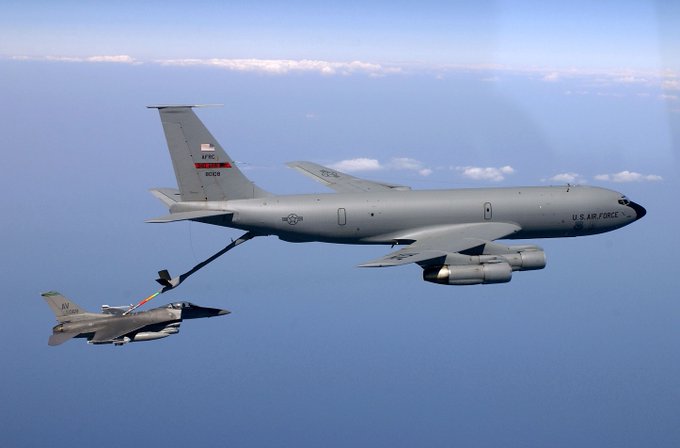
When Multiple Expensive Aircraft Start Falling Frequently Great Powers Cannot Admit Enemy Attrition
In war, what governments avoid saying clearly can tell you as much as what they openly admit. When expensive aircraft begin going down in or around a contested theatre, the immediate tactical explanation matters less than the political meaning of the loss. A state can absorb the destruction of cheap expendable systems and move on. It cannot easily admit that an adversary is successfully threatening the high-value aircraft on which its campaign depends. That is why the public language around such incidents becomes strained, evasive, and carefully incomplete. To say openly that the enemy is inflicting damage is to concede that the enemy has begun to alter the operational balance.
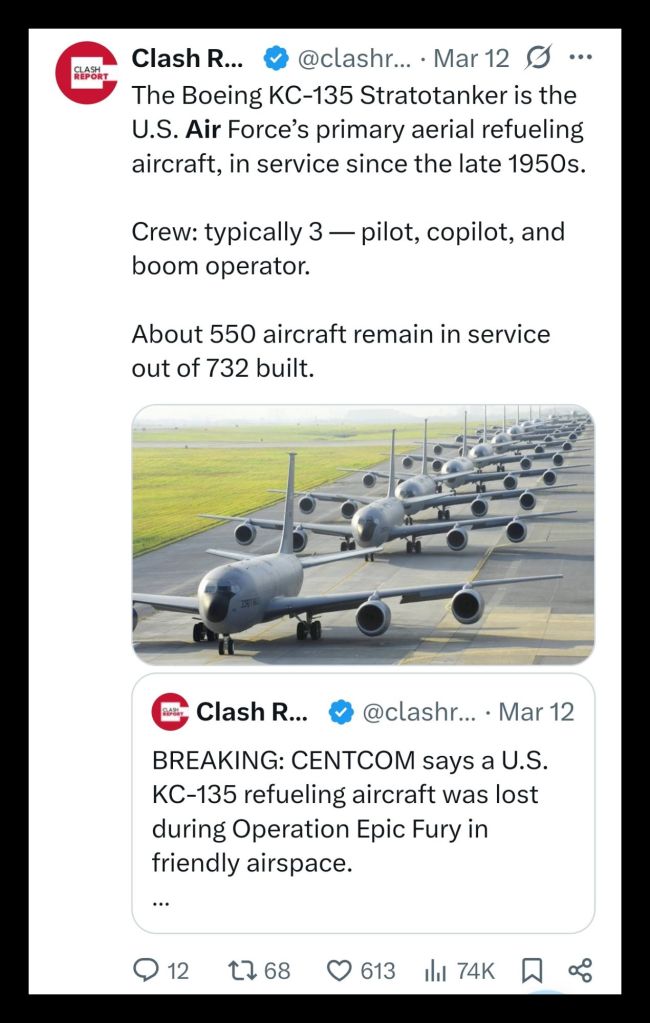
That is the correct starting point for analysing the recent pattern of aircraft losses and emergency incidents described in the material above. The point is not whether every public account is complete, or whether every battlefield claim can be independently verified in real time. Wars do not present themselves in neat evidentiary packages while they are still being fought. The point is that the pattern itself is strategically intelligible. If fighters are going down, if tankers are being lost or forced into emergency landings, if support assets are no longer operating with confidence, and if official statements describe these events in language designed to acknowledge the outcome while severing it from hostile agency, then the larger reality is already visible. The air war is becoming more dangerous for the side that depends on expensive airframes, long-range support, and the appearance of uncontested access.
That matters because modern American war-making is built around exactly those things. It depends on advanced aircraft, refuelling chains, fixed and semi-fixed bases, carrier support, and the assumption that a superior power can project force into a region while keeping the most valuable parts of its machinery relatively safe. Once that assumption begins to fail, the damage is not only material. It is doctrinal and political. A fighter jet is not just a plane. A tanker is not just a support aircraft. They are nodes in a system of intervention whose effectiveness depends on confidence in range, survivability, and routine operation. If those nodes become vulnerable, the system becomes strained even before it breaks.
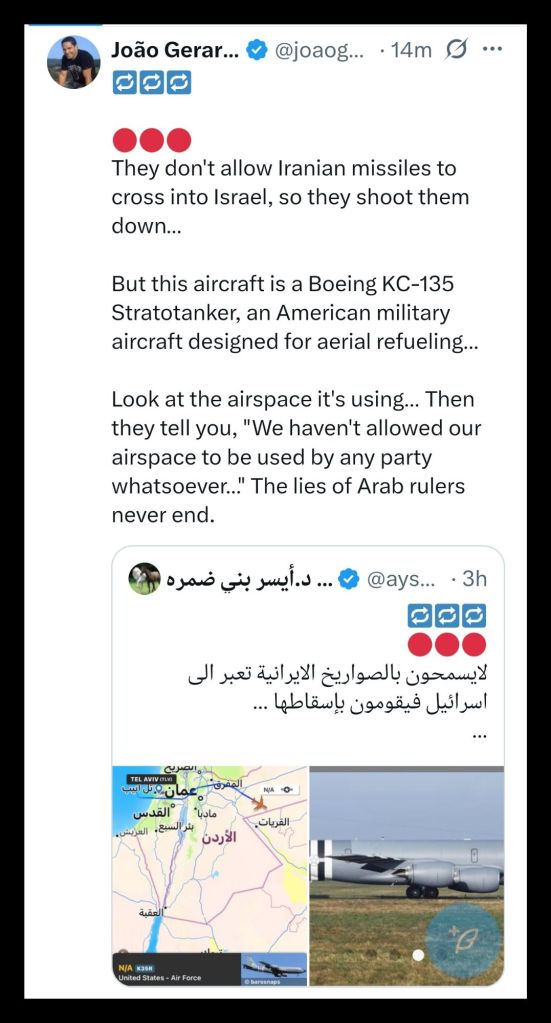
That is why the official treatment of aircraft losses is so revealing. A government may say that a plane went down during active combat but avoid saying that the enemy shot it down. It may emphasise that an aircraft was not lost to hostile fire or friendly fire, while still leaving unexplained why it was lost in the middle of a combat zone. It may acknowledge the incident while narrowing its significance into a technical event, a procedural failure, or a fog-of-war anomaly. But this kind of phrasing is itself evidence of the underlying problem. Public truth in such cases is constrained because a direct admission would amount to conceding that the enemy can reach assets that were meant to remain secure.
The stakes are even higher when the aircraft in question are refuelling tankers. Tankers are not glamorous in the way fighters are, but they are indispensable to long-range air operations. They extend mission endurance, create operational depth, and make it possible to sustain pressure from distance. If tankers are at risk, the entire geometry of air power changes. Fighters cannot simply continue as before, because their radius, loiter time, routing, and payload decisions all depend on aerial refuelling. The loss or degradation of a tanker is therefore not an isolated setback. It is a contraction of the battlespace. What had looked like a campaign with broad reach begins to narrow. The side with the larger air force discovers that access is more conditional than it had assumed.
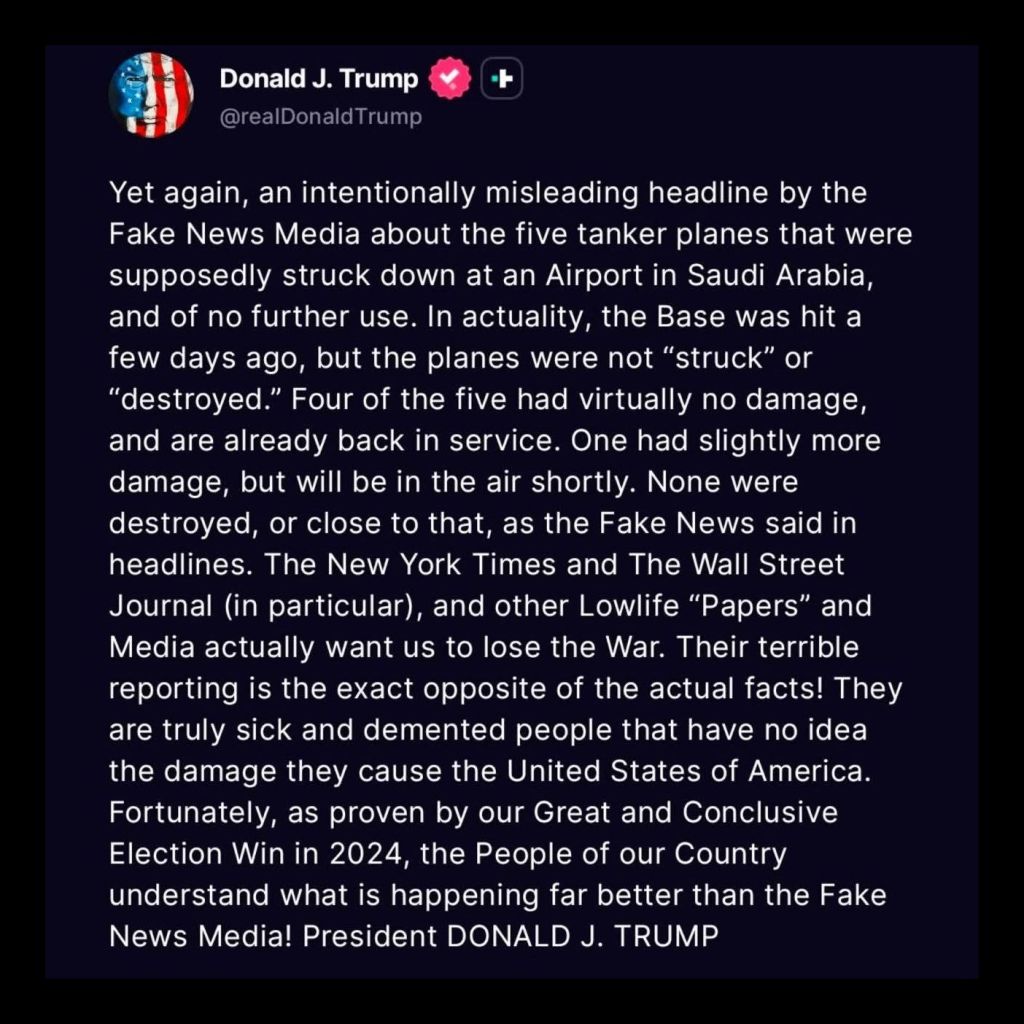
The pattern became harder to dismiss when reports emerged that five U.S. Air Force refueling aircraft were hit at Prince Sultan Air Base in Saudi Arabia. Even allowing for later efforts to minimise the extent of the damage, the strategic significance is obvious. Tankers are not optional platforms at the edge of the campaign. They are the mechanism that gives American air power reach, endurance, and operational flexibility. If they can be struck on the ground at a major staging base, then the problem is not merely the loss or damage of individual aircraft. The problem is that the logistical architecture sustaining the war is itself exposed. At that point, attrition is no longer confined to the battlespace overhead. It has reached the infrastructure that makes the air war possible.
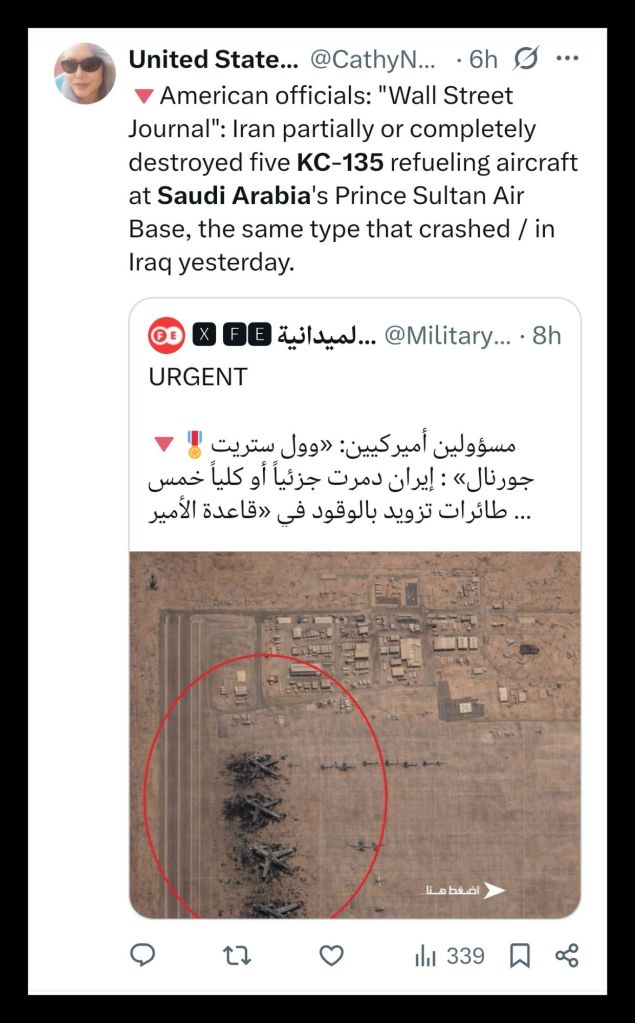
The specific incidents appear as part of a larger pattern of anti-access and area-denial framework. This makes sense analytically whether one accepts every tactical claim or not. Anti-access means raising the cost and difficulty of reaching the theatre and sustaining operations into it. Area-denial means making the contested zone itself too dangerous for normal freedom of action. Together, the two do not require the weaker power to defeat the stronger one symmetrically. They require only that it deny the stronger power easy use of its advantages.
On that reading, the loss of aircraft is not the centre of the story but one expression of it. If regional bases are under pressure, carrier groups are forced farther away, refuelling aircraft are endangered, and overflight becomes hazardous, then air power begins to lose the qualities that made it politically attractive in the first place. It becomes less precise, less flexible, less persistent, and above all less cheap in strategic terms. The side that expected to punish from a position of safety is pushed into a campaign of increasing exposure. Expensive assets must be risked more often and defended more heavily. The attacker starts paying more just to maintain the same appearance of control.
This is what many official statements try to obscure. Governments do not only conceal losses to avoid embarrassment. They conceal them because the open recognition of enemy-inflicted attrition would transform the public understanding of the war. It would force acknowledgement that the enemy is not merely absorbing strikes but shaping the terms of conflict. It would show that the battlespace is not permissive, that support systems are vulnerable, and that escalation may be working against the intervening power rather than for it. Once that recognition spreads, allied confidence weakens, markets react, and the prestige attached to advanced systems begins to erode.
The cost problem is central here. Expensive aircraft are symbols of a style of war in which technological superiority is expected to convert money into control. But attritional strategies are designed to reverse that equation. The point is not necessarily to destroy every aircraft, every base, or every ship. The point is to make their use progressively more difficult, more expensive, and more politically fraught. A refuelling aircraft that must fly under greater threat is already less useful. A fighter that must operate without secure support is already less dominant. A carrier that must stand farther off is already less effective. In this sense, the enemy does not need total kills to impose strategic loss. It needs only to create a persistent condition of risk that degrades operational freedom.
That is why the language of “incident” becomes so important. An incident sounds contained, but a strategic pattern sounds dangerous. If one aircraft falls, that can be explained away. If several expensive aircraft are lost, damaged, or constrained across a widening theatre, then a theory of the war begins to collapse. The attacking power is no longer simply demonstrating reach but exposing the fragile supports beneath that reach. And because those supports are expensive, scarce, and symbolically important, their loss carries a significance far beyond the raw number of platforms involved.
There is also a broader political reason the truth cannot easily be said. Great powers rely on credibility as much as on force. Their alliances, deterrent threats, and regional posture all rest in part on the belief that they can enter a theatre, dominate it from above, and absorb only manageable costs. Publicly admitting that the enemy is bringing down advanced aircraft would puncture that belief. It would encourage adversaries elsewhere, unsettle partners who host bases or depend on protection, and invite questions about whether the campaign was properly conceived in the first place. Under such conditions, euphemism is not a side effect of war reporting. It is part of strategic communication.
Yet euphemism has limits as attempts to downplay the situation cannot hide what is actually happening. If aircraft losses continue, if support chains tighten, if staging areas become less reliable, and if each explanation becomes narrower and more defensive than the last, then the pattern eventually speaks louder than the statement. The issue is no longer what happened to a particular aircraft on a particular day, but that a military system designed for long-range dominance is being forced into a more constrained and exposed form of operation. That is the strategic meaning of high-value aircraft attrition.
The argument, then, is not that one should accept every wartime claim uncritically. It is that the analytical task is to read the relationship between claims, official wording, and strategic structure. When a military power cannot plainly say how or why its expensive aircraft are being lost, that usually indicates not clarity but danger. It means that the truth, if stated directly, would concede too much. It would admit that the enemy has found a way to impose meaningful costs on the infrastructure of intervention itself.
In that sense, the most important question is not whether the public account is elegant or awkward. The question becomes what kind of war produces such awkwardness. The answer is a war in which the attacker’s prestige systems are no longer secure, the supporting architecture of air power is under pressure, and the defender or regional adversary is succeeding in turning access into vulnerability. Once that happens, aircraft do not simply fall from the sky. They take with them the assumptions that put them there.
Authored By: Global GeoPolitics
Thank you for visiting. If you believe journalism should serve the public, not the powerful, and you’re in a position to help, becoming a PAID SUBSCRIBER truly makes a difference. Alternatively you can support by way of a cup of coffee:
https://buymeacoffee.com/ggtv |
https://ko-fi.com/globalgeopolitics |
Bitcoin: 3NiK8BoRZnkwJSHZSekuXKFizGPopkE7ns


Leave a reply to albertoportugheisyahoocouk Cancel reply