
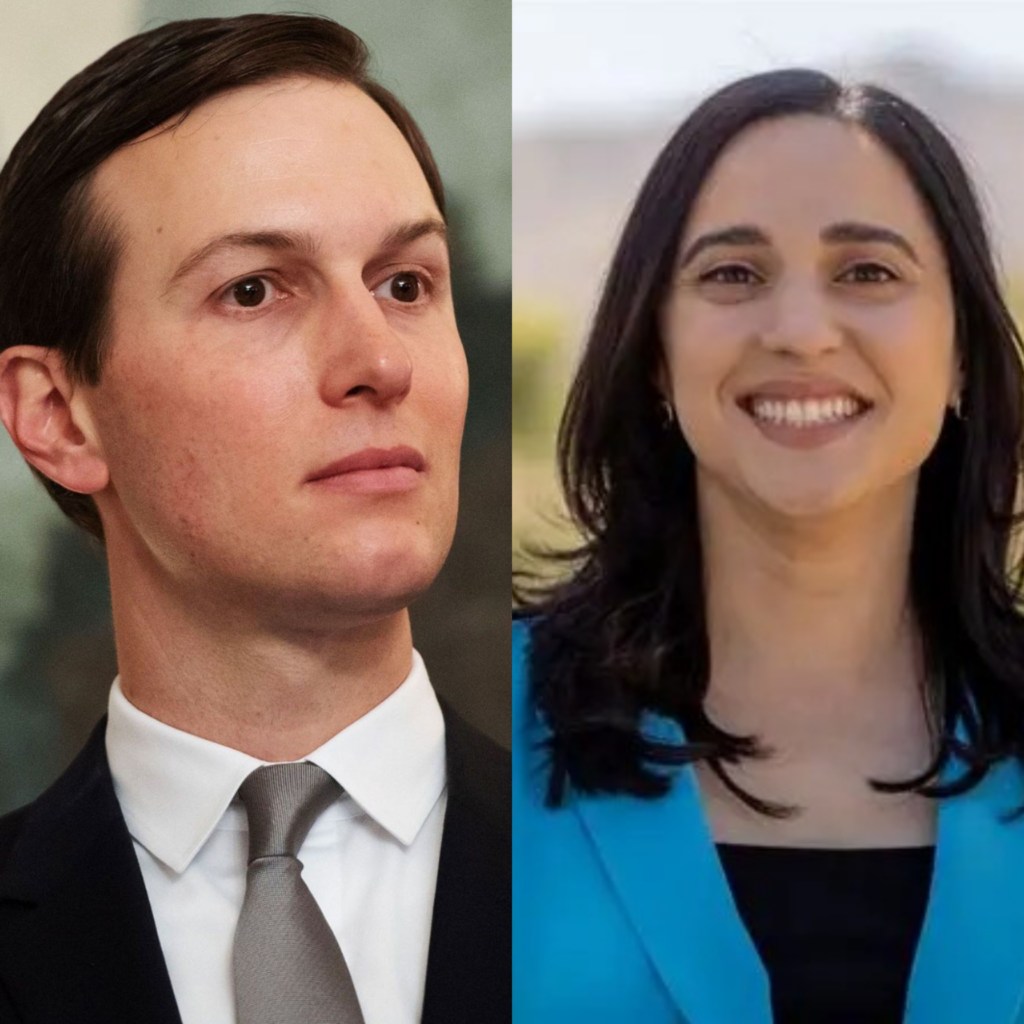
Officials cite national security and ethics concerns tied to investment activity and international negotiations
U.S. Representative Yassamin Ansari says she plans to investigate Jared Kushner over concerns about conflicts between U.S. foreign policy activity and private financial interests.
Kushner is the son-in-law of Donald Trump, a relationship that placed him in a senior advisory role during the Trump administration despite limited prior government or foreign policy experience.
He also has long-standing personal ties to Benjamin Netanyahu. Netanyahu has publicly stated that during earlier visits to the United States, he stayed with the Kushner family and slept in Jared Kushner’s bedroom rather than using official diplomatic accommodation. Analysts and ethics experts often cite these types of personal relationships as relevant context when assessing impartiality in diplomatic roles.
In a House speech, Ansari said Kushner has been involved in discussions related to countries including Iran and Gulf states while also raising investment capital from entities linked to those same governments.
Similar concerns have been raised by other U.S. officials. Representative Jamie Raskin, in launching a congressional inquiry, stated: “You cannot both be a diplomat and a financial pawn of the Saudi monarchy at the same time.”
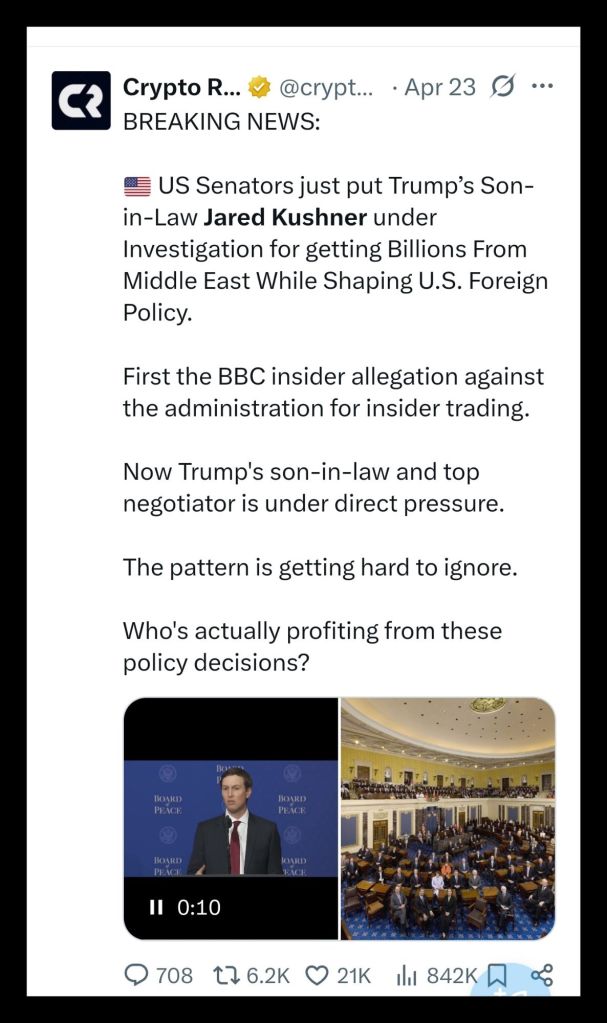
Kushner’s investment firm received a $2 billion commitment from a fund controlled by Mohammed bin Salman. Reporting has indicated that some internal advisers to the fund questioned the decision on financial grounds, but it was approved despite those concerns.
Policy concerns about this type of arrangement have been raised in formal ethics and oversight discussions in the United States. The U.S. Office of Government Ethics has long warned that conflicts can arise when public officials or closely connected individuals maintain financial ties that intersect with foreign governments, particularly where “a reasonable person could question impartiality” in decision-making.
Former White House ethics adviser Walter Shaub, who led the Office of Government Ethics under President Obama, has publicly argued that financial entanglements involving senior political figures and foreign governments can undermine trust even when technically legal. In past commentary on similar arrangements, he said that “the problem is the appearance of corruption, which erodes public confidence in government decisions.”
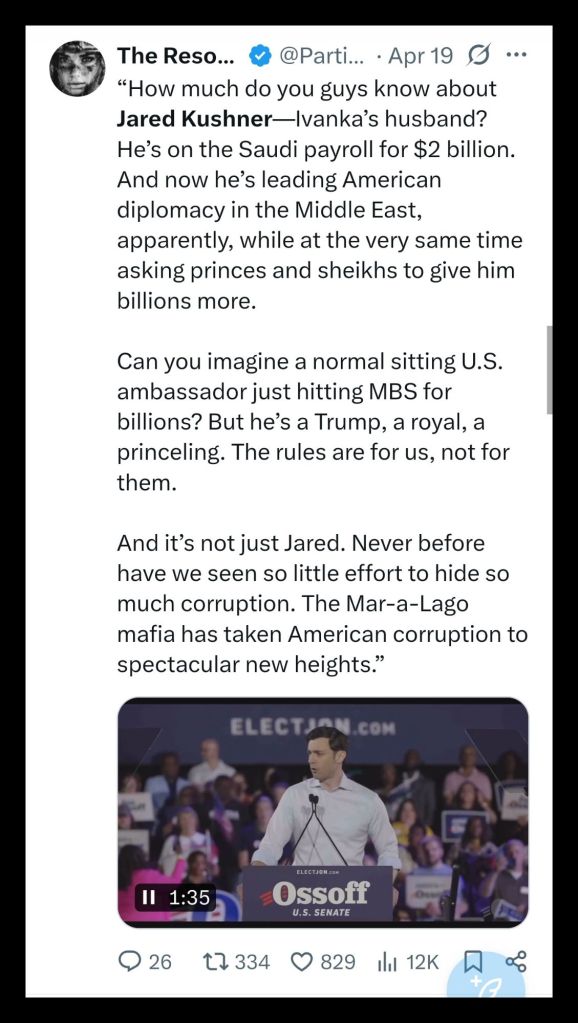
Legal scholar Lawrence Lessig of Harvard Law School has described this broader pattern as “dependence corruption,” where policy outcomes are influenced not through illegal acts, but through structural financial relationships between political actors and concentrated private or state-linked capital.
In congressional oversight discussions, lawmakers have previously noted that sovereign wealth funds investing in politically connected firms raise “potential national security implications,” particularly when those funds are linked to governments that are also major defense customers of the United States.
This concern is often discussed in relation to the structure of the global defense and procurement ecosystem. Major U.S. defense contractors such as Lockheed Martin, RTX Corporation, and Northrop Grumman operate primarily through long-term contracts with the U.S. Department of Defense and allied governments.
At the same time, these firms supply systems to foreign governments in the Middle East, Europe, and Asia under U.S.-approved export frameworks. Countries in the Gulf region are among the largest international buyers of U.S. defense systems, while also operating sovereign wealth funds that invest globally across private equity, infrastructure, and technology sectors.
This creates a layered structure in which state-backed capital, defense procurement, and political relationships can overlap indirectly. Analysts of defense economics note that sovereign wealth funds often pursue investments in sectors aligned with national security priorities, including aerospace, cybersecurity, and dual-use technologies.
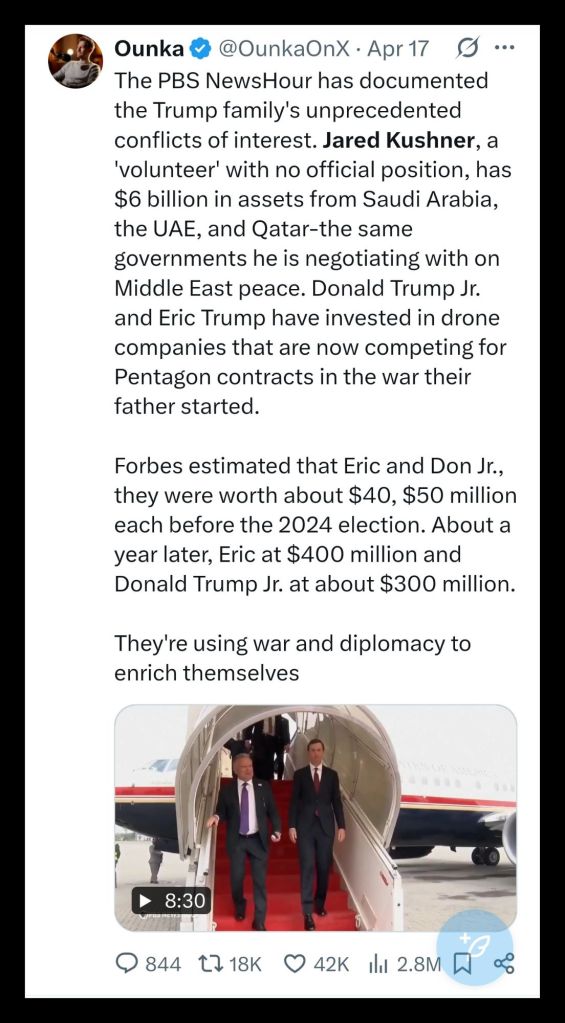
The Israeli defense sector, including firms such as Elbit Systems, operates in a similar environment where government procurement, foreign military sales, and private investment intersect.
The concern raised in oversight discussions is not that any single transaction is inherently improper, but that when individuals with access to policy discussions are also connected to investment structures funded by state-linked capital, it becomes more difficult to clearly separate commercial activity from strategic or political relationships. This is especially relevant in areas involving sanctions policy, regional diplomacy, and defense procurement decisions.
Former CIA Director John Brennan has previously warned that foreign governments often use “multiple channels of influence,” including financial and business relationships, to gain access and leverage in policy environments. This reflects a broader intelligence community view that economic relationships can function as indirect influence pathways even without formal agreements.
There are also relevant statements from foreign governments that reflect how these situations are viewed externally. Russian officials have emphasized structured, state-to-state negotiations and predictable channels. In recent talks, Sergey Lavrov said there is a need for formal discussion on U.S.–Russia relations while noting that “significant differences…persist.”
Russian officials have also previously engaged directly with figures including Kushner during negotiations, with Kremlin representatives describing such discussions as “constructive” and “systematic,” indicating they treated those contacts as part of formal diplomatic engagement despite his informal role.
From the Iranian side, officials have consistently emphasized sovereignty and structured multilateral frameworks in response to U.S. actions, stressing state-led processes as the basis for regional stability. Russian and Iranian messaging during recent conflicts has also included criticism of U.S. approaches to sanctions and regional security policy.
During his time in government, Kushner also had documented contacts with Russian officials, including meetings and communications later reviewed in U.S. investigations into foreign interactions.
Kushner and his representatives have denied wrongdoing and state that his business activities are separate from policy matters. No U.S. court has found him guilty of misconduct in relation to foreign investment or diplomatic activity.
Trump: “Unfortunately, the whole world has become somewhat of a casino. I don’t like it conceptually. It is what it is”.
Additional criticism has come from members of Congress including Jon Ossoff, who has referenced foreign financial ties in broader discussions about ethics and accountability. This raises a broader question about how oversight and accountability function in practice. It is not clear how far investigations into foreign influence in political or policy environments would realistically go, given that members of Congress routinely receive funding and political support from major lobbying organisations with significant influence in Washington, including AIPAC, which operates as a U.S.-based advocacy group rather than a registered foreign agent under the Foreign Agents Registration Act. At the same time, public debate around unresolved high-profile cases in particular, the Jeffrey Epstein Scandal, involving institutional accountability has contributed to skepticism about whether political and legal systems apply scrutiny consistently when sensitive networks of influence, reputation, or political exposure are involved. From that perspective, some observers question whether additional investigations into figures like Kushner would lead to substantive outcomes, or whether they would ultimately be shaped by the same structural incentives and constraints that affect other politically sensitive inquiries.
The issue identified by lawmakers and oversight discussions is whether individuals with access to policy environments should also maintain active financial relationships with foreign state-linked investors, particularly where those governments are also engaged in defense procurement and geopolitical negotiations with the United States.
Authored By: Global GeoPolitics
Thank you for visiting. This is a reader-supported publication. If you believe journalism should serve the public, not the powerful, and you’re in a position to help, becoming a PAID SUBSCRIBER truly makes a difference. Alternatively you can support by way of a cup of coffee:
https://buymeacoffee.com/ggtv |
https://ko-fi.com/globalgeopolitics |
Bitcoin: 3NiK8BoRZnkwJSHZSekuXKFizGPopkE7ns


Leave a comment