
Two recent decisions to remove designated terrorist organisations from US lists sit inside a longer pattern of tactical realignment against China and Russia
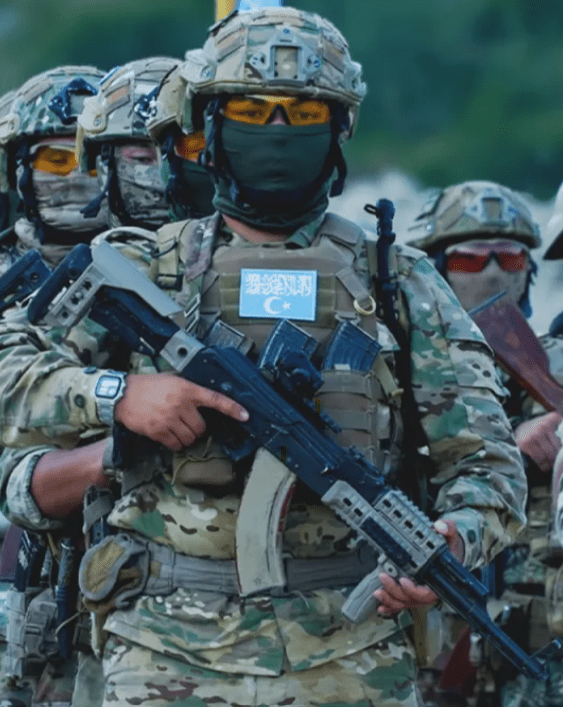
National Public Radio published a lengthy feature on 17 May 2026 profiling Uyghur fighters who helped topple the Assad government in Syria, describing them through interviews conducted in Idlib and Jisr al-Shughur over several weeks. The piece, reported by Emily Feng with support from the Pulitzer Center on Crisis Reporting, quotes Aaron Zelin of the Washington Institute for Near East Policy describing the Uyghur militia as “some of the key fighters that have been associated with Hayat Tahrir al-Sham prior to the fall of the regime,” language that acknowledges the group’s organisational proximity to a movement founded as al-Qaeda’s Syrian branch without dwelling on it. The fighters themselves told NPR they hope one day to “raise an army powerful enough to seize control of Xinjiang,” and Syria’s new government under President Ahmed al-Sharaa has since integrated the largest Uyghur militia into its reconstituted national army, appointing several of its commanders as defence ministry officers. China has responded by refusing, as a permanent member of the UN Security Council, to support lifting terrorism sanctions on Syria until Damascus addresses the Uyghur presence within its own security establishment.
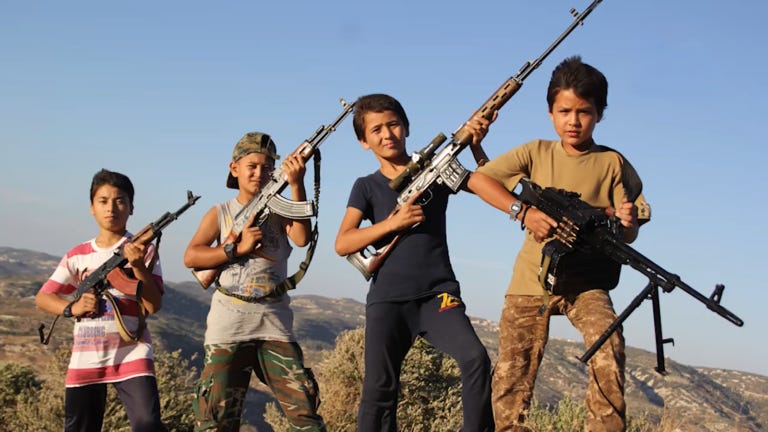
(Uyghur children in Syria)
The Syrian case did not develop in isolation from Washington’s own designation decisions. Secretary of State Marco Rubio announced on 7 July 2025 that the United States was revoking the Foreign Terrorist Organisation designation of al-Nusrah Front, the al-Qaeda affiliate that rebranded itself as Hayat Tahrir al-Sham in 2017, citing the group’s formal dissolution and its transformation into the core of Syria’s new governing structure. The Federal Register notice dates the decision to 23 June 2025, roughly six weeks after President Trump’s meeting with al-Sharaa in Riyadh, the first encounter between American and Syrian heads of state in a quarter century. Britain followed in October, Canada in December, and the United Nations Security Council’s ISIL and al-Qaida sanctions committee removed the group entirely in February 2026, a sequence that transformed an organisation Washington had targeted for over a decade into a diplomatically recognised government within eighteen months.
The Uyghur militant question intersects with a separate, earlier delisting that followed a similar trajectory. Secretary of State Mike Pompeo revoked the terrorist designation of the East Turkestan Islamic Movement, also known as the Turkestan Islamic Party, on 20 October 2020, a group the State Department itself had accused in 2002 of bombing buses, cinemas and department stores inside China. The department’s stated justification, that no credible evidence of the group’s continued existence had surfaced for over a decade, drew swift rebuttal from Beijing, which pointed to the Turkestan Islamic Party’s active combat role in Syria at the very moment the designation lapsed. The group’s own statement following delisting removed any ambiguity about its priorities: a commander identified as Abu Omar al-Turkistani told the outlet Modern Diplomacy that “we are not hostile to either the US or the West. We are hostile to China, which refused to grant us political rights.” The Turkestan Islamic Party’s central leadership figure, Abdul Haq al-Turkistani, remained simultaneously listed by the US Treasury as a specially designated global terrorist and a member of al-Qaeda’s Shura Council, an inconsistency the State Department’s own delisting order did not resolve.
This pattern of selective reclassification has precedent extending back decades before the current confrontation with Beijing took shape. Seymour Hersh’s 2007 New Yorker investigation, “The Redirection,” documented a strategic pivot under the Bush administration in which Washington, working with Saudi Arabia, funnelled support toward Sunni extremist networks as a counterweight to Iranian and Syrian influence, a strategy Hersh’s sources inside the administration described as risking the empowerment of groups sympathetic to al-Qaeda. The pattern recurred during the Syrian civil war itself: the New York Times reported in June 2012 that the CIA was helping steer weapons shipments to Syrian rebel factions, a covert programme later named Timber Sycamore, and the Washington Post reported in November 2014 that US-vetted rebel units had been routed by fighters linked to the al-Nusrah Front, the same organisation Washington would fully rehabilitate a decade later. Each episode involved American officials weighing the risks of arming or tolerating Islamist factions against the perceived benefit of weakening a common adversary, a calculation that has recurred with remarkable consistency across Afghanistan in the 1980s, Syria after 2011, and the Uyghur question since 2020.

The strategic logic behind cultivating armed movements along China’s periphery has been argued openly, by name, in Washington’s own foreign policy press, rather than left to inference. Selig Harrison, formerly the Washington Post’s South Asia bureau chief and a senior scholar at the Woodrow Wilson Center, wrote in The National Interest in 2011 that the United States should “aid the six million Baluch insurgents fighting for independence from Pakistan,” arguing explicitly that an independent Baluchistan “would serve U.S.” interests by denying China its naval and commercial foothold at the Gwadar port Islamabad had granted Beijing in the heart of Baluch territory. The proposal was a policy recommendation rather than an announced programme, and the Balochistan Liberation Army that has since carried out the October 2024 Karachi attack killing two Chinese nationals and the March 2025 hijacking of the Jaffar Express remains simultaneously listed as a terrorist organisation by the same State Department that once published Harrison’s case for arming Baluch separatists against Chinese interests, an unresolved contradiction in Washington’s own record rather than evidence against the underlying strategic logic. A comparable dynamic runs through Myanmar, where the Irrawaddy has documented at least seven major attacks between October 2021 and May 2025 on Chinese-built oil and gas pipeline infrastructure by resistance forces including the People’s Defense Force and the Ta’ang National Liberation Army, groups fighting a military junta that Beijing has propped up specifically to protect those same pipeline investments, according to Stimson Center and Irrawaddy reporting on China’s mediation of ceasefires along its border to safeguard Belt and Road infrastructure. The armed pressure on Chinese assets recurs in each theatre at precisely the points where Beijing has invested most heavily, from Gwadar to the Mandalay pipeline corridor, a geographic correlation that the region’s own resistance movements and Chinese state media alike have noted without needing an American hand proven at every node to register as strategically convenient for Washington.
The National Endowment for Democracy, a congressionally funded body that publishes its grants publicly, has for years supported Uyghur human rights organisations including the World Uyghur Congress, work the endowment credits with helping build congressional momentum toward the 2020 Uyghur Human Rights Policy Act, and this advocacy funding sits alongside, rather than separate from, the harder edge of policy represented by the Turkestan Islamic Party’s delisting the same year: one track builds international legal and diplomatic pressure on Beijing over Xinjiang, the other preserves the option of armed leverage, and both track the same underlying objective through different institutional channels. The US Naval War College Review published a paper in 2018 by Gabriel Collins examining a maritime oil blockade against China, concluding the option was tactically tempting but strategically flawed given the economic damage a prolonged blockade would inflict on the United States itself; the paper’s significance lies less in its cautious conclusion than in its existence, evidence that blockading China’s energy supply has been studied as a live strategic option inside the US military’s own professional literature since well before the current confrontation intensified.
Hayat Tahrir al-Sham’s fighters did not change their combat record between their years fighting the Assad government and their integration into Syria’s defence ministry; Washington’s assessment of their utility changed instead. The Turkestan Islamic Party’s stated hostility toward China preceded its 2020 delisting by many years and has continued unaltered since, and its fighters now sit inside a Syrian state structure roughly two thousand kilometres from the Xinjiang border they were originally organised to cross. Harrison’s 2011 case for arming Baluch insurgents against Chinese port access at Gwadar, Collins’s 2018 study of blockading Chinese oil imports, and the eventual 2020 and 2025 delistings of the Turkestan Islamic Party and Hayat Tahrir al-Sham describe a consistent institutional habit: American strategic and policy literature treats the question of which armed or insurgent actors to designate, tolerate, fund or rehabilitate as an instrument calibrated to the adversary of the moment, first Iran and Assad’s Syria, increasingly China, rather than as a fixed judgement about any given group’s methods.
The core thesis articulated above, on the whole, is positing that the United States is executing a cohesive, long-term global grand strategy specifically engineered to contain the geopolitical rise of China and preserve its own global primacy. Under this overarching objective, seemingly disparate international conflicts across Russia, Iran, Syria, Ukraine, Taiwan, the Philippines, and Xinjiang are characteristically interconnected operational elements of a singular strategy, operating as subordinate vectors within a larger geopolitical design. This grand strategy manifests not merely through overt military posturing, but through an intricate network of interconnected initiatives spanning from the military encirclement of the first island chain to covert political influence operations across Southeast Asia. By maintaining a persistent troop presence in Taiwan, expanding military cooperation agreements with the Philippines, and fortifying forward operating bases in Japan and South Korea, Washington establishes a perimeter designed to constrain Chinese maritime projection. Simultaneously, the cultivation of political elites and the financing of opposition organisations across Thailand, Myanmar, Pakistan, and the Philippines serve to insulate these regions from Beijing’s economic orbit, effectively creating a buffer zone wherein local political architectures can be reoriented to align with Western strategic priorities.
Within this strategic calculus, the deployment of proxy forces emerges as a highly efficient mechanism for exhausting peer competitors while minimizing the direct financial and political costs associated with overt military intervention. The systemic utilisation of state actors, such as Ukraine against Russia or the Philippines within the maritime disputes of the South China Sea, reflects a broader doctrine that prioritizes indirect attrition over direct kinetic engagement. This methodology is equally applicable to non-state actors and militant organizations, which are frequently leveraged to destabilise the critical nodes of rival economic networks. The geographic distribution of these operations targets the continental vulnerabilities of the Belt and Road Initiative, specifically where vital transport and energy infrastructure traverses Pakistan and Myanmar. Because these land corridors provide Beijing with critical insurance against potential maritime blockades at the Malacca Strait, the subversion of internal stability within transit states constitutes a primary objective of Western asymmetric warfare, effectively forcing China to divert substantial resources toward securing its periphery.
The ideological framework necessary to legitimise these encirclement strategies relies heavily on the synchronised execution of international media campaigns and the institutional support of Western-funded non-governmental organizations. A critical examination of the “Uyghur genocide” narrative thus reveals a highly coordinated information operation rather than a detached humanitarian assessment, designed primarily to manufacture domestic consensus for future economic and military escalation. Prominent advocacy organisations, including the Uyghur Human Rights Project and the Campaign for Uyghurs, operate within an institutional network heavily financed by the aforementioned National Endowment for Democracy, a state-funded entity with a documented history of nurturing foreign political upheavals. The dissemination of commentary by figures such as Tahir Imin through outlets like The New York Times and Voice of America illustrates how human rights discourse is systematically weaponized to shape public perception. These media interventions serve to obscure the underlying material realities of the Xinjiang conflict, transforming a complex internal security crisis into a simplified moral binary that precludes independent analytical scrutiny.
The historical reality of radicalisation within Xinjiang demonstrates that the internal violence observed between 2009 and 2015 was substantially driven by external ideological currents rather than purely indigenous grievances. Investigation by the Los Angeles Times confirms that the proliferation of Saudi-funded Salafism systematically undermined the traditional, syncretic Islamic practices of the Uyghur population, introducing a militant, exclusionary theology that fractured local communities and fomented sectarian friction. This imported radicalisation provided the ideological impetus for a series of mass-casualty terrorist attacks across Beijing and Kunming, which were documented at the time by BBC News. In response to this deteriorating security situation, the Chinese state implemented an aggressive domestic strategy focusing on counter-terrorism, deradicalisation, vocational education, and targeted economic development. By addressing the socio-economic disparities of the region and dismantling the infrastructure of extremist recruitment, these programs as aforementioned successfully neutralised the domestic threat of militant violence, thereby compelling radicalised networks to seek alternative theaters of operation.
The displacement of these extremist networks resulted in the migration of thousands of battle-hardened Uyghur combatants to the Syrian conflict, where they were integrated into the broader infrastructure of transnational jihadism. Reporting by NPR confirms that these foreign fighters formed significant operational contingents within anti-government coalitions, acquiring sophisticated tactical training and fighting alongside groups such as Hay’at Tahrir al-Sham to overthrow the administration of Bashar al-Assad. The trajectory of these militant groups corresponds precisely with the long-term strategic designs outlined by investigative journalist Seymour Hersh in his 2007 analysis mentioned eatlier, which detailed covert Western and regional efforts to weaponise Sunni extremist factions to undermine secular Arab republics and degrade Iranian influence. The survival and current integration of these Uyghur cadres into the contemporary Syrian security apparatus pose a continuous threat to Eurasian stability, as these forces retain the explicit long-term objective of returning to China to wage an asymmetric separatist campaign against Beijing according to the Pulitzer Center.
The political management of these organisations by Western intelligence agencies reveals a profound structural flexibility regarding the designation of international terrorist entities. The removal of Hay’at Tahrir al-Sham from formal terrorist classifications, alongside the political rehabilitation of its leadership under Abu Mohammad al-Julani, demonstrates that security designations are frequently subordinated to immediate geopolitical utility. When militant groups serve the strategic imperative of destabilising an adversary state, their extremist credentials are routinely minimised or reclassified under the guise of legitimate political opposition. This pattern of tactical tolerance ensures that organisations like Al-Qaeda, ISIS, and various Uyghur militant factions function as highly flexible geopolitical instruments, maintained as latent assets that can be mobilised or suppressed depending on the shifting requirements of global hegemony. Consequently, the ongoing international focus on the Xinjiang region cannot be understood apart from these broader mechanisms of political warfare, wherein human rights advocacy and managed militancy converge to undermine the sovereign integrity of the Chinese state.
Authored By: Global GeoPolitics
If you prefer to make a one time donation in support of my work, you can do so by clicking any link below:
https://buymeacoffee.com/ggtv |
https://ko-fi.com/globalgeopolitics |
Bitcoin: 3NiK8BoRZnkwJSHZSekuXKFizGPopkE7ns
References
BBC News (2014) China Xinjiang violence: Timeline of attacks. Available at: https://www.bbc.com/news/world-asia-china-26414014 (Accessed: 6 July 2026).
Democracy Digest (n.d.) Articles relating to Uyghur advocacy and democracy promotion. Available at:
(Accessed: 6 July 2026).
Feng, E. (2026) The Foreign Fighters Who Helped Topple Assad—and Why China Worries About Them. NPR, 17 May. Available at:
(Accessed: 6 July 2026).
Freedom House (n.d.) Democracy promotion programmes. Available at:
(Accessed: 6 July 2026).
Hersh, S.M. (2007) The Redirection. The New Yorker, 5 March. Available at: https://www.newyorker.com/magazine/2007/03/05/the-redirection (Accessed: 6 July 2026).
Imin, T. (2025) The World Has Failed the Uyghurs. The New York Times. Available at: https://www.nytimes.com/2026/07/02/opinion/uyghurs-china.html
(Accessed: 6 July 2026).
Kaiman, J. (2015) In China, rise of Salafism fosters suspicion and division among Muslims. Los Angeles Times, 19 July. Available at: https://www.latimes.com/world/asia/la-fg-china-salafists-20150719-story.html (Accessed: 6 July 2026).
National Endowment for Democracy (n.d.) Grants Database. Available at: https://www.ned.org/grants/ (Accessed: 6 July 2026).
Nixon, R. (2011) U.S. Groups Helped Nurture Arab Uprisings. The New York Times, 14 April. Available at: https://www.nytimes.com/2011/04/15/world/15aid.html (Accessed: 6 July 2026).
U.S. Department of State (n.d.) Country reports, foreign terrorist organization designations and related materials. (URL omitted.) (Accessed: 6 July 2026).
Uyghur Human Rights Project (n.d.) Reports and publications. Available at:
(Accessed: 6 July 2026).
Voice of America (n.d.) Reports relating to Uyghur issues. Available at:
(Accessed: 6 July 2026).
WikiLeaks – Public Library of US Diplomacy (PlusD) (n.d.) U.S. diplomatic cables. Available at: https://wikileaks.org/plusd/ (Accessed: 6 July 2026).
Berletic, B. (2026) US Prepares Army of Terrorists to Fight China Across Eurasia as War on Multipolarism Expands. The New Atlas. Available at: https://www.youtube.com/@TheNewAtlas (Accessed: 6 July 2026).


Leave a comment