

Why the warnings of existential risk from artificial intelligence serve the interests of the firms that issue them, and how the real harms of algorithmic governance are already being inflicted on populations that possess no means of resistance
Editorial Analysis | September 2026
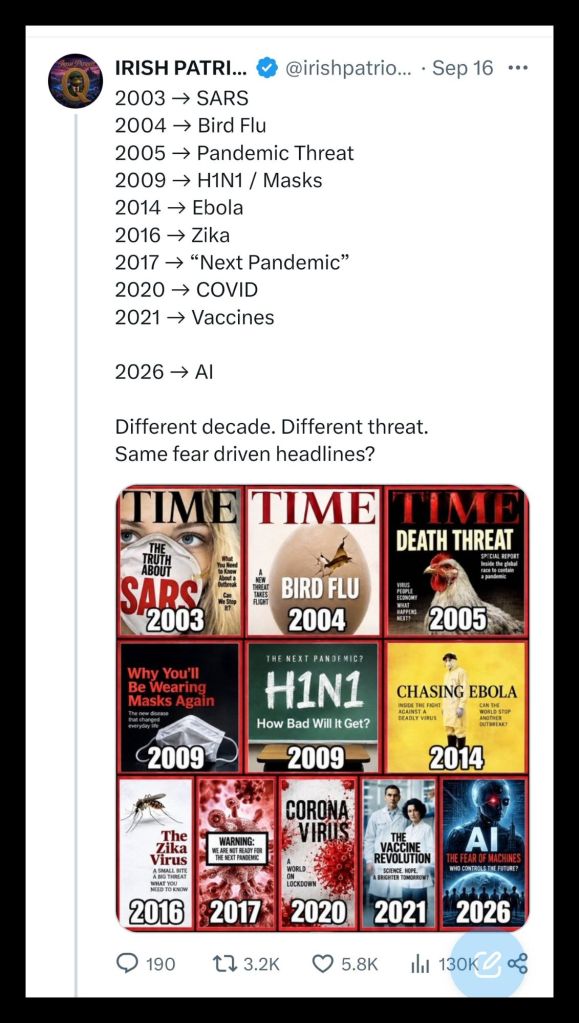
The claim that executives of leading artificial intelligence firms have experienced a genuine crisis of conscience regarding the existential risks posed by their own creations has been widely circulated in mainstream media coverage of the technology sector, yet this narrative warrants serious scepticism on evidentiary grounds. The executives who publicly warn of catastrophic outcomes simultaneously continue to develop, deploy, and profit from the very systems they describe as threatening human survival, and the regulatory frameworks they propose consistently serve to entrench their own market positions rather than constrain their operations [1][2]. This pattern is not coincidental, and it reflects the structural logic of an industry in which competitive advantage depends on regulatory barriers that exclude rivals while preserving the freedom of incumbents to pursue profitable applications of their technology [2]. The fear narrative functions as a strategic instrument through which technology corporations shape the parameters of permissible discourse about artificial intelligence in ways that advance their institutional interests, and the analytical task is to identify the mechanisms through which this narrative operates rather than to accept its claims at face value [1][2].
The material foundation of the technology sector’s power lies in the ownership and control of cloud computing infrastructure, data processing capacity, and the algorithmic systems that mediate an increasing proportion of economic and social activity [3][4]. The major technology firms have constructed proprietary platforms that generate revenue not primarily through the sale of commodities but through the extraction of rents from users who become dependent on services that appear free at the point of access [3]. The capitalization of the so-called magnificent seven technology companies on the New York Stock Exchange reflects not the value of goods and services produced but the power that these firms exercise over the behaviour of their users and the rents that they can extract from that power [4]. The executives who control these platforms possess an interest in maintaining their market dominance, and the fear narrative serves that interest by creating a justification for regulatory frameworks that raise barriers to entry while legitimising the continued expansion of their operations [1][2].
The documented consequences of algorithmic systems in military and commercial applications demonstrate that the real harms of artificial intelligence are already being inflicted, and these harms bear no resemblance to the speculative scenarios of rogue bots that dominate public discussion [5][6]. During the opening phase of the United States and Israeli military campaign against Iran, a strike on a school in Minab killed more than one hundred and twenty children, and subsequent reporting revealed that the targeting decisions were facilitated by Palantir software that required military officers to approve targets within seconds under the pressure of contractors sitting beside them [5]. The artificial intelligence systems that are actually killing people are not autonomous agents that have escaped human control, but rather tools that accelerate and institutionalise decision-making processes that lack adequate safeguards against civilian casualties [5]. The same pattern is visible in the commercial sphere, where Amazon has used algorithmic systems for approximately six years to determine which warehouses should be closed based on calculated probabilities of unionisation, thereby using technology that other firms have employed to design life-saving antibiotics as an instrument of labour discipline [6].
The Chinese model of artificial intelligence development presents a structural challenge to the American proprietary approach, and the response of the United States government to this challenge reveals the geopolitical dimensions of the technology competition [7][8]. The DeepSeek model released in early 2025 demonstrated that Chinese firms could produce systems that were nearly as performant as the frontier models of leading American companies while making them available on an open-source basis, which threatened the business model that American firms had constructed around proprietary technology and monopoly profits [7]. The American response to this challenge has involved the imposition of export controls on semiconductors and the construction of a regulatory architecture that seeks to exclude Chinese firms from global markets, but these measures have not prevented Chinese firms from developing increasingly capable systems [8]. The Chinese advantage lies not only in the quality of its models but in the integration of artificial intelligence with robotics and manufacturing, an approach that positions China to capture the productivity gains from automation in ways that proprietary American models cannot replicate [8].
The European response to the artificial intelligence competition has been characterised by regulatory frameworks that impose substantial compliance costs on technology firms without generating the productive capacity necessary to compete in the development of algorithmic systems [9][10]. The General Data Protection Regulation, which was intended to protect the privacy of European citizens, has had the practical effect of restricting the ability of European firms to leverage data for the development of artificial intelligence applications, while American and Chinese firms operate under frameworks that permit more extensive use of data for commercial purposes [9]. The Draghi report on European competitiveness acknowledged that Europe has failed to develop foundation models that can compete with those produced in the United States and China, and proposed a collective purchasing strategy through which European nations would use their combined market power to negotiate favourable terms with American technology firms [10]. This strategy misunderstands the nature of the power that cloud capital confers, because the ability to manipulate behaviour and extract rents does not depend on the control of physical commodities but on the algorithmic systems that mediate user access to services [3][4].
The class analysis of artificial intelligence development must begin by identifying the specific human agents who own and control the technology and the class interests that their operations serve [3][4]. The executives who run the major technology firms are not representatives of the working class but members of a distinct fraction of the capitalist class whose wealth derives from the ownership of cloud capital and the extraction of rents from users whose behaviour is shaped by algorithmic systems [3]. The professional-managerial class that staffs the technology firms, the intelligence agencies, and the defence contractors that develop and deploy algorithmic weapons systems occupies a position of material interest in the perpetuation of the security paradigm that justifies their employment [5]. The working class that bears the costs of algorithmic discipline in the workplace, algorithmic targeting in military operations, and algorithmic surveillance in daily life possesses no corresponding means of shaping the development of the technology [6]. The narrative of existential risk serves the interests of the owning and professional classes by directing attention away from the material harms that algorithmic systems are already inflicting and towards speculative scenarios that cannot be verified or falsified [1][2].
The regulatory framework that the technology firms have proposed through their public warnings about existential risk is designed not to constrain their operations but to entrench their market position against competition from smaller firms and from foreign adversaries [1][2]. The proposal that governments should impose safety standards on artificial intelligence development would create compliance costs that established firms with substantial resources can absorb while preventing new entrants from gaining a foothold in the market [2]. The exclusion of Chinese firms from the American market through export controls and sanctions achieves the same objective through geopolitical means, and the framing of the technology competition as a struggle between democratic and authoritarian systems obscures the fact that both American and Chinese firms are pursuing the same objective of market dominance through proprietary control of algorithmic systems [7][8]. The distinction that matters is not between democratic and authoritarian applications of artificial intelligence but between open-source models that distribute the technology broadly and proprietary models that concentrate it in the hands of a few [7].
The historical precedents for this pattern of regulatory capture are instructive, and they illuminate the mechanisms through which the technology firms have shaped the parameters of permissible discourse about artificial intelligence [2]. The industrialists who dominated the railroad, steel, and oil industries in the late nineteenth and early twentieth centuries similarly invoked the public interest when seeking regulatory protections that excluded competitors and stabilised their market positions, and the regulatory frameworks that emerged from these efforts served the interests of the regulated industries more effectively than they served the public [2]. The technology firms that now dominate the artificial intelligence sector are following a similar strategy, and the fear narrative that they have constructed serves the same function as the safety rhetoric that their predecessors deployed [1][2]. The threat of catastrophic outcomes is invoked not to justify genuine constraints on the industry but to legitimise the imposition of regulatory barriers that protect incumbents from competition [2].
The final assessment must remain analytical rather than definitive, because the trajectory of artificial intelligence development and its implications for class power and geopolitical competition remain uncertain and the evidence available is incomplete [7][8]. Several scenarios are possible, and they depend on the interaction of variables that cannot be predicted with confidence. The American technology firms could succeed in entrenching their market dominance through regulatory capture and geopolitical exclusion, thereby preserving their power to extract rents and shape behaviour [1][2]. The Chinese model of open-source development could prevail, thereby distributing the benefits of algorithmic systems more broadly and enabling developing nations to capture productivity gains from automation [7][8]. The European nations could develop coherent strategies that leverage their industrial and human capital to participate in the artificial intelligence economy, thereby avoiding the marginalisation that current trends project [10]. Or the contradictions of the current trajectory could produce a crisis that forces a fundamental reorientation of the relationships between technology corporations, governments, and the populations whose behaviour they seek to shape [3][4]. The indicators that would confirm or undermine each scenario are observable: the pace of open-source model development, the effectiveness of export controls in restricting Chinese access to advanced semiconductors, the trajectory of European industrial policy, and the frequency and severity of algorithmic harms in military and commercial applications [5][6]. What is clear from the evidence assembled here is that the fear narrative serves the interests of the firms that issue it, that the real harms of algorithmic systems are already being inflicted on populations that possess no means of resistance, and that the regulatory frameworks that the technology firms propose are designed to entrench their power rather than constrain it [1][2].
Authored By: Global GeoPolitics
Thank you for visiting. This is a reader-supported publication. If you believe journalism should serve the public, not the powerful, and you’re in a position to help, becoming a PAID SUBSCRIBER truly makes a difference. Alternatively you can support by way of a cup of coffee:
https://buymeacoffee.com/ggtv |
https://ko-fi.com/globalgeopolitics |
Bitcoin: 3NiK8BoRZnkwJSHZSekuXKFizGPopkE7ns
References
[1] Anthropic (2025) ‘The Case for AI Regulation’, Anthropic, June. Available at: https://www.anthropic.com/news (Accessed: 21 September 2026).
[2] Stigler, G.J. (1971) ‘The Theory of Economic Regulation’, Bell Journal of Economics and Management Science, 2(1), pp. 3-21. Available at: https://www.jstor.org/stable/3003160 (Accessed: 21 September 2026).
[3] Varoufakis, Y. (2023) Technofeudalism: What Killed Capitalism. London: Bodley Head. Available at:
(Accessed: 21 September 2026).
[4] Durand, C. (2020) ‘Technofeudalism: A New Form of Capitalism?’, New Left Review, 122, pp. 63-86. Available at:
(Accessed: 21 September 2026).
[5] Human Rights Watch (2026) ‘Iran: US-Israeli Strike on School Was Unlawful’, Human Rights Watch, 15 March. Available at:
(Accessed: 21 September 2026).
[6] The Guardian (2022) ‘Amazon used algorithm to calculate likelihood of unionisation at warehouses, report says’, The Guardian, 21 April. Available at: https://www.theguardian.com/technology (Accessed: 21 September 2026).
[7] Reuters (2025) ‘China’s DeepSeek triggers global tech sell-off with low-cost AI model’, Reuters, 27 January. Available at:
(Accessed: 21 September 2026).
[8] Lee, K.F. (2018) AI Superpowers: China, Silicon Valley, and the New World Order. Boston: Houghton Mifflin Harcourt. Available at:
(Accessed: 21 September 2026).
[9] European Commission (2018) 2018 reform of EU data protection rules. Brussels: European Commission. Available at:
(Accessed: 21 September 2026).
[10] Draghi, M. (2026) ‘Europe’s Difficult Choices on AI’, Financial Times, 11 September. Available at:
(Accessed: 21 September 2026).


Leave a comment