
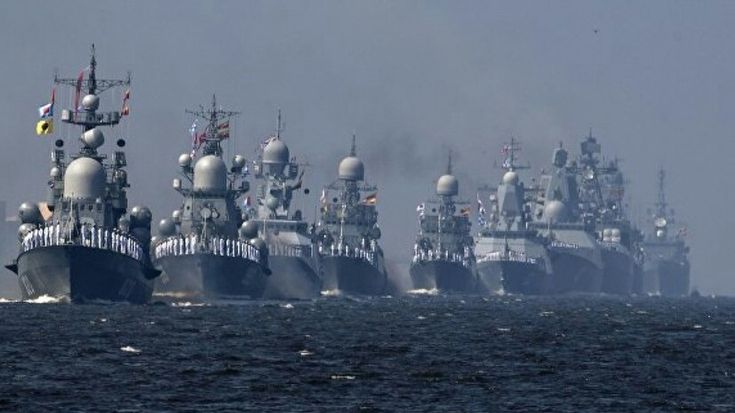
Convergence among Iran, China, and Russia in the Strait of Hormuz alters American risk calculations, though it does not remove the structural capacity of the United States to initiate military action.
American primacy in the Strait of Hormuz rests upon a maritime doctrine shaped by Alfred Thayer Mahan’s classic argument that control of sea lanes underwrites national power, an argument long embedded within United States naval planning and institutional culture. The United States Fifth Fleet, headquartered in Manama, operates as the operational arm of that doctrine in the Persian Gulf, integrating carrier strike groups, guided missile destroyers, and surveillance platforms into a continuous presence mission. Official statements from United States Central Command repeatedly frame this deployment as protection of freedom of navigation and defence of the rules based order, language reflecting a liberal internationalist conception of maritime governance rooted in post 1945 American strategy. Scholars within the realist tradition, including John Mearsheimer, have argued that such forward deployments represent classical offshore balancing combined with hegemonic maintenance, designed to prevent rival powers from dominating critical regions whose resources affect global distribution of power.
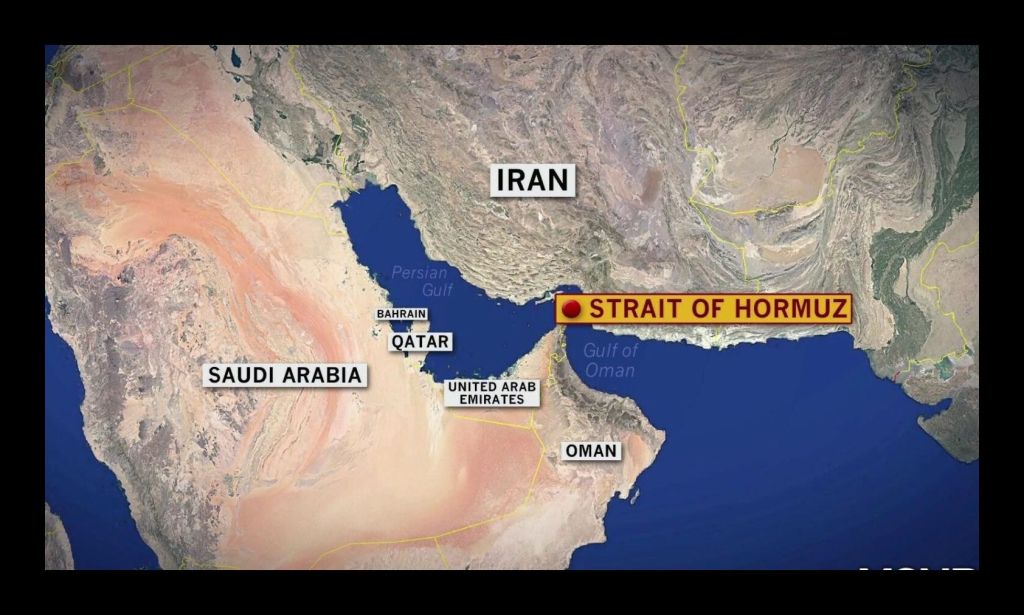
Roughly twenty percent of globally traded crude oil transits the Strait of Hormuz, a figure cited by the United States Energy Information Administration and widely used in strategic assessments. Energy economists from independent research houses have noted that even temporary disruption of tanker traffic would reverberate through futures markets within hours, raising insurance premiums and amplifying price volatility across Europe and Asia. Such structural centrality explains why Washington couples naval patrols with sanctions regimes targeting Iranian oil exports, seeking to shape both physical and financial flows of energy. Secondary sanctions imposed on firms facilitating Iranian crude shipments rely upon control of dollar clearing systems and access to Western insurance markets, embedding maritime security within a wider architecture of financial coercion.
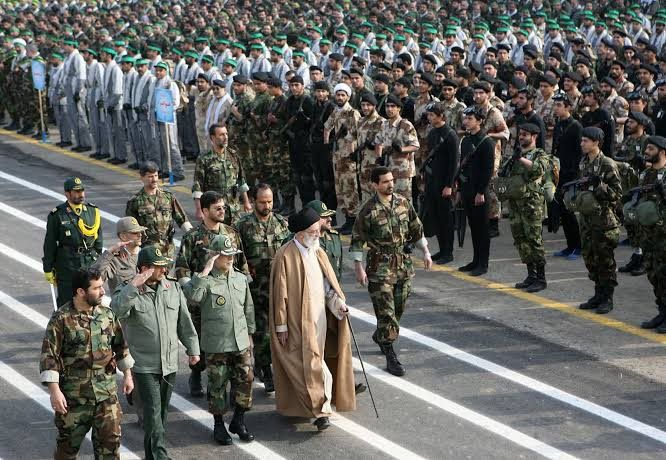
Iran’s strategic posture in the strait reflects a doctrine of asymmetric denial developed after the Iran Iraq War and refined under sustained sanctions pressure. Commanders of the Islamic Revolutionary Guard Corps Navy have publicly described their concept of layered defence, combining coastal anti ship missile batteries, naval mines, fast attack craft, and increasingly sophisticated drone systems capable of swarm tactics in confined waters. Iranian officials have repeatedly warned that closure of the strait would follow any attempt to strangle the country’s economy completely, framing Hormuz as both deterrent instrument and bargaining lever. Analysts such as Mohammad Marandi have argued that Iran’s approach draws upon a defensive realism grounded in survival under external pressure, rather than expansionist ambition, while Western naval strategists often interpret the same capabilities as escalatory and destabilising.
China’s engagement in the Persian Gulf derives from structural dependence on imported hydrocarbons and from a long term vision of Eurasian integration articulated through the Belt and Road Initiative. Chinese crude imports from the Gulf constitute a substantial portion of total supply, with significant volumes sourced from Iran despite sanctions through discounted arrangements and alternative payment mechanisms. Professor Glenn Diesen has contended that Eurasian connectivity projects aim to reduce vulnerability to maritime chokepoints dominated by the United States Navy, thereby weakening Washington’s capacity to weaponise interdependence. Beijing’s diplomatic facilitation of rapprochement between Tehran and Riyadh in 2023 illustrated a preference for stabilising commercial corridors without replicating American style military basing structures.
Russia’s position in the Gulf must be read against the background of sanctions and strategic confrontation following the conflict in Ukraine. Moscow expanded energy coordination with Tehran, including swap arrangements and discussions regarding integration of payment systems beyond the Society for Worldwide Interbank Financial Telecommunication. Russian officials have framed such cooperation as part of a broader transition toward multipolarity, a term frequently invoked by Foreign Minister Sergey Lavrov to describe erosion of Western dominance. Within Russian strategic thought, influenced by Eurasianist writers and realist theorists, maritime collaboration with China and Iran signals alignment against what Moscow characterises as unilateral enforcement regimes.
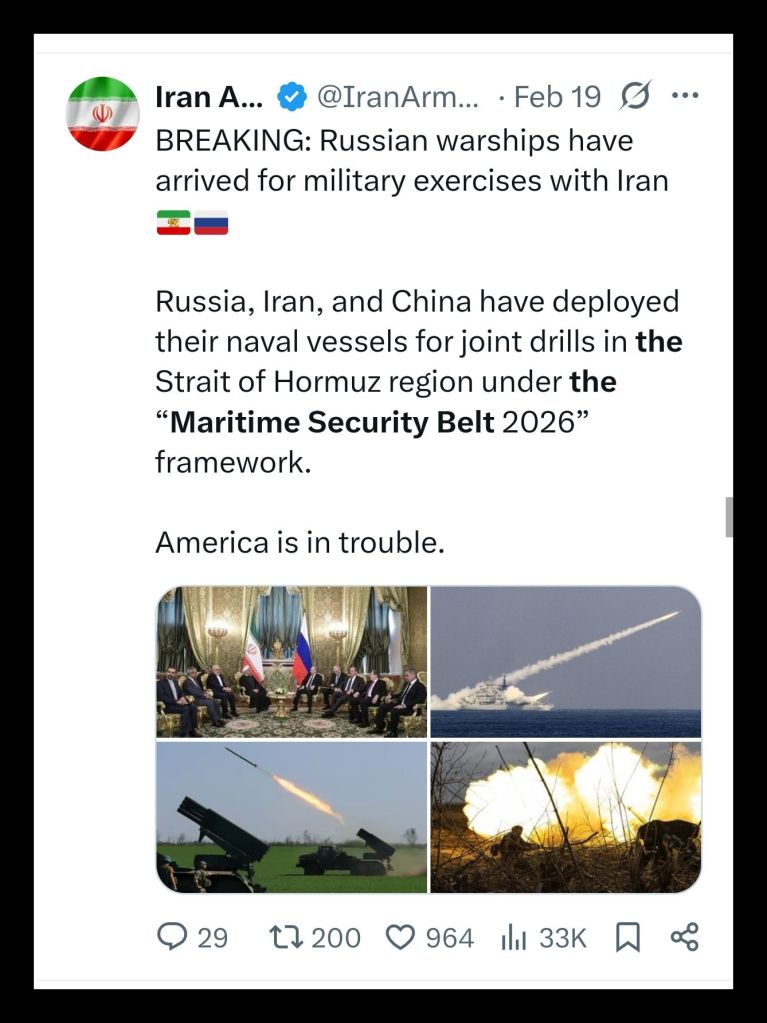
Joint naval exercises under the banner of the Maritime Security Belt have evolved from limited drills into more structured frameworks incorporating frontline assets from Russia, China, and Iran. The 2026 iteration deployed advanced surface combatants and support vessels into the Strait of Hormuz and adjacent waters, marking a qualitative expansion beyond symbolic port calls. Nikolai Patrushev, Assistant to the President of Russia and Chairman of the State Maritime Council, described the exercise as timely and strategically relevant, language reflecting Moscow’s view that coordinated presence in critical chokepoints enhances deterrence and political signalling. Chinese defence commentators emphasised counter piracy and maritime security cooperation, while Iranian commanders highlighted resistance to unilateral pressure.
Strategic theory offers competing lenses through which to interpret this convergence. Offensive realists would argue that rising powers seek to displace hegemonic control over critical sea lanes, testing American resolve through incremental presence and signalling. Defensive realists might instead interpret the exercises as hedging behaviour by states facing sanctions and containment, designed to raise the cost of coercion without provoking open war. Liberal institutionalists focus upon the absence of inclusive maritime governance structures that accommodate emerging powers, suggesting that exclusion from decision making forums encourages parallel security frameworks. Independent analysts outside mainstream Atlantic institutions have observed that sanctions and military encirclement often produce tighter coordination among targeted states, reinforcing rather than weakening their strategic cooperation.
Economic dimensions of the convergence remain central. American secondary sanctions compel Chinese refiners to utilise smaller trading houses, reflagged tankers, and non dollar settlement channels when purchasing Iranian crude. Discussions within BRICS forums regarding expansion of local currency trade reflect dissatisfaction with dollar centred clearing systems vulnerable to political decisions in Washington. Financial analysts from research groups critical of excessive sanctions argue that fragmentation of payment infrastructure accelerates development of parallel systems, reducing long term efficacy of unilateral measures. Insurance markets and maritime logistics companies respond pragmatically to risk assessments, adjusting premiums and routing decisions based upon perceived stability in the strait.
Gulf monarchies observe this shifting geometry with caution. Saudi Arabia and the United Arab Emirates maintain deep security ties with the United States, including procurement of advanced aircraft and missile defence systems, while simultaneously expanding trade and investment relations with China. Sovereign wealth funds allocate capital toward Asian markets at increasing scale, reflecting economic gravity shifting eastward. Regional officials publicly endorse freedom of navigation while privately acknowledging that diversification of partnerships provides insurance against overreliance on any single external power.
Operational risk within the Strait of Hormuz remains acute due to proximity of rival naval assets and dense commercial traffic. Independent maritime security experts warn that miscalculation rather than deliberate escalation poses the greatest immediate danger, given the compressed geography and rapid decision cycles involved in encounters between patrol craft and surveillance platforms. Rules of engagement and communication channels therefore assume heightened importance in preventing tactical incidents from escalating into strategic crises.
Convergence among the United States, Iran, China, and Russia in the Persian Gulf thus reflects structural transformation of the international system rather than episodic manoeuvring. American maritime primacy encounters coordinated though limited challenges from powers seeking insulation from sanctions and strategic encirclement. The Maritime Security Belt framework symbolises that coordination, embedding naval drills within broader economic and diplomatic realignment. Chokepoints such as the Strait of Hormuz crystallise these dynamics because control of narrow waters intersects with control of energy flows and financial architecture.
Authored By: Global GeoPolitics
Thank you for visiting. This is a reader-supported publication. I cannot do this without your support. If you believe journalism should serve the public, not the powerful, and you’re in a position to help, becoming a PAID SUBSCRIBER truly makes a difference. Alternatively you can support by way of a cup of coffee:
https://buymeacoffee.com/ggtv |


Leave a comment