
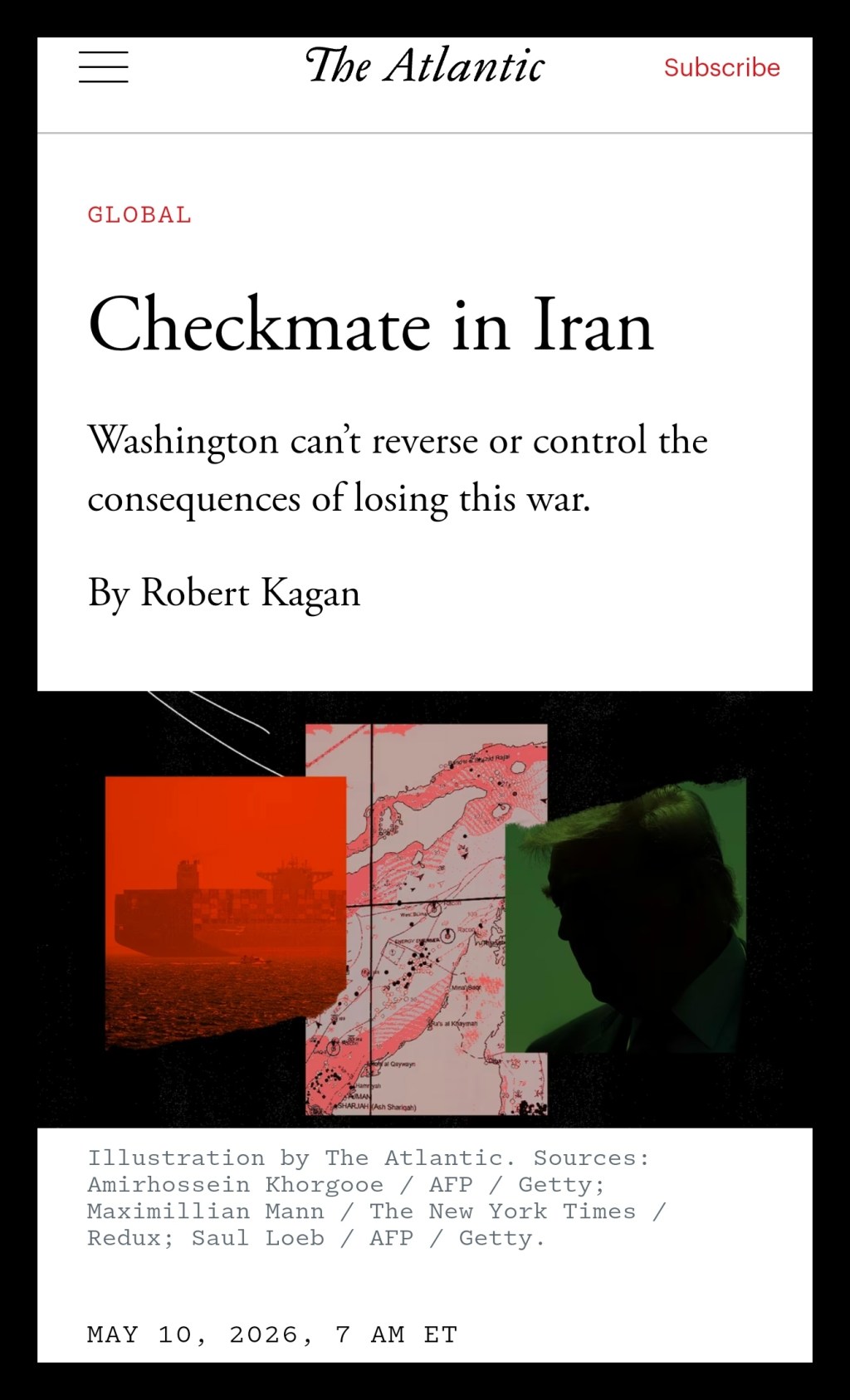
The co-founder of the Project for the New American Century writes the Empire’s Obituary – How the United States Lost a War it Started and Cannot Escape the Consequences
When Robert Kagan writes that the United States has suffered a total defeat from which it cannot recover, the machinery of American imperialism has not merely stalled. That hubristic machinery has broken down in plain view of the entire world. Kagan is not an anti-war activist or a left-wing critic of American power. He is the co-founder of the Project for the New American Century, the most aggressively imperialist think tank to emerge from the Washington swamp in the last thirty years. He is the husband of Victoria Nuland (Madam Regime Change), the former State Department official who helped orchestrate the 2014 coup in Ukraine and who has spent her career advocating for confrontation with Russia, Iran, and China. He is the brother of Frederick Kagan, one of the intellectual architects of the Iraq War surge. When Dick Cheney needed ideological reassurance before invading Iraq, he called people like Robert Kagan. And now, in the pages of The Atlantic, the same man who spent decades demanding American military intervention across the Middle East has published an obituary for the very project he helped build.
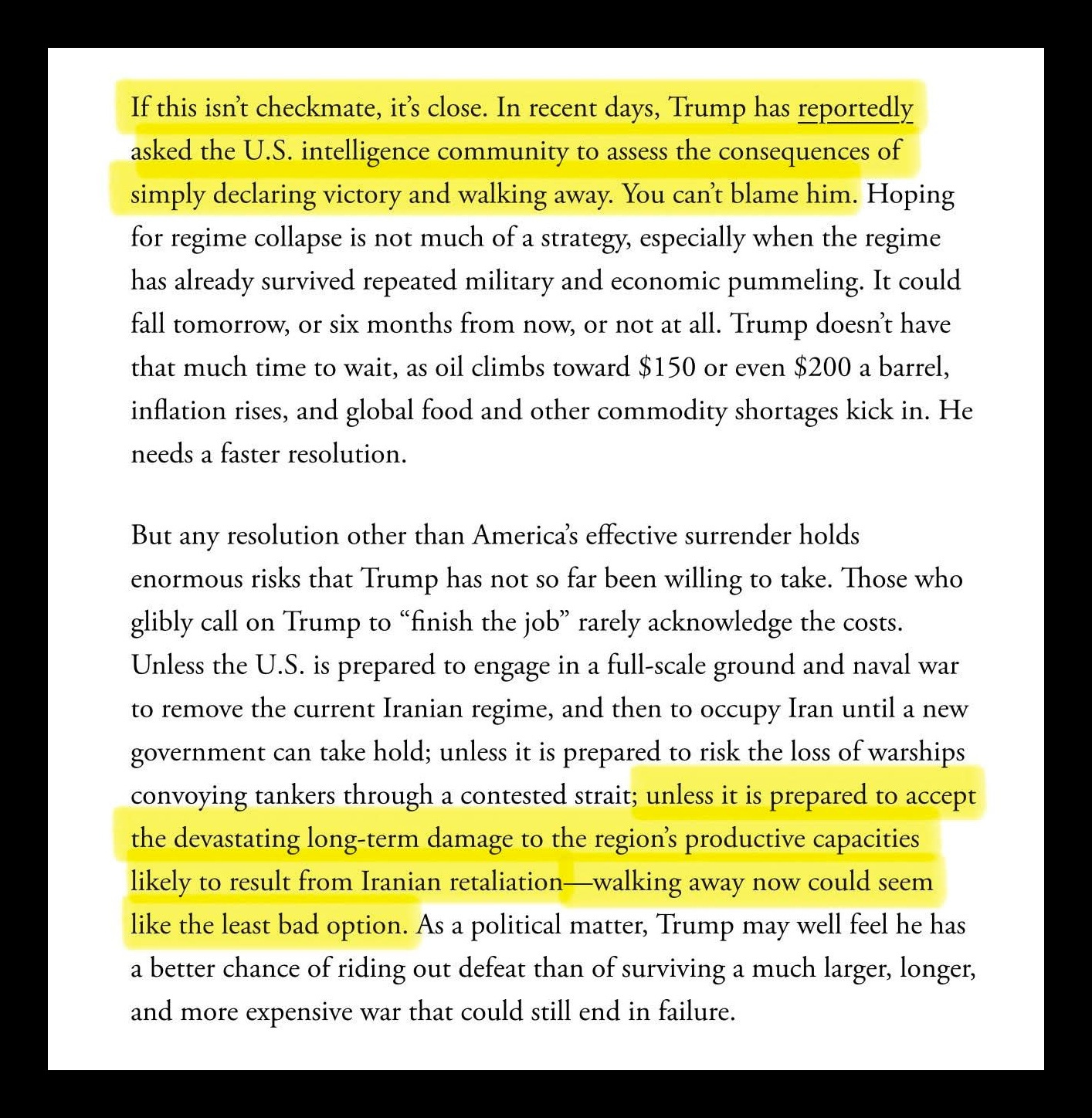
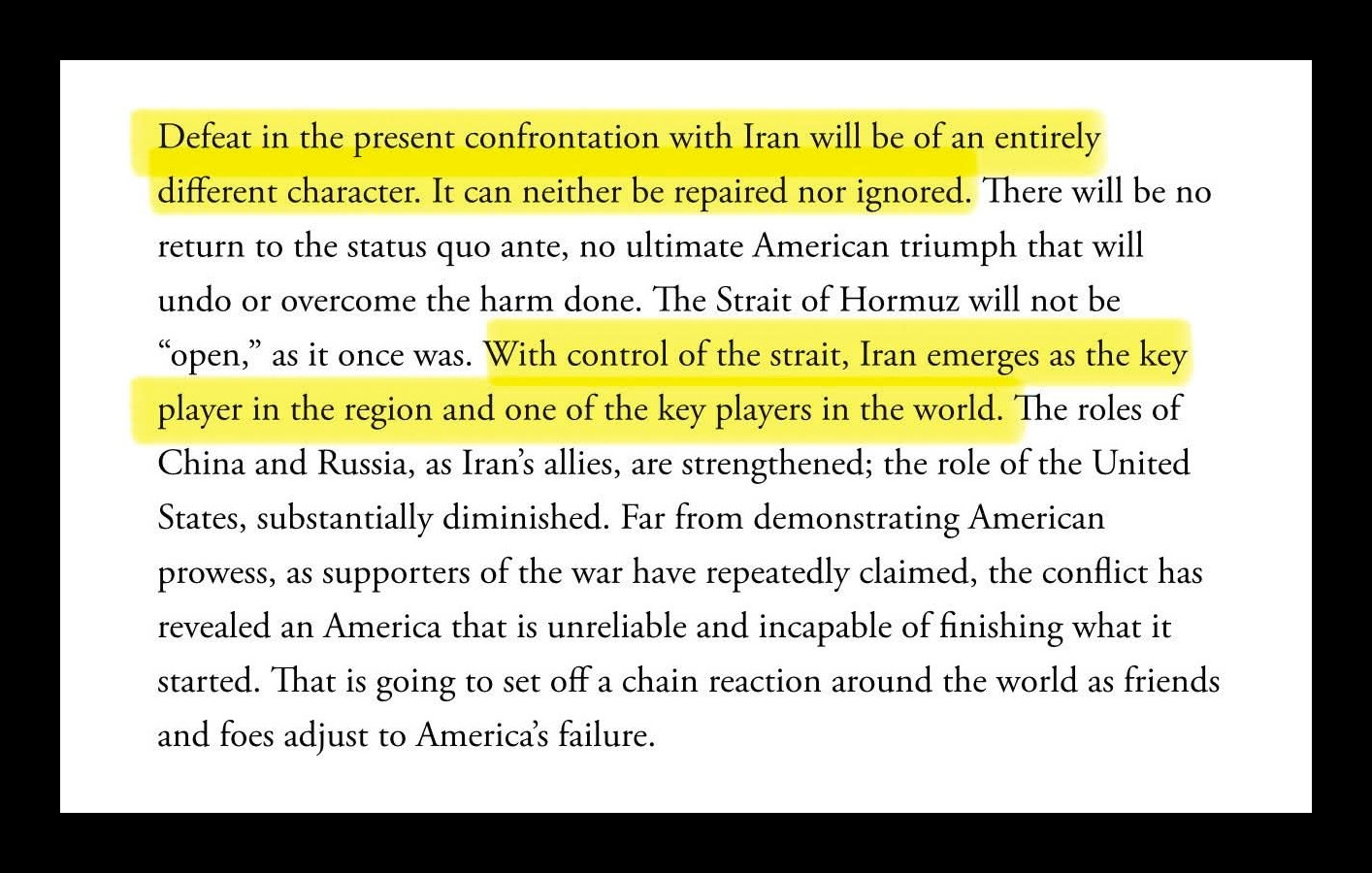
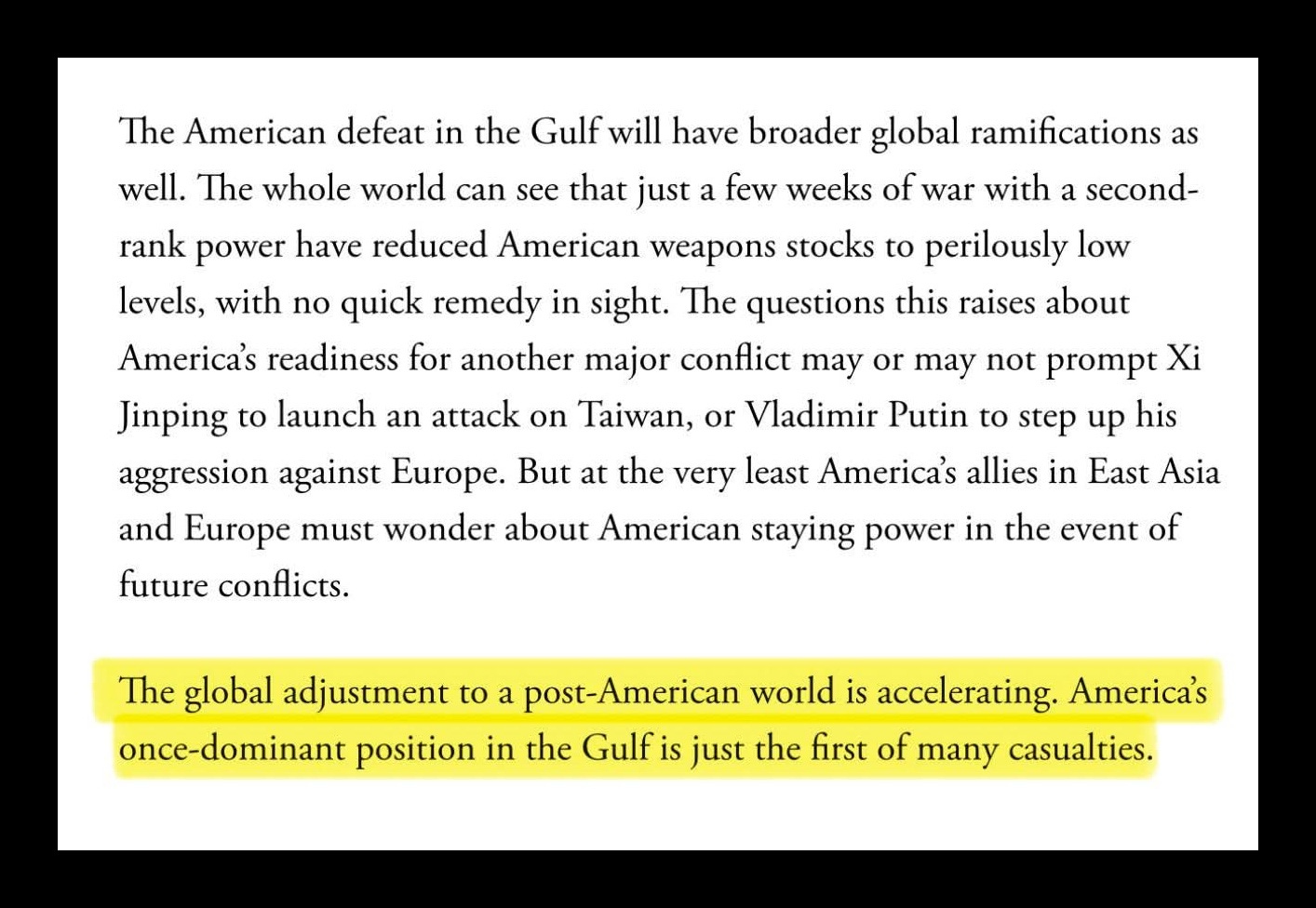
Kagan’s diagnosis in “Checkmate In Iran” published yesterday in “The Atlantic” is unambiguous. The United States cannot reverse the consequences of its defeat in Iran. It cannot control those consequences either. The Strait of Hormuz will not return to its previous status as an open waterway under American-managed security. Iran has emerged from this conflict as the key player in the Persian Gulf region and, by extension, as one of the key players in global energy geopolitics. The roles of Russia and China, as Iran’s allies, have been substantially strengthened, while the role of the United States has been substantially diminished. Far from demonstrating American prowess, the war has revealed an America that is unreliable, incapable of finishing what it started, and dangerously low on the weapons stocks required for any future major conflict. Kagan notes that just a few weeks of war with a second-rank power have reduced American munitions inventories to perilously low levels, with no quick remedy in sight. This is not the language of a peacenik exaggerating defeat. This is the language of a hawk forced to confront the consequences of his own worldview.
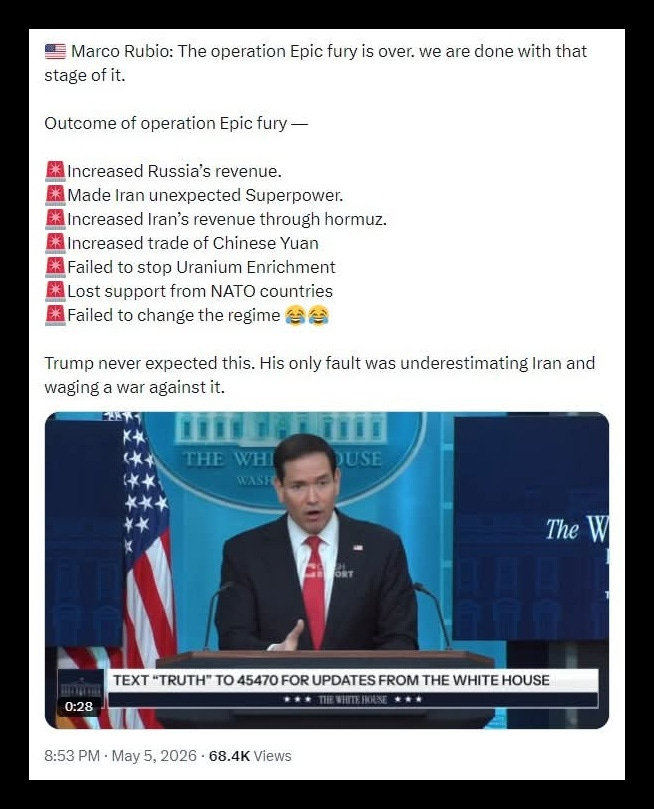
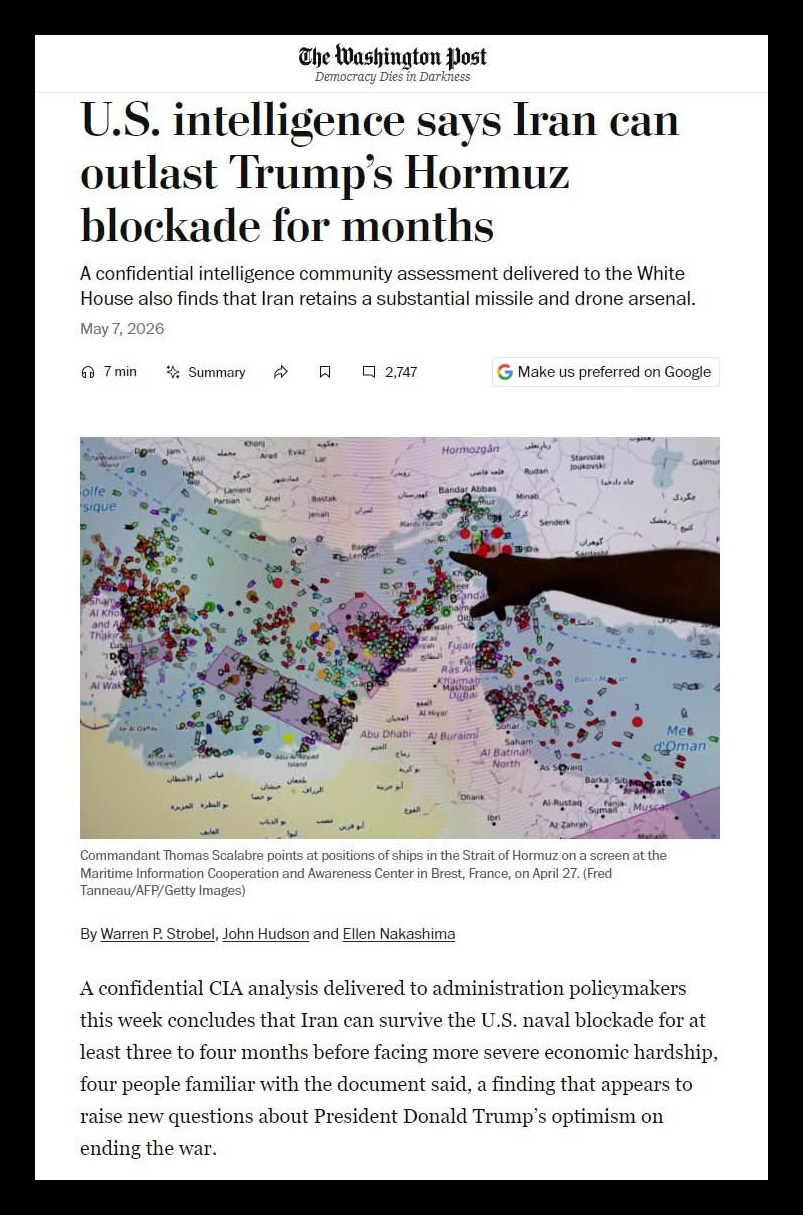
The intelligence community assessments leaked to the Washington Post confirm Kagan’s worst fears. Iran retains approximately seventy-five percent of its prewar missile launchers and inventory, despite weeks of intense American and Israeli bombardment. The Iranian regime has recovered and reopened almost all of its underground storage facilities. It can survive the American naval blockade for at least three to four months before facing more severe economic hardship, a timeline that far exceeds the political patience of any American administration. President Trump has reportedly asked for an intelligence assessment of the consequences of simply declaring victory and walking away, because the alternative is a full-scale ground and naval war to remove the Iranian regime, the occupation of Iran until a new government can take hold, and the acceptance of devastating long-term damage to the region’s productive capacities. No American president can sell that war. No American electorate would support it. The only remaining option is to accept defeat and manage its consequences.
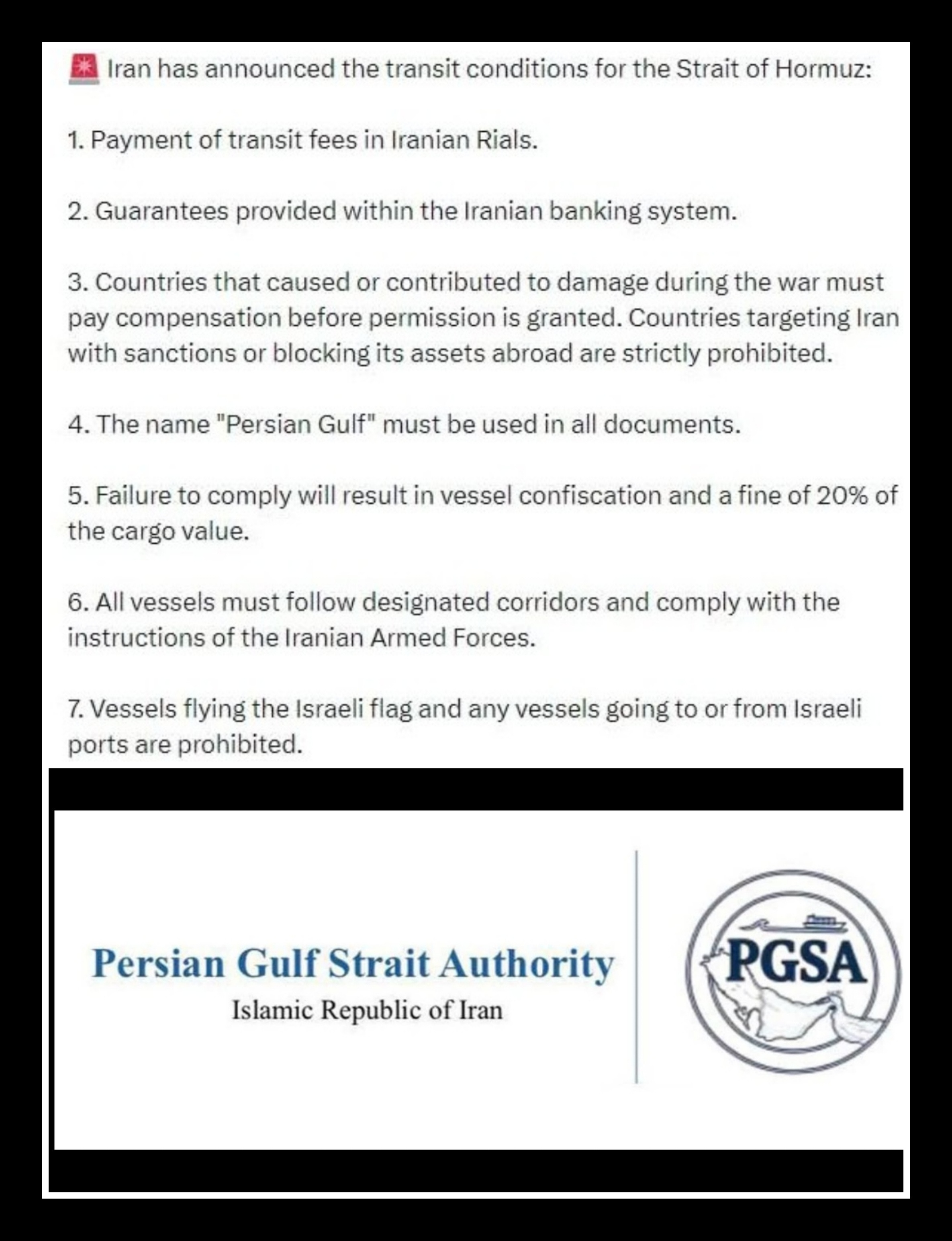
Iran has understood this strategic reality from the very beginning of the conflict. The Iranian response to American desperation has been a series of maximalist demands that would have been unthinkable before the war. Iran will not allow the United States to exit the crisis it created without paying reparations for war damage. The Strait will remain closed until the United States pays, even if all American forces withdraw fully from the region. Iran has announced the establishment of the Persian Gulf Strait Authority, a new regulatory body that will control all shipping through the Strait of Hormuz under terms dictated by Tehran. Those terms include the payment of transit fees in Iranian currency, guarantees provided within the Iranian banking system, compensation from countries that caused damage during the war, the exclusive use of the name Persian Gulf in all documents, and a complete prohibition on vessels flying the Israeli flag or travelling to and from Israeli ports. Failure to comply will result in vessel confiscation and a fine of twenty percent of the cargo value. These are not the demands of a defeated nation. They are the terms of a victor.
The military reality beneath this political framework is even more devastating for American pretensions. Reports from the Strait of Hormuz in early May 2026 describe an engagement in which three American destroyers, the Truxtun, the Mason, and the Rafael Peralta, attempted to transit the Strait from the Gulf of Oman. The Iranian response combined anti-ship ballistic and cruise missiles, kamikaze drones with high-explosive warheads, and fast attack boats. The destroyers were forced to deploy their last-resort defence systems, including CIWS close-in weapon systems, and retreated under fire. NASA FIRMS satellite data showed large fires in the exact area of the engagement, suggesting ships burning and drifting with the current. The American counter-response, described as impotent anger by analysts on the ground, consisted of strikes on several points on Qeshm Island. These strikes changed nothing. The undisputable conclusion, as one analyst put it, is that the United States Navy cannot escort even a seagull, let alone oil tankers, across the Strait of Hormuz. That will remain the case from now on.
This defeat has direct and immediate implications for the broader American imperial agenda, which the Senate hearing on Indo-Pacific Command made transparent only weeks before the Iranian collapse. The core axiom of that agenda was unipolar maintenance through the containment of China, supported by European proxies against Russia and Middle Eastern proxies against Iran. The Iran war was never primarily about Iran. It was about decoupling Asia from Middle Eastern energy and forcing Japan, South Korea, the Philippines, and Taiwan into dependency on expensive American liquefied natural gas. It was about demonstrating American military credibility to deter China from acting against Taiwan. It was about proving that the United States could fight and win a war on one front while preparing for a war on another. Every single one of those strategic objectives has now been destroyed by the defeat in the Strait of Hormuz.
The energy decoupling strategy is dead. Asia has just watched the United States Navy flee from Iranian anti-ship missiles in the most important energy chokepoint on the planet. Japan, South Korea, and the Philippines now know that American naval power cannot guarantee the safe passage of a single tanker through waters that Iran controls. The LNG projects that senators from Alaska and Texas were promoting as strategic assets now look like stranded investments, because no Asian buyer will pay a premium for American gas when the alternative is to negotiate directly with Iran for safe passage through the Strait. Iran has become the gatekeeper of Middle Eastern energy exports to Asia, and the United States has no military means to change that fact. The entire logic of the Senate hearing from April 2026 has been rendered obsolete by events that occurred less than three weeks later.
The implications for the Ukraine-Russia war are equally severe. Kagan acknowledges that the depletion of American weapons stocks raises serious questions about America’s readiness for another major conflict. European allies watching the Iranian debacle must now wonder whether American weapons shipments to Ukraine can be sustained at previous levels. The United States has fired an enormous quantity of munitions in the Middle East, including precision-guided missiles, air defence interceptors, and naval ordnance. Replacing these stocks will take years, given the current capacity of the American defence industrial base. Russia, meanwhile, has been watching the same events and drawing its own conclusions. The Russian military has already adapted to the Ukrainian battlefield through increased drone production, electronic warfare, and artillery shell manufacturing from North Korean and Iranian suppliers. If the United States cannot sustain a blockade against Iran, how can it sustain a proxy war against Russia indefinitely? The credibility of the American security guarantee to Europe, already damaged by the chaos of the Trump administration, has now been shattered by Iranian missiles in the Strait of Hormuz.
The main target of the American imperial agenda, however, has always been China. The entire architecture of Indo-Pacific Command, the forward bases in Japan and South Korea, the AUKUS submarine deal with Australia, the arming of Taiwan, and the encirclement of the South China Sea were all designed to contain China’s rise and preserve American primacy in Asia. That architecture now stands revealed as a house of cards. China has watched the United States lose a war to Iran, a country with a fraction of China’s military and economic power. China has watched American destroyers flee from Iranian anti-ship missiles and American intelligence agencies admit that Iran retains three-quarters of its missile inventory. China has watched the United States beg the international community to intervene in the Strait of Hormuz, unable to solve the problem itself. The Chinese leadership will have drawn one unavoidable conclusion: the United States cannot win a war against a determined regional power, and it certainly cannot win a war against a peer competitor on the other side of the world.
The ramifications of Iran emerging as a regional superpower and a Eurasian big power extend far beyond the Persian Gulf. Iran now sits at the centre of a newly solidified Eurasian axis that includes Russia, China, and the Central Asian republics. The Shanghai Cooperation Organisation already includes Iran as a full member. The Belt and Road Initiative already passes through Iranian territory. The International North-South Transport Corridor, which connects India to Russia through Iran, has become more valuable than ever as a route that bypasses American-controlled maritime chokepoints. Iran’s victory in the Strait of Hormuz has effectively given Tehran veto power over the maritime routes that carry the majority of the world’s oil. This is not a temporary inconvenience for the United States. It is a permanent structural shift in the distribution of global power.
A new West Asian order is on the horizon, and the United States will not be its architect. The American Empire of Bases in the Gulf has been revealed as a strategic liability incapable of defending itself, let alone projecting power. Countries that were once American proxies in the region are already recalibrating their positions. Saudi Arabia and Kuwait briefly blocked American access to their airbases during the recent fighting, a startling display of independence from Washington. The United Arab Emirates, which allowed its territory to be used for strikes against Iran, now finds itself described by Iranian officials as an enemy base rather than a neighbour. The petrodollar system, already under pressure from Chinese and Russian efforts to conduct bilateral trade in national currencies, has received another blow. If the world’s most important energy chokepoint is controlled by a country that does not use the dollar for its oil transactions, the dollar’s status as the world’s reserve currency becomes increasingly difficult to justify.
The defeat in Iran also carries profound implications for the internal politics of the United States. The American public has been told for decades that their military is the most powerful in human history, capable of fighting and winning two major wars simultaneously. That narrative has now been exposed as propaganda. The American people can see that their government started an unprovoked war against Iran based on false premises, lost that war in a matter of weeks, and is now begging for a face-saving exit that Iran refuses to grant. The political consequences of this defeat will be felt for generations. No future president will be able to credibly threaten military action against a foreign power without first confronting the memory of the Iranian humiliation. The American empire has not merely been defeated in one theatre. It has been psychologically broken in a way that cannot be easily repaired.
Kagan’s article is a blunt analysis of a military defeat, as it is an epitaph for a particular era of American foreign policy. The era of unipolarity, which began with the collapse of the Soviet Union in 1991 and continued through the invasion of Iraq in 2003, has ended in the waters of the Strait of Hormuz in 2026. The United States cannot reverse this outcome, nor can it control the consequences. It can only watch as Iran, Russia, and China consolidate a new multipolar order in which American primacy is no longer the organising principle of international relations. The senators who testified so confidently about containing China and deterring aggression just weeks before this collapse have been overtaken by events they failed to anticipate. The machine they thought they controlled has been revealed as a broken instrument, incapable of achieving its stated goals and too corrupt to reform itself.
The tragedy for the rest of the world is that the American empire will not go quietly. Defeated empires do not retire with dignity. They lash out, they blame others, they escalate in ways that cause enormous damage before they finally accept their fate. The Biden and Trump administrations both contributed to this debacle through arrogance, ignorance, and a refusal to recognise the limits of American power. The same arrogance is likely to produce further disasters in the coming years, as Washington searches for someone to blame and somewhere to prove that it is still capable of winning a war. But the lesson from Iran is clear and will not be unlearned. When a second-rank power can exhaust American weapons stocks, sink American naval prestige, and rewrite the rules of passage through the most important waterway on earth, the empire has already lost. The only remaining question is how much more will be destroyed before the American political class finally admits what Robert Kagan, of all people, has been forced to concede. The game is over. Iran spent 47 years of patience, defending the 1979 Revolution that deposed the CIA/MI6 backed Pahlavi dynasty. Iran has won. And the unipolar world is no more.
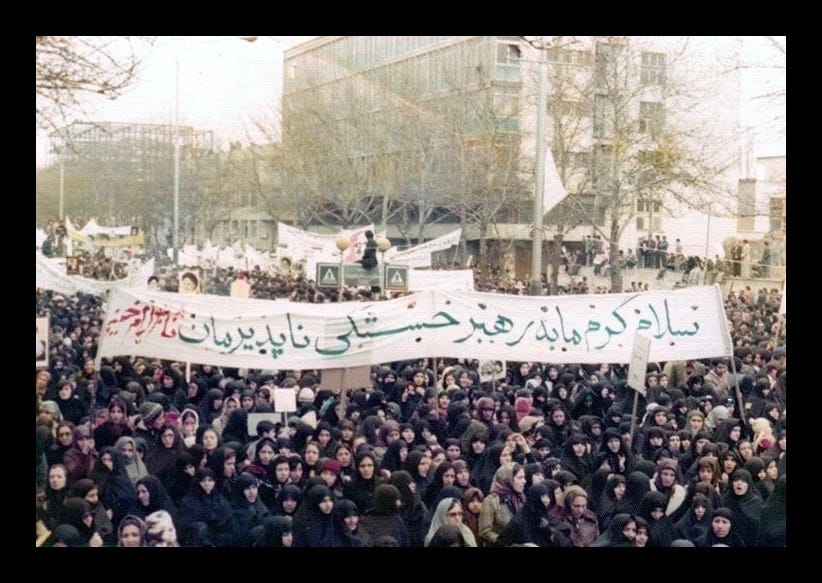
(The Iran Revolution 1978-79)
I would recommended reading this article in conjunction with the morning’s article for a full and rounded context:
The Unipolar Machine: A Geopolitical Analysis of the United States Senate Hearing on Indo-Pacific Command, April 2026
How a United States Senate hearing revealed the machinery of permanent war, energy blackmail, the consumption of proxies and the making of a new Asian front
The United States does not have a foreign policy driven by threat response. It has a foreign policy driven by structural maintenance of unipolarity on behalf it’s owners, a transnation corporate oligarchy. On 21 April 2026, the Senate Committee on Armed Services held a public hearing on the posture of Indo-Pacific Command and United States Forces Korea. The testimony confirmed eight core axioms that govern American grand strategy.
First, policy is visible in congressional hearings and think tank papers, not in headlines or podium speeches.
Second, there is bipartisan continuity of agenda; Republican and Democratic senators agree on every substantive matter.
Third, the United States has no genuine allies, only politically captured proxies that serve American interests at their own populations’ expense.
Fourth, the unipolar reflex demands the destruction of multipolarism because multipolarism dismantles the profit-extraction system of US-based corporate monopolies. Fifth, energy is not an economic commodity but a weapon of war; the United States deliberately destabilises rival energy supplies to force dependency on American LNG, applying to Asia the same blueprint executed in Europe.
Sixth, every American accusation against China, Russia, Iran, or North Korea is a confession of American behaviour. Seventh, proxies are not defended but consumed; Ukraine is the template, and Japan, South Korea, the Philippines, and Taiwan are next. Eighth, peace is not the goal; permanent wartime conditions that preserve American structural advantages are the goal. The evidence is unambiguous. South Korea’s largest trading partner is China, yet US troops remain on the peninsula to create dilemmas for China. Japan is being remilitarised against its own economic interest. Taiwan is being armed as a trigger mechanism.
The war against Iran has already redirected Asian energy imports toward the United States, with Vietnam increasing US LPG purchases from 2,000 tons to 66,000 tons in a single month. The senators who testified did not ask why the United States maintains forward bases on the other side of the planet. They asked for more bombers, more submarines, more LNG terminals, and bans on superior Chinese products. The machine is transparent. The question is whether enough people will finally look at it.
Article Link:
https://open.substack.com/pub/ggtvstreams/p/the-unipolar-machine-a-geopolitical?r=43m4ah&utm_campaign=post&utm_medium=web&showWelcomeOnShare=true
Authored By: Global GeoPolitics
Thank you for visiting. This is a reader-supported publication. If you believe journalism should serve the public, not the powerful, and you’re in a position to help, becoming a PAID SUBSCRIBER truly makes a difference. Alternatively you can support by way of a cup of coffee:
https://buymeacoffee.com/ggtv |
https://ko-fi.com/globalgeopolitics |
Bitcoin: 3NiK8BoRZnkwJSHZSekuXKFizGPopkE7ns


Leave a comment