
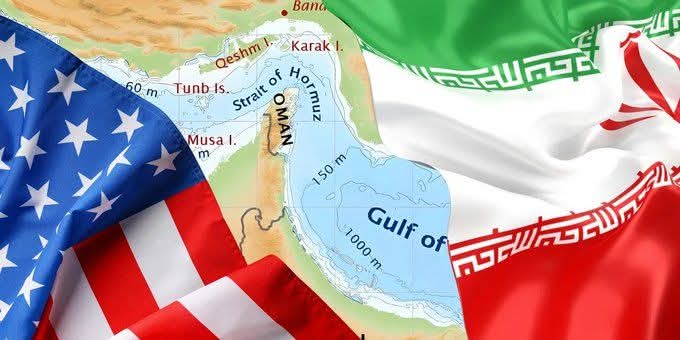
The Persian Gulf confrontation exposed the widening gap between military optics and operational control, while financial stabilisation and military escalation merged into the same strategic system
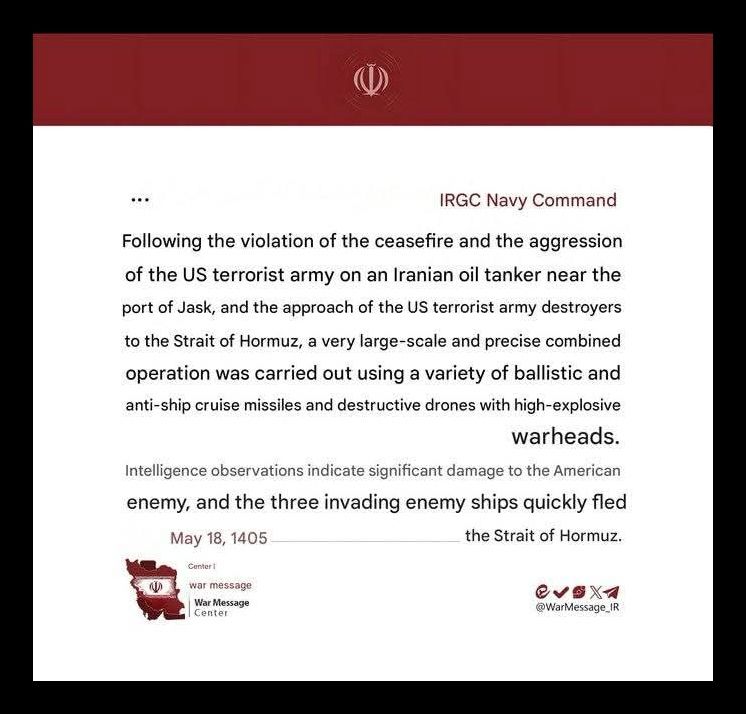
A naval withdrawal inside the Strait of Hormuz would mark a strategic rupture extending far beyond one contested waterway, because the credibility of American maritime supremacy depends upon sustained physical presence under hostile pressure rather than retaliatory missile strikes after operational retreat. Claims surrounding the reported engagement near Bandar Abbas and Qeshm therefore matter less for their immediate tactical details than for the structural reality they imply. A destroyer squadron compelled to withdraw under sustained missile pressure, while cruise missile strikes are simultaneously framed as punitive retaliation, would represent the inversion of a military doctrine Washington spent four decades attempting to institutionalise across the Persian Gulf. Maritime dominance ceases when naval forces cannot hold contested geography without exhausting defensive capacity. Strategic communications then become compensation for deteriorating positional control.
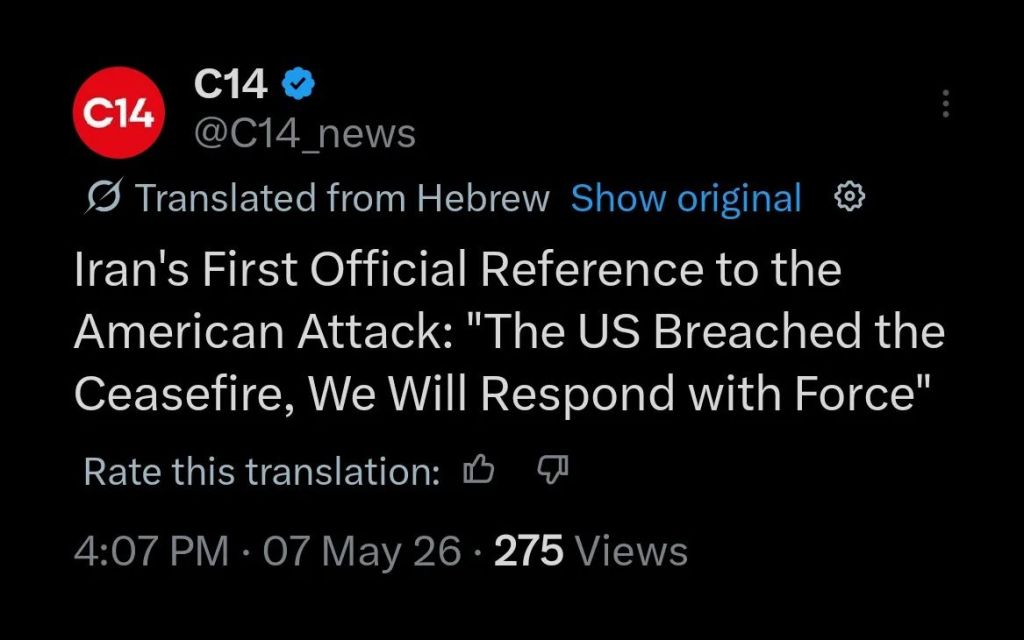
Reports surrounding the engagement described a familiar media sequence. American strikes against Bandar Abbas and Qeshm dominated official headlines, while Iranian missile fire against naval assets received secondary treatment framed as reciprocal escalation rather than operational coercion. Such framing follows a long-established doctrine of escalation management developed after the 1987 tanker wars and refined during the post-Cold War unipolar period. Public communications isolate tactical exchanges into discrete incidents because integrated narratives reveal structural weakness. The distinction matters enormously. One narrative describes balanced retaliation between near equals. The other describes a naval power losing freedom of manoeuvre inside a narrow maritime corridor central to global energy circulation.
The strategic geography of the Strait of Hormuz always favoured the defender despite decades of Western assumptions regarding technological superiority. Roughly one fifth of global petroleum consumption transits the strait according to the United States Energy Information Administration, while nearby Iranian coastline provides layered missile coverage extending deep into surrounding waters. American doctrine relied upon layered naval interception systems, carrier aviation, electronic warfare dominance, and overwhelming escalation capacity to offset geographic disadvantage. That doctrine depended upon suppressing hostile launch systems faster than hostile actors could regenerate attacks. Sustained saturation pressure therefore threatens the doctrinal foundation itself rather than merely individual platforms.
Claims that close-in weapon systems were activated against incoming missiles carry strategic significance exceeding ordinary battlefield reporting because CIWS engagement indicates the final defensive layer after longer-range interceptors fail or become exhausted. Modern destroyers depend upon integrated missile defence architecture involving SM-2, SM-6, ESSM, and Rolling Airframe Missile systems before terminal gun defence activates. Once engagements descend toward terminal interception, commanders confront arithmetic rather than abstraction. Interceptor inventories decline rapidly while coastal missile batteries remain geographically protected and comparatively inexpensive to replenish. The strategic imbalance therefore emerges through industrial economics rather than symbolic battlefield narratives.
Clausewitz wrote that the supreme act of judgement consists of recognising the kind of war one enters. Washington entered the Gulf expecting a demonstration of escalation dominance supported by precision strike capability and naval persistence. Tehran prepared for a war of attrition centred upon magazine depletion, geographic compression, and political exhaustion. Those are profoundly different wars. Cruise missile strikes against ports possess symbolic and punitive value, yet they cannot permanently suppress hundreds of kilometres of dispersed coastal launch infrastructure protected through hardened underground networks developed precisely to survive conventional bombardment. Iranian doctrine learned from Serbian dispersal methods during the Kosovo conflict, Hezbollah’s distributed command structures after 2006, and extensive observation of American campaigns against Iraq and Libya.

Military asymmetry therefore favours the weaker actor whenever geography compresses the stronger actor into predictable operational corridors. American destroyers represent extraordinary concentrations of technological and financial capital vulnerable to comparatively cheap anti-ship systems deployed from static defensive terrain. A single Arleigh Burke-class destroyer costs billions of dollars and requires years to replace, while anti-ship missile inventories can be manufactured domestically in large quantities under sanction conditions. The cost-exchange ratio gradually punishes expeditionary naval power despite overwhelming aggregate military superiority. Empires historically struggle against this arithmetic because prestige requires visible deployment while defenders absorb losses through depth and patience.
Historical precedent reinforces the point. Japanese naval planners before 1941 believed American industrial capacity would eventually overwhelm imperial expansion unless Washington’s Pacific fleet suffered decisive attritional losses. Soviet doctrine during the Cold War similarly focused upon missile saturation against carrier groups rather than direct fleet parity. Chinese anti-access and area denial strategy now follows related logic across the South China Sea and Taiwan Strait. Iran adapted these principles for enclosed Gulf geography where maritime manoeuvre space remains permanently constrained. A narrow waterway neutralises portions of blue-water superiority because saturation pressure compresses reaction time and magnifies defensive expenditure.
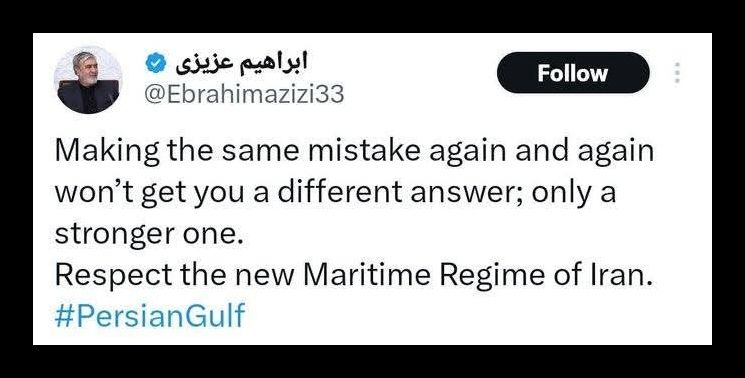
Strategic communications surrounding the engagement reveal another layer entirely. Simultaneous reporting of American strikes and Iranian retaliation produces the appearance of controlled escalation rather than positional retreat. Such sequencing matters because global financial systems remain deeply dependent upon perceptions of American coercive credibility. The United States dollar retains reserve dominance partly because maritime security underwrites energy circulation across chokepoints linking Gulf production with Asian and European consumption. Any perception that regional actors can impose sustained operational costs upon American naval forces therefore carries financial implications extending beyond immediate military outcomes.
Financial stabilisation mechanisms formed part of the same strategic theatre. Reports surrounding the timing of Thursday strikes drew attention toward the President’s Working Group on Financial Markets, widely labelled on Wall Street as the Plunge Protection Team after its creation under President Reagan following the 1987 market crash. The Treasury, Federal Reserve, Securities and Exchange Commission, and Commodity Futures Trading Commission coordinate continuously during periods of systemic stress because financial panic now threatens American strategic power as directly as battlefield losses. Military escalation therefore cannot be separated from liquidity management.
Thursday operations possess institutional logic independent of conspiratorial framing. Markets absorb immediate shock during Thursday and Friday sessions before closing for the weekend, granting central banks, primary dealers, and treasury authorities nearly forty-eight uninterrupted hours to stabilise futures pricing, coordinate liquidity facilities, manage swap lines, and prevent disorderly cascades before Asian markets reopen Sunday evening. Financial warfare now accompanies military operations automatically because sovereign credibility depends upon maintaining confidence across debt, energy, and currency systems simultaneously.
American administrations repeatedly synchronised military signalling with market management after the 1973 oil crisis, the 1987 crash, the attacks of September 2001, and the 2008 financial collapse. Washington understands that uncontrolled financial panic weakens coercive capability abroad by increasing borrowing costs, destabilising energy pricing, and undermining alliance confidence. Strategic timing therefore reflects systemic necessity rather than coincidence. Bombs fall according to operational calendars, yet modern escalation increasingly follows market structure as closely as battlefield geometry.
Another uncomfortable implication emerges from this relationship. Financial markets no longer react to Middle Eastern escalation with the panic behaviour common during previous decades because institutional investors increasingly assume state intervention will suppress disorder before systemic contagion spreads. That expectation itself forms part of American power. The credibility of emergency liquidity mechanisms, Federal Reserve intervention capacity, and coordinated treasury signalling now functions alongside carrier groups and destroyer squadrons within the same architecture of imperial maintenance. Military confrontation and financial engineering have become inseparable instruments supporting dollar hegemony and maritime order.
Such integration also exposes structural fragility beneath apparent calm. Markets remaining stable during regional escalation no longer necessarily indicate confidence regarding strategic success. Stability may instead reflect assumptions that central authorities will absorb volatility regardless of deteriorating geopolitical fundamentals. Artificial calm can therefore conceal weakening coercive leverage in precisely the same manner that retaliatory Tomahawk strikes may conceal operational withdrawal. Financial optics and military optics increasingly operate through the same political logic: preserve confidence immediately, delay recognition of strategic deterioration, and maintain institutional continuity long enough to avoid systemic repricing of American power.
Strategic timing therefore reflects institutional habit rather than cinematic intrigue. Military operations are now conducted alongside narrative management, market signalling, and alliance reassurance because financial stability forms part of national security architecture.
Game theory clarifies the deeper structure governing the confrontation. Washington traditionally operated under an escalation-dominance framework where superior military capability imposed higher expected costs upon adversaries than adversaries could impose reciprocally. Such systems resemble repeated deterrence games where one actor preserves credibility through willingness to escalate further at every stage. Tehran instead structured the confrontation as a war of endurance based upon asymmetric payoff distribution. Iranian leadership never required battlefield parity. Sustained ability to impose incremental operational costs while surviving retaliation altered the equilibrium sufficiently.
Within that structure, American commanders confront escalating marginal costs for continued presence while Iranian defensive systems benefit from geographic persistence. Tehran’s strategy resembles a constrained attritional game where the weaker actor avoids decisive engagement yet steadily increases the stronger actor’s operational expenditure and political risk. Withdrawal under pressure therefore transforms perceptions across every observing capital. Gulf monarchies reconsider security dependencies. China studies maritime denial lessons applicable near Taiwan. Russia observes another demonstration that expensive Western platforms remain vulnerable against layered missile systems supported by defensive geography.
Mainstream liberal frameworks misunderstand such confrontations because they prioritise institutional signalling and declaratory legitimacy over material endurance. Realist analysis instead focuses upon positional capability, industrial sustainability, and coercive credibility. Naval supremacy depends upon remaining physically present despite hostile pressure. Financial supremacy depends upon convincing markets that military guarantees remain enforceable indefinitely. Once either perception weakens, alliance systems gradually reprice strategic risk.
A harsher reality follows from this logic. American power since 1991 depended heavily upon the assumption that regional actors could be punished faster than they could adapt. Iraq collapsed conventionally within weeks during both Gulf wars. Serbia lacked strategic depth. Libya possessed little integrated defence infrastructure. Iran spent decades constructing exactly the opposite model. Sanctions accelerated domestic missile production, hardened logistical dispersal, and institutional commitment toward asymmetric deterrence. Pressure designed to weaken Tehran instead incentivised doctrinal adaptation centred upon survivability and attritional leverage.
Another reversal emerges through coalition politics. Gulf partners historically relied upon visible American naval presence to stabilise regional energy routes and deter Iranian coercion. Any engagement implying temporary operational withdrawal under fire forces regional states toward hedging behaviour rather than exclusive alignment. Saudi Arabia already deepened diplomatic restoration with Tehran through Chinese mediation during 2023. The United Arab Emirates expanded parallel economic engagement despite security dependence upon Washington. Regional actors increasingly balance between American security architecture and emerging Eurasian economic integration because absolute confidence in permanent American escalation dominance continues eroding.
Energy markets reflect the same structural transition. Asian economies consume the majority of Gulf exports while Chinese trade integration increasingly binds regional producers eastward rather than westward. Maritime insecurity within Hormuz therefore affects Beijing at least as profoundly as Washington. Chinese strategic planners consequently possess strong incentives to expand diplomatic and eventually naval involvement across Gulf security arrangements. American military pressure intended to preserve primacy may accelerate the multipolar distribution of influence it seeks to prevent.
Hard consequences follow whenever great powers fail to align military commitments with industrial sustainability. Missile warfare consumes stockpiles rapidly. Interceptor production across Western defence industries already struggles under the simultaneous pressures of Ukraine, Red Sea operations, and Indo-Pacific contingency planning. Iran, Russia, and China all emphasise comparatively cheap mass missile production precisely because saturation undermines high-cost interception doctrines. The industrial base becomes the battlefield long before decisive fleet engagements occur.
Another blunt conclusion now confronts policymakers across allied capitals. Precision strikes cannot substitute for positional control. Cruise missiles launched during withdrawal may satisfy domestic political narratives temporarily, yet adversaries evaluate geography rather than headlines. Maritime dominance exists only while fleets hold contested water under hostile pressure. Once naval forces retreat because continued presence becomes operationally unsustainable, strategic perception shifts permanently regardless of subsequent press statements.
Future stability therefore depends upon whether Washington adapts toward sustainable deterrence or doubles down upon symbolic escalation detached from industrial realities. Continued reliance upon episodic punitive strikes without durable regional positioning risks accelerating the exact erosion of credibility American strategy seeks to avoid. Tehran meanwhile benefits from every engagement framed as reciprocal exchange while defensive infrastructure remains intact and maritime disruption potential survives.
The wider international system already absorbs the implications. Ukraine demonstrated the vulnerability of armour and logistics under persistent drone and missile pressure. The Red Sea exposed the cost imbalance between cheap strike systems and expensive naval interception. Hormuz now reinforces the same lesson under even greater economic stakes. Geography, industrial depth, and attritional endurance increasingly matter more than spectacular demonstrations of precision force.
History judges empires harshly whenever symbolic retaliation replaces operational control. Rome understood that frontiers collapsed gradually through accumulated concessions masked by ceremonial victories. Britain discovered during the interwar period that financial overstretch eventually hollowed maritime supremacy regardless of imperial rhetoric. American power now confronts a similar contradiction between global commitments and the material costs required to enforce them continuously across multiple theatres.
Strategic systems rarely collapse through single defeats. They deteriorate when adversaries repeatedly demonstrate that dominant powers cannot impose outcomes proportionate to their expenditure. A destroyer withdrawal under sustained missile pressure inside Hormuz, if accurately reported, would therefore matter because it reveals the narrowing margin between American projection capacity and the defensive resilience of regional powers shaped by decades of sanctions, adaptation, and industrial militarisation. Press releases may temporarily reorder perception. Geography eventually restores the balance of facts.
Authored By: Global GeoPolitics
Thank you for visiting. This is a reader-supported publication. If you believe journalism should serve the public, not the powerful, and you’re in a position to help, becoming a PAID SUBSCRIBER truly makes a difference. Alternatively you can support by way of a cup of coffee:
https://buymeacoffee.com/ggtv |
https://ko-fi.com/globalgeopolitics |
Bitcoin: 3NiK8BoRZnkwJSHZSekuXKFizGPopkE7ns
References
Carl von Clausewitz, On War, translated by Michael Howard and Peter Paret, Princeton University Press, 1976.
Alfred Thayer Mahan, The Influence of Sea Power Upon History, 1660–1783, Little, Brown and Company, 1890.
Thomas Schelling, Arms and Influence, Yale University Press, 1966.
Kenneth Waltz, Theory of International Politics, Addison-Wesley, 1979.
John J. Mearsheimer, The Tragedy of Great Power Politics, W.W. Norton & Company, 2001.
Andrew F. Krepinevich, Maritime Competition in a Mature Precision-Strike Regime, Center for Strategic and Budgetary Assessments, 2015.
Office of Naval Intelligence, The Iranian Navy: From Guerrilla Warfare to a Modern Naval Strategy, United States Navy, 2009.
Anthony H. Cordesman, Iran’s Military Forces and Warfighting Capabilities, Center for Strategic and International Studies, 2021.
Michael Knights and Farzin Nadimi, Iran’s Expanding Maritime Precision-Strike Capability, Washington Institute for Near East Policy, 2020.
International Institute for Strategic Studies, The Military Balance 2024, Routledge, 2024.
United States Energy Information Administration, World Oil Transit Chokepoints, updated 2024.
Federal Reserve Bank historical archive, President’s Working Group on Financial Markets reports and policy coordination papers.
Ben Bernanke, The Courage to Act: A Memoir of a Crisis and Its Aftermath, W.W. Norton & Company, 2015.
Adam Tooze, Crashed: How a Decade of Financial Crises Changed the World, Allen Lane, 2018.
Giovanni Arrighi, The Long Twentieth Century: Money, Power and the Origins of Our Times, Verso, 1994.
Immanuel Wallerstein, World-Systems Analysis: An Introduction, Duke University Press, 2004.
Robert D. Kaplan, Monsoon: The Indian Ocean and the Future of American Power, Random House, 2010.
Martin van Creveld, The Transformation of War, Free Press, 1991.
Lawrence Freedman, Strategy: A History, Oxford University Press, 2013.
Seymour Melman, Pentagon Capitalism: The Political Economy of War, McGraw-Hill, 1970.
Michael Hudson, Super Imperialism: The Economic Strategy of American Empire, Pluto Press, 2003.
Barry R. Posen, Command of the Commons: The Military Foundation of U.S. Hegemony, International Security, Vol. 28, No. 1, 2003.
T.X. Hammes, The Sling and the Stone: On War in the 21st Century, Zenith Press, 2004.
Farzin Nadimi, Iran’s Evolving Approach to Asymmetric Naval Warfare, Washington Institute for Near East Policy, various briefings and reports.
Stephen Walt, The Origins of Alliances, Cornell University Press, 1987.
Hal Brands, The Twilight Struggle: What the Cold War Teaches Us About Great-Power Rivalry Today, Yale University Press, 2022.
Fernand Braudel, Civilization and Capitalism, 15th–18th Century, University of California Press, 1992.
Nicholas Spykman, America’s Strategy in World Politics, Harcourt Brace, 1942.
Julian Corbett, Some Principles of Maritime Strategy, Longmans Green and Company, 1911.


Leave a comment