
From Proxy Networks to Capital Dependency in the Post-War Middle East
The signing of the Islamabad Memorandum of Understanding between the United States and the Islamic Republic of Iran on June 17, 2026, marks a decisive inflection point in the geopolitical trajectory of the Middle East, yet its true significance lies less in the cessation of hostilities than in the structural realignment it codifies (1)(2). The 14-point agreement, brokered in Pakistan and signed electronically by President Donald Trump and President Masoud Pezeshkian, establishes a framework that extends far beyond a mere ceasefire, embedding Iran within a Gulf-led economic architecture and signalling the progressive dismantlement of the post-World War II security order. While the document has been publicly framed as a victory for diplomacy, a careful reading of its provisions, particularly those concerning the Strait of Hormuz and the $300 billion reconstruction fund, reveals a sophisticated mechanism designed to subordinate Iran to Gulf capital and to facilitate the withdrawal of American military power from the region, thereby validating the analytical framework of a managed multipolar transition.
The memorandum’s most immediate and consequential achievement is the formal termination of military operations on all fronts, including Lebanon, coupled with a mutual commitment to non-interference in internal affairs and respect for sovereignty (1)(2). The inclusion of Lebanon, a point reportedly insisted upon by Tehran, is a matter of considerable geopolitical significance, as it effectively severs the historical link between Iran’s regional posture and the militant proxy networks that have long defined its strategic depth. By placing the cessation of Israeli military operations in Lebanon at the core of the agreement, the United States has constructed a mechanism that ostensibly protects Lebanese territorial integrity while simultaneously setting the stage for a direct confrontation between Israel and the new regional order. This manoeuvre is a deliberate trap designed to facilitate Israel’s abandonment by forcing it to defy an American-brokered agreement, thereby providing Washington with the political cover to restructure its relationship with its erstwhile ally. The Israeli press’s warnings of an impending American embargo should Israel fail to comply with the MOU underscore the severity of this strategic repositioning.
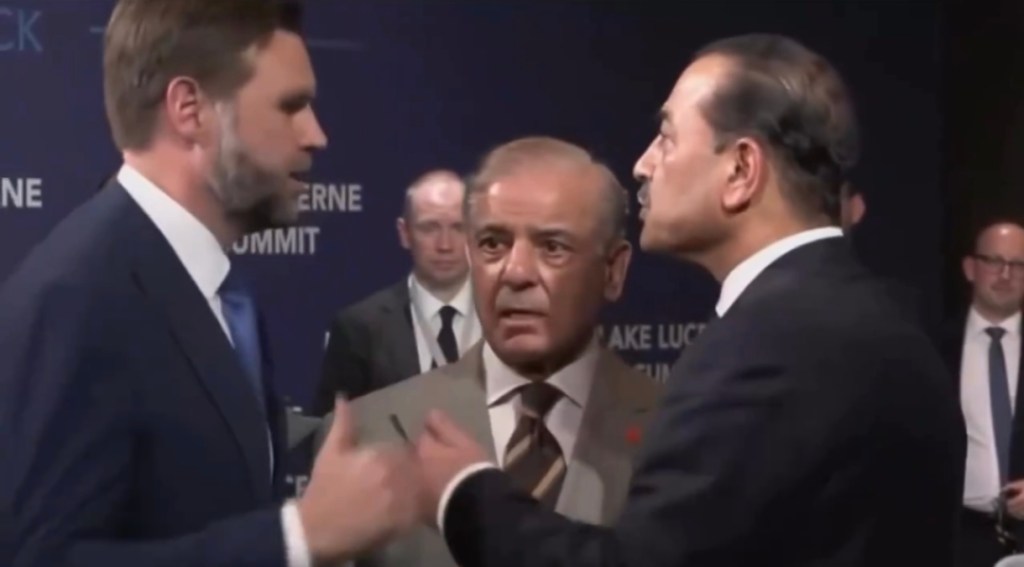
Vice President J.D. Vance’s public remarks following the Bürgenstock talks provide critical insight into the strategic logic of the agreement, revealing a mechanism that bears striking institutional similarities to the structural adjustment programs historically imposed by the International Monetary Fund (7)(8). The $300 billion reconstruction fund, framed by Vance as a mechanism that will make American farmers richer while feeding the Iranian people, is not an act of post-war restitution but a sophisticated instrument of economic leverage that subordinates Iranian reconstruction to the approval of the United States and its Gulf partners (13)(14). The vice president has clarified that this is not a US taxpayer-funded initiative, stating unequivocally that Iran will “never get a dime” from American taxpayers (7). His press conference on June 18 further outlined the operational logic involving the release of Iranian frozen assets would first be approved by the United States, then by Qatar, with the funds subsequently used to purchase American agricultural products (13)(14). As Vance explained, Jared Kushner and the Qataris developed this mechanism where if “Iranian assets are ever unfrozen… they’re going to go to make American farmers richer and to feed the Iranian people”(13). This is not a system of reparations or compensation for the destruction inflicted during the war; it is a mechanism that redirects Iranian capital back into the American economy while maintaining US approval authority over the entire process (8).
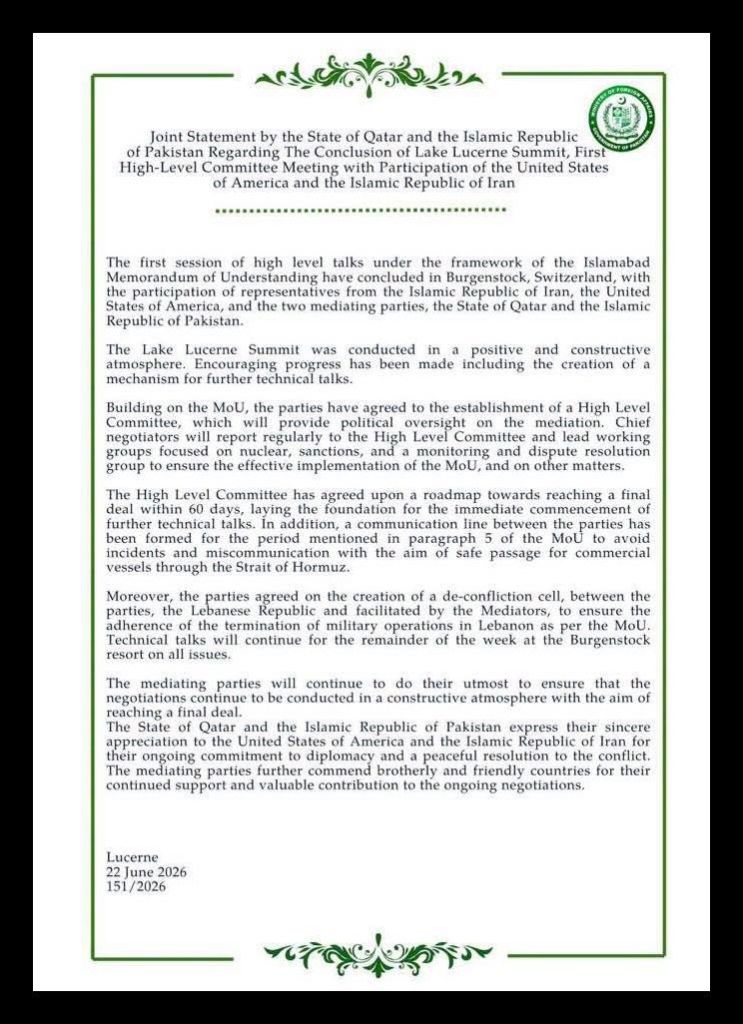
The structural similarity to IMF programmes is difficult to overlook. The IMF’s Enhanced Structural Adjustment Facility programmes, implemented across the Middle East from the 1980s onward, operated through a comparable logic: access to capital was conditioned on the adoption of policy reforms that served the interests of the creditor institutions (9)(10)(12). Countries like Egypt, Jordan, Morocco, and Tunisia were required to reduce subsidies, liberalise trade, and privatise state-owned enterprises, often resulting in severe social costs while failing to stimulate export-led growth (10). The Iranian reconstruction fund similarly embeds external approval mechanisms into the country’s economic recovery, with paragraph 6 of the memorandum requiring that “all required licenses, waivers and permissions needed for the relevant financial transactions will be granted by the United States of America”(1)(2(. This is not a partnership of equals but a structure of dependency. Vance’s consistent emphasis on verification and conditionality rather than trust reinforces this framework: “Whether good faith or bad faith, you can’t trust anybody’s words. You have to trust what they actually do”(5). This mirrors the IMF’s framework of phased disbursement and performance criteria, where financial flows are contingent on demonstrated compliance with agreed benchmarks (9). The temporary 60-day toll-free passage through the Strait of Hormuz, established under paragraph 5, similarly operates as a conditional concession that can be revoked or renegotiated based on Iranian behaviour (1)(2).
The distinction between the $300 billion reconstruction fund and IMF programmes is significant, however. While IMF structural adjustment was imposed on already-indebted states seeking debt relief, the Iranian fund is being deployed as a strategic tool in the context of a post-war settlement that has deliberately degraded Iran’s economic infrastructure. The targeting of Iran’s nuclear facilities, oil infrastructure, and power generation during the war created the conditions that necessitate external capital, and that capital now arrives with conditions attached. Vance’s claim that the arrangement would “make American farmers richer” while feeding the Iranian people reveals the dual purpose of the mechanism: it serves American economic interests while maintaining leverage over Iran’s recovery (13). This is not charity; it is a calculated investment that subordinates Iranian reconstruction to US interests.
The Subordination of Iran to Gulf Capital
Beyond the immediate cessation of hostilities, the memorandum’s true transformative potential lies in its provisions for the permanent resolution of the conflict and the subsequent economic reconstruction of Iran. Article 6 commits the United States, working with regional partners, to develop a plan for at least $300 billion for the reconstruction and economic development of Iran, while Article 11 mandates the full availability of Iran’s frozen assets (1)(2). It is critical to note that this $300 billion is not a form of war reparations; rather, it is a private investment vehicle, with more than half already committed by American and Gulf corporations, as reported by Reuters. This distinction is fundamental, as it transforms reconstruction from a matter of justice into a site of capital accumulation. The infusion of $300 billion in Gulf capital into Iran represents a strategic reorientation of the regional political economy, moving Iran from a state of isolation to one of structural dependency on its Gulf neighbours. The targeting of Iran’s nuclear facilities, oil infrastructure, and power generation during the war was not merely a military campaign but a deliberate degradation of the country’s economic infrastructure, creating the very conditions that necessitate such a massive influx of external capital. This process mirrors the historical mechanisms of the World Bank and the IMF, where capital is used as a management mechanism to subordinate economies to the strategic priorities of the financier, a dynamic that is now being repurposed by Gulf states.
The memorandum’s provision that the reconstruction fund will be developed with “regional partners” is a deliberate ambiguity that points toward Gulf state participation (1)(2). Vance has repeatedly emphasised the importance of working with allies “from the Israelis to the Gulf Arabs” to maintain the regional ceasefire and ensure compliance with the agreement. The Gulf states, which bore the brunt of Iranian attacks during the war, have not confirmed their willingness to invest in Iranian reconstruction, but Saudi Foreign Minister Prince Faisal bin Farhan acknowledged that “we’re going to have to have a conversation on how we rebuild that trust, how we rebuild that relationship before any concept of economic cooperation, mutual investment or anything like that can rationally be addressed.” This qualification underscores that Gulf capital will not flow without security guarantees and verifiable Iranian compliance. The bilateral approval structure for frozen assets, with the United States and Qatar holding joint approval authority, ensures that Iran cannot access its own funds without the consent of both parties, creating a permanent leverage point that extends beyond the immediate settlement (13)(14).
The Strait of Hormuz Paradigm Shift
The memorandum’s treatment of the Strait of Hormuz represents a paradigm shift with profound implications for global maritime governance. Article 5 mandates that Iran will provide safe passage for commercial vessels without charge for a period of sixty days only (1)(2). This conditional, time-limited concession is a deliberate acknowledgment by the United States that the post-war status of the Strait will not be a simple return to the pre-war order of “freedom of navigation.” Iranian officials, including Parliament Speaker Mohammad Bagher Ghalibaf, have publicly asserted that Iran intends to exercise its sovereign rights and charge service fees for transit through the Strait after this period expires. This assertion is not a mere negotiating tactic but a formal challenge to the post-World War II framework that systematically dispossessed strategically located countries of their natural leverage over maritime chokepoints. This principle, once established, could have a cascading effect on other critical passages such as the Strait of Malacca, Bab el-Mandeb, and the Suez Canal, potentially empowering Muslim-majority states to monetise their geographic positions in a manner that was previously structurally prohibited. The successful establishment of a tolling system at Hormuz would fundamentally alter the economic and security calculus for global energy markets and validate a new model of maritime sovereignty based on the assertion of territorial rights over international trade arteries.
The Strategic Implications of the New Regional Order
The Islamabad Memorandum is not a conventional peace treaty but an architectural blueprint for a managed regional transition. It successfully dismantles the symbiotic relationship between Iranian hardliners and the Zionist project, removing the IRGC’s strategic depth and replacing it with a dependency on Gulf capital. It facilitates the withdrawal of American military forces from the region, as explicitly mandated in Article 4, while simultaneously embedding Iran into a dollarised financial system that recreates the very vulnerabilities the 1979 revolution sought to escape (1)(6). Vance has confirmed that the United States is prepared to reduce its military presence near Iran to pre-conflict levels, stating: “What we’re saying is that we will withdraw troops to the pre-conflict level, meaning we’re not going to keep a couple of extra aircraft carrier groups over there”(6). The strategic decapitation of the IRGC leadership was an external purge, clearing the way for the pragmatists to negotiate a deal that dismantles the axis of resistance in favour of regional economic integration.
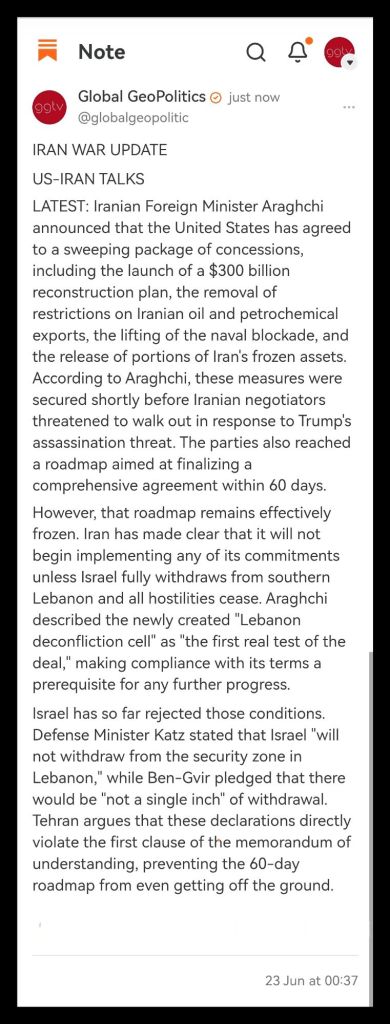
In the middle of the discussions, I learned that Trump had made threatening remarks regarding our president, the negotiating team, and possible attacks on our territory. We ended the negotiations, left the meeting, and did not return.
While this transition is framed by its architects as a positive step towards a multipolar order and collective Muslim sovereignty, it remains a process of subordination, the transfer of Iran’s political and economic independence from the West to the Gulf, a process that, while less culturally antagonistic, still represents the subjugation of one national bourgeoisie to another. The question for the region, and for the wider Global South, is whether this new architecture will ultimately lead to a genuine diffusion of power or merely represent a change in the management of the existing system.
Authored By: Global GeoPolitics
If you prefer to make a one time donation in support of my work, you can do so by clicking any link below:
https://buymeacoffee.com/ggtv |
https://ko-fi.com/globalgeopolitics |
Bitcoin: 3NiK8BoRZnkwJSHZSekuXKFizGPopkE7ns
References
1. Western Advocate. (2026, June 18). Interim 14-point US-Iran Memorandum of Understanding. https://www.westernadvocate.com.au/story/9294448/interim-14-point-us-iran-memorandum-of-understanding/
2. Ahram Online. (2026, June 18). Factbox | Full text of 14-point US-Iran agreement released by Washington. https://english.ahram.org.eg/UI/Front/Inner.aspx?NewsContentID=571111
5. Mediaite. (2026, June 18). ‘Countries Don’t Give Up the Right of Self-Defense’: JD Vance Confronted Over Trump’s Ballistic Missile Flip-Flop. https://www.mediaite.com/media/tv/countries-dont-give-up-the-right-of-self-defense-jd-vance-confronted-over-trumps-ballistic-missile-flip-flop/
6. TASS. (2026, June 18). US troop presence near Iran to return to pre-conflict levels under final deal -Vance. https://tass.com/world/2148563
7. UPI. (2026, June 18). Vance denies U.S. made concessions in Iran peace agreement. https://www.upi.com/Top_News/US/2026/06/18/vance-press-briefing-iran-peace-agreement/7851781804721/
8. Mediaite. (2026, June 18). Vance Rips Media Coverage of $300 Billion Fund to Iran, Which He Confirmed in the First Place. https://www.mediaite.com/media/news/vance-rips-media-coverage-of-300-billion-fund-to-iran-which-he-confirmed-in-the-first-place/
9. Control Risks. (2024). IMF support for MENA: no easy way out. https://www.controlrisks.com/our-thinking/insights/imf-support-for-mena-no-easy-way-out
10. Institute of Development Studies. (2022). Has policy-based lending by the IMF and World Bank been effective in the Arab world?. https://archive.ids.ac.uk/eldis/document/A40477.html
12. Richter, T. (German Institute of Global and Area Studies). Political Economy of IMF and World Bank Interventions in the Middle East. Columbia University CIAO. https://ciao-test.cdrs.columbia.edu/catalog.html?f%5Bauthor%5D%5B%5D=Thomas+Richter&f%5Binstitution%5D%5B%5D=German+Institute+of+Global+and+Area+Studies&f%5Blocation%5D%5B%5D=Middle+East&search_field=all_fields&searched=yes&sort=relevance
13. DTN Progressive Farmer. (2026, June 22). Vance: Unfrozen Iran Assets Could Be Used for US Soy, Corn and Wheat. https://www.dtnpf.com/agriculture/web/ag/news/business-inputs/article/2026/06/22/vance-unfrozen-iran-assets-used-us
14. Lokmat Times. (2026, June 22). Vance unveils plan for Iran funds, US farm exports. https://www.lokmattimes.com/international/vance-unveils-plan-for-iran-funds-us-farm-exports/


Leave a comment