
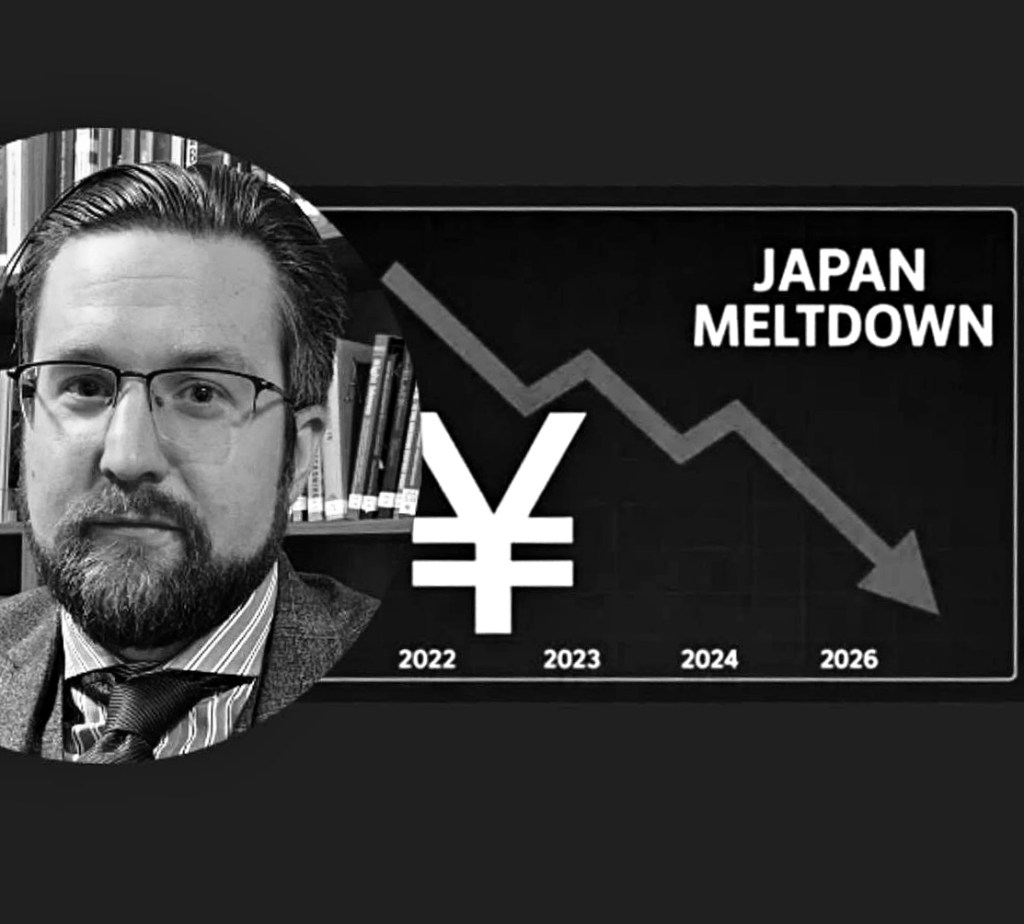
How Japan’s Financial Collapse Threatens to Trigger a Systemic Breakdown of the Global Dollar System
Philip Pilkington’s analysis reveals that Japan’s financial instability represents the most immediate threat to the entire dollar-based international monetary system, with the yen functioning as the “canary in the coal mine” that signals an impending systemic collapse. The yen carry trade, driven by persistent interest rate differentials between Japan and the United States, has created an insurmountable “gravity well” that Treasury Secretary Scott Bessent’s interventions cannot overcome, and Japan’s inability to raise interest rates without triggering mass bankruptcies among its zombie firms, combined with its extreme energy insecurity, traps the country in a downward spiral that threatens to force Tokyo to liquidate its $1.14 trillion holdings of US Treasuries. Such a liquidation would drive up American borrowing costs, crash the US stock market, and trigger a collapse of the dollar system that could reduce American living standards by 27 to 57 per cent. The only viable solution lies in a new Bretton Woods-style international agreement based on Keynes’s bancor proposal, which would manage the transition to a multipolar world order through balanced trade and multilateral cooperation rather than chaotic collapse.
The Japanese yen has hit a 40-year low against the American dollar, and the forces driving this decline are not temporary market fluctuations but structural pressures that threaten the stability of the entire global financial system. Japan has become the weakest link in the dollar-based international monetary order, and its impending crisis could trigger a chain reaction that unwinds the system of US financial hegemony that has existed since the collapse of the Bretton Woods system in 1971. The carry trade, in which investors borrow yen at Japan’s persistently low interest rates and reinvest them in higher-yielding dollar assets, has generated roughly twice the gains of the S&P 500 since 2022, creating a powerful profit motive that exerts relentless downward pressure on the Japanese currency. Treasury Secretary Scott Bessent’s recent interventions, including a $53 billion bailout announced on 31 July 2026 and a larger $73.5 billion intervention in April-May, have proven short-lived, with the yen giving up a third of its gains less than two weeks after the latest intervention. This pattern suggests that Bessent is “fighting gravity,” attempting to counteract a structural imbalance that cannot be remedied through temporary market operations alone.
The underlying cause of the yen’s weakness lies in the interest rate differential between Japan and the United States. On the day of writing, the Japanese 10-year sovereign bond yield stands at 2.85 per cent while the 10-year US Treasury trades at 4.68 per cent, a differential of nearly 2 per cent that makes yen borrowing extraordinarily attractive. This differential cannot be closed without catastrophic consequences because Japan’s economy has become addicted to low interest rates over decades of monetary accommodation. Approximately 15 per cent of Japanese firms are so-called “zombie companies,” enterprises that earn less in profits than they pay in interest on their loans and survive only through what the economist Hyman Minsky called “Ponzi borrowing”, borrowing more money simply to pay off existing interest obligations. If the Bank of Japan raised interest rates to close the carry trade, a large portion of the Japanese economy would cease to exist, unemployment would explode, and the country’s social and political stability would be threatened. The structural incapacity of the Japanese monetary authorities to defend their own currency represents a fundamental vulnerability that cannot be resolved through cosmetic interventions.
Japan’s extreme energy insecurity compounds this vulnerability. The country imports nearly 100 per cent of its oil, coal, and natural gas, making it one of the most energy-insecure nations in the developed world. As the yen falls, energy bills rise, and the resulting inflationary pressure eventually becomes self-reinforcing. If Japan allowed the yen to enter freefall, the country could turn into “Argentina,” with inflation and currency instability eviscerating the remaining competitiveness of its manufacturing sector. The decline of the yen would potentially be bottomless because the carry trade pressures are perpetual so long as the interest rate differential remains, and there is no clear equilibrium price for the currency. The combination of structural debt dependency, zombie firms, and energy insecurity creates a trap from which Japan cannot escape through conventional monetary policy measures.
The implications of a Japanese collapse for the United States are profound and potentially catastrophic. Japan is the largest foreign holder of US Treasury bonds in the world, holding roughly $1.14 trillion, followed by the United Kingdom with $949 billion and China with $659 billion. If Japan’s crisis deepens, Tokyo would be forced to begin liquidating these holdings to defend its currency, and selling such large quantities of US Treasuries into the market would drive up American borrowing costs and drive down the dollar. This would force the United States to close its large current account deficits, which have been running without interruption since 1991, and live within its means. The entire US credit-backed consumer economy runs on these deficits, and without them, American living standards would fall dramatically. Pilkington’s research demonstrates that the privileged role of the US dollar props up American living standards, and a chart plotting average daily wages against current account balance for 27 countries shows the United States as a clear outlier. If the dollar’s privileged role dissipates, American living standards would fall by 27 per cent, and if the United States reverted to the level of “partly privileged” wealthy Western countries, the fall could be closer to 57 per cent.
The United States has increasingly had to rely on selling American stocks as well as Treasury debt to finance its consumption, and this reveals the fragility of the entire financial architecture. Starting in 2020, sales of US Treasury debt to the rest of the world became insufficient to prop up America’s credit-based economy, and the country started having to rely on both sales of Treasury debt and sales of American stocks. The narrative of an “AI boom” and a “fourth industrial revolution” serves, in Pilkington’s analysis, as a marketing tool to encourage foreigners to buy American stocks, thereby propping up American living standards. If US interest rates rise too high, the equity market is likely to crash, and a black hole would open at the centre of the American economy, sucking the entire credit-based system into oblivion.
The United Kingdom represents the second powder keg in this unfolding crisis. The country is the second largest holder of US Treasury debt and is also on the verge of bankruptcy, with British economists warning that the country may need an IMF bailout, although this is unlikely only because the IMF does not have the resources to bail out a country of the UK’s size. If the United Kingdom starts to go bankrupt, the most likely outcome would be the same as in Japan: it would start dumping its holdings of US Treasuries, triggering a run on US Treasuries and the dollar more generally. Such a scenario could see the complete collapse of the global dollar system in as little as 12 to 18 months, with a chaotic unwinding that would destroy the living standards of millions and threaten global stability.
Pilkington argues that the solution to this crisis lies in a new Bretton Woods-style international agreement based on Keynes’s bancor proposal, which would manage the transition from a dollar-dominated to a truly multipolar world much better than a chaotic collapse. The bancor system would operate as a supranational currency used only to clear trade through an International Clearing Bank, with each country’s currency pegged to bancor at an adjustable rate. Countries running imbalances would be penalised on both sides, with limits placed on how large a surplus or deficit a country could accumulate. The system would force adjustments through devaluation or revaluation when imbalances crossed certain thresholds, and it would impose interest charges on bancor accounts to provide strong incentives for countries to resolve imbalances. The system would require capital controls and would leave existing institutions like the World Bank and the IMF intact, absorbing them into a new architecture that could manage the transition to a multipolar world order.
Treasury Secretary Bessent has floated the idea of a new global monetary architecture, very likely referring to Pilkington’s proposal, but implementing it would require a “Herculean diplomatic effort” to get China, Europe, and perhaps Russia on board. Since 2022, arguably since 2014, the BRICS countries have been developing an alternative financial architecture, and Pilkington emphasises that “those things can be activated almost immediately” and that “everyone can just switch to the other system pretty much immediately”, it all depends on trust. China’s strategy, with Russia involved in that strategy, is “basically to just wait” and “never interrupt your enemy when he’s making a mistake,” as Sun Tzu said. The Iran war has accelerated everything by a factor of five to ten, and the transition to a multipolar world order is now occurring far more rapidly than anyone anticipated.
A Necessary Counterpoint: The Moral and Historical Context of Dollar Hegemony
Any discussion of a managed transition from the dollar system must confront the uncomfortable reality that the privilege the United States has enjoyed for the past five decades was never earned through productive superiority or moral legitimacy but was extracted through the systematic exploitation of the global majority. The United States has no inherent right to the exorbitant privilege that has allowed its citizens to consume more than they produce, to run persistent trade deficits without consequence, and to finance wars and domestic consumption through the issuance of paper currency that the rest of the world is compelled to accept. This privilege was not a gift from the international community but a structure imposed through military might, coercive diplomacy, and the threat of exclusion from the global financial system, and its maintenance has required the systematic impoverishment of the Global South through debt dependency, structural adjustment, and the weaponisation of the dollar as an instrument of state power.
The rest of the world owes the United States and its Western allies nothing in the transition to a multipolar order. For decades, the Global South has been pillaged, ransacked, and looted at gunpoint through mechanisms that range from outright colonial exploitation to the more subtle but equally destructive debt traps imposed by the International Monetary Fund and the World Bank. The $152 trillion extracted from the Global South since 1960 represents the accumulated surplus that has sustained Western living standards while condemning the majority of humanity to poverty and underdevelopment, and the call for a “soft landing” for American living standards in the transition away from dollar hegemony is a demand that the victims of this system continue to subsidise their oppressors. The soft landing that Western elites are now scrambling to secure is not a humanitarian concern but a desperate attempt to preserve their own wealth and power at the expense of nations that are finally reclaiming their economic sovereignty.
The BRICS countries have demonstrated that nations across the Global South seek to reclaim their sovereignty and freedom from subservience to the empire that has dominated them for centuries. China, Russia, India, Brazil, South Africa, Iran, and the other nations that are building a multipolar world order are not motivated by a desire to destroy the United States but by a determination to build a world in which their own interests are no longer subordinated to the dictates of Western capital. The transition away from the dollar system is not an act of aggression but an act of self-defence, a necessary response to a system that has consistently used the dollar as a weapon to enforce compliance and punish dissent. The argument that the United States and its allies deserve a managed transition is an argument that the victims of imperialism should continue to bear the costs of a system that was designed to benefit their oppressors, and this is an argument that the peoples of the Global South have every right to reject.
The working classes of the United States and Western Europe are not the enemy of the Global South; they are fellow victims of a system that has enriched the few at the expense of the many. The American and European populations that would suffer from a chaotic collapse of the dollar system deserve to be saved from the excesses of their elites, but this salvation cannot come through the continued exploitation of the Global South. A new Bretton Woods system must be genuinely multilateral, with all nations participating as equals and with the interests of working people in all countries placed above the profits of transnational capital. The choice facing humanity is not between a managed transition that preserves the privileges of the Western elite and a chaotic collapse that destroys the living standards of ordinary Americans and Europeans; the choice is between a genuinely democratic and equitable international order and the continued domination of the global majority by a tiny financial oligarchy that has demonstrated its willingness to sacrifice the future of humanity for the preservation of its wealth. Philip Pilkington economic multipolarity: “My concern is that Western countries are overestimating how significant they are”.
The conclusion that emerges from this analysis is that the dollar system is dying, and the question is not whether it will collapse but how. A managed transition through international agreement is the only viable alternative to a catastrophic unwinding that would destroy the living standards of millions and threaten global stability. The ruling class has demonstrated its willingness to sacrifice the future of humanity for the preservation of its wealth, as seen in its response to the climate crisis and the current drive toward war. Whether the working class can organise to demand a different path, one that prioritises human welfare over financial speculation and geopolitical rivalry, remains the open question of our time.
Authored By: Global GeoPolitics
If you prefer to make a one time donation in support of my work, you can do so by clicking any link below:
https://donate.stripe.com/7sY8wPfvi864don0k3awo07 |
https://buymeacoffee.com/ggtv |
https://ko-fi.com/globalgeopolitics |
Bitcoin: 3NiK8BoRZnkwJSHZSekuXKFizGPopkE7ns
References
Pilkington, Philip. 2024. “Reimagining Bretton Woods: How International Agreement Could Resolve Economic Imbalances.” Hungarian Institute of International Affairs.
Pilkington, Philip. 2024. “The Collapse of Global Liberalism.” Forthcoming book.
Pilkington, Philip. 2026. Interview on Going Underground. RT International, 17 August.
Pilkington, Philip. 2026. “US buys yen to stop Japan from wrecking America’s bond market.” The Canary, 4 August.
Pilkington, Philip. 2024. “Current Account Balance Predicts Average USD Income.” X/Twitter, 21 April.
Pilkington, Philip. 2026. Thread on US Treasury intervention. X/Twitter, 3 August.
Pilkington, Philip. 2017. “Can Global Elites Pave the Way for a New Transnational Unit of Account?” World Review of Political Economy, 8(4): 542-563.
Pilkington, Philip. 2026. “Japan Looks Like the Canary in the Coal Mine.” Analysis, 3 August.
Pilkington, Philip. 2026. “Treasury Secretary Bessent Floats New Bretton Woods.” Analysis, 17 August.


Leave a comment