
How Ukraine’s Drone Offensive Accelerated Its Own Strategic Collapse
The forty-day drone offensive launched by Ukraine against Russian territory represents one of the most significant tactical gambits of the entire conflict, and its consequences will likely reshape the trajectory of the war in ways that Kyiv’s planners almost certainly did not anticipate. President Volodymyr Zelensky announced that the campaign was designed to force Russia to the negotiating table, but as Russian analysts have observed, Russia has consistently remained at that table with clearly articulated terms. Zelensky’s actual objective was not to initiate negotiations but to coerce Moscow into accepting Ukraine’s conditions, which include retaining control over the Donbas provinces that Russia has claimed. The drone offensive was therefore an act of coercion, an attempt to strengthen Ukraine’s bargaining position through the infliction of pain on Russian territory, and it has failed utterly in that purpose.
The means of the campaign were Fire Point drones, produced by a Ukrainian company heavily supported by Western allies. Production is claimed to be in Ukraine, some of it underground, but most components are assembled in Western countries including Denmark, Germany, Poland, and France. The Russian Ministry of Defence has published the addresses of these facilities, and Fire Point is now developing a ballistic missile capable of hitting Moscow, scheduled for production in October. This evolution represents a significant qualitative shift, from small, low-flying drones that Russian air defence systems struggle to intercept, to larger, more sophisticated weapons that are actually easier to shoot down. Russia’s air defence systems were designed to intercept ballistic missiles, not the small toy drones that have been inflicting damage on oil facilities. The Ukrainian shift toward more sophisticated weapons, as observed by Professor Vladimir Brovkin, “makes them easier for the Russians to shoot.”

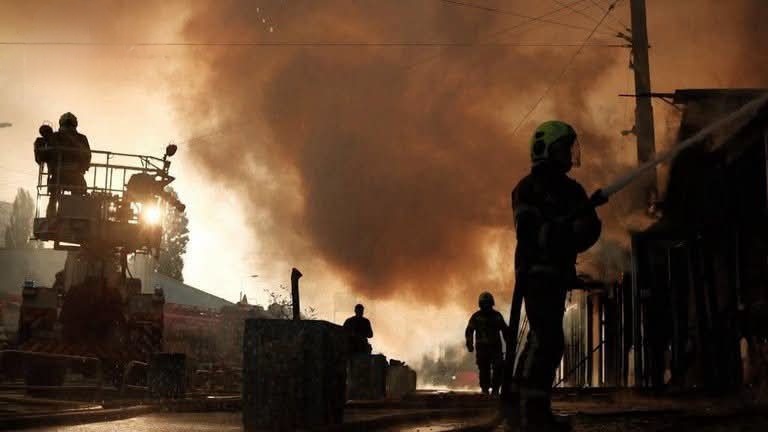
The accomplishments of the campaign, measured in tactical terms, are not insignificant. Ukrainian sources claim to have put 40 per cent of Russian oil facilities out of action, forcing Russia to purchase gasoline. Significant damage was done to Russian grain exports, which had to be rerouted away from the Black Sea. Civilian infrastructure was hit, including apartment buildings, a cafe in Moscow, a beach in Gelendzhik, and numerous civilian casualties in Kursk, Bryansk, and Belgorod provinces. However, Brovkin notes, “destroying oil facilities does not stop the Russian army.” The strategic purpose of the campaign, forcing Russia to accept Ukrainian terms, was not achieved. The achievements were primarily propaganda victories, designed to create images of black smoke and civilian casualties in Russia, to project an impression of Ukrainian strength, and to extract more funding from the European Union and the United States.

The Russian response has been multi-layered and devastating. On the defensive front, Russia has deployed a network of radar towers, high-caliber machine guns, lasers, and small aircraft to intercept low-flying drones. The statistics are striking, of 1,500 drones sent toward Moscow in recent weeks, only one got through. Approximately 80 per cent were intercepted at the Moscow province level, with another 15 per cent stopped at the approaches to the city limits. Moscow has become virtually impenetrable to drone attack. However, these defensive measures are not yet deployed around all facilities, and Ukrainian forces have responded by targeting unprotected civilian infrastructure, which is both a war crime and a strategic mistake that has hardened Russian public opinion.
The offensive Russian response has been far more damaging than the drone campaign itself. Russian forces have launched a massive assault on Ukrainian logistics, communications, and economic infrastructure. Port infrastructure in Odessa and all southern ports has been almost completely destroyed. Russian assault on Odessa and shipping in the Black Sea have escalated from targeted attacks to a systemic blockade. More than 70 strikes on port infrastructure and over 60 attacks on merchant vessels have been recorded. Odessa, through which approximately 60% of Ukraine’s $3.5 billion in monthly exports passes, is effectively cut off from global markets. Ukraine is now effectively landlocked. Every day, two or three ships that enter Ukrainian waters are destroyed. Rail junctions and locomotives are being systematically hit and destroyed, one by one. The bridge to Romania has been partially destroyed, and barges along the Danube are being targeted. Russia is “finally fighting gloves off,” with the objective of depriving Ukraine of ammunition supplies from the European Union and collapsing the Ukrainian economy. The systematic destruction of Ukraine’s industrial base and logistics network means that, within “a matter of a month or two,” the Ukrainian economy will collapse.
The diplomatic landscape has shifted decisively. President Trump’s initiatives to send Steve Witkoff and Jared Kushner to Moscow for negotiations are dismissed by Russian analysts as “deja vu.” The Russians are tired of such overtures. The critical factor is that Russian analysts now regard the war as “Trump’s war,” not Biden’s war, because the United States under Trump provides satellite support for Ukrainian targeting, making Washington a direct party to the conflict. The Turkish sale of 17 ATACMS missiles to Ukraine, with American approval, confirms US complicity. Russia has formally demanded explanations from Ankara, warning that the transfer would ‘seriously damage’ bilateral relations, while Turkey has so far remained silent. This diplomatic friction is compounded by Israel’s 18 August airstrike on a Syrian airbase near the Turkish border, conducted explicitly to prevent Turkish military deployment, which Turkey condemned as ‘Israeli aggression.’ Caught between Russian economic leverage and Israeli military assertiveness, Ankara’s balancing act is becoming untenable. Trump is irrelevant as a mediator unless he simply accepts Putin’s conditions, which is unlikely given the current political climate in Washington. The European Union’s decision to transfer €1.5 billion in interest from frozen Russian assets to Ukraine is characterised in Russian discourse as “stolen Russian assets,” an assault on Russian sovereignty that will have to be returned “one way or another, maybe even by force.”
The most significant development, however, is the shift in Russian public opinion and the emergence of a legal framework for regime change in Ukraine. The deliberate targeting of Russian civilian infrastructure has been accompanied by Ukrainian admissions of responsibility, which Russian commentators argue constitutes a war crime. When a state openly declares and conducts such attacks, it becomes a “terrorist state.” Russia, according to this reasoning, does not negotiate with terrorist states but “liquidates” them. This provides the legal foundation for regime change in Ukraine, the overthrow of the Zelensky government. It is now evident that Russian public opinion has undergone a dramatic transformation, a virtually universal demand to finish the war with a Russian victory quickly and no more negotiations. The drone campaign, intended to strengthen Ukraine’s bargaining position, has instead hardened Russian resolve and legitimised the pursuit of regime change.
The implications of this analysis are profound. Ukraine’s drone offensive has backfired spectacularly, provoking a Russian military response that may prove decisive, hardening Russian public opinion against any compromise, and legitimising the pursuit of regime change in Kyiv. The drone campaign, which was supposed to force Russia to accept Ukrainian terms, has instead accelerated the collapse of Ukraine’s economy and military capabilities. The diplomatic initiatives of the United States are irrelevant, and the European Union’s seizure of Russian assets is viewed as an act of theft that will have consequences. The trajectory of the war is increasingly unfavourable for Ukraine, and the consequences of a strategic miscalculation are becoming apparent. The drone offensive, intended as a coercive tactic to strengthen Ukraine’s position, has instead weakened it irreparably, and the warning from Russian analysts is clear: Ukraine’s drone campaign has backfired, and the consequences may be catastrophic for the Ukrainian state.
Authored By: Global GeoPolitics
If you prefer to make a one time donation in support of my work, you can do so by clicking any link below:
https://donate.stripe.com/7sY8wPfvi864don0k3awo07 |
https://buymeacoffee.com/ggtv |
https://ko-fi.com/globalgeopolitics |
Bitcoin: 3NiK8BoRZnkwJSHZSekuXKFizGPopkE7ns
References
Brovkin, Vladimir. 2026. “Russia to Finish Ukraine War Quickly.” History and Politics with Dr. Brovkin, 10 August. Available at: [YouTube/Substack] [Accessed 19 August 2026].
Reuters. 2026. “Ukraine’s 40-day drone campaign: What was achieved?” Reuters, 9 August. Available at:
[Accessed 19 August 2026].
Kyiv Post. 2026. “Fire Point developing ballistic missile capable of hitting Moscow.” Kyiv Post, August. Available at:
[Accessed 19 August 2026].
Russian Ministry of Defence. 2026. “Daily briefing on the special military operation.” Ministry of Defence of the Russian Federation, 7 August. Available at:
[Accessed 19 August 2026].
TASS. 2026. “Russia intercepts 1,499 of 1,500 drones targeting Moscow.” TASS, 9 August. Available at:
[Accessed 19 August 2026].
European Commission. 2026. “EU transfers €1.5 billion in frozen Russian assets to Ukraine.” European Commission Press Release, 9 August. Available at:
[Accessed 19 August 2026].
Anadolu Agency. 2026. “Turkey sells 17 ATACMS missiles to Ukraine.” Anadolu Agency, 10 August. Available at:
[Accessed 19 August 2026].
Al Jazeera. 2026. “Russia strikes Odessa port infrastructure.” Al Jazeera, 10 August. Available at:
[Accessed 19 August 2026].


Leave a comment