
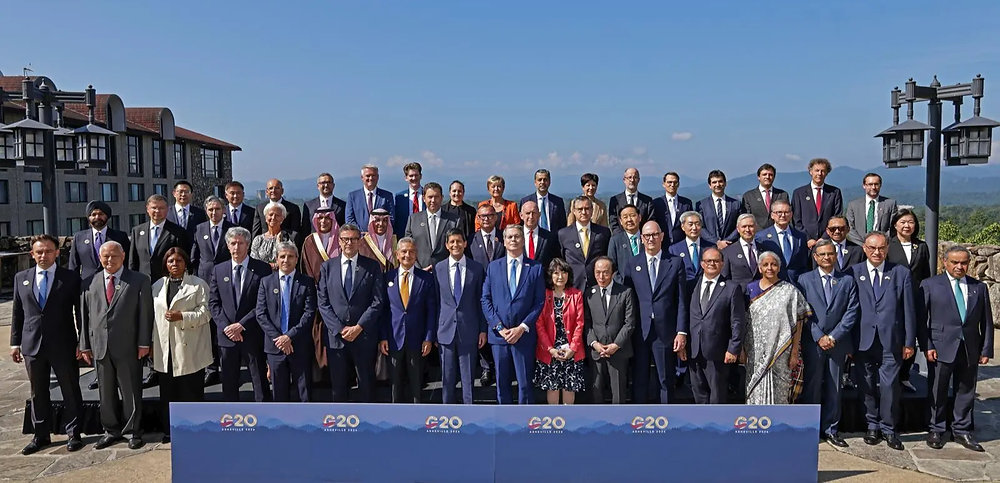
An examination of the institutional, strategic and economic drivers behind Beijing’s refusal to endorse language on trade imbalances, non-market policies and critical supply chains in the chair’s statement issued after the Asheville gathering
Editorial Analysis | September 2026
In the closing days of the United States G20 presidency’s finance track, finance ministers and central bank governors gathered in Asheville, North Carolina, only for the customary joint communiqué to give way to a chair’s statement endorsed by every member except China. Officials from the host country and several European capitals attributed the outcome to Beijing’s resistance against specific formulations concerning external surpluses, non-market policies, critical mineral supply chains and navigation through the Strait of Hormuz. The contested paragraph on imbalances stated that countries with excessive and persistent external surpluses should remove distortions that constrain domestic consumption and that result in an over-reliance on exports for growth. Parallel language called for steps to eliminate non-market policies and practices that exacerbate imbalances and for improved data work by the International Monetary Fund and the Organisation for Economic Co-operation and Development. Additional objections covered language on ensuring efficient supply chains for critical minerals and free, safe and predictable navigation through the Strait of Hormuz amid ongoing disruptions linked to conflict involving Iran.
United States Treasury Secretary Scott Bessent told reporters that the country with the world’s largest and unsustainable current account surplus had been the dissenter and that non-market-based economies pushing out a never-ending stream of cheap exports could not be sustained. Chinese representatives, by contrast, maintained that addressing global imbalances required structural reforms across all economies and that framing the issue as primarily a Chinese problem amounted to pressure rather than genuine multilateral coordination. People’s Bank of China Governor Pan Gongsheng stressed commitment to expanding domestic demand while rejecting any suggestion that China deliberately pursued trade surpluses or would weaponise the yuan. The Ministry of Commerce later described the elevation of so-called economic imbalances and overcapacity within the G20 as an attempt to promote protectionism and to find pretexts for restrictions.
These positions reflect deeper institutional and strategic calculations. For the United States and several partners, persistent Chinese current-account surpluses, estimated to have reached approximately 1.2 trillion dollars in goods trade in 2025, together with state-supported industrial capacity in sectors ranging from electric vehicles to advanced manufacturing, generate competitive pressure on domestic industries already strained by earlier waves of financialisation and offshoring. Language on non-market policies seeks to codify long-standing American and European complaints about subsidies, directed credit and industrial planning that, in their view, distort relative prices and produce excess capacity. Parallel concern over critical minerals arises from China’s dominant position in refining and processing rare earths and related materials, a position that confers leverage against unilateral coercive measures and that Beijing has previously demonstrated a willingness to activate.
China’s refusal to endorse the relevant passages follows a consistent pattern of resisting formulations that could legitimise further restrictions on its industrial model or dilute the strategic value of its resource advantages. Dominance in rare-earth processing functions as a form of self-defence against export controls and tariffs; accepting language that prioritises uninterrupted supply chains under terms set by others would amount to unilateral disarmament in a domain of acute strategic competition. Objection to Strait of Hormuz language, according to reporting, also reflected broader concerns about precedents that might later be invoked in relation to maritime claims closer to Chinese shores. In each case the calculus appears driven less by abstract attachment to multilateral process than by concrete assessment of relative power and vulnerability.
Western complaints about Chinese overcapacity have intensified in parallel with difficulties in upgrading industrial capacity at home. Decades of prioritisation of financial services, privatisation of strategic assets and erosion of industrial policy capacity have left several advanced economies dependent on imports for both intermediate goods and finished products associated with green transitions and digital infrastructure. Chinese export growth has been underpinned by economies of scale, iterative technical improvement and rising external demand for lower-cost components and finished goods. At the same time, Chinese imports of commodities, capital goods and intermediate products from a substantial share of its trading partners have expanded, indicating that bilateral balances are not uniformly one-directional. Data showing that a majority of China’s fifty largest trading partners recorded faster export growth to China than import growth from China in recent periods complicates the narrative of unidirectional imbalance.
Efforts to convert these structural frictions into G20 consensus language encounter predictable resistance because the proposed remedies distribute adjustment costs asymmetrically. Demands that surplus countries expand domestic consumption and abandon industrial policies that generate competitive advantage place the burden of rebalancing primarily on the surplus economy while leaving fiscal, monetary and industrial choices of deficit economies relatively unexamined. From Beijing’s perspective, such demands resemble an attempt to internationalise a domestic American preference for managed trade and selective industrial revival without reciprocal concessions on market access, technology transfer restrictions or energy-market interventions that themselves affect global prices and stability.
The chair’s statement ultimately issued by the United States therefore functions less as a reflection of genuine collective diagnosis than as a record of the host’s preferred framing, supported by a coalition of convenience among economies that share varying degrees of concern about Chinese competition. The nineteen-to-one outcome underscores both the breadth of unease over export volumes and the limits of converting that unease into binding multilateral discipline when the principal target retains the capacity to withhold consent. Subsequent bilateral engagement, including any high-level meetings between American and Chinese leadership, will test whether narrower understandings on specific sectors can be reached without the public symbolism of G20 language.
Longer-term trajectories remain contingent on relative industrial performance, demographic and technological shifts, and the evolution of energy and logistics costs. Should Western economies succeed in rebuilding productive capacity through coherent industrial strategies, the political salience of Chinese surpluses may diminish. Should Chinese domestic demand expand more rapidly while external markets continue to absorb Chinese goods at scale, the imbalance debate will persist in other forums. In either case the Asheville episode demonstrates that multilateral statements on trade and industrial organisation remain arenas in which states pursue national advantage under the cover of collective language, and that consensus fails when the costs of that language fall disproportionately on a single major participant.
Authored By: Global GeoPolitics
If you prefer to make a one time donation in support of my work, you can do so by clicking any link below:
https://donate.stripe.com/7sY8wPfvi864don0k3awo07 |
https://buymeacoffee.com/ggtv |
https://ko-fi.com/globalgeopolitics |
Bitcoin: 3NiK8BoRZnkwJSHZSekuXKFizGPopkE7ns
References
Financial Times (2026) ‘China derails consensus after US-hosted G20’, 1 September. Available at: https://www.ft.com/content/dcefdf76-9bac-4b34-80c2-eab80b559f53 (Accessed: 4 September 2026).
Reuters (2026) ‘G20 finance chiefs except China back action on distorted trade’, 1 September. Available at: https://www.reuters.com/world/china/us-pushes-g20-cut-trade-imbalances-focus-china-2026-09-01/ (Accessed: 4 September 2026).
South China Morning Post (2026) ‘China rejects G20 trade-imbalance claims, says no need to devalue yuan’, 3 September. Available at: https://www.scmp.com/economy/global-economy/article/3366213/china-rejects-g20-trade-imbalance-claims-says-no-need-devalue-yuan (Accessed: 4 September 2026).
Axios (2026) ‘China’s objections derail G20 finance statement’, 2 September. Available at: https://www.axios.com/2026/09/02/china-g20-bessent-trade (Accessed: 4 September 2026).
Bloomberg (2026) ‘Bessent Says China Prevented G20 Communique Over Imbalance Spat’, 2 September. Available at: https://www.bloomberg.com/news/articles/2026-09-01/bessent-says-china-prevented-g20-communique-over-imbalance-spat (Accessed: 4 September 2026).
Global Times (2026) ‘China opposes using G20 to hype so-called “economic imbalances,” “overcapacity”: MOFCOM’, 3 September. Available at: https://www.globaltimes.cn/page/202609/1369739.shtml (Accessed: 4 September 2026).
New York Times (2026) ‘At G20 Meeting, Scott Bessent Accuses China of Flooding the World With Cheap Exports’, 1 September. Available at: https://www.nytimes.com/2026/09/01/business/economy/bessent-china-iran-g20.html (Accessed: 4 September 2026


Leave a comment