
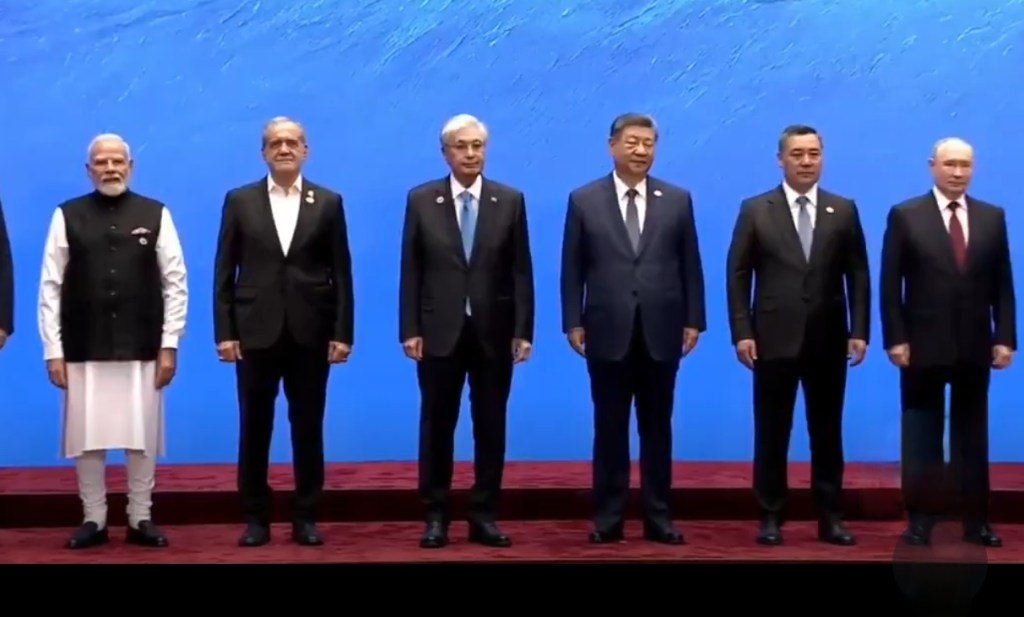
The Shanghai Cooperation Organisation’s unanimous condemnation of the American-Israeli attack on Iran signals more than diplomatic posturing; it exposes the deepening structural contradictions within a unipolar order that can no longer enforce its will without provoking collective resistance.
Editorial Analysis | September 2026
The Shanghai Cooperation Organisation’s Bishkek Declaration, adopted on 1 September 2026, represents the first instance in which all ten member states have jointly condemned military action against a fellow member without equivocation [4][9]. The declaration affirmed the member nations’ position condemning military strikes on Iranian territory that had resulted in numerous civilian casualties and significant damage to the country’s economy [8]. Iranian President Masoud Pezeshkian subsequently hailed the organisation’s unanimous condemnation, noting that all members without exception affirmed that aggression against Iran was unacceptable and condemned the aggressor [9]. Yet the declaration conspicuously refrained from naming the United States or Israel directly, a diplomatic omission that reveals the careful balancing act required of an organisation comprising states with divergent economic relationships with the Western powers [8]. This strategic ambiguity does not diminish the significance of the moment; rather, it underscores the institutional maturation of an organisation that has evolved from a border-security forum into a vehicle for articulating opposition to the existing global order.
The military campaign that prompted this diplomatic response began on 28 February 2026, when the United States and Israel launched coordinated strikes against Iranian targets [11]. President Trump characterised the operation as aimed at eliminating imminent threats from the Iranian regime, a formulation that echoed the language of preventive war that has animated American strategic doctrine since the publication of the National Security Strategy of 2002. The attack followed the failure of nuclear negotiations in Geneva and occurred against the backdrop of the largest American military build-up in the Middle East in twenty-three years. Iran responded with retaliatory strikes against Israel and American bases in the region, and the subsequent escalation effectively closed the Strait of Hormuz to commercial shipping, demonstrating the capacity of a determined regional power to disrupt the global energy supplies upon which the international capitalist economy depends [11]. The attack on Iran, however, cannot be understood as a discrete event or as the product of a single administration’s foreign policy preferences. Its roots lie in a strategic vision articulated nearly a quarter-century earlier, when the Pentagon developed plans to remove the governments of seven countries in five years, a list that began with Iraq and ended with Iran [2]. General Wesley Clark, the former NATO Supreme Allied Commander, publicly disclosed this planning in 2007, revealing that a memorandum described how the United States intended to take out seven countries in five years, starting with Iraq and then Syria, Lebanon, Libya, Somalia, Sudan and finishing with Iran [6]. The invasion of Iraq in 2003, the subsequent destabilisation of Libya and Syria, and the decades-long sanctions regime against Iran all conform to this underlying strategic logic, which treats the Middle East as a theatre for the maintenance of American hegemony and the preservation of energy security on terms favourable to Western capital.
Donald Trump’s role in this sequence requires careful examination, for his administration presents a paradox that illuminates the structural determinants of American foreign policy. Trump won the 2024 election in part because of his explicit promise to end American involvement in foreign wars [1]. In his victory address on 6 November 2024, he declared that under his leadership the United States would have no more wars, no more disruptions and prosperity and peace for all [7]. He repeated this formulation frequently on the campaign trail, and his supporters understood his election as a mandate for disengagement from the endless conflicts that had characterised American foreign policy since the attacks of September 2001 [1]. Yet within eighteen months of his inauguration, Trump had authorised a major military strike against Iran, effectively repudiating the central promise of his political career. When challenged on this contradiction in a June 2026 interview with NBC, Trump denied ever having guaranteed that the United States would avoid new wars, a claim that BBC Verify subsequently refuted by producing multiple examples of his campaign-trail statements [1][7]. This disavowal of his own recorded words reveals less about Trump’s personal veracity than about the institutional pressures that operate upon any American president, regardless of their electoral mandate or rhetorical commitments.
The mechanisms through which presidential intentions are subordinated to the imperatives of the national security state are multiple and well-documented. During his first term, Trump had attempted to withdraw American troops from Syria and Afghanistan, only to encounter fierce opposition from both Republican and Democratic hawks in Congress. The Senate voted to oppose the withdrawal of troops from Syria and Afghanistan in a bipartisan rebuke to the president, and Trump’s own Secretary of Defense, James Mattis, resigned in protest over the Syria decision. A similar dynamic operated in the lead-up to the Iran attack: the president who had campaigned against foreign entanglements found himself unable to resist the combined pressure of the military establishment, the intelligence community, the defence industry and the Israeli lobby, all of which had long identified Iran as the principal obstacle to American dominance in the Middle East. The attack on Iran, therefore, represents not a failure of Trump’s personal judgment but a demonstration of the structural limits on presidential agency within the American political system.
The early months of Trump’s second administration had offered some indication that a genuine policy correction might be possible. Secretary of State Marco Rubio, in his Senate confirmation hearing, declared that the post-war global order was not merely obsolete but had become a weapon being used against the United States [10]. This remarkable statement, which effectively repudiated the liberal internationalism that had guided American foreign policy since 1945, suggested that the administration intended to abandon the multilateral institutions and legal frameworks that had constrained American power [10]. Rubio characterised established geopolitics as a failing system and signalled that the Trump administration would prioritise the national interest over the maintenance of world order [10]. Yet this rhetorical radicalism did not translate into a fundamental reorientation of policy. The attack on Iran demonstrated that the administration’s critique of the existing order was instrumental rather than principled: the United States would reject international law when it constrained American action but would continue to use military force to enforce its strategic preferences when the opportunity arose.
The Western media’s treatment of the Bishkek summit provides further evidence of the structural biases that shape the production of geopolitical knowledge in the liberal democracies. The transcript’s claim that the summit received no Western coverage is not strictly accurate; the German newspaper Berliner Zeitung characterised the event as an uprising against the old order, and NHK World-Japan reported that the leaders of Russia, China and India were gathering to counter American influence [5]. Yet the framing of this coverage reveals the analytical limitations of the Western press. Eurasianet dismissed the summit as producing no big announcements or viral moments, while Reuters, Bloomberg and numerous Western think-tanks described the organisation as a motley collection of disparate states with internal divisions, a paper tiger incapable of meaningful collective action [3]. This dismissive framing serves an ideological function: by representing the SCO as an incoherent and ineffectual assembly, the Western press reinforces the legitimacy of the existing order and discourages serious consideration of alternative institutional arrangements. The reality, however, is that the SCO now comprises states representing approximately forty per cent of the world’s population and a growing share of global economic output, and its members are actively developing alternative financial mechanisms, including bilateral trade agreements denominated in national currencies, that progressively reduce their dependence on the dollar-based financial system controlled by the United States [5][8].
(Was Narendra Modi forced to condemn Israeli-American attack on Iran by signing SCO joint declaration. Will he be able to face Netanyahu and Trump )
A historical materialist analysis of these developments must begin from the proposition that the American-Israeli attack on Iran and the SCO’s response are both expressions of underlying economic contradictions rather than autonomous political choices. The United States maintains its global hegemony through a combination of military superiority, financial control and energy dominance, and Iran represents a strategic challenge to all three pillars of American power. Iran possesses the world’s second-largest natural gas reserves and fourth-largest proven oil reserves, and its exclusion from global energy markets benefits American-allied producers in Saudi Arabia and the Gulf states while preserving the dollar’s role as the exclusive currency for petroleum transactions [9]. The sanctions regime against Iran, which has been maintained and intensified across multiple administrations, serves the material interests of American energy corporations, financial institutions and defence contractors, all of which profit from the perpetuation of conflict and the prevention of Iranian integration into the global economy [4][9]. The attack of February 2026, whatever its stated justification, must be understood within this material context: it represents an attempt to eliminate a competitive energy producer, to demonstrate American military credibility to allies and adversaries alike, and to distract from the deepening domestic contradictions of American capitalism.
The SCO member states, for their part, are responding to their own material incentives rather than to any abstract commitment to anti-imperialism. China requires access to Iranian energy and seeks to develop overland trade routes through Central Asia that bypass the maritime chokepoints controlled by the American navy. Russia, subjected to extensive sanctions following its invasion of Ukraine, has found in the SCO a mechanism for coordinating resistance to Western economic pressure and for developing alternative payment systems that reduce its vulnerability to financial exclusion [4]. India, despite its historically close relationship with the United States, has economic interests in Iran that include access to energy supplies and the development of the Chabahar port, which provides an alternative to the Pakistani route for trade with Afghanistan and Central Asia. These material interests, rather than any ideological affinity, explain the SCO’s unanimous condemnation of the attack on Iran [8]. The organisation’s members are not constructing a socialist alternative to global capitalism; they are competing with the United States for access to resources, markets and trade routes within a capitalist world system whose fundamental dynamics they accept. The SCO represents, in this sense, an intra-bourgeois alliance of competing capitalist powers rather than a genuinely counter-hegemonic formation.
The implications of these developments for the future of the international order are profound but uncertain. The Bishkek Declaration demonstrates that the United States can no longer rely on the automatic compliance of major powers with its strategic objectives, and the development of alternative financial and institutional arrangements progressively reduces the effectiveness of sanctions as a tool of American foreign policy [4][8]. Yet the SCO’s internal contradictions are equally significant: China and India have competing territorial claims and strategic interests, Russia’s relationship with China is characterised by asymmetrical dependency, and the Central Asian members maintain complex economic relationships with both the West and their larger neighbours. The organisation’s ability to sustain its current unity in the face of these tensions remains an open question. What seems clear, however, is that the American attack on Iran has accelerated a process of institutional differentiation that was already underway, and that the unipolar moment that followed the collapse of the Soviet Union has definitively passed. The rules-based order that Marco Rubio declared obsolete has given way to a more fragmented and contested international system, in which competing powers pursue their material interests through a combination of military pressure, economic coercion and institutional construction [10]. The outcome of this competition will depend less on the rhetorical commitments of individual leaders than on the underlying trajectories of economic growth, technological development and demographic change that are reshaping the distribution of global power.
Authored By: Global GeoPolitics
If you prefer to make a one time donation in support of my work, you can do so by clicking any link below:
https://donate.stripe.com/7sY8wPfvi864don0k3awo07 |
https://buymeacoffee.com/ggtv |
https://ko-fi.com/globalgeopolitics |
Bitcoin: 3NiK8BoRZnkwJSHZSekuXKFizGPopkE7ns
References
[1] BBC News. (2026, June 8). Trump denies promising ‘no new wars’ – but he campaigned on that.
[2] Clark, W. (2007). Winning Modern Wars: Iraq, Terrorism, and the American Empire. PublicAffairs.
[3] Eurasianet. (2026, September 3). Shanghai Cooperation Organization summit comes up short on achievements.
[4] Mehr News Agency. (2026, September 1). SCO leaders slam US-Israeli war of aggression against Iran.
[5] NHK World-Japan. (2026, September 2). Shanghai Cooperation Organization summit closes with show of unity with Iran.
[6] Salon. (2007, October 12). “Seven countries in five years”.
[7] The Independent. (2026, June 8). Trump said he never guaranteed ‘no new wars’ despite 2024 campaign promises.
https://www.the-independent.com
[8] The Wire. (2026, September 2). At Bishkek Summit, SCO Condemns Strikes on Iran but Doesn’t Name US or Israel.
[9] Tehran Times. (2026, September 1). SCO slams US-Israeli aggression, Ayatollah Khamenei’s assassination and sanctions on Iran.
[10] Washington Examiner. (2025, January 15). Marco Rubio scorns ‘postwar global order’ as ‘obsolete’ in Senate hearing.
[11] Xinhua News Agency. (2026, February 28). U.S., Israel strike Iran, trigger retaliations.


Leave a Reply