
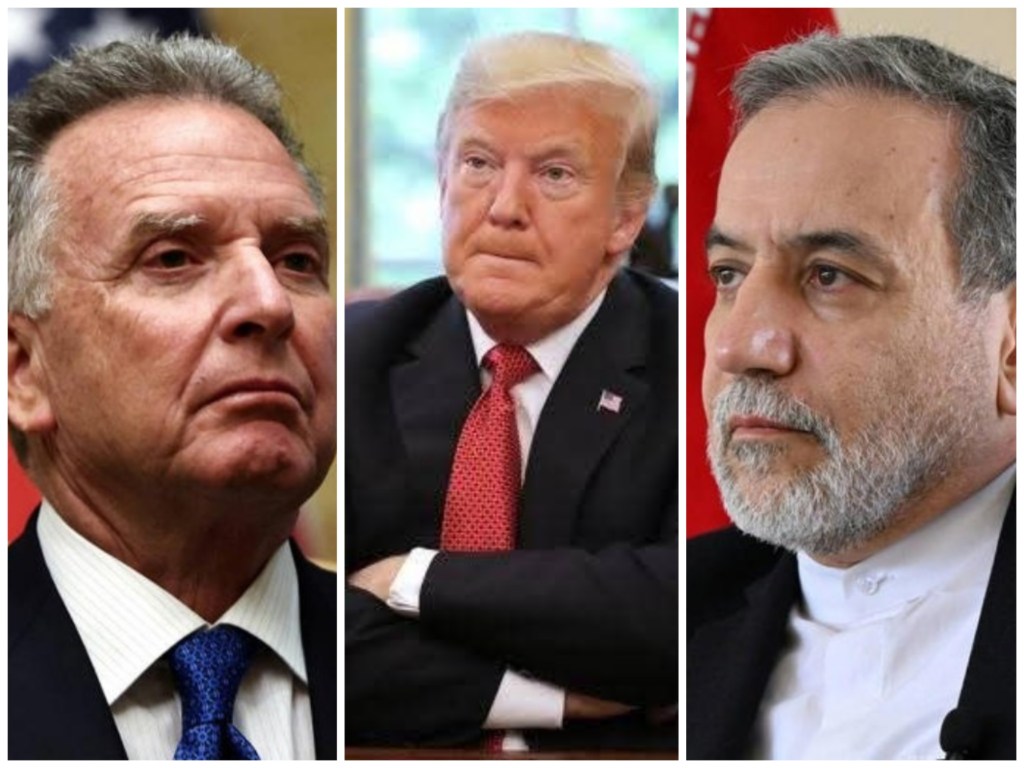
The consequences of underestimation and misreading capability by the United States and Israel has resulted in measurable strategic cost
The available evidence indicates that the scale and resilience of Iranian state capacity under sustained attack have been materially underestimated in much Western policy analysis, despite repeated cautions issued over several years by academic specialists in Middle Eastern security studies and former military officials. The United States, in concert with Israel, represents the most capable and extensively networked military force in the contemporary international system, and the scale of force assembled against Iran would, in most comparable cases, have compelled rapid capitulation by a middle or smaller power, as demonstrated in the recent intervention in Venezuela where limited resistance capacity and centralised leadership structures enabled swift external coercion to achieve its objectives .
Scholars such as Kenneth Pollack and Anatol Lieven have previously argued that Iran’s strategic depth, decentralised command structures, and experience under sanctions would complicate any attempt at rapid coercion or regime destabilisation, assessments which appear to have been insufficiently integrated into policy planning. The result is a situation in which an initial decapitation-oriented campaign, intended to produce rapid strategic paralysis, has instead failed to achieve decisive effects.
The removal of senior leadership figures across multiple Iranian institutions did not produce systemic collapse, which aligns with long-standing academic assessments of the Islamic Republic’s hybrid governance model combining ideological authority with bureaucratic redundancy. Research produced by institutions such as the International Institute for Strategic Studies has consistently noted that Iran’s command-and-control architecture is deliberately layered, allowing operational continuity even under severe disruption. The continuation of coordinated military operations following leadership losses therefore reflects structural design rather than improvised adaptation.
Operationally, the reported degradation of United States regional basing infrastructure and surveillance capabilities suggests a level of preparedness that exceeds prior public estimates. Studies in contemporary military doctrine, including work by Lawrence Freedman, emphasise that modern force projection depends heavily on uninterrupted reconnaissance and forward basing. The disruption of radar systems and the necessity to rely on airborne early warning platforms indicates that Iran has targeted critical enablers rather than frontline assets alone, a strategy consistent with asymmetric doctrine developed over decades. Such actions impose operational friction that cannot be rapidly offset without escalation or redeployment from other theatres.
The extension of strikes across multiple Gulf states, combined with sustained operations against Israeli targets, reflects both range and inventory depth in missile and drone capabilities. Academic analyses from centres such as the Stockholm International Peace Research Institute have documented Iran’s investment in relatively low-cost, high-volume strike systems designed to saturate air defences. The persistence of large-scale missile and drone operations without evident depletion supports earlier estimates that Iran prioritised stockpile accumulation precisely for protracted conflict scenarios. Claims regarding censorship of damage within Israel cannot be independently verified in full, yet the scale and continuity of strikes align with the known characteristics of Iran’s arsenal.
Maritime disruption in the Gulf and the assertion of control over the Strait of Hormuz must be understood within the framework of economic statecraft. Approximately one fifth of globally traded oil passes through that corridor under normal conditions, a figure widely cited in energy security literature. Analysts such as Meghan O’Sullivan have long argued that Iran’s capacity to threaten this chokepoint constitutes a central pillar of its deterrence posture. The reported destruction or disabling of multiple vessels, combined with the imposition of cumulative costs on shipping and insurance markets, indicates that this leverage is being operationalised rather than merely signalled.
The role of allied non-state actors in Iraq and Lebanon further extends Iran’s strategic reach without requiring direct territorial expansion. Work by Fanar Haddad has emphasised that Iran’s networked approach to regional influence allows it to distribute risk and maintain pressure across multiple fronts. The activation of these actors under conditions of direct confrontation reinforces the concept of a distributed deterrence system, complicating adversary targeting and increasing the cost of escalation.
Cyber operations, though less visible, form an additional layer of capability that aligns with broader trends in hybrid warfare. Research from the Royal United Services Institute has noted Iran’s growing competence in offensive cyber activities, particularly in targeting infrastructure and communications. Even limited successes in this domain can have disproportionate psychological and operational effects, especially when combined with kinetic actions.
The cumulative effect of these developments is to shift the balance of leverage. Iran retains multiple escalation pathways, including the expansion of operations through partners such as the Houthis, increased targeting of critical infrastructure, and the potential to impose sustained attritional costs on regional adversaries. The implicit threat of protracted insurgency in the event of ground intervention further constrains external military options, reflecting lessons drawn from conflicts in Iraq and Afghanistan that have been extensively analysed in academic literature.
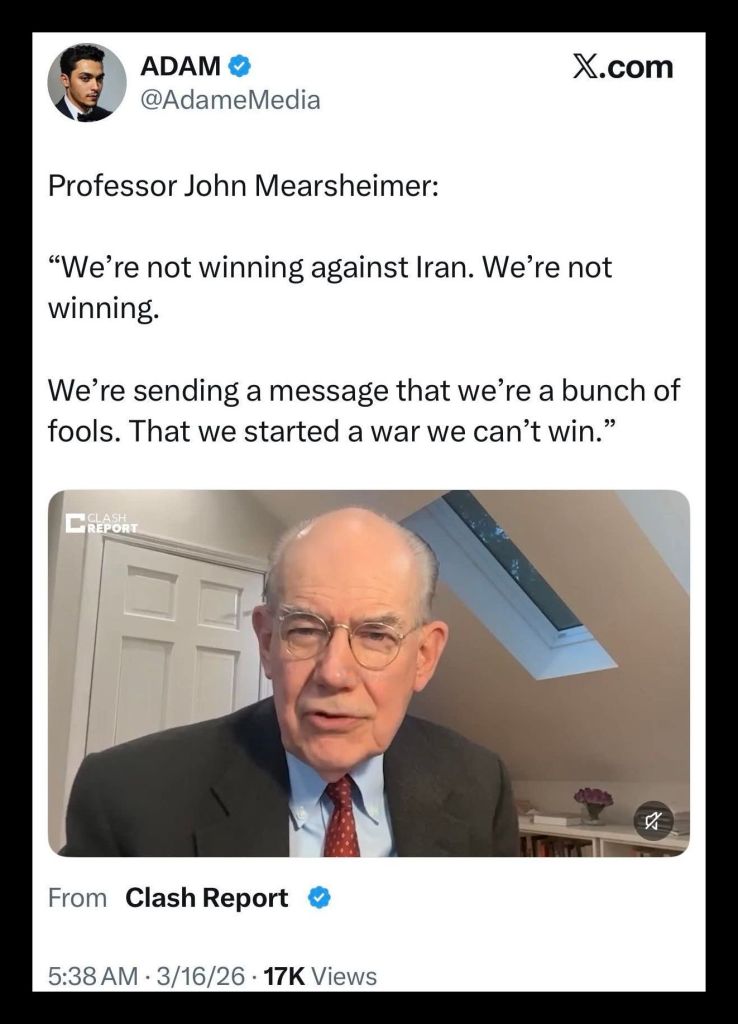
The broader implication is that the initial strategic assumptions underpinning the campaign appear to have underestimated both Iranian resilience and its capacity for sustained retaliation. This miscalculation is not without precedent, as highlighted in retrospective analyses of previous interventions where state cohesion under external pressure proved more robust than anticipated. The present situation demonstrates that a state capable of maintaining coordinated military, economic, and political functions under extensive attack possesses a degree of strategic depth that cannot be easily neutralised through conventional means alone.
The emerging recognition among analysts that the conflict has not followed its anticipated trajectory reflects a reassessment already visible in specialist commentary. The issue is not solely one of military capability but of systemic endurance and the integration of multiple instruments of power. Any evaluation that isolates individual elements without considering their interaction risks repeating the same analytical shortcomings that contributed to the current impasse.
For small and middle powers, the central lesson is that Iran did not attempt to match superior force with symmetry, but instead studied the operational patterns, dependencies, and vulnerabilities of a more powerful adversary over several decades, developing a cost-efficient model of decentralised defence and offensive attrition designed to survive initial shock and impose cumulative costs; the effectiveness of this approach, particularly in enduring the opening phase of the war, reflects a doctrine explicitly built around absorbing early damage to preserve continuity of operations and second-strike capability, thereby transforming survival in the first weeks from a tactical necessity into the decisive foundation of strategic leverage.
Authored By: Global GeoPolitics
Thank you for visiting. If you believe journalism should serve the public, not the powerful, and you’re in a position to help, becoming a PAID SUBSCRIBER truly makes a difference. Alternatively you can support by way of a cup of coffee:
https://buymeacoffee.com/ggtv |
https://ko-fi.com/globalgeopolitics |
Bitcoin: 3NiK8BoRZnkwJSHZSekuXKFizGPopkE7ns


Leave a comment