
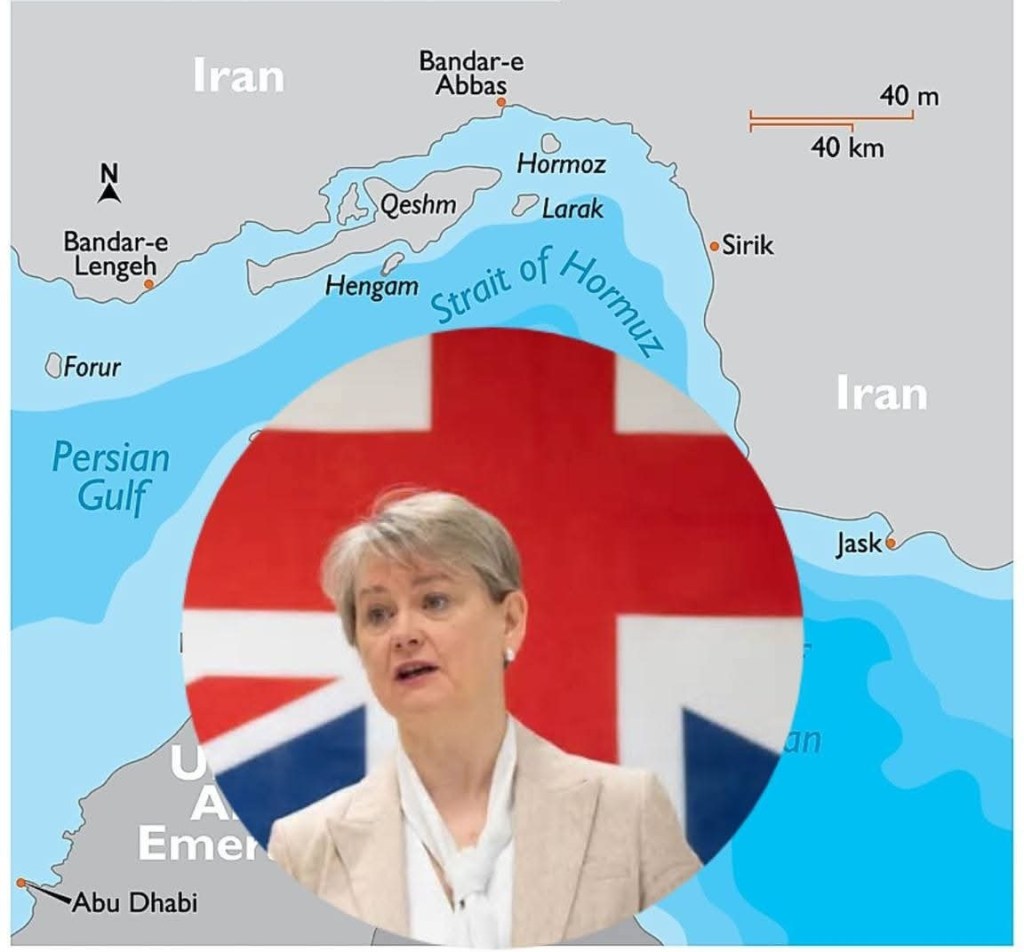
London hosts talks on Hormuz while enabling the very conflict it claims to stand apart from
The decision by the United Kingdom to convene a gathering of 35 countries to “explore” reopening the Strait of Hormuz carries the appearance of urgency and coordination, yet it is difficult to avoid the conclusion that it is largely detached from the realities shaping the crisis. The most striking feature of the initiative is not who is attending, but who is absent. Neither Iran, the actor with direct control over the strait’s closure, nor the United States, whose military presence and regional posture are central to the broader confrontation, are part of the process. A forum designed to address a conflict while excluding the principal belligerents is not diplomacy in any meaningful sense; it is an exercise in managing optics rather than outcomes.
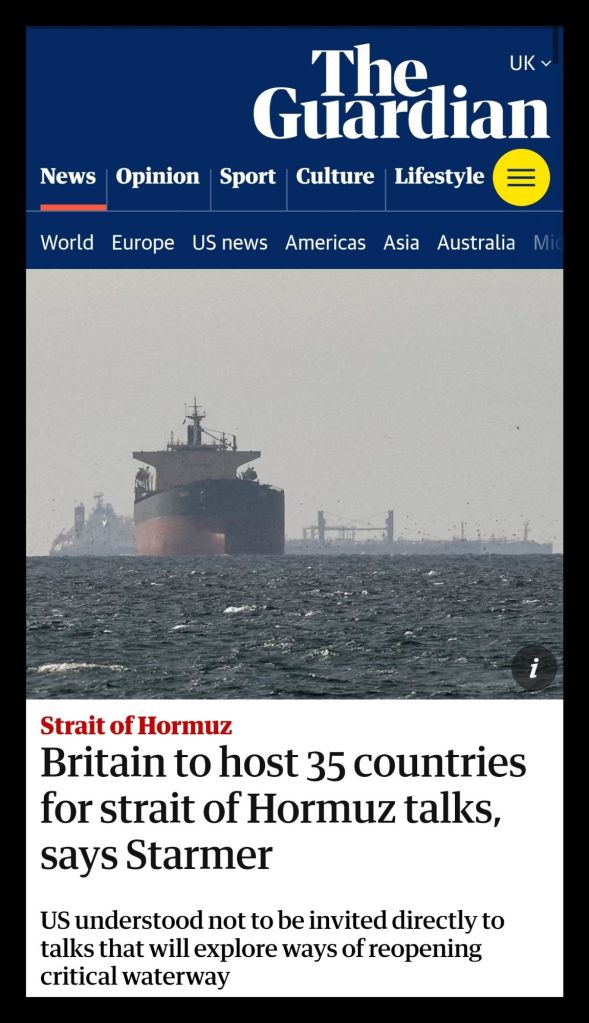
The premise of “exploring solutions” further underscores the disconnect. There is no ambiguity about why Hormuz is disrupted. The strait has not become a contested space because of technical misunderstandings or gaps in coordination, but as a direct consequence of escalating conflict, competing security doctrines, and unresolved strategic grievances. To frame the situation as a problem requiring exploratory dialogue is to sidestep the fact that the causes are already well understood, and, more importantly, that they are rooted in political decisions that external observers are either unwilling or unable to confront directly.
At the core of the issue lies a set of demands articulated by Iran that it has consistently presented as non-negotiable. These include an end to military pressure, guarantees regarding sovereignty, and a fundamental reconfiguration of the security architecture that has defined the Persian Gulf for decades, particularly the network of American bases and forward deployments. Whether one agrees with these demands is secondary to the fact that they form the basis of Iran’s current posture. They are not bargaining positions in the traditional sense, but conditions tied to a perception, rightly or wrongly, of strategic advantage. In this respect, the situation bears comparison to other conflicts where one party, convinced of its leverage, sets maximalist terms and shows little inclination to dilute them under external pressure.
Against this backdrop, the London meeting risks becoming an exercise in abstraction. The participating states, many of which lack direct leverage over either Tehran or Washington, are left to discuss mechanisms for de-escalation without access to the levers that would make such de-escalation possible. The result is a form of diplomatic displacement, where attention is focused on secondary actors and procedural frameworks rather than on the central antagonists whose decisions determine the trajectory of the crisis.
There is also an evident reluctance to engage with the underlying asymmetry of the situation. Control over the Strait of Hormuz, whether through geography, military capability, or the willingness to disrupt global energy flows, provides Iran with a form of leverage that cannot be neutralized through multilateral discussion alone. Any serious attempt to reopen the waterway would have to grapple with this reality directly, which in turn would require addressing the broader confrontation that produced the closure. By excluding the very actors capable of altering that dynamic, the process effectively confines itself to managing consequences rather than resolving causes.
In this sense, the initiative reflects a familiar pattern in international diplomacy: the convening of large, ostensibly inclusive forums that project engagement and concern, while carefully avoiding the political risks associated with confronting the core dispute. It allows participants to signal involvement without committing to the kinds of concessions or strategic shifts that a genuine resolution would demand. The likely outcome is a series of statements emphasizing cooperation, stability, and the importance of maritime security, none of which will materially alter the situation on the ground.
The broader implication is not merely that the talks may fail, but that they illustrate a persistent gap between diplomatic form and strategic substance. As long as the conflict continues on its current trajectory, and as long as the principal actors maintain positions they consider non-negotiable, external gatherings of this kind will struggle to achieve more than symbolic relevance. The Strait of Hormuz will not be reopened through discussion alone, particularly not discussions that exclude those who have both the capacity and the intent to keep it closed.
Set alongside the earlier discussion of diplomatic posturing, there is a contradiction in Britain’s position that is difficult to ignore. Within the span of a few hours, two entirely different narratives were effectively presented: one of detachment, and one of active facilitation. In the early hours of the morning, B-2 Spirit aircraft departed from RAF Fairford to carry out strikes against Iranian missile sites. At the same time, refuelling operations involving U.S. aircraft were taking place at RAF Mildenhall, while long-range missions continued to be supported from Diego Garcia. These are not incidental details; they form the operational backbone of sustained military action.
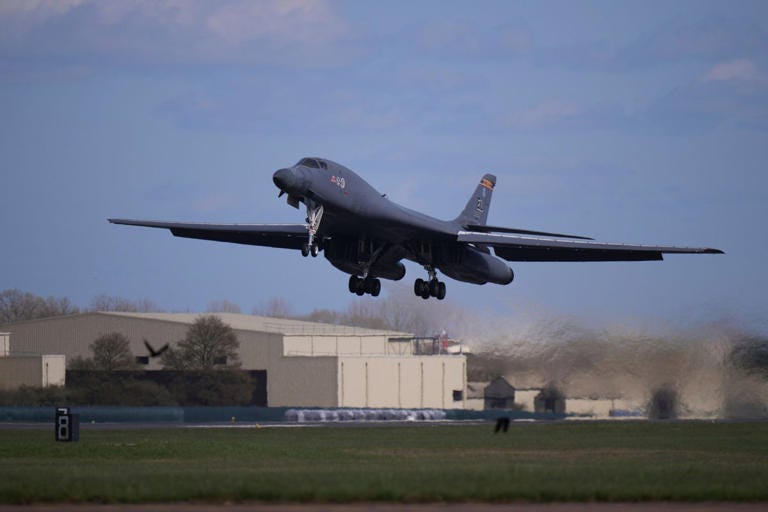
All of this activity relies on British infrastructure. Aircraft take off from British runways, are sustained by British fuel, and move through British-controlled airspace. This is happening even as other European countries reportedly restrict access to their skies for flights connected to the conflict. The contrast is stark: while some states are attempting to distance themselves from escalation, Britain is providing the logistical continuity that allows it to proceed.
Against this backdrop, the statement by Keir Starmer on March 31, that “this is not our war and we are not going to be dragged into it”, appears increasingly difficult to reconcile with events. The language suggests non-involvement, yet the reality points to a role that, while indirect, is structurally essential. Modern warfare is not defined solely by who pulls the trigger; it is sustained by networks of access, supply, and coordination. In that sense, the distinction between participant and bystander becomes far less clear.
The official justification rests on the idea that each sortie is approved by the Ministry of Defence for “specific and limited defensive operations.” Yet the elasticity of the term “defensive” is evident. What is framed as defensive support in one capital is unlikely to be perceived the same way in Iran, particularly when the outcome is the projection of force against its territory. Definitions in such contexts are not neutral; they are contested, and often irreconcilable.
There is also a clear political calculation underpinning this posture. The shadow of the Iraq War continues to shape British decision-making, particularly the fallout that followed the findings of the Chilcot Report into the actions of Tony Blair. The lesson drawn from that period appears not to be an avoidance of entanglement altogether, but rather an avoidance of visible ownership. The emphasis is on remaining in the background, providing support without assuming the political liabilities that come with overt leadership.
However, this approach carries its own risks. Every aircraft returning to Fairford, every refuelling operation completed, incrementally ties Britain to the consequences of the conflict. Political exposure accumulates regardless of how involvement is framed. The notion that one can enable military action at scale while remaining insulated from its repercussions is increasingly difficult to sustain.
That tension has already begun to manifest in retaliatory signals. Strikes on assets linked to BP, including facilities associated with its Castrol brand, appear to carry symbolic weight beyond their immediate impact. These are not random targets, but ones embedded in a longer historical arc that stretches back to the origins of Anglo-Iranian economic relations. The reference point is unmistakable: the nationalisation of Iranian oil under Mohammad Mossadegh in 1951, followed by his overthrow in the 1953 Iranian coup d’état orchestrated by the CIA and MI6. That episode, and the subsequent rule of Mohammad Reza Pahlavi, laid much of the groundwork for the Iranian Revolution and the emergence of the Islamic Revolutionary Guard Corps.
In that context, the selection of targets is as much about historical memory as it is about present-day strategy. It signals that the current confrontation is not viewed in isolation, but as part of a continuum of grievances and power struggles. The implication is that actions taken today are being interpreted through the lens of decades, even generations, of contested history.
The broader strategic alignment also comes into question. Britain’s position remains closely tied to that of the United States, whose approach to the conflict appears increasingly assertive. Speculation about the future of alliances such as NATO reflects a deeper uncertainty about the durability and direction of transatlantic cooperation. Past interventions, from Iraq to Afghanistan to Libya, are frequently cited as precedents in which European states were drawn into conflicts that ultimately proved costly and destabilising.
Whether one accepts that interpretation in full or not, it underscores a growing perception that strategic autonomy remains limited. The current situation reinforces that concern: even when political leaders seek to frame their role as restrained or peripheral, the underlying infrastructure of cooperation ensures a level of involvement that is difficult to disentangle. The contradiction, therefore, is both rhetorical and structural, embedded in the very way alliances operate and wars are sustained.
Authored By: Global Geopolitics
Thank you for visiting. This is a reader-supported publication. If you believe journalism should serve the public, not the powerful, and you’re in a position to help, becoming a PAID SUBSCRIBER truly makes a difference. Alternatively you can support by way of a cup of coffee:
https://buymeacoffee.com/ggtv |
https://ko-fi.com/globalgeopolitics |
Bitcoin: 3NiK8BoRZnkwJSHZSekuXKFizGPopkE7ns


Leave a comment