
Energy Systems as Strategic Targets in the Transition from Unipolar Control to Multipolar Contestation
The core claim of this article is that the current ruling transnational oligarchy and supranational interests seek to maintain their grip over primacy and hegemony, preventing the fragmentation of the unipolar rules-based order into multipolarity led by emerging blocs. Control of energy sources and supply chains remains central to maintaining that dominance. Oil refineries, export terminals, pipelines, and power generation sites have increasingly become targets within a wider struggle over strategic leverage and economic endurance.
The pattern extends beyond isolated industrial accidents or localised conflict. A growing number of energy facilities have become part of a broader contest over supply chains, maritime routes, insurance costs, refining margins, and geopolitical pressure. Energy infrastructure, once secondary in military planning, now sits at the centre of modern conflict.
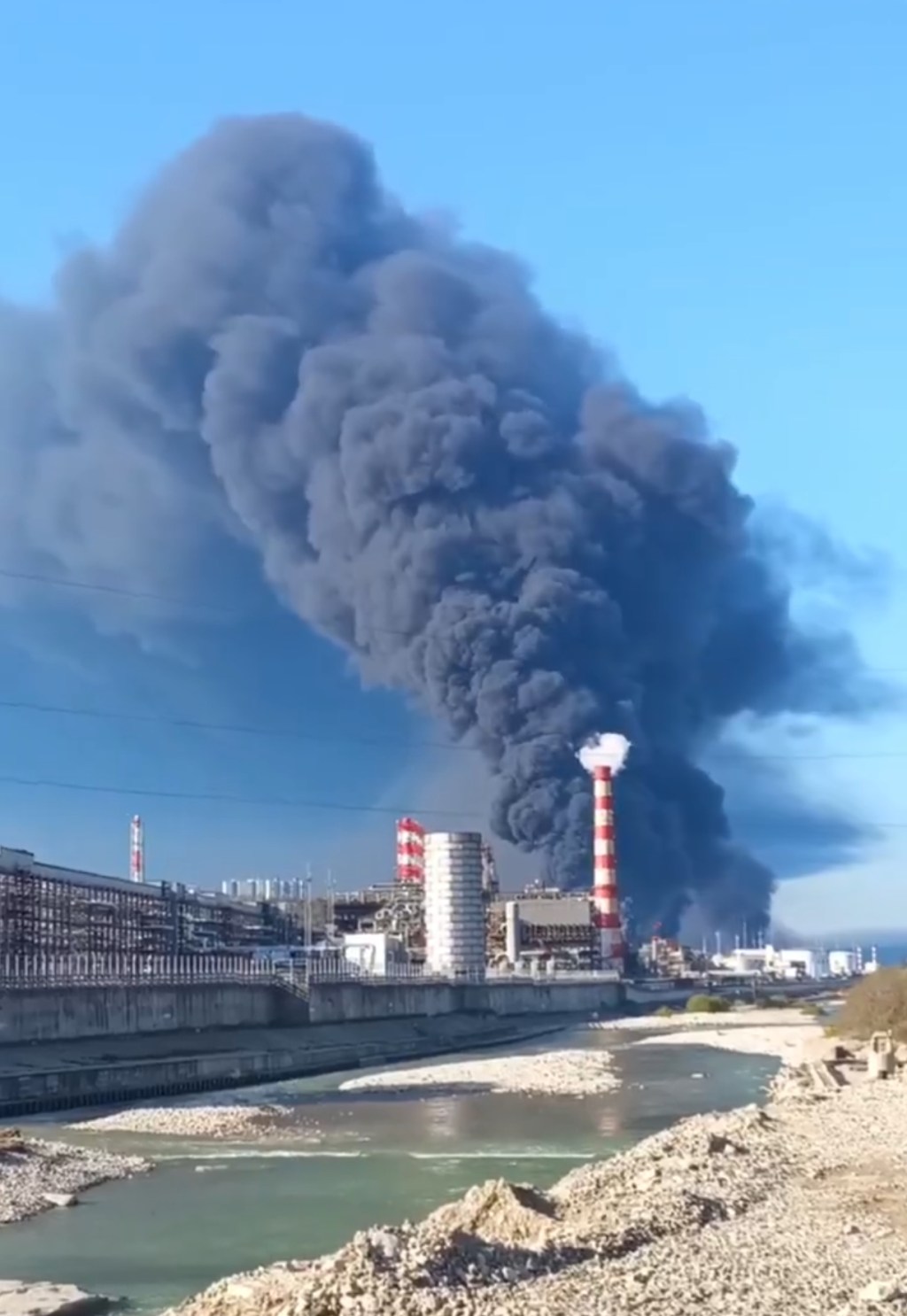
Since the escalation of the Ukraine war in February 2022, the largest concentration of confirmed refinery damage has taken place inside Russia and Ukraine. Energy infrastructure became a direct military target because refining capacity affects transport fuel, military logistics, export revenue, and state income. Russian refining capacity has faced repeated drone strikes across multiple regions, forcing shutdowns and reducing throughput.¹
Facilities including Tuapse, Ryazan, Syzran, Novokuibyshevsk, Saratov, Volgograd, and NORSI have all experienced disruption linked to long-range drone operations.² Export infrastructure such as Primorsk and Sheskharis terminals, along with gas processing facilities at Ust-Luga, have also faced attack or interruption.³ Open-source and insurance-linked assessments suggest that a substantial portion of Russia’s refining network has experienced temporary outages or damage since 2022.⁴
The Tuapse refinery provides a clear case study. Repeated drone strikes triggered fires, environmental damage, and eventual shutdown of operations, demonstrating how relatively low-cost systems can disable critical industrial infrastructure.⁵ The Ryazan refinery similarly experienced multiple attacks across 2025, reinforcing the systematic nature of the campaign.⁶
Within Ukraine, the Kremenchuk refinery suffered extensive structural damage, removing a significant share of domestic refining capacity, while the Lysychansk refinery was heavily damaged during frontline combat. Fuel depots and storage facilities linked to Naftogaz were also repeatedly targeted, further degrading national fuel resilience.
Beyond the Russia–Ukraine theatre, energy infrastructure has increasingly been drawn into regional conflict systems. In the Middle East, missile and drone attacks have targeted refining and processing infrastructure across multiple states, including Saudi Arabia, Iran, and the Gulf region.⁷ The Ras Tanura refinery experienced disruption linked to drone strikes, while earlier attacks on facilities such as Abqaiq demonstrated the vulnerability of large-scale processing systems.⁸
Iran’s South Pars gas processing complex, one of the most critical energy hubs in the world, suffered damage to multiple processing units during escalation cycles, temporarily disrupting output and triggering wider market concerns.⁹ Analysts described these attacks as a major escalation because they directly targeted the economic foundations of energy production rather than military assets alone.¹⁰
Maritime energy transit routes have also come under sustained pressure. Disruption to the Strait of Hormuz and Red Sea shipping corridors has forced tanker rerouting, increased insurance costs, and extended delivery times, amplifying the economic effects of infrastructure attacks.¹¹
Energy infrastructure disruption extends beyond active war zones. In the United States, refinery fires and shutdowns along the Gulf Coast have drawn increased scrutiny in the context of global instability. In Australia, the Geelong refinery experienced a major fire affecting national fuel supply. In Mexico, the Dos Bocas refinery has faced repeated operational disruptions during commissioning. While many such incidents are classified as industrial, their cumulative effect reinforces perceptions of systemic vulnerability.
This shift reflects a broader transformation in the logic of war. Direct confrontation between major powers carries extreme escalation risks, particularly under nuclear deterrence. As a result, states increasingly target economic arteries rather than massed armies. Industrial systems, especially energy infrastructure, offer long-term leverage without requiring territorial occupation.
Refineries occupy a uniquely strategic position within this framework. Crude oil has limited utility without processing. Damage to refining capacity disrupts fuel production, aviation supply, petrochemical output, shipping logistics, and domestic transport simultaneously. Export terminals play a similar role, determining whether production can reach global markets.
Energy warfare increasingly resembles attritional economic conflict rather than conventional battlefield destruction. Temporary outages generate uncertainty, raising insurance premiums, altering futures markets, and changing pricing expectations. Market psychology amplifies disruption before physical shortages fully materialise.
Strategic dominance has historically depended on control over energy flows, maritime chokepoints, and financial settlement systems. The integration of oil trade with dollar-denominated finance reinforced global demand for dollar liquidity, embedding energy markets within a broader financial hierarchy.¹² As alternative payment systems and regional trade arrangements emerge, competition over energy infrastructure becomes intertwined with monetary and geopolitical influence.
Energy facilities represent concentrated value within this contest. Refineries require years of construction, specialised equipment, and continuous maintenance, yet can be disabled within hours. This asymmetry allows relatively low-cost attacks to generate disproportionate economic impact.
The cumulative effect since 2022 has been the erosion of redundancy within global energy systems. Many states reduced domestic refining capacity during decades of globalised trade, increasing dependence on external supply. Under conditions of widespread disruption, spare capacity disappears rapidly, producing cascading effects across shipping, pricing, and political control of fuel access.
Energy systems function through continuity rather than abundance. War disrupts continuity first, exposing structural fragilities that existed long before overt conflict. The repeated targeting of refineries, processing plants, and export infrastructure should therefore be understood as part of a systemic struggle over control of global economic arteries.
Energy warfare rewards states capable of enduring disruption longer than their rivals. Oil infrastructure now sits at the centre of geopolitical competition because the ability to sustain energy flows under pressure has become inseparable from the ability to sustain power itself.
Authored By: Global GeoPolitics
Thank you for visiting. This is a reader-supported publication. If you believe journalism should serve the public, not the powerful, and you’re in a position to help, becoming a PAID SUBSCRIBER truly makes a difference. Alternatively you can support by way of a cup of coffee:
https://buymeacoffee.com/ggtv |
https://ko-fi.com/globalgeopolitics |
Bitcoin: 3NiK8BoRZnkwJSHZSekuXKFizGPopkE7ns
Footnotes
- Reuters, “Ukraine Renews Attacks on Russian Energy Sites: What Has Been Hit,” April 22, 2026.
- Reuters, “Ukraine Renews Attacks on Russian Energy Sites.”
- Reuters, “Ukraine Renews Attacks on Russian Energy Sites.”
- The Moscow Times, “Ukrainian Strikes Cost Russian Oil Sector Over $13bn in 2025,” February 9, 2026.
- Reuters, “Russia’s Tuapse Oil Refinery Halted Operations After Drone Attack,” April 21, 2026; Reuters, “Fire After Ukrainian Attack on Tuapse Refinery Hits Air Quality,” April 22, 2026.
- The Guardian, “Ukraine War Briefing: Drones Hit Russia’s Ryazan Oil Refinery,” November 16, 2025.
- Reuters, “Attacks on Major Oil and Gas Sites in the Middle East,” March 20, 2026.
- Reuters, “Saudi Aramco Shuts Ras Tanura Refinery After Drone Strike,” March 2, 2026.
- Reuters, “Iran’s South Pars Gas Field at Centre of Gulf War Escalation,” March 19, 2026.
- The Guardian, “Why Attacks on South Pars Gas Field Are a Major Escalation,” March 18, 2026.
- Reuters, “Alternative Routes for Middle East Oil and Gas Due to Hormuz Disruption,” April 21, 2026.
- Michael Hudson, Super Imperialism: The Origin and Fundamentals of U.S. World Dominance.
Methodology Note
This article synthesises open-source reporting, primarily from Reuters and other major international media, alongside reference material and strategic economic analysis. Incidents were included based on:
- Repetition across multiple credible reports
- Confirmation of physical damage, fire, shutdown, or operational disruption
- Relevance to refining, processing, or export infrastructure
Limitations include:
- Wartime reporting inconsistencies
- Government classification of infrastructure damage
- Difficulty distinguishing between industrial accidents and deliberate targeting in some cases
The analysis therefore focuses on pattern recognition across verified incidents, rather than definitive attribution in every case.
Authored By: Global GeoPolitics
Refineries and Energy Infrastructure Targeted
In Russia:
Tuapse Oil Refinery – repeated drone strikes, fires, export disruption, temporary shutdowns.
Ryazan Oil Refinery – multiple drone strikes reported across 2024–2025.
Novokuibyshevsk Refinery – repeated strikes affecting operations.
Syzran Refinery – drone impacts and fires reported several times.
Saratov Oil Refinery – strike reports and operational disruption.
Volgograd Refinery – processing units damaged, temporary shutdowns.
Afipsky Oil Refinery – drone strike fires and interruptions.
Ilsky Oil Refinery – fire after drone attack.
Ukhta Refinery – processing unit fire after attack.
NORSI Refinery – major strikes affecting throughput.
Kirishi Refinery – reported damage and temporary reductions.
Bashneft-Novoil Refinery – strike reports tied to long-range drone operations.
Orsknefteorgsintez Refinery – confirmed strike reports during 2025.
Primorsk Oil Terminal – export infrastructure damage.
Sheskharis Oil Terminal – berth damage and export interruption.
Ust-Luga Gas Processing Complex – processing disruption after attacks.
In Ukraine:
Kremenchuk Oil Refinery – repeatedly struck, heavy structural damage, major refining capacity lost.
Lysychansk Oil Refinery – damaged within frontline combat areas.
Naftogaz fuel depots, storage terminals, and refining support facilities – repeated strikes and disruption.
In Iran:
South Pars Gas Processing Complex (Phases 3, 4, 5, 6, 14) – fire damage and structural disruption across processing units.
Fajr Jam Gas Refinery – reported fire and operational disruption.
Mahshahr Petrochemical Complex – petrochemical and utility infrastructure incidents.
Tehran-area fuel depots – fires and suspected strike-related disruption.
In Saudi Arabia:
Abqaiq Oil Processing Facility – major earlier attacks demonstrating vulnerability of processing systems.
Khurais Oil Field Processing Facility – associated processing disruption during attacks.
Ras Tanura Refinery – reported disruption linked to drone strike allegations.
In Kuwait:
Mina al-Ahmadi Refinery – fires reported following drone strike claims.
In United Arab Emirates:
Ruwais Industrial Complex – refinery and energy infrastructure incidents during regional escalation.
In Israel:
Haifa Oil Refinery Complex – missile impact proximity and temporary power disruption.
In Australia:
Geelong Refinery – major fire disruption affecting national fuel output.
In United States:
Port Arthur Refinery – explosion-related disruption (industrial classification).
Gulf Coast refining and petrochemical infrastructure (Texas and Louisiana) – fires, shutdowns, and operational interruptions across multiple facilities.
In India:
Multiple refinery, power plant, and energy-sector facilities – fires, construction incidents, and operational disruptions (individual sites not specified in source material).
In Romania:
Power-generation infrastructure – industrial fire incidents affecting energy stability (no specific refinery named).
In Mexico:
Dos Bocas Refinery – repeated fires, technical faults, and early-stage operational disruptions.
Appendix A: Timeline of Reported Refinery & Energy Infrastructure Disruptions (2022–2026)
2022
- Russian invasion of Ukraine triggers systematic targeting of energy infrastructure.
- Kremenchuk Oil Refinery – repeatedly struck, severe structural damage.
- Lysychansk Oil Refinery – damaged during frontline combat.
- Early strikes on Ukrainian fuel depots and storage systems linked to Naftogaz.
2023
- Expansion of strikes into Russian territory begins shifting toward refinery targets.
- Initial attacks and fires reported at:
- Tuapse Oil Refinery
- Syzran Refinery
- Novokuibyshevsk Refinery
2024
- Large-scale escalation of long-range drone warfare targeting refining systems.
- Repeated strikes across Russian refining network including:
- Ryazan Oil Refinery
- Volgograd Refinery
- Afipsky Oil Refinery
- Ilsky Oil Refinery
- Export infrastructure disruption:
- Primorsk Oil Terminal
- Sheskharis Oil Terminal
2025
- Sustained attritional pressure on Russian refining capacity:
- NORSI Refinery
- Kirishi Refinery
- Bashneft-Novoil Refinery
- Orsknefteorgsintez Refinery
- Processing infrastructure hit:
- Ust-Luga Gas Processing Complex
- Parallel escalation in Middle East:
- South Pars Gas Processing Complex – multiple phases damaged.
- Fajr Jam Gas Refinery – fire incidents.
- Ruwais Industrial Complex – reported disruption.
2026 (to date)
- Continued global spread of incidents (mixed causes: industrial + geopolitical context):
- Port Arthur Refinery – explosion-related disruption.
- Geelong Refinery -major fire affecting output.
- Dos Bocas Refinery – repeated operational incidents.
- Ongoing strategic vulnerability of:
- Haifa Oil Refinery Complex
- Mina al-Ahmadi Refinery
- Ras Tanura Refinery
Appendix B: Strategic Pattern Summary
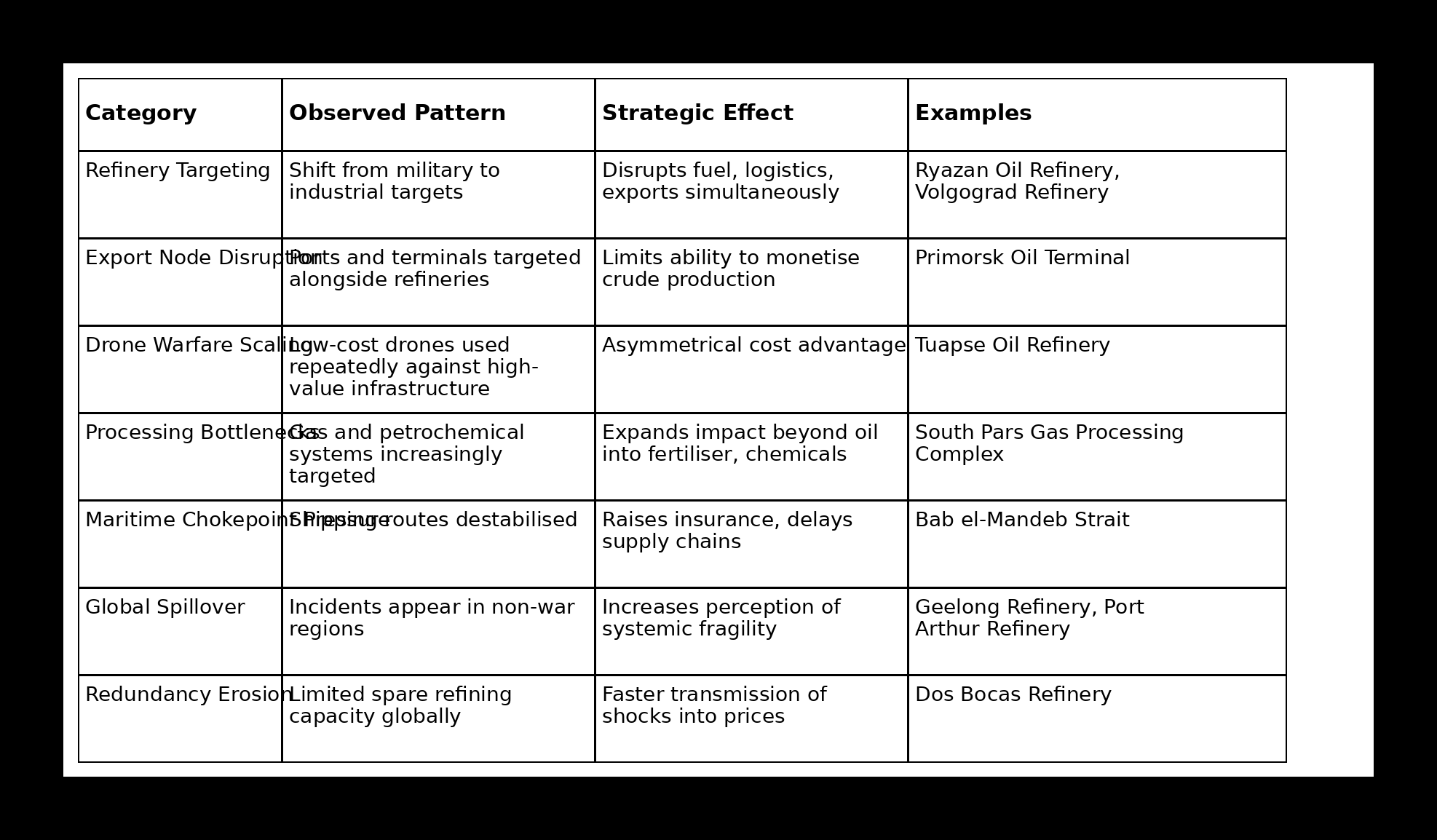
The dataset above illustrates that refinery warfare is no longer episodic but systemic, embedding energy infrastructure directly within the operational logic of modern geopolitical competition.


Leave a Reply