
On the Fragmentation of Globalisation into Competing Systems of Power
Post-1945 international economic order did not emerge as neutral design but as structured dominance disguised as institutional consensus. The International Monetary Fund, World Bank, and General Agreement on Tariffs and Trade formalised trade liberalisation and capital mobility under United States leadership, yet their deeper function was the stabilisation of a dollar-centred hierarchy anchored in security control and financial depth rather than pure efficiency. What appeared as economic architecture operated in practice as geopolitical consolidation.
That structure became self-reinforcing after 1971, when the collapse of gold convertibility removed any physical constraint on monetary expansion. From that point onward, global demand for U.S. Treasury securities became the hidden pillar of stability, reaching over 7.6 trillion dollars in foreign holdings by 2024 according to U.S. Treasury data. Energy markets locked this system in place. With roughly 80 percent of global oil invoiced in dollars according to the Bank for International Settlements, hydrocarbons ceased to be merely commodities and became the circulatory system of dollar liquidity itself.
The result was not balance but dependency. Every barrel of oil priced in dollars reinforced demand for U.S. debt, and every accumulation of reserves reinforced the legitimacy of American financial centrality. Yet such systems do not remain static. They evolve through pressure applied at their weakest structural joints, and in this case those joints are energy transport, commodity settlement, and reserve asset conversion.
Within this architecture, control over oil and gold has always functioned as latent power rather than visible authority. The strategist Zoltan Pozsar captures this shift precisely when arguing that control over commodity flows increasingly determines monetary hierarchy. The implication is not theoretical. Whoever influences the flow of physical energy increasingly influences the pricing of financial assets themselves.
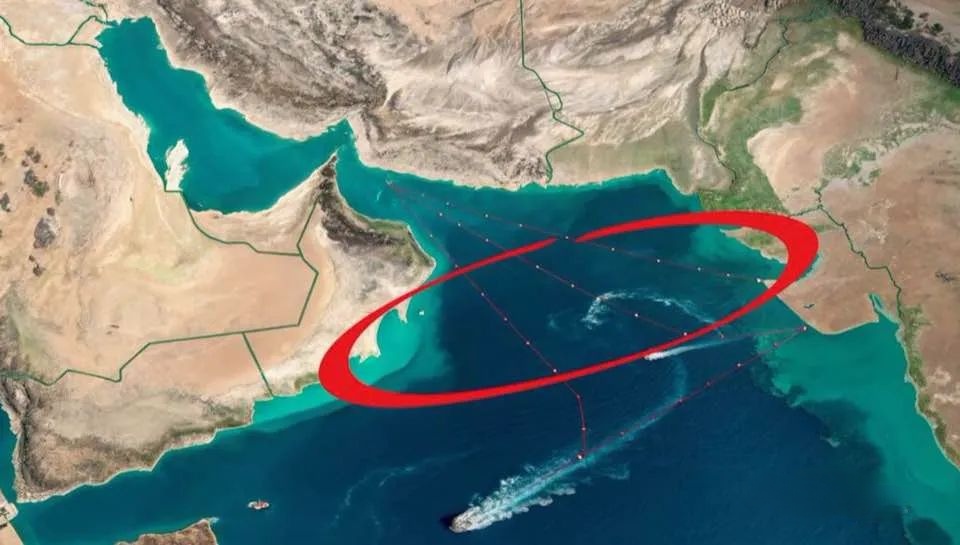
That logic explains why coordination among Iran, Russia, and China does not resemble traditional alliance formation. It functions instead as distributed system design. Iran holds geographic leverage over the Strait of Hormuz, through which roughly one-fifth of global oil flows. Russia supplies the alternative energy source when Western-linked supply chains tighten. China sits at the settlement layer where commodities are converted into monetary claims. Each node performs a function that becomes meaningful only when combined with the others.
The Strait of Hormuz is not merely a maritime corridor but a pricing trigger embedded in global energy psychology. Even temporary disruption produces immediate inflationary transmission across global markets, turning geography into financial leverage. Russian energy exports, redirected toward Asia after 2022 sanctions, extend this leverage into supply substitution. China then absorbs these flows not through open currency markets but through controlled renminbi access, which forces trade counterparties into structured conversion chains rather than free exchange.
Those chains reveal the emerging architecture more clearly than any formal agreement. Dollar liquidity is first converted into gold, gold is then converted into yuan, and yuan is finally used to access energy supply. The system does not replace the dollar directly; it routes around it. China therefore occupies a central intermediary position, not by dominance of force but by positioning within conversion infrastructure. In such a system, pricing authority shifts subtly toward whoever sits at the junction between commodities and settlement assets.
This rearrangement gains depth from industrial history. China’s integration into global manufacturing following WTO accession in 2001 redirected production capacity away from advanced economies and concentrated it within a single scalable industrial core. Research by David Autor demonstrates that this shift contributed to approximately one million lost manufacturing jobs in the United States between 1999 and 2011, producing not temporary adjustment but structural divergence between consumption systems and production systems.
As production shifted, so too did financial dependency. Japanese Treasury holdings fluctuated in response to domestic currency defence, European economies absorbed energy shocks following the Ukraine conflict, and emerging economies began experimenting with partial settlement diversification through BRICS-aligned frameworks. None of these movements constituted exit, yet together they introduced friction into what had previously been a frictionless dollar recycling mechanism.
At the same time, financial power concentrated rather than dispersed. Asset managers such as BlackRock, Vanguard, and State Street accumulated more than 20 trillion dollars in combined assets, embedding governance influence across corporate structures globally. Lucian Bebchuk’s work on common ownership demonstrates how overlapping equity stakes subtly align corporate behaviour without formal coordination, producing influence without visible command.
Monetary authority itself began to fragment. Central banks, facing digitisation pressure and private payment competition, moved toward digital currency experimentation. The Bank for International Settlements reports that the vast majority of central banks are now engaged in CBDC development, not as innovation but as defensive adaptation. Christine Lagarde describes this transition as a search for “balanced and durable equilibrium,” yet the underlying tension is more direct: control over money is shifting from issuance to infrastructure.
Private digital finance intensifies this shift. Stablecoins and decentralised systems introduce parallel settlement layers that operate outside traditional banking rails. The Oxford Internet Institute notes that these systems simultaneously increase efficiency and amplify systemic fragmentation, because liquidity no longer flows through a single controllable corridor.
States respond in predictable fashion. Russia maintains strategic control over energy through state-linked enterprises, while China integrates industrial policy across technology and finance under central coordination. The Peterson Institute for International Economics observes that economic security has displaced efficiency as the guiding principle of major power policy. This is not ideological change but structural adaptation to a more fragmented monetary environment.
Military capacity remains present but structurally constrained. Global defence spending exceeds two trillion dollars annually, yet nuclear deterrence prevents direct systemic confrontation between major powers. As a result, coercion migrates into financial instruments, sanctions regimes, and energy leverage rather than conventional warfare. The Council on Foreign Relations documents a steady expansion of sanctions as a primary tool of statecraft, reinforcing the financial system as an extension of geopolitical power.
What emerges across all domains is not a single transition but a layered reconfiguration. The dollar system remains dominant but no longer exclusive. Energy flows still anchor monetary demand but no longer determine it alone. Commodity settlement is still peripheral but increasingly structurally meaningful. Historical precedent suggests that such systems do not collapse; they recompose through overlap, redundancy, and gradual displacement of central functions.
The critical shift is therefore not the end of the post-1945 order but the loss of its singularity. Authority is no longer concentrated in one monetary centre but distributed across energy corridors, commodity anchors, financial intermediaries, and state-controlled industrial systems. Each layer constrains the others, and each layer depends on what it is simultaneously trying to bypass.
The system does not proceed towards replacement, nor does it collapse into some clean historical succession where one order yields neatly to another. It thickens instead, like river water gathering silt, until movement continues only through obstruction. Power does not depart from its older structures; it binds itself more tightly to them, even as it builds new channels elsewhere. What emerges is not clarity but layered dependence, where each mechanism survives by entangling itself with the very arrangements it appears to supersede.
This condition has been observed in earlier monetary transitions, where authority does not vanish but is gradually redistributed through overlapping instruments of credit and settlement. As Barry Eichengreen has argued in his study of reserve currency transitions, “dominance erodes gradually as networks of trade and finance diversify, rather than through sudden displacement.” The implication is not rupture but coexistence under strain, where the old order persists precisely because the new one is not yet capable of full substitution.
Within such a structure, power no longer resembles sovereignty at all, but rather a form of dependency that wears the appearance of permanence. Each node in the system draws strength from circuits it cannot fully control, and in doing so becomes bound to them. Charles Kindleberger described hegemonic stability in terms of a centre providing liquidity and order, yet the deeper historical record suggests that when that centre multiplies its dependencies, stability ceases to be command and becomes entanglement. Order endures, but only as a web that tightens with every attempt to loosen it.
Thus the present arrangement does not resolve itself into succession. It folds inward upon its own architecture, binding energy, finance, and currency into a single interdependent lattice. What appears as diversification is, in truth, the deepening of mutual constraint. And in such a condition, systems do not end; they become inseparable from the very forces that are slowly reshaping them.
Authored By: Global GeoPolitics
Thank you for visiting. This is a reader-supported publication. If you believe journalism should serve the public, not the powerful, and you’re in a position to help, becoming a PAID SUBSCRIBER truly makes a difference. Alternatively you can support by way of a cup of coffee:
https://buymeacoffee.com/ggtv |
https://ko-fi.com/globalgeopolitics |
Bitcoin: 3NiK8BoRZnkwJSHZSekuXKFizGPopkE7ns
References
Bank for International Settlements (BIS) (2023) Triennial Central Bank Survey: Foreign Exchange and Over-the-Counter Derivatives Markets. Basel: BIS.
Bebchuk, L., Cohen, A. and Hirst, S. (2017) ‘The Agency Problems of Institutional Investors’, Journal of Economic Perspectives, 31(3), pp. 89–102.
Carnegie Endowment for International Peace (2023) Dollar Dominance and the Future of International Finance. Washington, D.C.: CEIP.
Council on Foreign Relations (2023) Sanctions and the Evolution of Economic Statecraft. New York: CFR.
Energy Information Administration (EIA) (2024) World Oil Transit Chokepoints. Washington, D.C.: U.S. Department of Energy.
European Commission (2022) REPowerEU Plan: Joint European Action for More Affordable, Secure and Sustainable Energy. Brussels: European Commission.
David Autor, Dorn, D. and Hanson, G. (2013) ‘The China Syndrome: Local Labor Market Effects of Import Competition in the United States’, American Economic Review, 103(6), pp. 2121–2168.
International Energy Agency (IEA) (2023) World Energy Outlook 2023. Paris: IEA.
International Institute for Strategic Studies (IISS) (2023) Strategic Survey: The Annual Review of World Affairs. London: IISS.
International Monetary Fund (IMF) (2023) World Economic Outlook. Washington, D.C.: IMF.
Mearsheimer, J. (2018) The Tragedy of Great Power Politics. Updated edn. New York: W.W. Norton.
Oxford Internet Institute (2022) Digital Finance and Systemic Risk in Decentralised Markets. Oxford: University of Oxford.
Peterson Institute for International Economics (2023) State Capitalism and Economic Security in Global Trade. Washington, D.C.: PIIE.
Christine Lagarde (2023) Remarks at the World Economic Forum Annual Meeting, Davos.
Shanghai International Energy Exchange (2023) Renminbi Oil Futures Market Development Report. Shanghai: INE.
Stockholm International Peace Research Institute (SIPRI) (2023) Trends in World Military Expenditure. Stockholm: SIPRI.
U.S. Department of the Treasury (2024) Major Foreign Holders of Treasury Securities. Washington, D.C.: U.S. Treasury.
World Bank (2023) Global Economic Prospects. Washington, D.C.: World Bank.
World Trade Organization (2023) World Trade Report. Geneva: WTO.
Yergin, D. (2020) The New Map: Energy, Climate, and the Clash of Nations. New York: Penguin Press.
Zoltan Pozsar (2022) Bretton Woods III. Credit Suisse Research Publication.


Leave a comment