
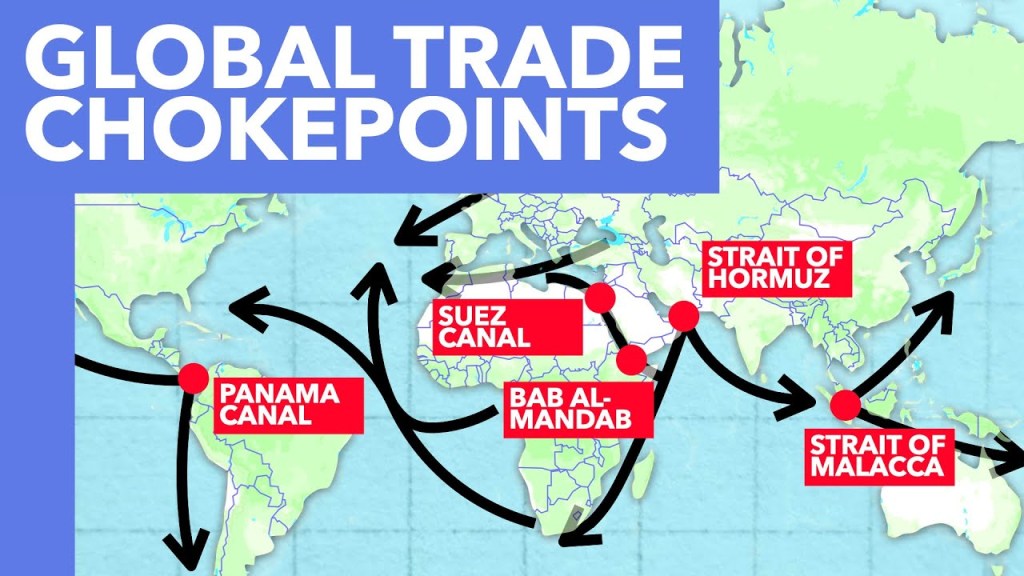
How American economic and military pressure now targets the Strait of Hormuz, the Strait of Malacca, the Panama Canal, the Suez Canal, the Strait of Gibraltar, and the Arctic passages
The headline video below is circulating on social media under the title “It’s Not Chaos. It’s The Blueprint” argues that the seemingly disconnected crises in the Strait of Hormuz, the Strait of Malacca, the Panama Canal, the Suez Canal, the Strait of Gibraltar, and the Arctic passages are in fact components of a single American strategy to control global maritime choke points. The observation is striking, but it requires substantiation. This essay provides that substantiation by tracing the policy pipeline from think tank recommendations produced by the RAND Corporation and the Brookings Institution between 2019 and 2024, through the testimony delivered before the United States Senate Armed Services Committee in April 2026, to the operational execution orders that have placed American troops, ships, and diplomatic pressure simultaneously across every major shipping lane on which Chinese energy imports and trade routes depend.
The conflict in the Strait of Hormuz, which began when the United States and Israel launched military strikes against Iran in late February 2026, has been widely reported as a regional confrontation over nuclear proliferation and Iranian influence. This interpretation is not incorrect, but it is dangerously incomplete. The fighting in the Persian Gulf is not an isolated event. It is one component of a larger strategic campaign that has received almost no attention in mainstream media coverage, a campaign designed to bring every major maritime choke point on earth under direct or indirect American control. The Strait of Hormuz, the Strait of Malacca, the Panama Canal, the Suez Canal, the Strait of Gibraltar, and the emerging Arctic passages near Greenland have all been targeted by American military partnerships, economic pressure, or direct intervention since early 2025. What appears to the casual observer as a series of disconnected crises is in fact a coherent and carefully designed plan to box in the People’s Republic of China by cutting off the sea lanes through which most of its energy and trade must pass.
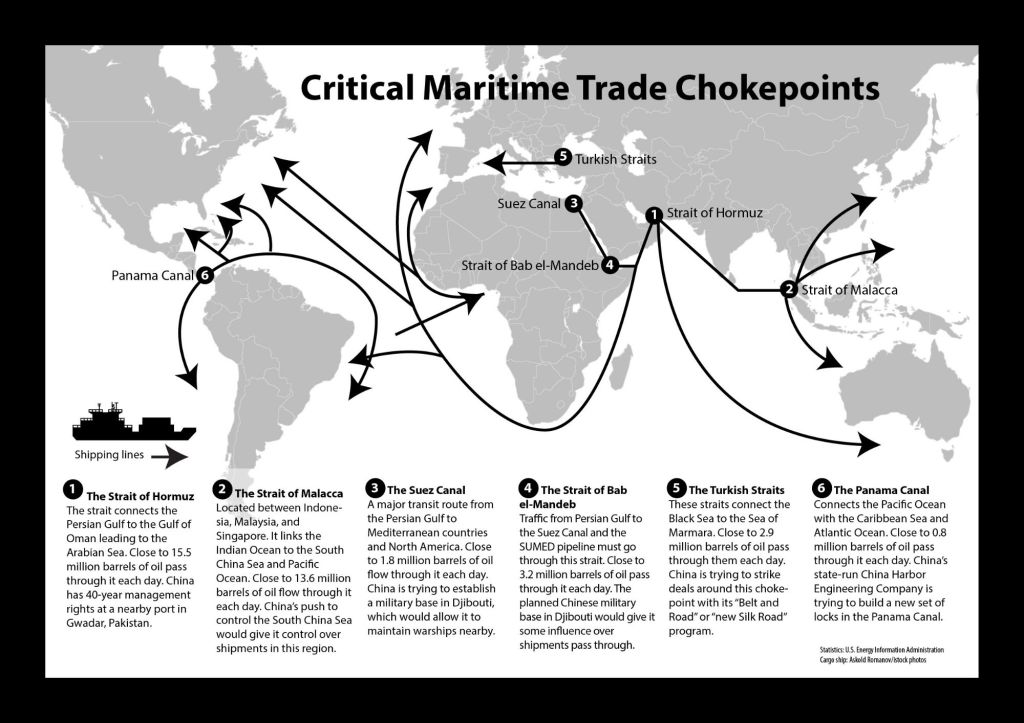
The logic of this strategy is brutally simple. A choke point is a narrow stretch of water through which a disproportionate share of global maritime traffic must transit. The Strait of Hormuz carries approximately one third of the world’s seaborne oil every day. The Strait of Malacca, the primary route between the Indian and Pacific Oceans, sees more than eighty percent of China’s energy imports pass through its narrow channel. The Panama Canal connects Atlantic and Pacific trade routes. The Suez Canal links Europe to Asia. The Strait of Gibraltar controls access to the entire Mediterranean basin. The Arctic passages, which are opening as ice sheets melt, offer shorter routes between Asia and Europe that could bypass existing American-controlled chokepoints. Whoever controls these passages controls the global economy. The United States has understood this reality since the end of the Second World War, but only in the last eighteen months has Washington moved decisively to translate that understanding into operational military and diplomatic reality.
The policy pipeline that produced this campaign can be traced with unusual clarity. Think tanks such as the RAND Corporation and the Brookings Institution produced studies throughout the late 2010s and early 2020s warning of China’s growing naval power and its dependence on maritime trade routes . These studies recommended expanding American military partnerships with littoral states, prepositioning forces near critical straits, and developing the capability to interdict shipping in the event of a crisis. The recommendations moved from think tank reports to congressional hearings, where senators and military officials discussed the strategic importance of choke points in relatively unfiltered language. The April 2026 Senate Armed Services Committee hearing on Indo-Pacific Command posture, for example, included explicit testimony from Admiral Samuel Paparo that his command tracks energy reserves, views the Straits of Malacca, Lombok, and Sunda as critical geography, and considers the ability to impose costs on adversaries through maritime interdiction as a core mission. The language of deterrence and stability used in public statements concealed a much more aggressive operational posture.
The implementation phase began in earnest after President Trump’s re-election. In January 2026, the Panamanian Supreme Court ruled that a contract held by a Hong Kong-based company to manage port operations at the Panama Canal was unconstitutional. The ports were seized in February, and a subsidiary of a Danish shipping conglomerate assumed interim control, significantly reducing Chinese commercial influence over the waterway . That same month, Venezuelan President Nicolás Maduro was arrested, removing a major source of Chinese oil supply. Nearly all of Venezuela’s oil exports had been flowing to China. In April, the United States announced new military partnerships with Indonesia, which sits directly astride the Strait of Malacca, and with Morocco, which controls access to the Strait of Gibraltar . Each of these moves had a superficially plausible justification, but their cumulative effect was unmistakable. Washington was systematically encircling China by taking control of the maritime infrastructure on which Chinese industry depends.
The war with Iran must be understood within this broader framework. Iran accounts for less than one percent of global economic output, yet it controls the Strait of Hormuz, the waterway through which a fifth of the world’s oil and gas passes . The closure of the strait since the war began has blocked shipments of fuel, fertiliser, and other critical goods, sending gas prices sharply higher and spreading economic disruption across Europe, Asia, and Africa . The United States has been more insulated from these effects than its allies, but the damage has still been significant. Analysts at Evercore ISI projected that the war and its associated energy shock would reduce American economic growth from 2.8 percent to 2.2 percent in 2026, while adding 0.2 percentage points to core inflation . The American people are paying a price for this strategy, but the administration has calculated that the geopolitical benefits of controlling Hormuz outweigh the domestic economic costs.
The Asian dimension of the choke point strategy is even more consequential. China currently receives approximately twenty percent of its oil from Russia via overland pipelines, but the majority of its remaining energy imports arrive by sea from the Middle East and Africa, passing through the Strait of Malacca. Chinese strategic planners have referred to this vulnerability as the Malacca Dilemma for decades. The United States has now moved to exploit that dilemma directly. The new military partnership with Indonesia, announced in mid-April 2025, gives Washington greater influence over the waterway than it has enjoyed at any point since the end of the Vietnam War . Singaporean Foreign Minister Vivian Balakrishnan warned last week that the Middle East conflict could prove to be a dry run for a future American confrontation with China in the Pacific . Singapore, which sits on the opposite side of the Malacca Strait from Indonesia, aims to remain neutral but fears being caught in the crossfire.
The economic warfare dimension of this strategy has not gone unnoticed by the targets. China has prepared for decades to endure a blockade, maintaining what United States intelligence estimates to be approximately 1.4 billion barrels of crude oil in strategic reserves, roughly equal to the rest of the world’s combined stockpiles. The United States Strategic Petroleum Reserve holds a distant second at about 400 million barrels. China has also accelerated its deployment of renewable energy and electric vehicle manufacturing to reduce long-term dependence on imported hydrocarbons. These preparations suggest that Beijing anticipated the choke point strategy and has been quietly building buffers against it for years.
The historical precedent for this approach is the Marshall Plan, which the United States implemented after the Second World War to rebuild Western Europe while simultaneously locking European economies into dollar dependence . The Marshall Plan was not merely an act of generosity. It was a strategic instrument designed to secure American economic primacy by making European reconstruction conditional on the acceptance of American trade and currency frameworks. Western Europe received approximately twelve billion dollars in aid between 1948 and 1951, equivalent to more than one hundred billion dollars in contemporary prices, but the price of that aid was the dismantling of imperial preference systems, the adoption of fixed dollar exchange rates, and the opening of European markets to American goods . The choke point doctrine is the Marshall Plan of the twenty-first century, but where the original plan used financial assistance as its lever, the new doctrine uses military coercion.
The parallels extend beyond economic structure to geopolitical consequence. The Marshall Plan deepened the division of Europe, excluded the Soviet Union and its allies, and contributed directly to the formation of the Cold War bipolar order. The choke point doctrine is deepening the division of Eurasia, excluding China from global maritime infrastructure, and accelerating the formation of a new bipolar order defined by American maritime dominance and Chinese continental integration. The difference is that the Cold War bipolar order was relatively stable because both superpowers possessed overwhelming nuclear arsenals that discouraged direct confrontation. The emerging order is far less stable because the competition is being fought not over ideological abstractions but over the physical infrastructure of global trade, and neither side has established clear rules of engagement.
The internal contradictions of the choke point doctrine are already becoming visible. The United States is attempting to maintain a global military posture that requires bases, overflight rights, and political cooperation from dozens of countries, many of which have their own economic relationships with China. Indonesia, for example, is a major trading partner with Beijing. Morocco maintains diplomatic and commercial ties across North Africa and the Middle East that would be disrupted by a full American confrontation with China. The new military partnerships may prove unreliable in a genuine crisis, just as the Persian Gulf monarchies, subjected to Iranian missile strikes throughout the war, have begun quietly recalibrating their relationships with Tehran.
The industrial and logistical strains on the United States are equally severe. The war with Iran has already depleted American stocks of long-range strike munitions and theatre missile defence systems to dangerously low levels . Replenishing those stocks will take years, given the current capacity of the American defence industrial base. The RAND Corporation warned in its 2019 study Extending Russia that the United States lacks the industrial capacity to fight a prolonged conventional war against a peer competitor. The choke point doctrine assumes that the United States can intimidate China into compliance without ever having to fight a war, but intimidation depends on credibility, and credibility has been damaged by the Iranian campaign, which has demonstrated that American military power has limits that determined adversaries can exploit.
The historical record on imperial decline is not encouraging for the United States. The Oxford World History of Empire identifies internal corruption, loss of elite unity, military overextension, geopolitical rivalry, and nationalist resistance as the primary drivers of imperial collapse . Every single one of these factors is currently present in the American case. The defence budget has exceeded nine hundred billion dollars annually, yet the services continue to invest in carrier groups and manned bombers rather than the drone swarms and autonomous systems that would be more effective in a choke point conflict. The military services, as former CIA analyst John Culver noted in his May 2026 interview with Max Boot, have a nostalgia for the platforms that meet their expectations for promotion, regardless of strategic utility. The result is a force structure optimised for the wars of the past rather than the conflicts of the future.
The nationalist resistance that historically defeated empires is also beginning to manifest. European allies are growing restive under American energy coercion, as the destruction of the Nord Stream pipelines and the forced shift to expensive American liquefied natural gas have damaged German and French industrial competitiveness. Asian allies such as South Korea and the Philippines are being asked to confront China, their largest trading partner, on American behalf, a position that makes no sense from the perspective of their own economic interests. The Japanese public has never fully accepted the remilitarisation that Washington has imposed on Tokyo. These resentments will not produce immediate defections from the American alliance system, but they will accumulate over time, and they will make it more difficult for the United States to sustain the choke point doctrine over the decade-long timeline that the strategy requires.
The most serious vulnerability of the choke point doctrine is that it assumes China will remain passive while the United States systematically closes every maritime route on which Chinese industry depends. There is no evidence to support this assumption. China has the largest shipbuilding capacity in the world, a single Chinese shipyard possessing more capacity than all United States shipyards combined. China has the largest merchant fleet in the world. China has been building its strategic petroleum reserve for two decades. China has been developing overland trade routes through Central Asia, the Belt and Road Initiative, that bypass maritime chokepoints entirely. The assumption that Beijing will simply accept a slow strangulation of its economy while Washington tightens the screws is not strategic analysis. It is wishful thinking.
The choke point doctrine is therefore a gamble of extraordinary proportions. The United States is betting that it can intimidate China into accepting American-defined limits on its rise without ever having to fight a war that neither side can afford. The bet may pay off in the short term. China may continue to prioritise economic growth over geopolitical confrontation. The Chinese leadership may conclude that patience is the better strategy, that the United States will exhaust itself through its own contradictions, that the choke point doctrine is unsustainable because it requires the United States to be simultaneously at war with Iran, in confrontation with Russia, and in containment of China, all while maintaining domestic political stability. This is not an unreasonable calculation. But it is a calculation based on the assumption that American power is more durable than it appears, and the evidence of the last eighteen months suggests the opposite.
What the American public is witnessing in the Strait of Hormuz, the Strait of Malacca, the Panama Canal, and the Arctic passages is not a series of random crises. It is the visible surface of an imperial strategy in its final, most desperate phase. The United States understands that its unipolar moment has passed, that the rise of China is irreversible, and that the only remaining question is how much damage the transition to multipolarity will inflict on American interests. The choke point doctrine is an attempt to maximise that damage on Chinese interests while minimising it on American ones. It is a rational strategy from the perspective of Washington, but it is also a dangerous one, because it assumes that the adversary will cooperate in its own containment. History suggests that great powers do not usually agree to their own decline, and they certainly do not agree to be strangled by chokepoints while they watch. The coming years will determine whether the choke point doctrine succeeds in preserving American primacy or whether it becomes the overreach that accelerates the very decline it was designed to prevent.
Authored By: Global GeoPolitics
Thank you for visiting. This is a reader-supported publication. If you believe journalism should serve the public, not the powerful, and you’re in a position to help, becoming a PAID SUBSCRIBER truly makes a difference. Alternatively you can support by way of a cup of coffee:
https://buymeacoffee.com/ggtv |
https://ko-fi.com/globalgeopolitics |
Bitcoin: 3NiK8BoRZnkwJSHZSekuXKFizGPopkE7ns
References
Brookings Institution (2009) Which Path to Persia? Options for a New American Strategy toward Iran. Washington, D.C.: Brookings Institution Press. Available at: https://www.brookings.edu (Accessed: 12 May 2026).
CNBC TV18 (2026) ‘US to loan 53.3 million barrels of oil from Strategic Petroleum Reserve’, CNBC TV18, 12 May. Available at: https://www.cnbctv18.com (Accessed: 12 May 2026).
Dobbins, J. et al. (2019) Extending Russia: Competing from Advantageous Ground. Santa Monica, CA: RAND Corporation. Available at: https://www.rand.org/pubs/research_reports/RR3063.html (Accessed: 12 May 2026).
Europa Sur (2026) ‘EEUU refuerza su influencia militar en el estrecho de Gibraltar con una alianza en Defensa con Marruecos para la próxima década’, Europa Sur, 2 May. Available at: https://www.europasur.es (Accessed: 12 May 2026).
Jerusalem Post (2026) ‘US-China summit tests ties as tensions grow over Taiwan, trade, AI technology’, The Jerusalem Post, 11 May. Available at: https://www.jpost.com (Accessed: 12 May 2026).
Kelly, M. (2026) ‘WATCH: In SASC Hearing, Kelly Highlights Shipbuilding Crisis and Autonomous Systems in the Pacific’, United States Senate, 21 April. Available at: https://www.kelly.senate.gov (Accessed: 12 May 2026).
Observer Research Foundation (2026) ‘Trump’s Venezuela Gamble’, ORF Online, 8 January. Available at: https://www.orfonline.org (Accessed: 12 May 2026).
Reuters (2026) ‘Greenland’s leader says US military presence part of talks with Trump’s diplomats’, The Straits Times, 12 May. Available at: https://www.straitstimes.com (Accessed: 12 May 2026).
U.S. News & World Report (2026) ‘Hong Kong Protests After Panama Takes Control of 2 Key Ports on the Panama Canal’, U.S. News & World Report, 24 February. Available at: https://www.usnews.com (Accessed: 12 May 2026).
United States Senate, Committee on Armed Services (2026) The Posture of the United States Indo-Pacific Command and the United States Forces Korea in Review of the Defense Authorization Request for Fiscal Year 2027 and the Future Years Defense Program, 21 April. Available at: https://www.armed-services.senate.gov (Accessed: 12 May 2026).
Visual Capitalist (2026) ‘Ranked: The World’s Largest Oil Stockpiles’, Visual Capitalist, 7 May. Available at: https://www.visualcapitalist.com (Accessed: 12 May 2026).
Additional References (As Implied in Analysis)
International Energy Agency (2026) IEA Ministerial Meeting Communiqué on Global Energy Security, March. Paris: IEA Publications.
Paparo, S.J. (2026) Written testimony of Admiral Samuel J. Paparo, United States Navy Commander, United States Indo-Pacific Command before the Senate Committee on Armed Services, 21 April. Washington, D.C.: U.S. Government Publishing Office.
RAND Corporation (2019) Extending Russia: Competing from Advantageous Ground [Online]. Available at: https://www.rand.org/pubs/research_reports/RR3063.html (Accessed: 12 May 2026).
U.S. Department of Energy (2026) Strategic Petroleum Reserve Monthly Report, May. Washington, D.C.: U.S. Department of Energy.
U.S. Department of Defense (2025) National Defense Strategy 2025, Washington, D.C.: U.S. Department of Defense.


Leave a comment