
As Washington races to scale low-cost drone production after lessons from Ukraine, the United States is confronting a deeper challenge: transforming a defense system built for technological superiority into one capable of sustaining industrial-scale autonomous warfare during an active era of global competition.
The U.S. Department of Defense is reportedly expanding efforts to strengthen domestic drone manufacturing following lessons publicly framed around the war in Ukraine. However, the deeper strategic catalyst appears broader than Ukraine alone.
While Ukraine demonstrated the scale and tactical adaptability of low-cost drone warfare, Iran’s long-term development and operational export of expendable drone systems, particularly the Shahed series may have been the more consequential factor in forcing a reassessment inside Washington. Iran proved that relatively inexpensive autonomous strike systems could bypass traditional assumptions about airpower, overwhelm layered defenses through saturation, and impose disproportionate economic costs on technologically superior adversaries.
For years, many Western defense institutions viewed systems like the Shahed as technologically unsophisticated. Yet their battlefield effectiveness challenged a core assumption underpinning post-Cold War U.S. doctrine: that precision and technological superiority alone could guarantee escalation dominance.
Reports and defense commentary over the past two years suggest the U.S. military was initially slower than Ukraine in embracing low-cost drone attrition warfare as a central doctrinal component. Ukrainian operators repeatedly emphasized rapid battlefield adaptation, decentralized manufacturing, and disposable systems, while much of the U.S. defense establishment remained tied to traditional procurement logic centered around survivability and high-end platforms.
The apparent acceleration only after direct confrontation with Iranian drone capabilities is significant. It suggests the doctrinal shift was driven not merely by observing Ukraine, but by recognizing that adversarial states outside the traditional great-power framework had successfully altered the economics of modern warfare.
According to reporting from The Wall Street Journal and Reuters, the Trump administration is in discussions with several American drone companies regarding potential government funding agreements. Companies involved in the talks reportedly include Unusual Machines, Neros Technologies, and Performance Drone Works.
The initiative is connected to the Pentagon’s “Drone Dominance” program, which aims to build an arsenal of approximately 300,000 low-cost attack drones by the end of 2027. Defense officials are also seeking to reduce unit costs, with a reported target price of around $5,000 per drone. Some of the proposed funding structures could reportedly include debt and equity financing, potentially allowing the U.S. government to take ownership stakes in selected drone manufacturers.
The push comes amid concerns about production capacity. Estimates cited in the reports suggest the United States currently has the ability to produce roughly 100,000 drones annually, while Ukraine reportedly manufactured around 4 million drones last year. What makes this significant is not simply the production target, but the underlying doctrinal shift taking place in real time.
The timing of the shift matters. For much of the Ukraine conflict, the United States treated drones primarily as supplementary systems supporting conventional warfare. Iran, by contrast, treated drones as a strategic equalizer capable of compensating for limitations in conventional airpower.
That distinction is important because it reflects two fundamentally different military philosophies. The American model historically prioritized exquisite systems with high survivability and deep integration into complex command structures. The Iranian model prioritized affordability, redundancy, manufacturability, and the ability to absorb attrition.
The growing U.S. focus on low-cost autonomous systems suggests Washington is now partially converging toward concepts it previously associated with less technologically advanced adversaries.
For decades, U.S. military doctrine was built around technological overmatch through expensive, highly sophisticated platforms: aircraft carriers, stealth aircraft, precision-guided munitions, and network-centric warfare systems. The assumption was that quality, precision, and dominance in high-end systems would offset the need for mass production.
The Ukraine war has challenged that assumption. Cheap FPV drones, loitering munitions, and expendable autonomous systems have demonstrated that attrition, saturation, and industrial scalability can erode the battlefield advantage of far more expensive systems. A drone costing a few hundred or a few thousand dollars can disable armored vehicles, force aircraft dispersal, disrupt logistics, and exhaust air defense inventories worth millions per interceptor.
Historically, major powers rarely change military doctrine successfully during active geopolitical confrontation. Most doctrinal revolutions occur after strategic shock or military failure. The German blitzkrieg model emerged after the static trench warfare of World War I. U.S. carrier doctrine matured only after Pearl Harbor exposed the declining dominance of battleships. The Soviet Union restructured around deep battle concepts after observing failures in early mechanized warfare. Even the U.S. shift toward counterinsurgency doctrine during Iraq and Afghanistan required years of adaptation, organizational resistance, and uneven implementation.
What history consistently shows is that military institutions are structurally conservative. Procurement systems, officer career paths, training pipelines, and defense industries are optimized around existing doctrine. Changing doctrine during an active strategic competition introduces friction because the military must simultaneously fight, deter adversaries, retrain forces, redesign logistics, and rebuild industrial capacity without operational pause. That is the context behind the Pentagon’s urgency.
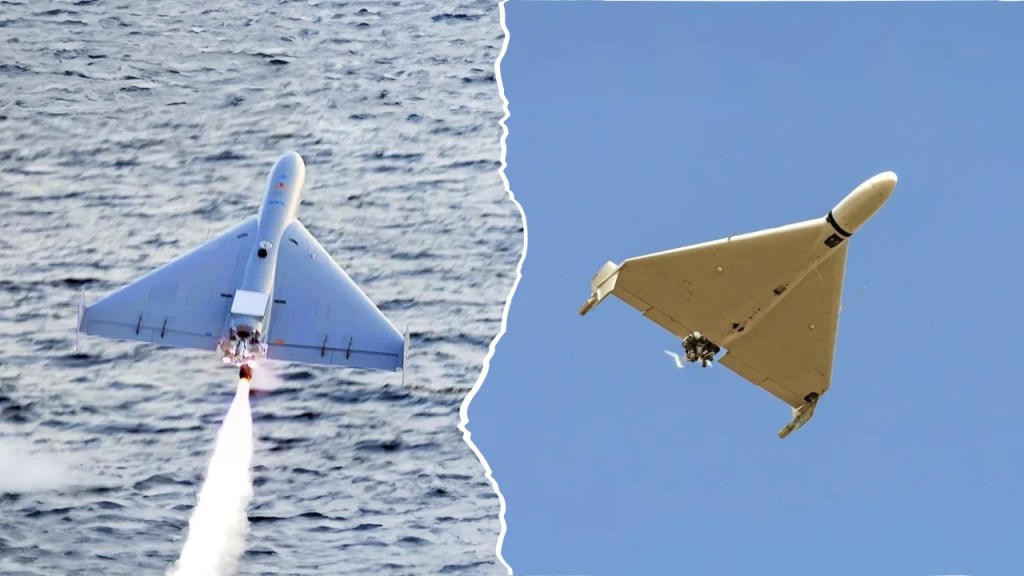
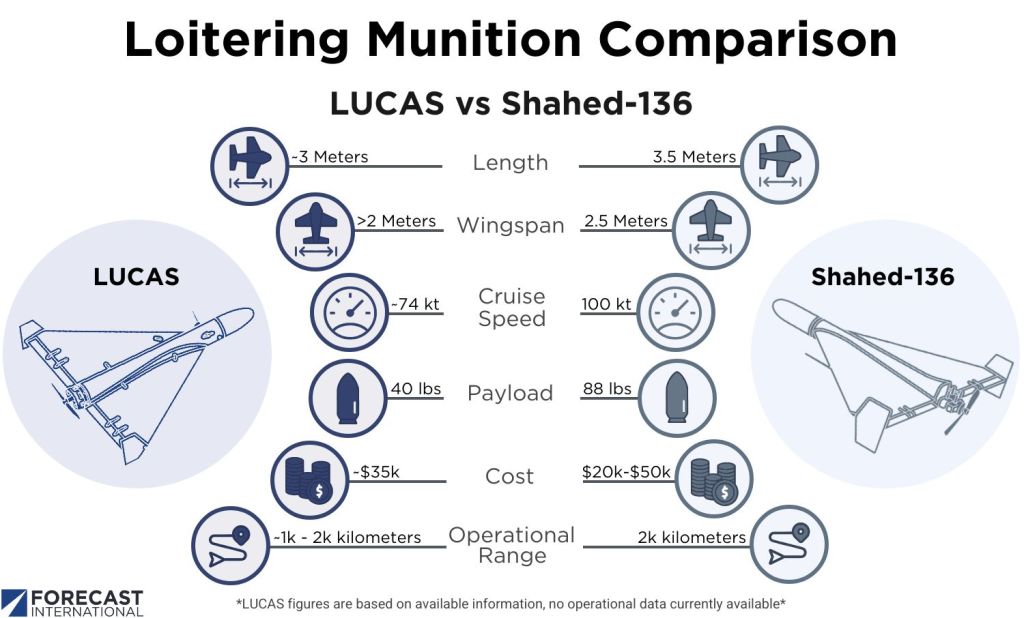
The most revealing development is not that the U.S. is building drones, but that it is openly reverse-engineering adversary concepts. The FLM-136 “LUCAS” drone developed after analysis of Iran’s Shahed-136, represents a significant psychological and doctrinal shift. Reports indicate the Pentagon accelerated the system from concept to combat deployment within roughly eight months, an acquisition timeline almost unprecedented in modern U.S. defense procurement. The drone has reportedly already seen operational use in strikes against Iranian targets. (TechSpot)
This matters because it demonstrates an implicit admission: the U.S. defense establishment underestimated the strategic value of low-cost expendable systems while Iran, Russia, and Ukraine operationalized them at scale.
The Shahed itself was initially dismissed in many Western defense circles as crude and technologically unsophisticated. Yet the strategic effectiveness of the platform did not come from technical sophistication. It came from affordability, manufacturability, operational persistence, and the ability to saturate defenses faster than defenders could economically respond.
The U.S. response with LUCAS effectively acknowledges that the defining feature of modern drone warfare may not be superior engineering, but superior production economics.
That creates a deeper challenge for the American defense model. The U.S. defense industry has historically been optimized for small numbers of highly advanced systems produced through long procurement cycles. Companies are incentivized around billion-dollar platforms, not disposable mass-manufactured systems. In contrast, drone warfare increasingly rewards rapid iteration, decentralized production, software adaptability, and the ability to absorb losses at scale. This resembles wartime industrial logic more than peacetime procurement logic.
The discussion around government equity stakes in drone manufacturers reflects this tension. Historically, the United States only moved toward direct industrial coordination and state-backed production during periods such as World War II or the early Cold War. The current drone push suggests Washington increasingly views autonomous systems as strategically comparable to shipbuilding, aircraft production, or semiconductor capacity. The Saudi dimension is also important. Recent reporting indicates broader U.S.-Saudi defense industrial cooperation is expanding into advanced manufacturing, drone exports, rare-earth processing, and localized military production. (Investing.com)
That matters because sustained drone warfare is fundamentally an industrial competition. Producing drones at scale requires semiconductors, batteries, rare earth materials, optical systems, AI-enabled software, and flexible manufacturing networks. The U.S. appears to be building not just weapons, but a transnational supply chain architecture designed to compete with Chinese manufacturing dominance and the rapidly expanding Russia-Iran drone ecosystem.
This also explains the shift in export policy. Washington recently moved to loosen restrictions on military drone exports, treating some drone systems more like conventional aircraft than missile technologies. (Investing.com) The objective is not simply commercial; it is strategic standardization. The U.S. wants allied states integrated into a shared drone production and operational ecosystem before rival supply chains become entrenched.
The risk is that doctrinal transitions during active competition often create hybrid periods where old and new systems coexist inefficiently. The Pentagon is still structured around carrier strike groups, fifth-generation aircraft, and legacy procurement frameworks while simultaneously attempting to pivot toward mass autonomous systems. That creates internal competition for funding, organizational resistance, and uncertainty over force design priorities.
There is also the danger of overcorrection. Ukraine demonstrated the effectiveness of cheap drones under specific battlefield conditions: dense trench warfare, static front lines, heavy artillery usage, and contested airspace. Future conflicts involving the United States may involve very different operational environments, including maritime warfare in the Indo-Pacific, anti-satellite operations, cyber disruption, and long-range missile exchanges.
Cheap drones are transformative, but they are not independently decisive. What appears to be emerging instead is a hybrid doctrine where mass autonomous systems complement , rather than replace, traditional airpower, naval power, and strategic deterrence capabilities.
The larger implication is not simply that drones are changing warfare, but that the United States is being forced to adapt to a model of warfare it did not originally design for and, in some respects, initially underestimated.
The strategic shock did not come from a peer competitor unveiling a revolutionary stealth platform or next-generation fighter aircraft. It came from relatively inexpensive systems developed outside the traditional hierarchy of military power, proving capable of reshaping battlefield economics and forcing even advanced militaries to reconsider force structure, procurement logic, and industrial priorities.
In that sense, the current doctrinal shift represents more than a modernization effort. It is an acknowledgment that the barriers to strategic disruption in warfare have fallen dramatically. States and non-state actors no longer need parity in traditional airpower to impose serious military and economic costs on technologically superior opponents.
The Pentagon’s current push toward scalable autonomous systems therefore reflects not only adaptation, but recognition that future military advantage may depend less on possessing the most advanced singular platforms and more on sustaining rapid industrial iteration, distributed manufacturing, software adaptability, and affordable mass at scale.
That represents one of the most significant conceptual shifts in U.S. military thinking since the post-Cold War era.
Authored By: Global GeoPolitics
If you prefer to make a one time donation in support of my work, you can do so by clicking any link below:
https://buymeacoffee.com/ggtv |
https://ko-fi.com/globalgeopolitics |
Bitcoin: 3NiK8BoRZnkwJSHZSekuXKFizGPopkE7ns
References
Palyekar, A. (2026) ‘Trump administration in talks to fund US drone companies, WSJ reports’, Reuters, 28 May. Available at: https://www.reuters.com/world/trump-administration-talks-fund-us-drone-companies-wsj-reports-2026-05-28/ (Accessed: 28 May 2026).
The Wall Street Journal (2026) ‘The Trump Administration Is in Talks to Fund U.S. Drone Companies’, The Wall Street Journal, 28 May. Available at: https://www.wsj.com/politics/national-security/ttrump-us-drone-company-funding-cadef1f7 (Accessed: 28 May 2026).
The Wall Street Journal (2026) ‘The Pentagon Is Buying 300,000 Drones in a Competition Designed for a New Kind of War’, The Wall Street Journal, May 2026. Available at: https://www.wsj.com/politics/national-security/pentagon-drone-dominance-gauntlet-program-2026 (Accessed: 28 May 2026).
U.S. Department of Defense (2025) ‘Drone Dominance Memorandum’, Office of the Secretary of Defense. Available at: https://www.defense.gov/ (Accessed: 28 May 2026).
TechSpot (2026) ‘US military deploys low-cost LUCAS drone built from lessons learned studying Iran’s Shahed-136’, TechSpot, May 2026. Available at: https://www.techspot.com/news/111939-us-military-deploys-low-cost-lucas-drone-built.html (Accessed: 28 May 2026).
Reuters (2026) ‘US reinterprets arms control pact to ease military-drone exports’, Reuters, May 2026. Available at: https://www.reuters.com/world/us/us-reinterprets-arms-control-pact-ease-military-drone-exports-2026/ (Accessed: 28 May 2026).
Reuters (2026) ‘US and Saudi Arabia discuss expanded defense and manufacturing cooperation’, Reuters, May 2026. Available at: https://www.reuters.com/ (Accessed: 28 May 2026).
Konaev, M. and Dunham, J. (2024) ‘The Revolution of Cheap Drones in Modern Warfare’, Center for Strategic and International Studies (CSIS). Available at: https://www.csis.org/analysis/revolution-cheap-drones-modern-warfare (Accessed: 28 May 2026).
Kofman, M. and Lee, R. (2023) ‘Not Built for Purpose: The Russian Military’s Ill-Fated Force Design’, War on the Rocks. Available at: https://warontherocks.com/ (Accessed: 28 May 2026).
Hambling, D. (2024) Swarm Troopers: How Small Drones Will Conquer the World. London: Constable.
Biddle, S. (2004) Military Power: Explaining Victory and Defeat in Modern Battle. Princeton: Princeton University Press.
Freedman, L. (2017) The Future of War: A History. London: Penguin.


Leave a Reply