
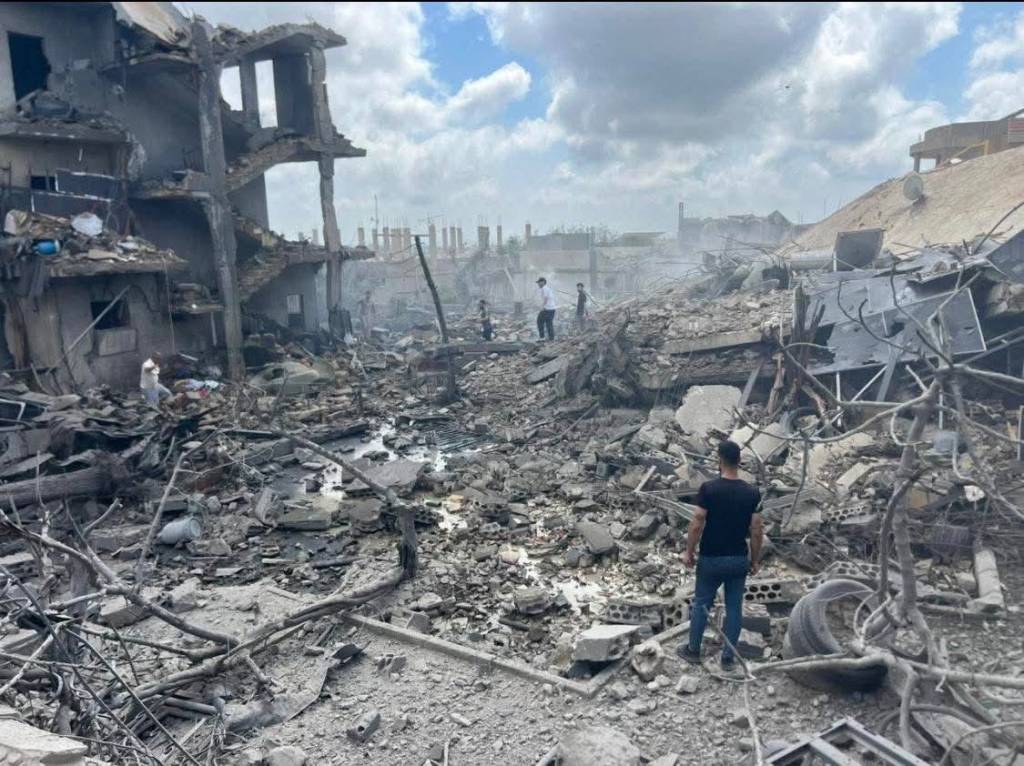
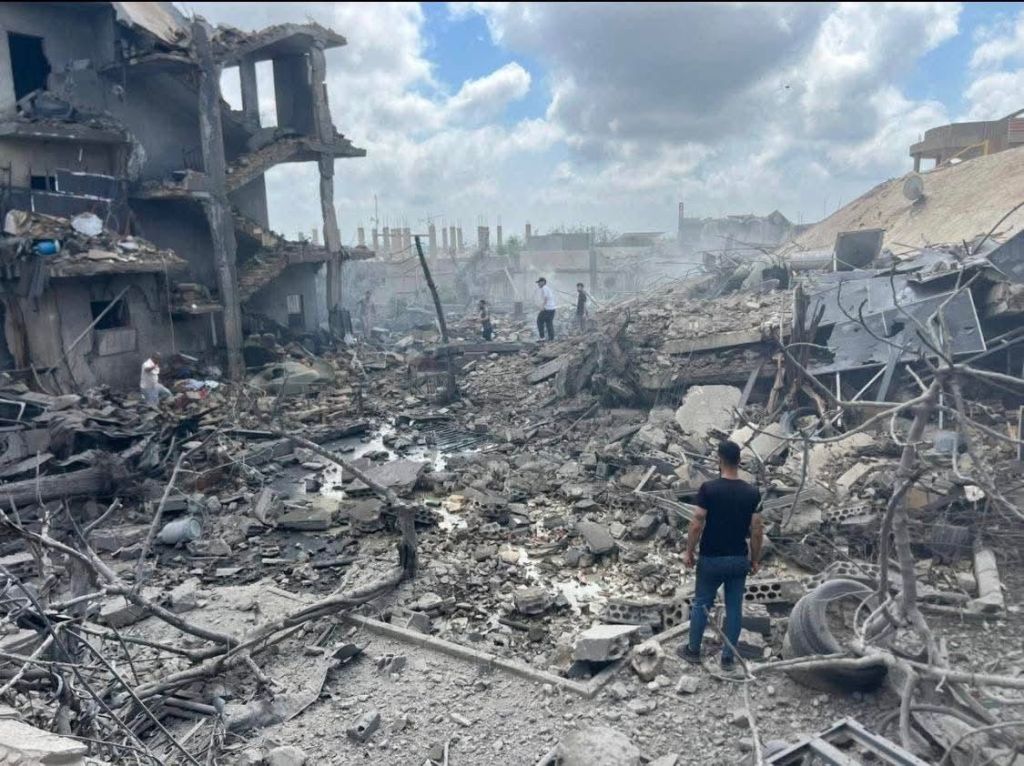
Washington’s long-prepared campaign Tehran operates through Israeli military assets, diplomatic theatre, and a calculated energy strategy designed to reshape Asia’s supply dependencies
On 8 June 2026, Israeli aircraft struck Iranian military targets hours after Iran launched missiles toward Israel, and American officials promptly announced that United States forces had played no part in the operation. The denial followed a format that has become entirely predictable: Washington publicly urges restraint, Israeli warplanes conduct the mission, and the State Department issues a statement of studied ignorance. The sequence has repeated itself across three distinct administrations and several rounds of escalation since 2024, which raises a straightforward question about whether the pattern reflects a genuine division of decision-making between two allied governments or a deliberate structure of plausible deniability engineered well in advance.
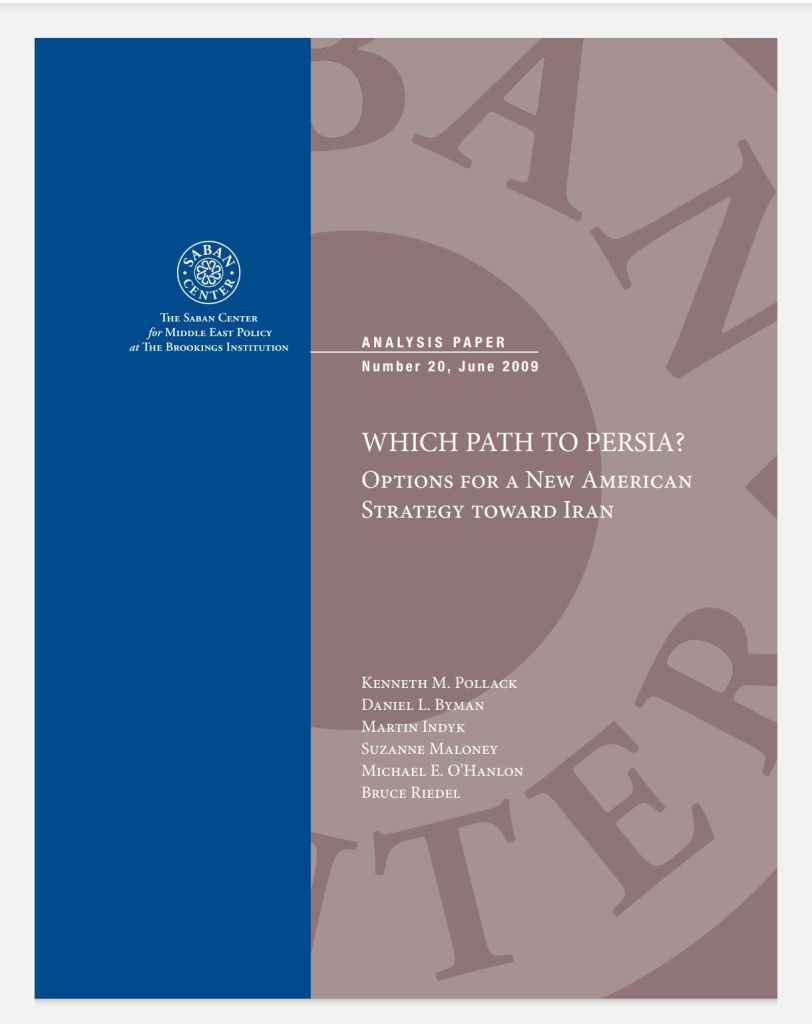
The question has an answer, and the answer was published in June 2009 by the Saban Center for Middle East Policy at the Brookings Institution. Which Path to Persia?: Options for a New American Strategy toward Iran, authored by Kenneth M. Pollack, Daniel L. Byman, Martin Indyk, Suzanne Maloney, Michael E. O’Hanlon, and Bruce Riedel, laid out with considerable frankness the full range of methods by which Washington might pursue the weakening or removal of the Iranian government. Chapter Five of that document, titled “Leave It to Bibi,” addressed the scenario in which the United States would encourage or permit Israeli military strikes on Iranian territory, with the explicit expectation that international condemnation and Iranian retaliation would fall on Israel rather than on Washington. The chapter described how the United States would need to assist Israel logistically and with intelligence while publicly maintaining distance from the operation. Seventeen years later, that chapter reads less like a policy proposal than a project log.
The logistical argument is not theoretical. On 27 February 2026, the day before the first major coordinated United States and Israeli strikes on Iran, at least fourteen American aerial refuelling tankers arrived at Ben Gurion International Airport in Israel, comprising nine KC-46 Pegasus aircraft and five KC-135s, according to reporting by The War Zone and corroborated by social media documentation from Israeli defence correspondents including Emanuel Fabian. The Israeli Air Force’s entire tanker fleet, by contrast, consists of seven ageing KC-707 derivatives, which impose severe constraints on range, sortie rates, and payload options for strikes requiring transit across several hundred kilometres to Iranian territory. The presence of an American tanker force roughly twice the size of Israel’s own fleet at Ben Gurion the day before strikes commenced is not consistent with the narrative of an uninvolved ally caught by surprise. The United States Air Force also deployed EA-18G electronic warfare aircraft in the region, providing suppression of Iranian air defence systems that the Israeli Air Force could not have replicated independently. The Congressional Research Service confirmed in its March 2026 briefing on the United States conflict with Iran that American forces carried out strikes on three Iranian nuclear facilities, with officials subsequently clarifying that the operation was, in their phrasing, not about regime change, a statement President Trump contradicted within days on his Truth Social account.
The Brookings document anticipated precisely this arrangement. Its chapter on the Israeli strike option noted that Washington would need to provide active assistance in order for the operation to succeed, while the strategic benefit lay in the deflection of blame and retaliation away from American assets and toward Israel. The House of Commons Library research briefing published in June 2026 confirmed that Iran retaliated against United States military installations across the Gulf Cooperation Council states, against Bahrain’s Naval Support Activity where the United States Fifth Fleet is headquartered, and against targets in Saudi Arabia, Qatar, Kuwait, Iraq, Oman, and Jordan, exactly the dispersed retaliation pattern the Brookings framework predicted would result from using Israel as the visible belligerent. Iran struck American and allied infrastructure rather than confining its response to Israeli territory, which demonstrates that Tehran drew no meaningful distinction between the principal and the proxy, even if Washington’s press releases did.
The diplomatic record from the months preceding the February 2026 strikes supports the argument that negotiations served as a preparatory mechanism rather than a genuine attempt at resolution. The House of Commons briefing notes that the Omani foreign minister, who had been mediating indirect talks, reported significant progress in early 2026 and indicated that Iran was prepared to make concessions on its nuclear programme. President Trump stated publicly that he was “not thrilled” with the state of negotiations. Within weeks, strikes commenced. The Brookings document, in its chapters on diplomacy, was explicit that the United States might pursue engagement not to prevent war but to create the conditions in which war would appear justified to international audiences, and to exhaust the diplomatic option in a manner that left Iran appearing intransigent. The pattern in 2026, reported Iranian flexibility, American dissatisfaction, rapid escalation, follows that prescription with unsettling fidelity.
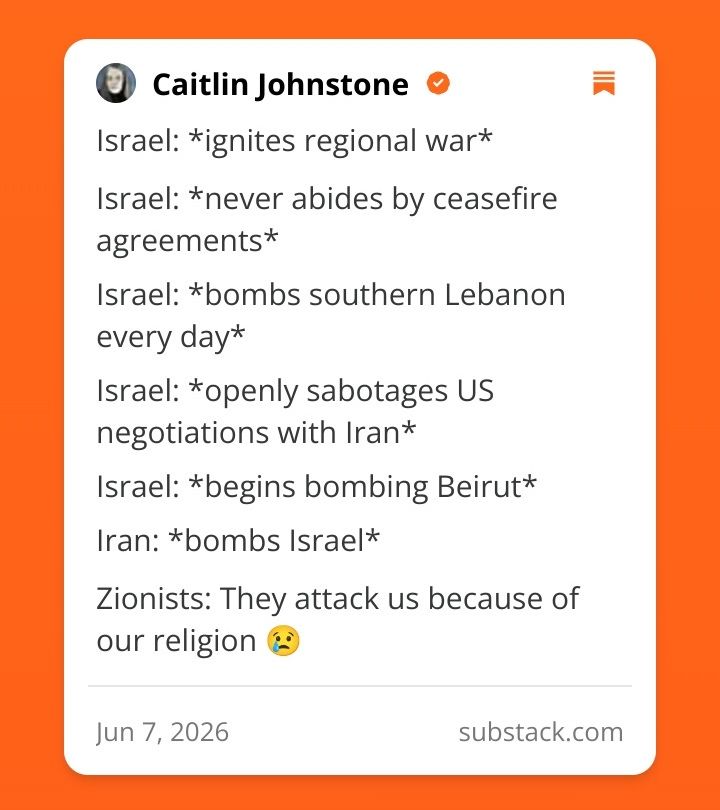
The ceasefire declared on 8 April 2026 likewise warrants scrutiny on its own terms. Between the February strikes and early June, the United States imposed a naval blockade on Iranian ports beginning on 13 April, carried out the Strait of Hormuz aerial campaign from 19 March onwards, and seized or struck Iranian vessels operating in international waters. These actions occurred simultaneously with the nominal ceasefire and with ongoing statements from Washington expressing preference for a diplomatic resolution. By June 2026, with Israeli strikes resuming against Iranian military targets, the ceasefire had functioned not as a genuine pause in hostilities but as a period of repositioning, precisely the pattern described by the Brookings authors in their discussion of how diplomatic intervals could be exploited to rearm and reorganise before the next escalatory phase.
The energy dimension of the conflict has received less analytical attention than the military operations, though it may prove equally consequential. The Strait of Hormuz, through which approximately twenty percent of the world’s oil and a substantial proportion of global liquefied natural gas transited in 2025, was effectively closed to LNG cargoes from March 2026 following Iran’s retaliatory closure of the waterway. Qatar’s Ras Laffan LNG complex, the largest single concentration of LNG export capacity on the planet, declared force majeure on its contracts after two of its fourteen liquefaction trains were damaged. The International Energy Agency estimated in April 2026 that global LNG production had declined by eight percent year on year, and that the combined effect of short-term supply losses and infrastructure damage to Qatari capacity could result in the loss of approximately 120 billion cubic metres of LNG supply between 2026 and 2030. Asian benchmark LNG prices jumped nearly forty percent at the onset of the crisis, according to analysis published by the Arab Reform Initiative.
The commercial beneficiaries of this disruption were not difficult to identify. Glenfarne Group, the majority owner and developer of the Alaska LNG project, a planned 20-million-tonne-per-year export terminal on Alaska’s Pacific coast, was actively seeking binding offtake agreements with Asian buyers in early 2026. TotalEnergies signed a preliminary twenty-year agreement with Glenfarne on 27 February 2026, the day before the strikes commenced, for two million tonnes per year of Alaskan LNG. By March, OilPrice.com reported that interest in Alaska LNG had spiked sharply as the war choked off Middle Eastern supply and forced Asian buyers to seek long-term alternatives outside Hormuz-linked routes. The connection between Middle Eastern supply disruption and Alaskan LNG viability was not speculative, Glenfarne executives had acknowledged in investor presentations as recently as 2025 that the project’s competitive positioning relative to Gulf Coast LNG depended on the relative safety and directness of Pacific shipping lanes compared with routes through contested waterways. The war in the Middle East converted a project whose economics had appeared marginal into an apparent necessity for Asian energy security planners.
This commercial logic extends across American energy strategy more broadly. In the years preceding the escalation, the United States built substantial LNG export capacity specifically oriented toward Asian markets, at costs that analysts had found difficult to justify so long as Qatari and Emirati supply flowed freely through Hormuz at competitive prices. Europe had already been redirected toward American LNG following the destruction of the Nord Stream pipelines in 2022 and the subsequent removal of Russian gas from continental European supply chains, a process accompanied by American political pressure on European governments to accept both the loss of Russian energy and the costs of its American replacement. The Asian market represented the remaining frontier for enforcing energy dependency on United States supply, and approximately ninety percent of the LNG transiting Hormuz in 2025 was destined for Asian buyers, according to the Arab Reform Initiative. The effective closure of Hormuz achieved in a single escalatory episode what years of commercial lobbying had failed to accomplish: it made American LNG the default alternative for a continent that had possessed cheaper and more proximate sources.
The China dimension of American strategic calculation runs through the entire regional analysis. China imported roughly half its energy from Middle Eastern sources prior to the conflict, and the disruption of those supply chains forced Beijing to seek alternatives from Russia, from the United States, or from other exporters operating outside Hormuz. American pressure on Chinese energy infrastructure extended simultaneously to Pakistan and Myanmar, where Beijing had constructed pipeline routes intended to bypass maritime chokepoints. The United States military was also reported to be pressing Indonesia for expanded military basing access, specifically citing the Strait of Malacca as a potential pressure point if the Hormuz model proved transferable. The geographic pattern, Hormuz, Malacca, Venezuelan oil exports, Russian energy infrastructure, describes a coherent campaign of supply chain interdiction rather than a collection of unrelated regional disputes.
The Ukraine parallel is instructive in this regard. From 2022 onwards, the United States supplied Ukraine with the military capability to sustain an attritional conflict with Russia, while simultaneously expressing public preference for diplomatic resolution and presenting the war as a Ukrainian sovereign decision. The Ukrainian military could not have maintained operations at the scale it achieved without American intelligence, satellite support, weapons systems, and training, yet Washington maintained that the war was Ukraine’s to fight and Ukraine’s to end. The structural relationship between Washington and Kyiv replicated itself in the relationship between Washington and Tel Aviv, with Israeli Air Force capabilities expanding through American arms transfers, American tanker support, and American suppression of Iranian air defences, while American officials described each escalatory episode as an Israeli decision taken independently. The Brookings document anticipated this arrangement, the military deployment record confirms it, and the pattern of official denial following each escalation repeats it with consistent predictability.
Assertions from Washington about Israeli independence in military targeting decisions warrant testing against verifiable operational realities rather than acceptance as the defining account. Israeli F-35 squadrons cannot sustain operations against targets in Iran without aerial refuelling, and that refuelling was provided by American KC-46 and KC-135 aircraft physically stationed in Israel before each major escalatory episode. Israeli intelligence collection against Iranian air defence networks draws on American satellite and signals intelligence sharing arrangements that cannot be replicated by Israeli national collection assets alone. American EA-18G electronic warfare platforms suppressed Iranian radar and surface-to-air missile systems during the February 2026 strikes, creating the conditions in which Israeli strike aircraft could operate with reduced attrition risk. All of these contributions were present, documented, and operationally necessary. Their presence is irreconcilable with the assertion that the United States was not a participant in the strikes they made possible.
Whether the strategic objectives being pursued through this architecture will be achieved is a separate question from whether the architecture itself exists and operates as described. Iran, despite sustained pressure including the decapitation of Hezbollah’s senior leadership in 2024, the overthrow of the Assad government in Syria at the close of 2024, direct strikes on its territory in June 2025 and again on 28 February 2026, and the killing of Supreme Leader Ali Khamenei in that February operation, had not as of June 2026 produced the political collapse that Washington’s planning documents had anticipated as a possible outcome. The Islamic Republic’s successor leadership under Khamenei’s son had not been recognised as legitimate by Washington, and the pressure campaign showed no signs of diminishing. China’s economic adjustment to the supply disruption remained incomplete but had begun. Russia continued to offer alternative energy supply to Asian buyers at terms competitive with spot LNG markets. Whether the disruption of Middle Eastern supply chains proves sufficient to arrest Chinese economic development and constrain Beijing’s capacity to assist both Russia and Iran in resisting American strategic pressure is not yet determinable from the evidence available in mid-2026.
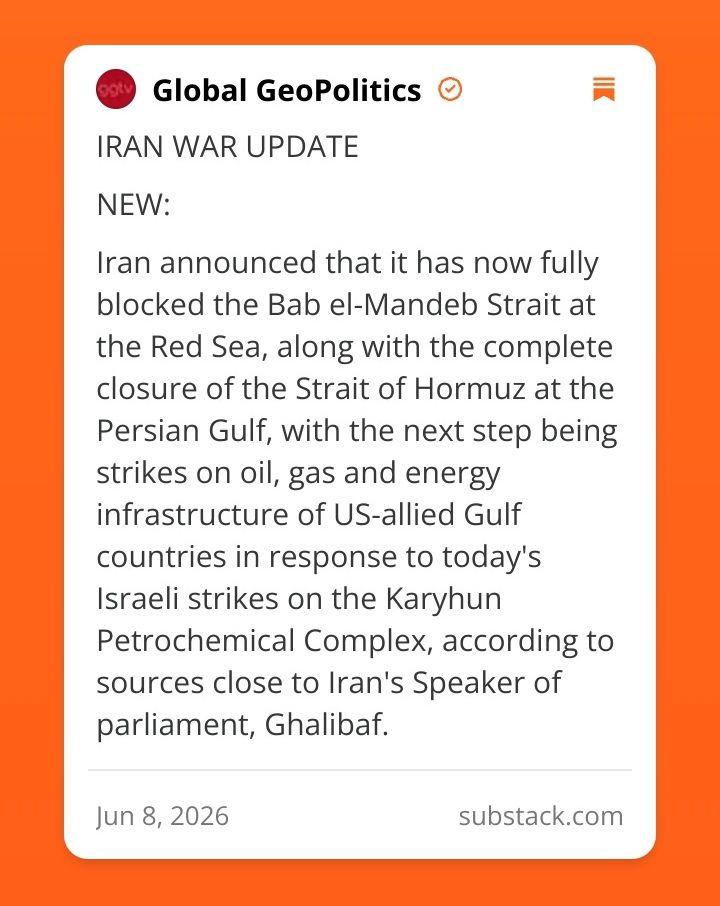
What is determinable is the general framework within which events since 2024 have unfolded. The Brookings Institution’s 2009 analysis paper described a set of tools, diplomatic pretexts, Israeli proxy strikes, regime change operations, support for internal insurgency, and military options, to be deployed against Iran in pursuit of sustained American regional primacy. The document was not a secret. It was published, freely available, and cited by analysts throughout the intervening years. Its chapter headings and strategic logic have mapped onto events with sufficient precision to warrant the conclusion that observers of the region should read primary policy documents rather than press statements when attempting to understand what is occurring and why. The current episode of Israeli strikes on Iranian military targets, accompanied by American denials of involvement and expressions of preference for diplomacy, falls within the chapter titled “Leave It to Bibi” with greater accuracy than it falls within any alternative interpretive framework that Western media organisations have offered their audiences.
Authored By:
If you prefer to make a one time donation in support of my work, you can do so by clicking any link below:
https://buymeacoffee.com/ggtv |
https://ko-fi.com/globalgeopolitics |
Bitcoin: 3NiK8BoRZnkwJSHZSekuXKFizGPopkE7ns
References
1. Pollack, K.M., Byman, D.L., Indyk, M., Maloney, S., O’Hanlon, M.E., and Riedel, B. (2009). Which Path to Persia? Options for a New American Strategy toward Iran. Brookings Institution Press / Saban Center for Middle East Policy, Analysis Paper No. 20, June 2009. Available at: https://www.brookings.edu/wp-content/uploads/2016/06/06_iran_strategy.pdf
2. House of Commons Library (2026). Israel/US-Iran Conflict 2026: Background and UK Response. Research Briefing CBP-10521, June 2026. Available at: https://commonslibrary.parliament.uk/research-briefings/cbp-10521/
3. Congressional Research Service (2026). U.S. Conflict with Iran. CRS Report R48887, 26 March 2026. Available at: https://www.congress.gov/crs_external_products/R/PDF/R48887/R48887.1.pdf
4. Rogoway, T. et al. (2026). Israel’s Fighter Force Stands to Be Far More Effective with Full USAF Tanker Support in a War with Iran. The War Zone, 28 February 2026. Available at: https://www.twz.com/air/israels-fighter-force-stands-to-be-far-more-effective-with-full-usaf-tanker-support-in-a-war-with-iran
5. Council on Foreign Relations (2026). Iran’s War with Israel and the United States: Global Conflict Tracker. Updated June 2026. Available at: https://www.cfr.org/global-conflict-tracker/conflict/confrontation-between-united-states-and-iran
6. Britannica (2026). 2026 Iran War. Updated 8 June 2026. Available at: https://www.britannica.com/event/2026-Iran-war
7. Arab Center Washington DC (2026). The US-Israel War on Iran: Analyses and Perspectives. Available at: https://arabcenterdc.org/resource/the-us-israel-war-on-iran-analyses-and-perspectives/
8. International Energy Agency (2026). Middle East Crisis Disrupts International Natural Gas Markets and Delays Global LNG Supply Wave. IEA News Release, 24 April 2026. Available at: https://www.iea.org/news/middle-east-crisis-disrupts-international-natural-gas-markets-and-delays-global-lng-supply-wave
9. IEA (2026). The Middle East and Global Energy Markets. Available at: https://www.iea.org/topics/the-middle-east-and-global-energy-markets
10. S&P Global Market Intelligence (2026). Middle East War Disrupts Global LNG Near-Term Outlook. 11 March 2026. Available at: https://www.spglobal.com/market-intelligence/en/news-insights/research/2026/03/middle-east-war-disrupts-global-lng-near-term-outlook
11. OilPrice.com (2026). Middle East War Revives Interest in Alaska LNG. 16 March 2026. Available at: https://oilprice.com/Latest-Energy-News/World-News/Middle-East-War-Revives-Interest-in-Alaska-LNG.html
12. OilPrice.com (2026). Middle East Crisis Accelerates US-Thailand LNG Supply Talks. Available at: https://oilprice.com/Energy/Energy-General/Middle-East-Crisis-Accelerates-US-Thailand-LNG-Supply-Talks.amp.html
13. Arab Reform Initiative (2026). Hormuz Under Fire: LNG Disruption, Regional Exposure, and Energy Sovereignty in MENA. 16 March 2026. Available at: https://www.arab-reform.net/publication/hormuz-under-fire-lng-disruption-regional-exposure-and-energy-sovereignty-in-mena/
14. Institute for Energy Economics and Financial Analysis (2026). Impact of Middle East Crisis on Global Energy Markets. Available at: https://ieefa.org/impact-middle-east-crisis-global-energy-markets
15. Gupta, L. (2026). TotalEnergies Locks In Massive 20-Year Alaska LNG Deal to Fuel Asia. Finviz / Reuters wire, 27 February 2026. Available at: https://finviz.com/news/324781/totalenergies-locks-in-massive-20-year-alaska-lng-deal-to-fuel-asia
16. Jerusalem Post (2026). Israel’s New Refuellers Could Give It Greater Freedom to Strike Iran Without US Support. May 2026. Available at: https://www.jpost.com/israel-news/defense-news/article-895049
17. Wikipedia (2026). 2026 Strait of Hormuz Campaign. Available at: https://en.wikipedia.org/wiki/2026_Strait_of_Hormuz_campaign
18. Wikipedia (2026). 2026 Iran War. Available at: https://en.wikipedia.org/wiki/2026_Iran_war


Leave a Reply