
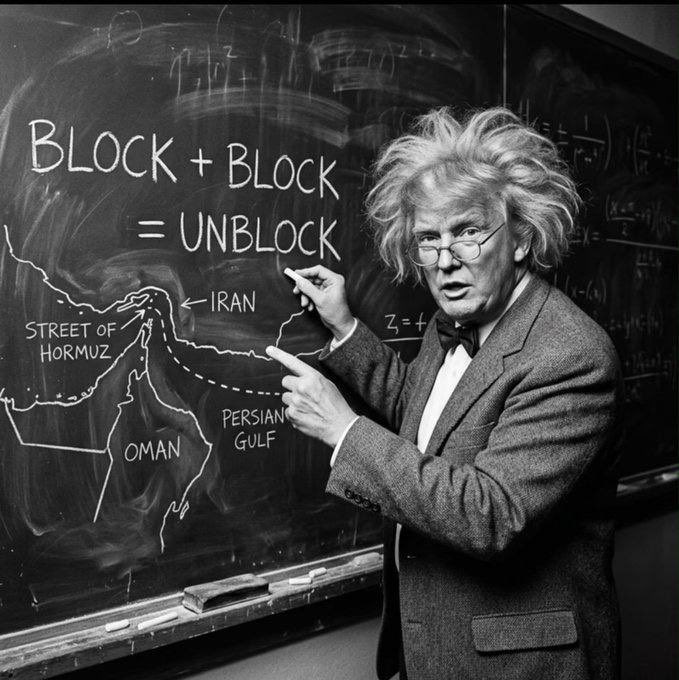
How regional conflict obscures a larger strategy targeting China’s economic lifelines
Something has already changed in the way power is organised, though it is rarely put plainly. The pattern of events still looks familiar, which is why it is easy to miss. Military movements in the Middle East are usually explained in terms of local disputes. That explanation no longer fits the facts. These movements bear on the flow of oil and trade beyond the region, and in particular on the routes China relies on. What is being arranged is a position from which those routes can be interfered with, or, if required, cut. There is a fixation on Israel as the central driver of escalation which obscures a more consequential reality: the United States has entered an indirect but material phase of systemic war against China, using geographically dispersed conflicts as instruments of economic strangulation.
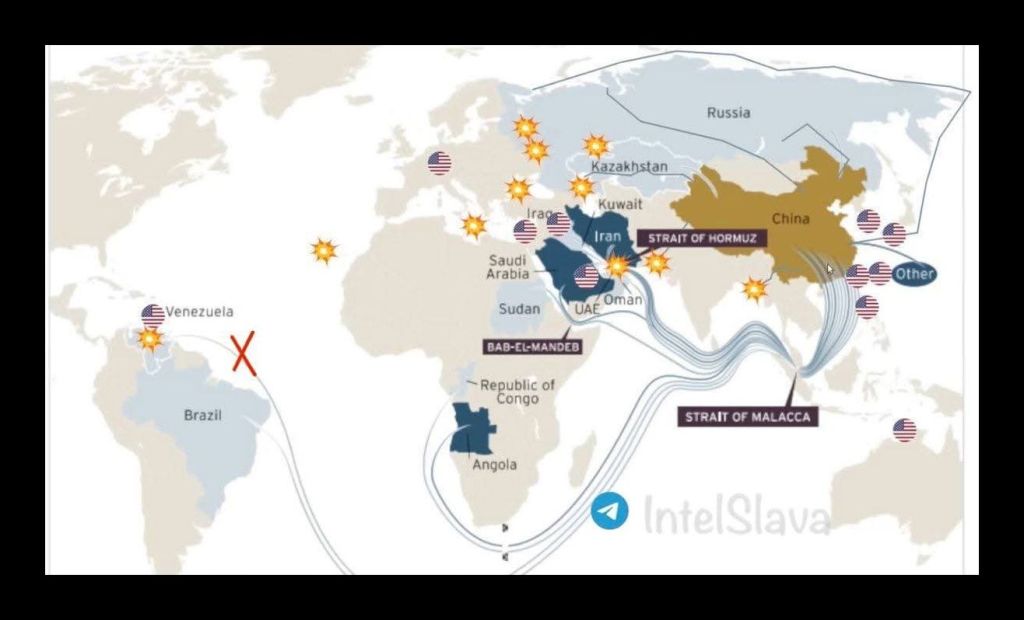
Global scale defines the significance of this shift, not the local intensity of any individual conflict. Maritime trade routes carry approximately 80 percent of global goods by volume, with China dependent on imported energy for sustaining industrial output and social stability. According to the International Energy Agency, China imported approximately 10.8 million barrels of crude oil per day in 2025, with roughly 45 percent originating from Gulf states. Roughly 40–45 percent of these imports transit through chokepoints such as the Strait of Hormuz and the Strait of Malacca, while approximately 20 percent of total global oil supply passes through Hormuz alone (U.S. Energy Information Administration). These corridors are therefore structurally decisive in any prolonged confrontation. The deployment of a Marine Expeditionary Unit equipped with anti-shipping capabilities represents not a tactical manoeuvre, but a strategic intervention into the circulatory system of the global economy. Reporting from US Naval Institute News (14 April 2026) identified a measurable decline in tanker traffic through the Strait of Hormuz, attributed to deterrent effects generated by an evolving United States naval posture, including boarding and interdiction capabilities. Such deployments operate asymmetrically, where a naval force capable of interdiction imposes disproportionate economic costs on a distant industrial power without requiring direct territorial confrontation.
Strategic execution reveals coherence rather than contingency. The restructuring of the United States Marine Corps—documented in analyses such as “How US Marines are being reshaped for China threat” (BBC, 2023) and formalised under Force Design 2030 by Commandant General David Berger, demonstrates a deliberate shift away from conventional land warfare toward distributed, maritime denial capabilities. The removal of heavy armour, elimination of main battle tanks, reduction of infantry battalions, and integration of precision strike systems such as HIMARS, ATACMS, and the emerging Precision Strike Missile reflects a doctrinal pivot toward sea denial operations across critical chokepoints. This transformation aligns with Expeditionary Advanced Base Operations, enabling dispersed units to establish temporary forward positions along maritime corridors. Analysts at the Center for Strategic and Budgetary Assessments, including Bryan Clark, have emphasised that such capabilities are designed to deny adversaries access to critical maritime routes through distributed, mobile firepower. Brian Berletic similarly notes that such restructuring only achieves full coherence within a strategy aimed at disrupting maritime trade routes essential to China’s economic stability (New Atlas, 2026).
Operational patterns extend beyond maritime interdiction into covert territorial penetration. Reports surrounding a failed “rescue mission” inside Iran, involving C-130 transport aircraft, MH-6 helicopters, and improvised airstrips, mirror a 2023 training exercise conducted in Wyoming under Agile Combat Employment doctrine (WyoToday, 2023). That doctrine explicitly prioritises the rapid establishment of temporary forward operating bases, including forward arming and refuelling points capable of sustaining combat operations in contested environments. The dual-use nature of these systems, supporting both contingency response and offensive insertion, reinforces their function as instruments of deep penetration. Lieutenant Colonel Dave Meyer’s assertion that adversaries “cannot defend every single linear mile of road” underscores a strategy predicated on dispersal, unpredictability, and penetration. The Iranian episode therefore aligns with a pre-existing operational framework, indicating not an improvised rescue mission, but a compromised or exposed insertion consistent with established doctrine.
Economic dimensions consolidate the strategic intent into a unified system. Control over Middle Eastern energy flows has historically functioned as a lever of global power, but current developments integrate this lever into a targeted containment strategy against China. Iranian oil exports, despite sanctions, continue to reach China through indirect channels, including reflagging and transshipment practices documented by the United Against Nuclear Iran monitoring group. Disruption of these flows would impose measurable constraints on Chinese industrial output, given the continued centrality of hydrocarbons to manufacturing and power generation. Sanctions on Venezuela, disruption of Russian energy exports through the Ukraine conflict, and interdiction of Iranian oil shipments collectively form a triangulated pressure system constraining China’s access to affordable energy inputs. This configuration transforms regional conflicts into nodes within a global economic blockade. Energy markets respond not merely to supply disruptions, but to the credible threat of sustained interdiction, amplifying price volatility and forcing China into more expensive and less secure supply arrangements.
Strategic literature clarifies the underlying structure of this confrontation. The RAND Corporation report War with China: Thinking Through the Unthinkable (2016) outlined scenarios in which maritime interdiction imposes economic costs without immediate escalation to full-scale war. More recent analyses from the Center for a New American Security have advanced the concept of “economic warfare at sea,” where control of maritime routes functions as a primary lever of coercion. The interaction resembles a multi-stage deterrence game transitioning into a blockade equilibrium, where the United States seeks to impose escalating costs without triggering immediate full-scale retaliation. The primary players include the United States as the initiating actor, China as the target of economic coercion, and intermediary states such as Iran and Russia as both buffers and enablers. The payoff matrix favours the United States if China refrains from escalation while absorbing economic damage, but shifts dramatically if China responds by expanding the conflict domain.
Equilibrium has already shifted. The imposition of de facto maritime restrictions constitutes an act of economic warfare, altering the payoff structure by increasing the long-term cost of inaction for China. Classical realist frameworks emphasise balance of power, yet this situation aligns more closely with hegemonic stability under stress, where the dominant power employs systemic control mechanisms to preserve its position. The innovation lies in the integration of military deployments with economic interdiction, producing a hybrid form of coercion that operates across domains simultaneously.
Long-standing doctrines have been quietly reversed. Post-Cold War assumptions of globalisation as a stabilising force have collapsed under the weight of deliberate supply chain weaponisation. The principle of free navigation, once upheld as a cornerstone of international order, has been subordinated to strategic denial operations. The notion that regional conflicts remain contained has been invalidated by their integration into a global strategy targeting a specific economic rival. Even the expectation that wars require formal declarations has been superseded by a continuum of actions that collectively achieve the same effect without explicit acknowledgement.
Historical continuity defines the present moment. The Carter Doctrine of 1980 established the Persian Gulf as a vital United States interest subject to military protection, embedding energy security within grand strategy. Academic analysis by historian Melvyn Leffler has demonstrated that access to resources and denial of such access to rivals, has remained a persistent element of United States policy. Comparative imperial frameworks, including Edward Luttwak’s analysis of Roman strategy, illustrate how peripheral regions are leveraged to sustain central objectives. Contemporary operations replicate this logic with greater technological sophistication and global reach.
Systemic consequences extend across the entire international order. Russia’s role as an energy supplier and strategic partner to China becomes more critical under conditions of maritime constraint, reinforcing a Eurasian bloc that operates increasingly outside Western-controlled systems. Russian Security Council commentary reported by TASS has framed ongoing developments as part of a broader escalation dynamic, linking Middle Eastern tensions, the Ukraine conflict, and Indo-Pacific competition into a single strategic continuum. Middle Eastern states face intensified pressure to align with or resist external control over their resources, while Iranian retaliatory doctrine, including threats to target infrastructure such as Abqaiq, Yanbu, and Fujairah, introduces additional volatility into global energy systems. Global trade networks fragment into competing spheres, with financial systems adapting to alternative payment mechanisms that bypass traditional Western institutions.
Future dynamics depend on the sustainability of the current equilibrium. Continued interdiction risks forcing China into a strategic response that expands the conflict into new domains, including cyber operations, financial disruption, and military escalation in the Indo-Pacific. Conversely, failure to maintain pressure undermines the credibility of the blockade strategy, allowing China to stabilise its supply chains and erode the effectiveness of coercion. Structural incentives therefore favour continued escalation, even in the absence of explicit declarations of war.
The margin for miscalculation has effectively disappeared, as the space for error in relations between major powers has narrowed under sustained pressure and continuous strategic competition. Economic warfare now functions as the primary instrument of power, taking precedence over diplomatic negotiation in shaping outcomes between states. Regional conflicts are no longer isolated events, but have been absorbed into a broader strategic framework in which actions in one theatre influence conditions in others. Maritime chokepoints have become decisive arenas of global confrontation, where control or disruption of shipping routes carries direct consequences for the wider international system. Doctrinal changes within military planning have already translated future conflict scenarios into operational practice, embedding long-term assumptions into present deployments. As a result, the global order can no longer be described as cooperative in structure; it is increasingly defined by rivalry and opposition between competing centres of power.
Historical continuity defines the present moment. Empires have always conducted peripheral operations to secure central objectives, and contemporary actions follow that logic with greater efficiency and scale. Technological advancement has compressed timeframes and expanded reach, but the underlying mechanism remains unchanged. Control of resources enables projection of power, and projection of power enforces control of resources.
The decisive reality is already established, the target is China, and that means WW3.
Authored By: Global GeoPolitics
Thank you for visiting. This is a reader-supported publication. If you believe journalism should serve the public, not the powerful, and you’re in a position to help, becoming a PAID SUBSCRIBER truly makes a difference. Alternatively you can support by way of a cup of coffee:
https://buymeacoffee.com/ggtv |
https://ko-fi.com/globalgeopolitics |
Bitcoin: 3NiK8BoRZnkwJSHZSekuXKFizGPopkE7ns


Leave a Reply