
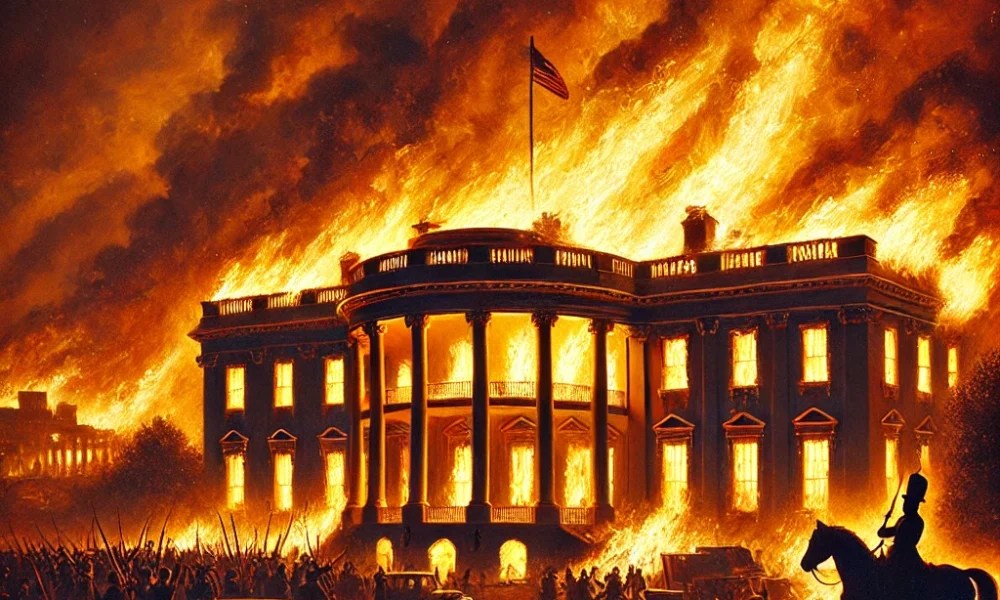
From Tehran to Taiwan: The Men Who Built America’s Empire Are Now Writing Its Autopsy
The extraordinary significance of the Max Boot interview with former CIA analyst John Culver does not rest merely in the military assessments themselves, severe as they already appear. The deeper significance rests in who is speaking, where they are speaking, and what institutional tradition they represent. Max Boot spent decades advocating American military interventionism across multiple theatres, while John Culver spent most of his professional life inside the intelligence architecture of the United States state apparatus studying China’s military capabilities. Their discussion therefore carries weight far beyond ordinary journalistic commentary because it represents a form of strategic disclosure emerging from within the ideological core of the American foreign policy establishment itself.
Only forty eight hours earlier, Robert Kagan, another central intellectual architect of post-Cold War American primacy, published an extraordinary admission regarding Iran in The Atlantic, arguing that the United States had suffered a strategic defeat carrying consequences which could neither be repaired nor ignored. Kagan’s admission alone would have represented a major geopolitical event because few figures embodied the ideology of liberal interventionist primacy more comprehensively than the co-founder of Project for the New American Century. Yet the Culver interview published by Boot appears even more devastating because the discussion moves beyond the Middle East and toward the central theatre of twenty first century geopolitical competition itself: the Pacific.
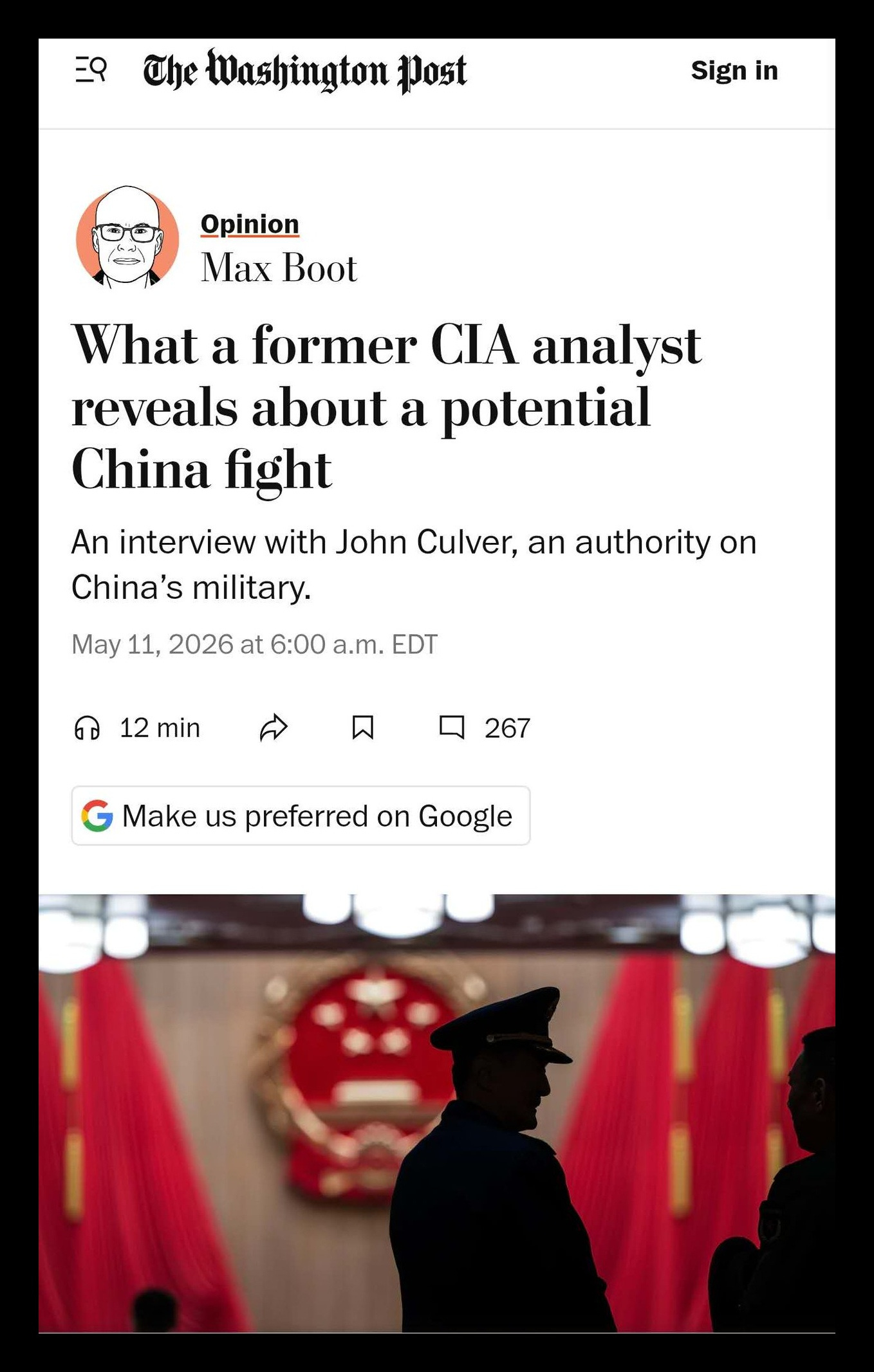
( WSJ link: What a former CIA analyst reveals about a potential fight with China
Kagan effectively acknowledged strategic failure against a regional middle power integrated into the emerging Eurasian system. Culver’s analysis implies that the United States may no longer possess escalation dominance against the primary industrial power of the twenty first century. Taken together, the two interventions amount to something approaching an obituary for the doctrine of uncontested American military primacy which dominated global politics after the collapse of the Soviet Union.
For more than three decades the United States operated according to a strategic assumption inherited from the unipolar moment of the 1990s. American planners believed that military superiority, maritime dominance, technological advantage, reserve currency power, alliance systems, sanctions enforcement, and forward basing structures would allow Washington to shape geopolitical outcomes across Eurasia indefinitely. Every major intervention after the Cold War rested upon some variation of this assumption. Yugoslavia, Iraq, Libya, Afghanistan, Syria, sanctions warfare against Iran, NATO expansion, and Indo-Pacific containment strategy all emerged from the belief that the United States retained overwhelming escalation superiority against any regional adversary.
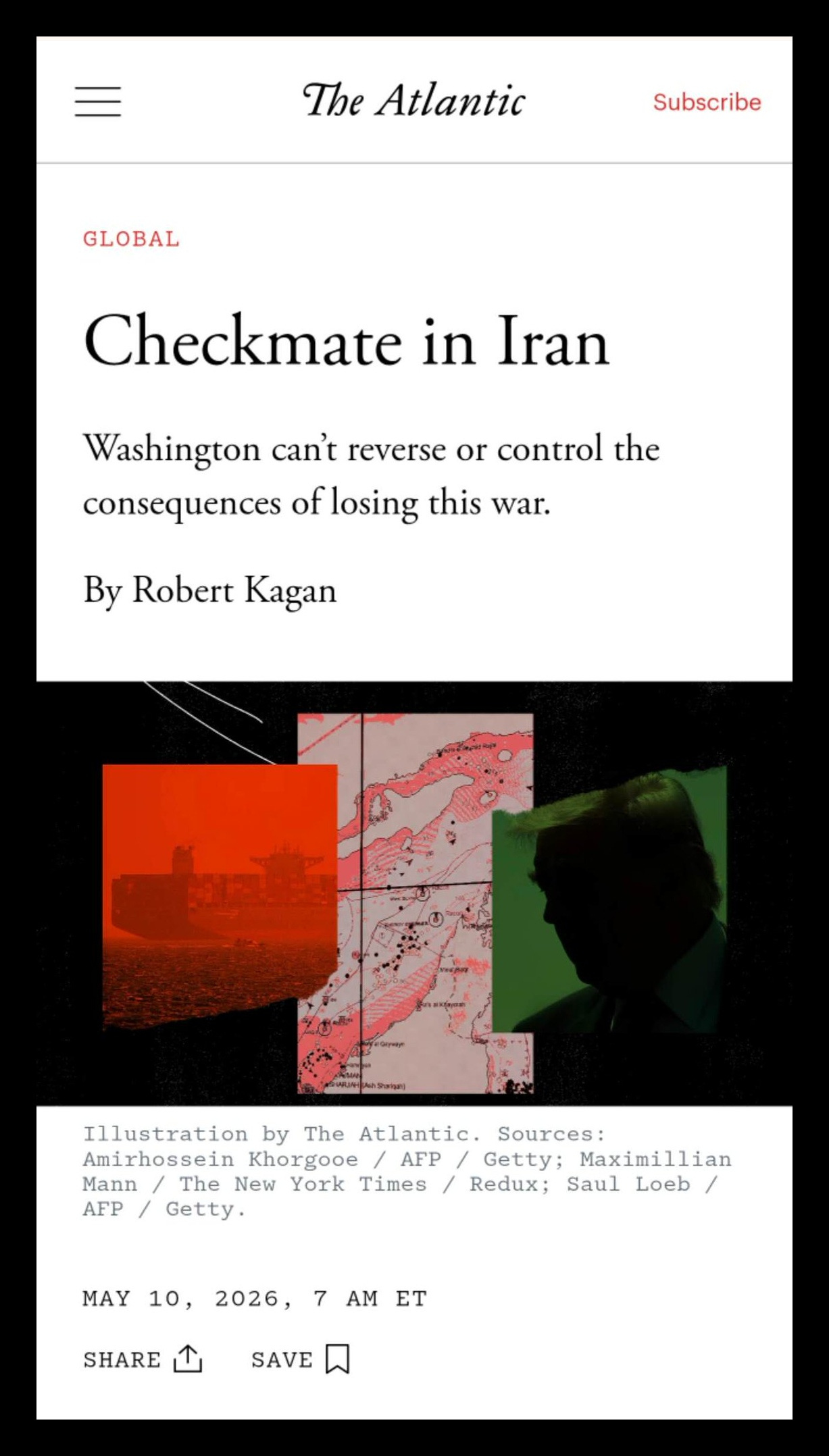
(The Atlantic link: Checkmate in Iran)
The admissions now appearing within establishment outlets suggest that sections of the American strategic class increasingly understand that this assumption no longer corresponds to material reality.
Culver’s comments regarding Taiwan represent the clearest articulation of this shift. His statement that Pentagon planning may involve withdrawing high-value naval assets from the theatre before hostilities even begin constitutes a profound strategic admission. During the unipolar era the United States Navy functioned as the central instrument of American coercive diplomacy precisely because aircraft carrier strike groups symbolised unrestricted forward projection of power. Carrier deployments served both military and psychological functions. They demonstrated escalation credibility while reassuring allies that American military superiority remained unquestionable.
Culver’s remarks imply that the carrier system itself may now represent vulnerability rather than dominance within the Western Pacific battlespace. China’s anti-ship missile systems, reconnaissance networks, industrial scale, and regional proximity have apparently transformed the strategic geometry of the Pacific. The issue extends beyond simple military parity. Culver explicitly argues that there are effectively no safe spaces for forward American deployment within operational range of Taiwan. Guam no longer appears secure. Japanese bases remain vulnerable. South Korean infrastructure may be targeted. Australian facilities remain within strike calculations. Carrier groups themselves can be continuously tracked.
Such admissions carry implications extending far beyond Taiwan itself because the entire architecture of American alliance credibility depends upon confidence in forward military survivability. Once allies begin questioning whether the United States can maintain operational superiority near China’s coastline, the political foundations of the Indo-Pacific containment system begin weakening simultaneously.
The broader significance becomes clearer when viewed alongside the April 2026 Senate Armed Services Committee hearing on Indo-Pacific Command posture. The hearing exposed with unusual clarity the strategic continuity underlying multiple American administrations regardless of electoral rhetoric. Senators and military officials repeatedly framed China not as a conventional competitor but as the central systemic challenge to American global dominance across military, technological, industrial, maritime, financial, and logistical domains simultaneously.
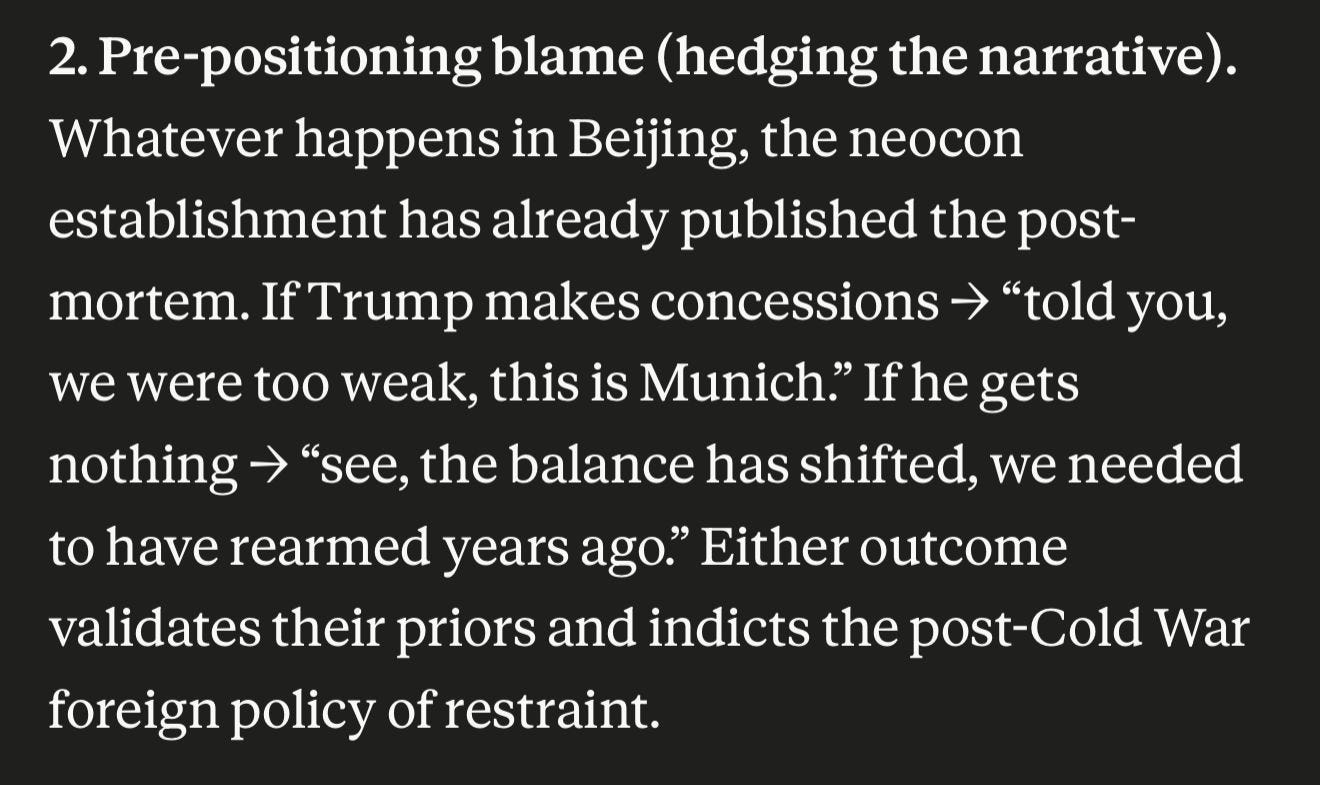
The hearing revealed several strategic priorities operating beneath public political discourse. American planners seek expanded access to Southeast Asian infrastructure, greater military integration with Japan and South Korea, deeper basing relationships across the Pacific islands, enhanced maritime interdiction capabilities, and increasingly aggressive control over strategic chokepoints such as the Strait of Malacca. Public language surrounding “regional stability” and “deterrence” often concealed a far broader strategic objective: preventing Eurasian integration under Chinese industrial leadership.
The confrontation with Iran therefore cannot be separated from the Pacific theatre because both conflicts emerge from the same grand strategic logic. American pressure against Iran was never solely about Iran itself. Iran occupies one of the most strategically important positions within Eurasia, connecting the Persian Gulf, Central Asia, the Caucasus, the Caspian Basin, the Indian Ocean, and western Chinese trade corridors. A stable Iran integrated with Russia and China undermines the maritime containment architecture historically favoured by Anglo-American strategy.
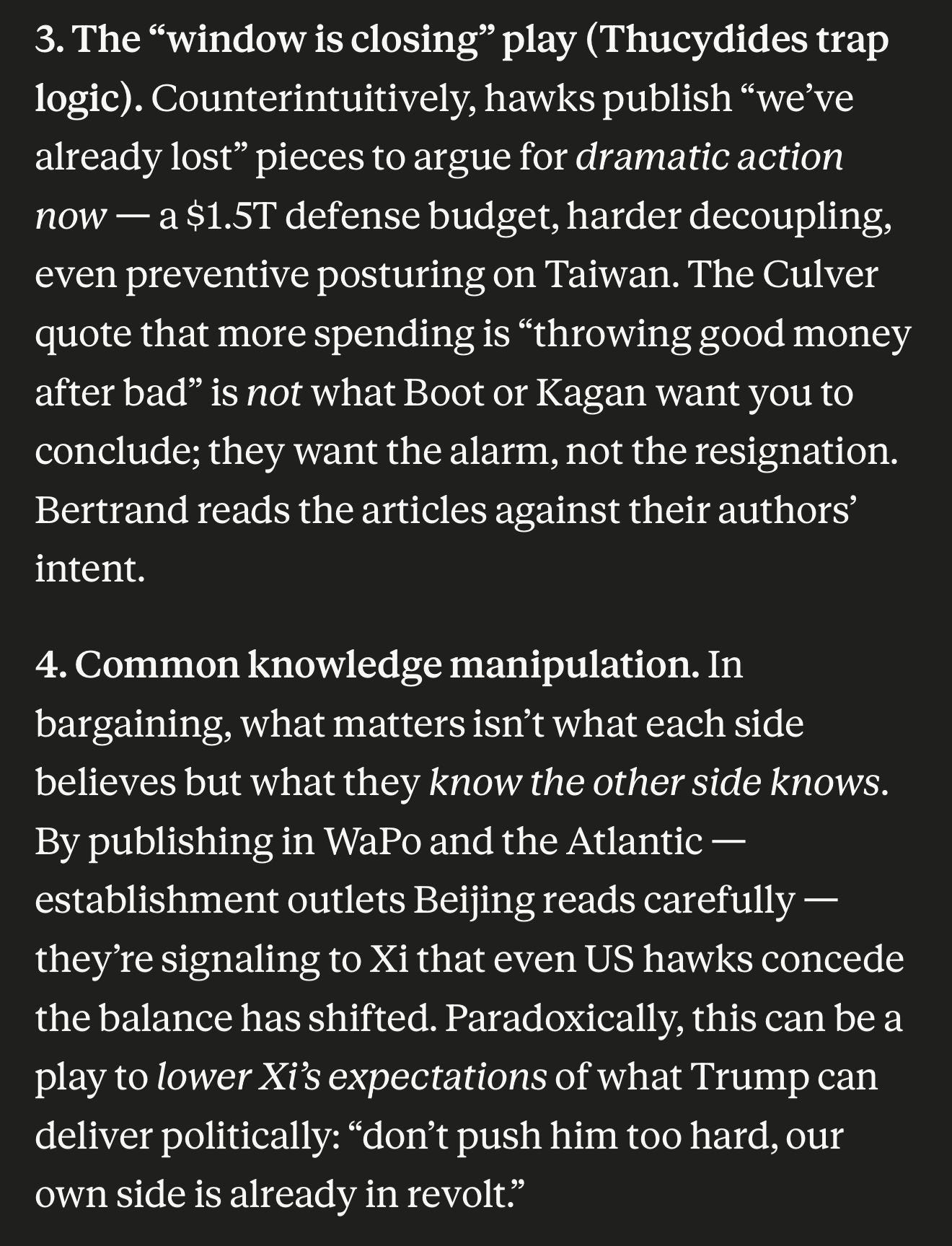
The Senate hearing repeatedly demonstrated that energy flows remain central to American strategic calculations. References to maritime interdiction, supply chain resilience, fuel security, regional basing, and logistics corridors all pointed toward a larger effort to preserve leverage over Asian industrial systems dependent upon imported energy. Several analysts associated with the hearing openly discussed the strategic utility of threatening Chinese energy imports through maritime chokepoints. Hormuz and Malacca therefore emerge as interconnected theatres within the same geopolitical design.
The Iran confrontation appears to have exposed severe weaknesses within this strategy. Kagan’s article effectively acknowledged that Washington could neither decisively defeat Iran nor restore the previous regional balance without unacceptable cost. Reports regarding depleted missile inventories, damaged regional infrastructure, operational vulnerabilities, and compromised naval freedom of movement suggested that American coercive capacity may no longer guarantee desired political outcomes even against states lacking conventional parity with the United States military.
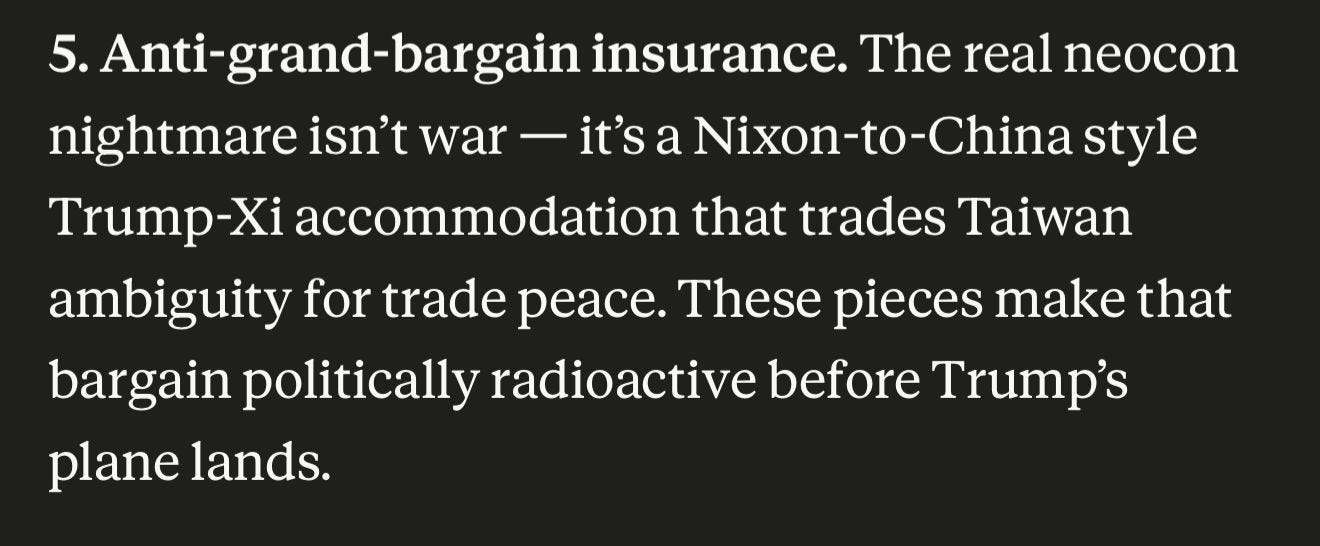
Culver’s analysis extends this logic dramatically further. If Iran exposed weaknesses in American escalation management within West Asia, then China appears capable of fundamentally overturning the entire military balance within the Pacific itself.
The industrial dimension of Culver’s remarks may ultimately prove even more important than the operational details. He repeatedly emphasises production capacity rather than technological spectacle. One Chinese shipyard allegedly possessing greater productive capacity than all American shipyards combined represents more than an embarrassing statistic. Industrial scale determines strategic sustainability during prolonged conflict. Modern warfare consumes munitions, electronics, fuel systems, replacement platforms, and logistical infrastructure at extraordinary rates. The side capable of replenishing losses faster generally acquires long-term advantage regardless of initial tactical outcomes.
American military planning after the Cold War increasingly prioritised precision systems, financialisation, contractor dependency, and technological sophistication while simultaneously presiding over large-scale deindustrialisation. China pursued the opposite trajectory. Beijing combined state-directed industrial expansion with infrastructure integration, maritime manufacturing dominance, electronics production, rare earth control, and logistical scaling across Eurasia.
The consequences now appear visible. Culver openly questions whether increased American defence expenditure can reverse structural decline because the issue no longer concerns budgetary totals alone. American defence spending remains enormous by historical standards. The deeper issue concerns industrial conversion capacity, supply chain resilience, manufacturing throughput, shipbuilding capability, labour force structure, and logistical sustainability. Money alone cannot instantly recreate industrial ecosystems dismantled across decades of financial globalisation.
The contradiction embedded within contemporary American strategy therefore becomes increasingly obvious. Washington seeks simultaneously to contain China while remaining economically dependent upon Chinese manufacturing systems. The United States attempts to preserve maritime supremacy while lacking equivalent shipbuilding capacity. It attempts to sustain alliance networks while exposing allied territories to potential devastation. It seeks technological leadership while confronting supply chain vulnerabilities across semiconductors, rare earths, industrial components, and energy systems.
Culver’s comments regarding Taiwan reveal another uncomfortable reality frequently obscured within public discourse. Chinese strategy appears considerably more patient and structurally grounded than many Western narratives acknowledge. Much media analysis presents Beijing as preparing imminent invasion because sensationalism benefits both defence budgets and political mobilisation. Culver instead suggests that Chinese leadership may view time itself as strategically advantageous.
That assessment aligns with broader structural trends. China’s industrial output continues expanding relative to the United States. Eurasian trade integration continues deepening through infrastructure corridors, energy agreements, and regional financial arrangements. The Belt and Road Initiative, despite setbacks and criticism, still reflects a continental strategy fundamentally different from maritime coercion. Demographic pressures, fiscal constraints, political fragmentation, and industrial erosion continue affecting much of the Western alliance system simultaneously.
Under such conditions, immediate military escalation may appear strategically unnecessary from Beijing’s perspective. Taiwan’s political position becomes increasingly complicated if Washington itself gradually doubts the viability of military intervention. Culver’s remark regarding future American reluctance to fight for Taiwan may represent the single most consequential statement within the entire interview because deterrence collapses once security guarantees lose credibility.
The broader geopolitical consequences extend well beyond East Asia. Russia benefits significantly from any deterioration in American strategic credibility because the Ukraine war already exposed many of the same industrial and logistical weaknesses now discussed regarding China. Western stockpile depletion, ammunition shortages, production bottlenecks, alliance fatigue, and fiscal strain became increasingly visible throughout the Ukraine conflict. Russian planners likely interpret the Iran and Pacific developments as confirmation that American power projection faces severe structural limits across multiple theatres simultaneously.
The implications for Europe remain severe. European states aligned themselves closely with Washington’s confrontation strategies against both Russia and China while simultaneously sacrificing significant economic flexibility, energy security, and industrial competitiveness. German manufacturing suffered heavily following the rupture of energy integration with Russia. Rising military expenditure across Europe increasingly coincides with stagnant growth, political fragmentation, social unrest, and industrial relocation toward cheaper energy markets elsewhere.
American strategy appears increasingly contradictory even from the perspective of its own allies. European governments are encouraged to decouple from Russian energy, reduce Chinese technological dependence, increase military spending, support Ukraine indefinitely, and align with Indo-Pacific containment policies while facing worsening economic conditions domestically. Meanwhile, the United States itself struggles to maintain industrial readiness against peer competitors despite vastly greater defence expenditure than any rival state.
The ideological significance of these admissions should not be underestimated. Kagan and Boot never belonged to anti-imperialist traditions. Both spent decades defending American interventionism as morally necessary and strategically sustainable. Their current pessimism therefore reflects something more serious than ordinary policy disagreement. Sections of the American establishment increasingly appear to recognise that the unipolar era has ended materially even if institutional rhetoric has not yet fully adjusted psychologically.
Such transitions historically produce dangerous behaviour from declining powers attempting to preserve strategic primacy despite worsening structural realities. Culver himself notes that Chinese leaders increasingly perceive the United States as a declining hegemon becoming more aggressive precisely because its dominance is weakening. Historical parallels become difficult to ignore. Britain before the First World War confronted rising German industrial competition. Imperial Japan reacted violently to perceived encirclement and resource vulnerability. Late Soviet leadership oscillated between reform, retrenchment, and coercive assertion during periods of systemic decline.
The risk today emerges from the combination of military overstretch, economic fragmentation, alliance obligations, domestic political instability, and declining strategic confidence occurring simultaneously across the Atlantic system.
The confrontation with Iran already demonstrated how quickly regional conflict can disrupt global energy circulation, insurance systems, maritime traffic, and military inventories. A Pacific confrontation would carry consequences many times larger because the Western Pacific constitutes the productive core of the global industrial economy. Taiwan alone dominates advanced semiconductor production. South Korea and Japan remain central to electronics, shipping, automotive systems, and industrial components. China itself functions as the manufacturing centre of the world economy.
Culver’s observations regarding blockade dynamics deserve particular attention because they reveal how modern warfare increasingly targets economic systems directly rather than merely military formations. Disrupting shipping insurance, port handling infrastructure, logistics corridors, semiconductor production, and maritime confidence can generate immense geopolitical pressure without requiring full-scale territorial conquest. China’s strategic advantage derives partly from geography itself. The Pacific theatre operates under what Culver calls the tyranny of time and distance. American logistics must traverse enormous maritime spaces while Chinese systems operate closer to industrial and military support networks.
The contrast with the post-Cold War period could hardly be sharper. During the 1991 Gulf War American forces operated against an isolated regional military lacking peer industrial support, sophisticated anti-access systems, modern reconnaissance integration, or continental strategic depth. Contemporary Eurasian powers increasingly possess all four simultaneously.
The growing convergence between Russia, China, and Iran therefore represents the central strategic challenge confronting Washington. American planners long sought to prevent exactly such alignment because Eurasian integration threatens maritime hegemonic systems historically dependent upon controlling trade routes, energy circulation, and financial networks from offshore positions. Sanctions against Russia accelerated Moscow’s pivot toward Asia. Pressure against Iran deepened Iranian integration with both Beijing and Moscow. Technology restrictions against China encouraged indigenous industrial substitution and alternative financial mechanisms.
Each coercive measure intended to preserve unipolar dominance appears increasingly to accelerate the formation of parallel systems outside American control.
The decline of uncontested primacy does not imply immediate American collapse. The United States retains enormous military, technological, financial, agricultural, and institutional advantages. American universities, corporations, intelligence agencies, research sectors, energy production, and alliance systems remain formidable. Yet the strategic environment increasingly resembles competitive multipolarity rather than unchallenged unipolar supremacy.
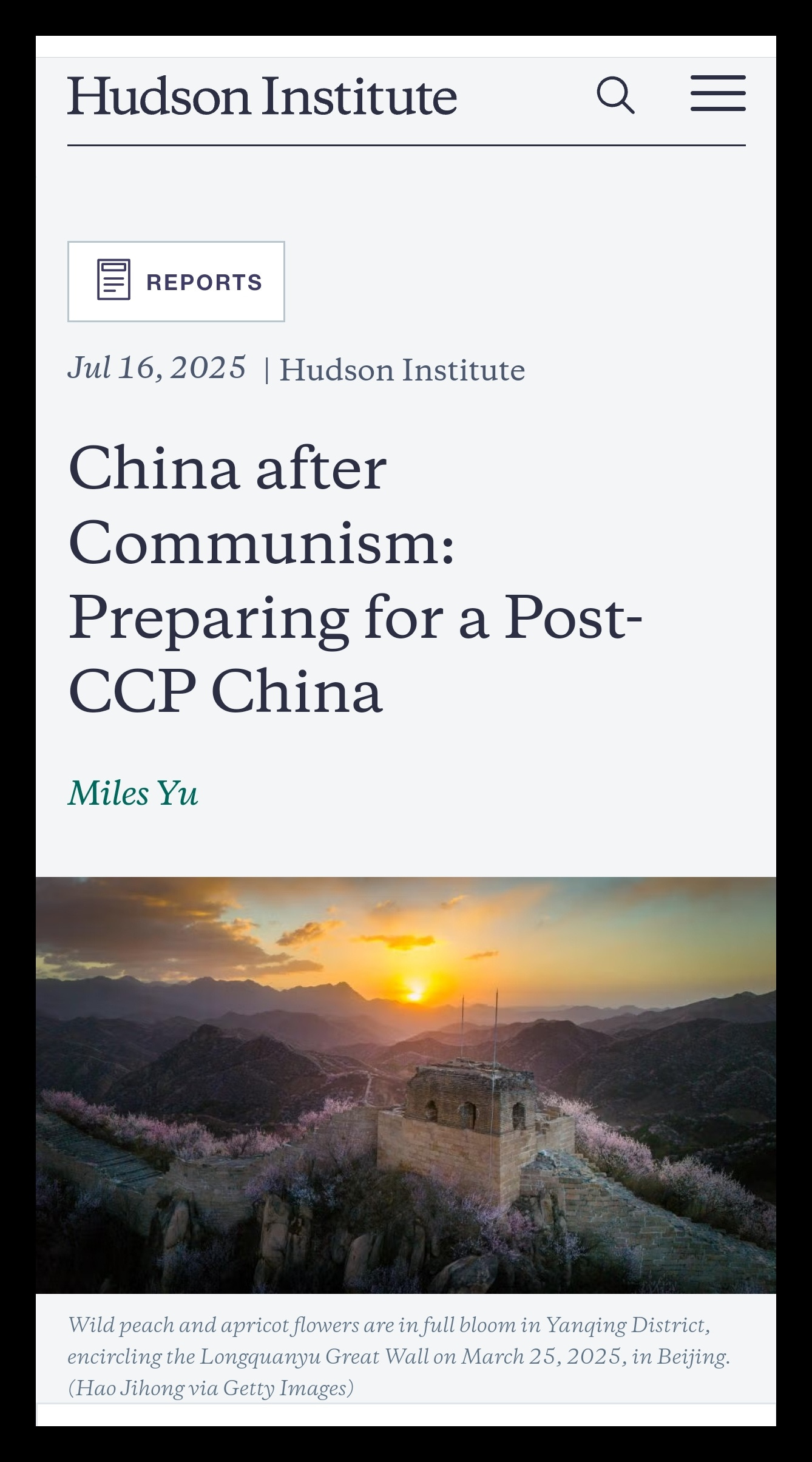
(Except from article: “With chapters written by experts in military affairs, intelligence, economics, human rights, transitional justice, and constitutional governance, this report examines the initial steps that should be taken in the immediate aftermath of the CCP regime’s collapse and the long-term trajectory China might take after a stabilization period.”)
Washington’s problem begins with the fact that its ruling assumptions were shaped for a world which no longer exists. Large sections of the American political establishment still speak and behave as though the unipolar moment never ended, even while the material foundations supporting that dominance steadily weaken. Defence spending rises year after year, yet production constraints, depleted stockpiles, and industrial shortfalls grow more visible across every major theatre. Alliance networks continue expanding geographically, although many of those same allies now sit exposed to increasingly serious military risks. Sanctions remain the preferred instrument of coercion, but parallel financial systems and alternative settlement mechanisms continue developing outside American control. Overseas deployments stretch further across the globe at the precise moment domestic patience for open-ended confrontation appears thinner than at any period since the Iraq and Afghanistan wars.
The Boot and Culver interview therefore matters because it reveals an emerging awareness within establishment circles that the old assumptions no longer hold. Kagan effectively admitted that Iran could not be decisively subdued without unacceptable strategic consequences. Culver implies that China may already possess structural military advantages impossible to reverse quickly through spending increases alone.
Taken together, the message appears stark. The United States can still inflict enormous destruction globally, yet increasingly struggles to convert military power into stable political outcomes against determined and industrially capable adversaries integrated across Eurasia.
The most dangerous period in geopolitical history often emerges not during unquestioned dominance or settled equilibrium, but during transitions between systems when old assumptions remain politically influential despite changing material realities. The strategic class responsible for constructing the unipolar order now appears increasingly aware that the foundations supporting that order are eroding.
American military primacy is now being pronounced dead by the same establishment figures who spent thirty years building, defending, and expanding it across the world.
The striking part lies less in the conclusion itself than in the men arriving at it. Figures such as Robert Kagan and Max Boot built entire careers arguing that American power could shape the political order of Eurasia indefinitely through military superiority, alliance systems, and economic coercion. Their recent admissions carry weight precisely because they come from inside the imperial tradition rather than against it.
The obituary for American military primacy has not been written by anti-imperial dissidents operating outside the establishment. The obituary is being drafted by the architects of the system themselves. As former United States Secretary of State Henry Kissinger once remarked during another period of imperial strain, “No power on earth can permanently remain dominant.” The significance today rests in who is finally prepared to admit it.
Authored By: Global GeoPolitics
Thank you for visiting. This is a reader-supported publication. If you believe journalism should serve the public, not the powerful, and you’re in a position to help, becoming a PAID SUBSCRIBER truly makes a difference. Alternatively you can support by way of a cup of coffee:
https://buymeacoffee.com/ggtv |
https://ko-fi.com/globalgeopolitics |
Bitcoin:3NiK8BoRZnkwJSHZSekuXKFizGPopkE7ns
References
- The Atlantic – Robert Kagan: “Checkmate in Iran”
- The Washington Post – Max Boot interview with John Culver
- US Senate Armed Services Committee Hearing – Indo-Pacific Command Posture Review (April 21, 2026)
- US Senate Armed Services Committee YouTube Archive – Indo-Pacific Command Hearing
- The New York Times – “The Separation: Inside the Unravelling U.S.-Ukraine Partnership”
- US Department of Defense – Opening Remarks by Secretary Pete Hegseth at Ukraine Defense Contact Group
- Financial Times – Iranian Tankers Bypass US Blockade
- Reuters – How China Is Plugging Energy Supply Gaps Left by US-Iran Conflict
- Reuters – US Intercepts Iranian Oil Tankers in Asian Waters
- Politico – “5 Charts Show China’s Oil Dilemma After US Strikes”
- The Diplomat – Indonesia and the Future of Regional Energy Security
- Brookings Institution – “Which Path to Persia?”
- RAND Corporation – “Extending Russia”
- US Naval Institute Proceedings – “Tighten the Belt and Cut the Roads”
- The Guardian – “The Great Energy Pivot”
- CNN – China Preparing Weapons Shipment to Iran Amid Fragile Ceasefire
- Newsweek – JD Vance Floats Iran Blockade Proposal
- Geopolitical Economy Report – Oil War and the Petrodollar System
- US Office of the Historian – Courses of Action in Vietnam (1965)
- US Office of the Historian – The Philippine-American War, 1899–1902


Leave a comment