
How Washington’s pursuit of maritime dominance, from the Persian Gulf to Southeast Asia, is reshaping the geopolitical fate of the world’s fourth most populous nation and why Jakarta’s modest gestures of independence have already attracted familiar consequences
Editorial Analysis | 16 June 2026
The American and Israeli strikes on Iran, launched on 28 February 2026, produced consequences that extended well beyond the Persian Gulf. By disrupting transit through the Strait of Hormuz, they elevated every remaining maritime chokepoint in the global trading system into a subject of acute strategic interest. The most consequential of those remaining corridors is the Strait of Malacca. Compressed at its narrowest point, the Phillips Channel, to a width of 2.8 kilometres, the strait handles approximately 75 to 80 percent of China’s imported crude oil, along with roughly a quarter of global seaborne trade measured by volume. China’s dependence on this passage is not incidental. Between 2000 and 2025, Chinese oil consumption quadrupled from 3.5 million barrels per day to over 15 million barrels per day, and the overwhelming majority of that supply arrives through Malacca from the Middle East and Africa. Rerouting through the Lombok or Sunda Straits adds between 1,000 and 1,500 nautical miles and up to 15 days of transit delay to individual voyages, a cost the Chinese economy can absorb temporarily but cannot sustain as normal operating practice.
The geopolitical significance of this dependency is not a recent discovery in Washington. American strategic literature has discussed what it terms the “Malacca Dilemma”, China’s structural vulnerability to maritime interdiction, for well over two decades. The question after Hormuz is not whether this vulnerability exists but how actively Washington intends to exploit it, and whether the Major Defense Cooperation Partnership formalised between the United States and Indonesia at the Pentagon on 13 April 2026 represents one step toward that exploitation. That agreement, signed by Indonesian Defence Minister Sjafrie Sjamsoeddin and United States Defence Secretary Pete Hegseth, establishes frameworks for military modernisation, joint training, and expanded exercises including Super Garuda Shield, in which American forces conducted the first live firing of the FIM-92 Stinger missile on Indonesian soil during the August 2025 iteration. On the same day as the signing, Jakarta confirmed that Washington and Jakarta were also negotiating a separate non-binding Letter of Intent that would extend blanket overflight access to American military aircraft through Indonesian airspace. The preliminary draft remained under internal discussion and legally non-binding, the Indonesian Defence Ministry stated, stressing that full sovereignty over national airspace would be preserved. Whether that preservation holds against sustained American pressure is a separate and more important question.
The context behind the airspace negotiations had been apparent since at least April 2026, when Indonesia’s Foreign Ministry sent an urgent and confidential letter to the Defence Ministry urging extreme caution before any final arrangement was concluded. The letter noted that American military aircraft had conducted surveillance operations over the South China Sea on at least eighteen occasions between January 2024 and April 2025, operations which constituted violations of Indonesian territorial waters and airspace that had received no adequate response from Washington despite repeated Indonesian objections. Granting blanket overflight permission, the Foreign Ministry argued, risked entangling Indonesia irreversibly in future South China Sea confrontations. Reports in April 2026 suggested that President Prabowo had verbally approved the proposal in principle during a bilateral meeting with President Donald Trump in Washington in February, though Jakarta’s official position emphasised that nothing had been finalised or rendered legally operative. The ambiguity itself is informative. Prabowo is attempting to satisfy multiple competing pressures simultaneously, maintaining American goodwill while preserving sufficient operational independence to keep options open with Beijing, Moscow, and other capitals where he has cultivated ties.
Prabowo met Vladimir Putin in April 2026 to discuss oil supply arrangements, flew to Paris the following day to meet Emmanuel Macron, and has maintained Indonesia’s historic non-aligned posture while contributing the largest national contingent of troops to Trump’s proposed Gaza stabilisation force. On Pancasila Day on 2 June 2025, he addressed the nation with a warning that any outside analyst following Indonesian affairs would immediately recognise as directed at Washington’s civil society infrastructure. “We must not be played by any nation,” he told the assembled ceremony at the Foreign Ministry’s Pancasila Building in Jakarta. Foreign nations, he said, remained actively provoking Indonesia, adding that the long history of colonialism and external interference demonstrated systematic patterns of division-sowing from outside. Without naming specific organisations, he described foreign-funded non-governmental bodies that claimed to promote democracy as operating in practice as instruments for division and soft-power manipulation. The reference to the National Endowment for Democracy and associated structures was widely understood in Jakarta’s political circles even without explicit naming.
The National Endowment for Democracy was established in 1983 under President Ronald Reagan with the explicit purpose of advancing what Washington termed democratic movements abroad. Its annual congressional appropriation reached $315 million in February 2026, distributed across more than 2,000 grants to non-governmental organisations in over 100 countries. Indonesia appears by name on the NED’s active grant territory listing alongside China, Iran, Venezuela, Russia, Myanmar, and other countries that have been targets of American policy pressure. The organisation describes itself as a non-governmental body committed to democratic values, but its board composition, its funding mechanism through direct congressional appropriation, its coordination with State Department programming objectives, and its pattern of geographic concentration in countries experiencing tensions with Washington all invite scrutiny that NED’s self-description cannot resolve. William Blum, Allen Weinstein, one of NED’s founders, and others have described its function in terms that diverge markedly from the organisation’s own institutional language. Weinstein told the Washington Post in 1991 that NED was doing openly what the CIA had previously done covertly. The operational model has not fundamentally changed in the intervening decades.
NED has been formally expelled from Russia, Venezuela, mainland China, Hong Kong, Egypt, and other jurisdictions on the grounds that its grant-making constituted foreign interference in domestic political affairs. In each case, the pattern involved a period of grant accumulation to civil society organisations, training programmes for activists and journalists, coordination with sympathetic media outlets, and the eventual emergence of street mobilisation that the domestic authorities traced to externally funded networks. Whether that pattern applies in Indonesia requires examining what is actually known about NED’s and associated organisations’ activities there, rather than accepting either the Indonesian government’s characterisations or the NED’s own denials at face value.
Internews, a Washington-based non-profit funded primarily through USAID contracts and historically through NED grants, has operated in Indonesia for decades. Its flagship programme, the Media Empowerment for Democratic Integrity and Accountability project, known by the acronym MEDIA, funds seven implementing partner organisations working across investigative journalism, public-interest media sustainability, and civil society accountability operations. The programme is explicitly framed around democratic governance objectives aligned with USAID priorities. In June 2026, a joint media probe conducted by Tempo magazine, Kompas.com, Suara.com, Tribunnews.com, and the social media monitoring platform Drone Emprit, conducted under a European Union-backed media development programme run by Internews, claimed to have identified foreign information manipulation campaigns during the August and September 2025 protests. The probe concluded that pro-Russian and pro-Chinese actors had promoted the characterisation of those protests as a foreign-backed colour revolution operation. The Jakarta Post reported the study’s finding that no evidence had been found linking George Soros’s Open Society Foundations to the organisation or funding of the 2025 protests.
The analytical problem with this investigation is not whether its specific factual claims are accurate. The problem is that the probe itself — conducted to investigate allegations of western interference in Indonesia — was funded by western institutions, coordinated by Internews, and published through outlets with documented USAID-connected funding relationships. Tempo in particular was named by the analyst Brian Berletic and the journalist Angelo Giuliano as having published a hit piece accusing both of them, along with Nile Bowie, of being Russian or Chinese agents on the basis that they had reported western political organisations including NED and Internews as active in Indonesia. The Tempo investigation’s evidence for those accusations amounted to the claim that the reporting was false. Yet the investigation discrediting those reporters was produced through exactly the funding network those reporters had identified. The circularity of that evidentiary structure is not a small methodological concern. It is the central concern.
This pattern, in which western-funded media outlets in target countries attack the credibility of journalists who document western funding networks, has been observed across multiple theatres over several decades. In Hong Kong ahead of 2019, in Ukraine ahead of 2014, in Venezuela during the Chavez and Maduro governments, and in various colour revolution sequences across Eastern Europe and Central Asia, a recognisable infrastructure preceded major civil unrest: NED and allied organisation grants to civil society groups, USAID media development funding, internet platform algorithm alignment with opposition narratives, and eventual street mobilisation anchored on genuine domestic grievances but organised and amplified through externally funded logistics. Whether the August and September 2025 protests in Indonesia fit this template fully, partially, or not at all cannot be definitively established without access to financial records that are not publicly available in granular form. However, the geographic and temporal correlation between NED’s active Indonesian programming and the emergence of sustained civil unrest coinciding with Jakarta’s foreign policy independence signals warrant serious analytical attention rather than institutional dismissal.
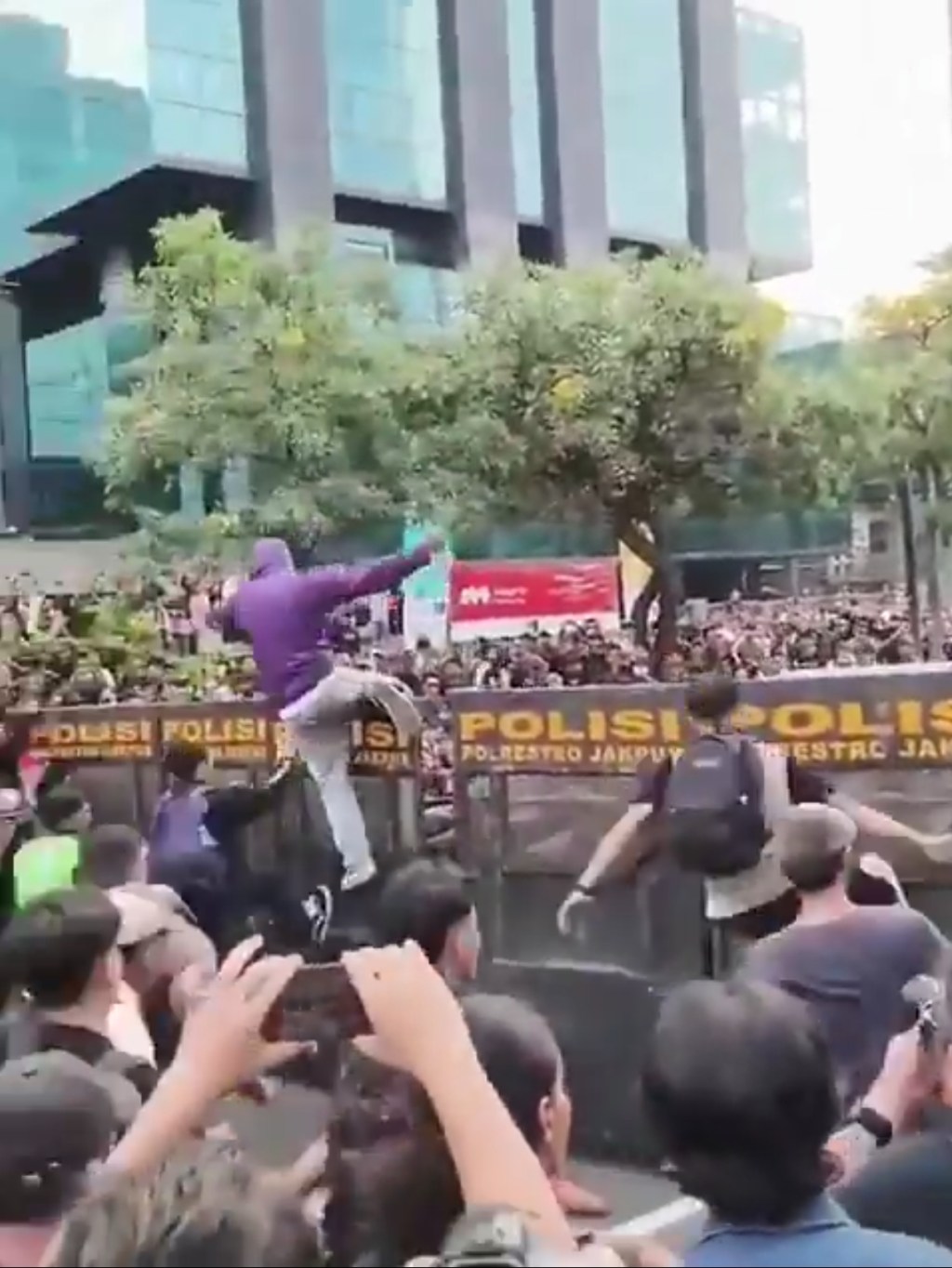
The domestic grievances underlying the 2025 protests in Indonesia were real and substantial. In August 2025, Prabowo announced new salary and benefit increases for members of the Indonesian House of Representatives at a moment when mass unemployment, rising living costs, and economic inequality were generating widespread frustration. The killing of motorcycle taxi driver Affan Kurniawan by members of the Indonesian National Police during protests on 28 August 2025 transformed localised demonstrations into nationwide mobilisation. According to a September 2025 report by the Centre for Strategic and International Studies, the unrest resulted in at least ten deaths and twenty people reported missing, with government buildings torched across multiple cities and damage estimates reaching 55 billion rupiah, approximately $3.3 million at prevailing exchange rates. Prabowo characterised the violence as driven by rioters rather than protesters, describing what he called signs of unlawful acts tending toward treason and terrorism. Human Rights Watch’s 2026 World Report documented that security forces detained thousands of demonstrators while the military simultaneously conducted operations against a separatist insurgency in Papua. The compound pressures on the Prabowo government reflected both genuine popular anger at elite economic behaviour and the calculated escalation potential that external actors with regime change objectives exploit once domestic unrest reaches a certain threshold of visibility.
The protests have continued into 2026. In June of that year, approximately 1,500 students demonstrated in Jakarta outlining five demands focused on fuel and food prices, as the region absorbed the economic shock of doubled jet fuel costs following the Hormuz disruption. The Indonesian rupiah’s weakness against the dollar has increased the local cost of fuel imports while modestly benefitting overseas remittance recipients, producing an asymmetric economic impact across the population. Washington’s tariff policies under Trump, which analysts noted as undermining Prabowo’s economic growth projections, added further external pressure to the domestic fiscal position. These are the material conditions on which externally assisted civil unrest is historically constructed, not fabricated from whole cloth but amplified, sustained, and channelled through organisations that serve strategic objectives quite different from the welfare of the Indonesian people whose grievances they invoke.
Brian Berletic, writing and broadcasting from Bangkok, has described Washington’s objectives in the region with consistent analytical precision over several years. His formulation that the United States is engaged in “politically capturing Asian states along China’s periphery” and that Indonesia represents one of those targets identifies a strategic logic supported by the observable pattern of American relationships with Japan, South Korea, Taiwan, and the Philippines, all of which maintain defence arrangements with Washington that constrain their independent foreign policy capacity to varying degrees. Berletic’s further observation, posted to the platform X, that nations need to “secure their information space” and resist American social media platform algorithms determining what their populations see and think is an accurate description of a genuine problem. American technology platforms function as both commercial enterprises and instruments of information environment management, with moderation decisions, algorithmic amplification, and content visibility policies that consistently favour narratives aligned with American foreign policy objectives while suppressing or reducing the reach of contrary perspectives. The BBC and Reuters, both of which maintain significant Indonesian readership and institutional relationships, have historically declined to give prominent coverage to documented western political interference operations in countries subject to American pressure, a pattern consistent with the described information blackout that obscures the machinery from broader public view.
The fundamental question for Indonesia over the coming period is whether Jakarta possesses the institutional capacity, political will, and public information environment to resist the combined pressure of American strategic demands, externally funded civil society mobilisation, and a domestic media landscape significantly penetrated by western programme money. Prabowo’s balancing act, contributing troops to Washington’s Gaza board while meeting Putin, signing a Major Defense Cooperation Partnership while insisting on airspace sovereignty, praising American partnership while warning against foreign manipulation, may be sustainable for a period but carries the structural weakness of any position that attempts to satisfy mutually incompatible demands simultaneously. Washington’s track record in dealing with governments that pursue genuine non-alignment rather than managed accommodation suggests that the patience for Indonesian independent manoeuvring is limited. The appearance of civil unrest, as analysts of regime change architecture have consistently observed, is the preparatory stage of a process that has more severe phases available to it. Whether Indonesia, with its 280 million people, its command over the maritime approaches to Malacca, and its history of surviving colonial interference through multiple imperial iterations, has the coherent national consciousness and institutional depth to navigate what follows remains the central uncertainty of Southeast Asian geopolitics in 2026.
Authored By: Global GeoPolitics
If you prefer to make a one time donation in support of my work, you can do so by clicking any link below:
https://buymeacoffee.com/ggtv |
https://ko-fi.com/globalgeopolitics |
Bitcoin: 3NiK8BoRZnkwJSHZSekuXKFizGPopkE7ns
References
Defence Security Asia. “Strait of Malacca Under Pressure: US–Indonesia Defense Pact Sparks Fears of New Global Oil Chokepoint Crisis Targeting China.” Defence Security Asia, 1 May 2026. https://defencesecurityasia.com/en/malacca-strait-us-indonesia-defense-pact-china-energy-chokepoint-crisis/
Romaniuk, Scott N., László Csicsmann, and Amparo Pamela Fabe. “China and Maritime Chokepoints: Hormuz, Malacca, and Indo-Pacific Vulnerability.” The Diplomat, May 2026. https://thediplomat.com/2026/05/china-and-maritime-chokepoints-hormuz-malacca-and-indo-pacific-vulnerability/
Kpler Marine Analytics. “From Hormuz to Malacca: the Next Chokepoint Risk.” Kpler, 22 April 2026. https://www.kpler.com/blog/from-hormuz-to-malacca-the-next-chokepoint-risk
SOFX. “Indonesia Opens Airspace Negotiations With Pentagon Weeks After Prabowo Rejected Foreign Bases.” SOFX, 14 April 2026. https://www.sofx.com/indonesia-opens-airspace-negotiations-with-pentagon-weeks-after-prabowo-rejected-foreign-bases/
Bangkok Post. “Controversy in Indonesia over US Military Overflight Proposal.” Bangkok Post, 14 April 2026. https://www.bangkokpost.com/world/3236849/controversy-in-indonesia-over-us-military-overflight-proposal
Al Jazeera. “Indonesia, US Sign ‘Major’ Defence Cooperation Agreement.” Al Jazeera, 14 April 2026. https://www.aljazeera.com/news/2026/4/14/us-indonesia-sign-major-defence-cooperation-agreement
Australian Strategic Policy Institute. “Indonesia Shouldn’t Give Blanket Airspace Access to the US.” The Strategist, 15 April 2026. https://www.aspistrategist.org.au/indonesia-shouldnt-give-blanket-airspace-access-to-the-us/
Al Mayadeen. “Indonesia Chief Accuses Foreign-Backed NGOs of Fueling Division.” Aletho News, 2 June 2025. https://alethonews.com/2025/06/02/indonesia-chief-accuses-foreign-backed-ngos-of-fueling-division/
ANTARA News. “Do Not Reduce Pancasila to Mere Slogans: Prabowo.” ANTARA, 2 June 2025. https://en.antaranews.com/news/357441/do-not-reduce-pancasila-to-mere-slogans-prabowo
VOI Indonesia. “Speech On The Birthday Of Pancasila, Prabowo Reminds The Dangers Of Foreign Influence.” VOI, 2 June 2025. https://voi.id/en/news/486062
National Endowment for Democracy. 2025 Annual Report. NED, 2026. https://www.ned.org/national-endowment-for-democracy-2025-annual-report/
Global Research. “National Endowment for Democracy — NGO Funded by Taxpayers.” Global Research, 2 March 2026. https://www.globalresearch.ca/national-endowment-democracy-ngo-funding-taxpayers/5917494
CGTN. “Reality Behind ‘Democracy Promotion’: Three Questions About US National Endowment for Democracy.” CGTN, 18 April 2026. https://news.cgtn.com/news/2026-04-18/Reality-behind-democracy-promotion-Three-questions-about-US-NED-1MrNR48zFUA/p.html
Centre for Strategic and International Studies (CSIS). “Indonesia Protests Amid Economic Anxieties and Police Violence.” CSIS, September 2025. https://www.csis.org/analysis/indonesia-protests-amid-economic-anxieties-and-police-violence
Human Rights Watch. “Indonesia: Perks for Military, Lawmakers Spark Dissent, Protests.” Human Rights Watch World Report 2026, 4 February 2026. https://www.hrw.org/news/2026/02/04/indonesia-perks-for-military-lawmakers-spark-dissent-protests
Associated Press / PBS NewsHour. “What to Know About Indonesia’s Deadly Nationwide Unrest Over Lawmakers’ Perks.” PBS News, 1 September 2025. https://www.pbs.org/newshour/world/what-to-know-about-indonesias-deadly-nationwide-unrest-over-lawmakers-perks
Al Jazeera. “Indonesian Students Protest Government Policies Amid Economic Strain.” Al Jazeera, 12 June 2026. https://www.aljazeera.com/news/2026/6/12/indonesian-students-protest-govt-policies-amid-economic-strain
The Jakarta Post. “Media Probe Reveals Disinformation Behind ‘Foreign-Backed’ 2025 Protests.” The Jakarta Post, 4 June 2026. https://www.thejakartapost.com/indonesia/2026/06/04/media-probe-reveals-disinformation-behind-foreign-backed-2025-protests
Internews. “Internews Funding Helps Strengthen Capacity of Media Organizations in Indonesia.” Internews, 2022. https://internews.org/story/internews-funding-helps-strengthen-capacity-of-media-organizations-in-indonesia/
Mongabay. “’Without Us, No Scrutiny’: Indonesia’s Independent Media Count Cost of US Funding Cuts.” Mongabay, 16 June 2025. https://news.mongabay.com/2025/03/without-us-there-is-no-scrutiny-indonesias-independent-media-count-cost-of-us-funding-cuts/
Hermawan, Ary. “A Year of Protests: What 2025 Says About Indonesian Democracy.” Indonesia at Melbourne, University of Melbourne, 23 December 2025. https://indonesiaatmelbourne.unimelb.edu.au/a-year-of-protests-what-2025-says-about-indonesian-democracy/
Berletic, Brian. Post to X (formerly Twitter), June 2026.
Weinstein, Allen, quoted in Ignatius, David. “Openness Is the Secret of the NED.” Washington Post, 21 September 1991.
Modern Diplomacy. “The Malacca Dilemma: China’s Achilles’ Heel.” Modern Diplomacy, 8 July 2025. https://moderndiplomacy.eu/2025/07/08/the-malacca-dilemma-chinas-achilles-heel/
Global Geopolitics. “The Choke Point Doctrine.” Global Geopolitics, 13 May 2026. https://globalgeopolitics.co.uk/2026/05/13/the-choke-point-doctrine/


Leave a comment