
Why Beijing’s refusal to recognise American sanctions marks a structural shift in global financial power
A legal border moved across the international system when China’s Ministry of Commerce instructed domestic firms not to recognise, enforce, or comply with United States sanctions against five Chinese refineries. Financial globalisation relied upon a silent assumption that American secondary sanctions represented the final authority inside cross-border commerce. Beijing has now denied that assumption in formal legal language. A structure that endured through compliance, ambiguity, and commercial caution entered a new phase of confrontation. Decoupling is no longer confined to trade rhetoric or tariff disputes; it has evolved into a conflict between rival sovereign jurisdictions.
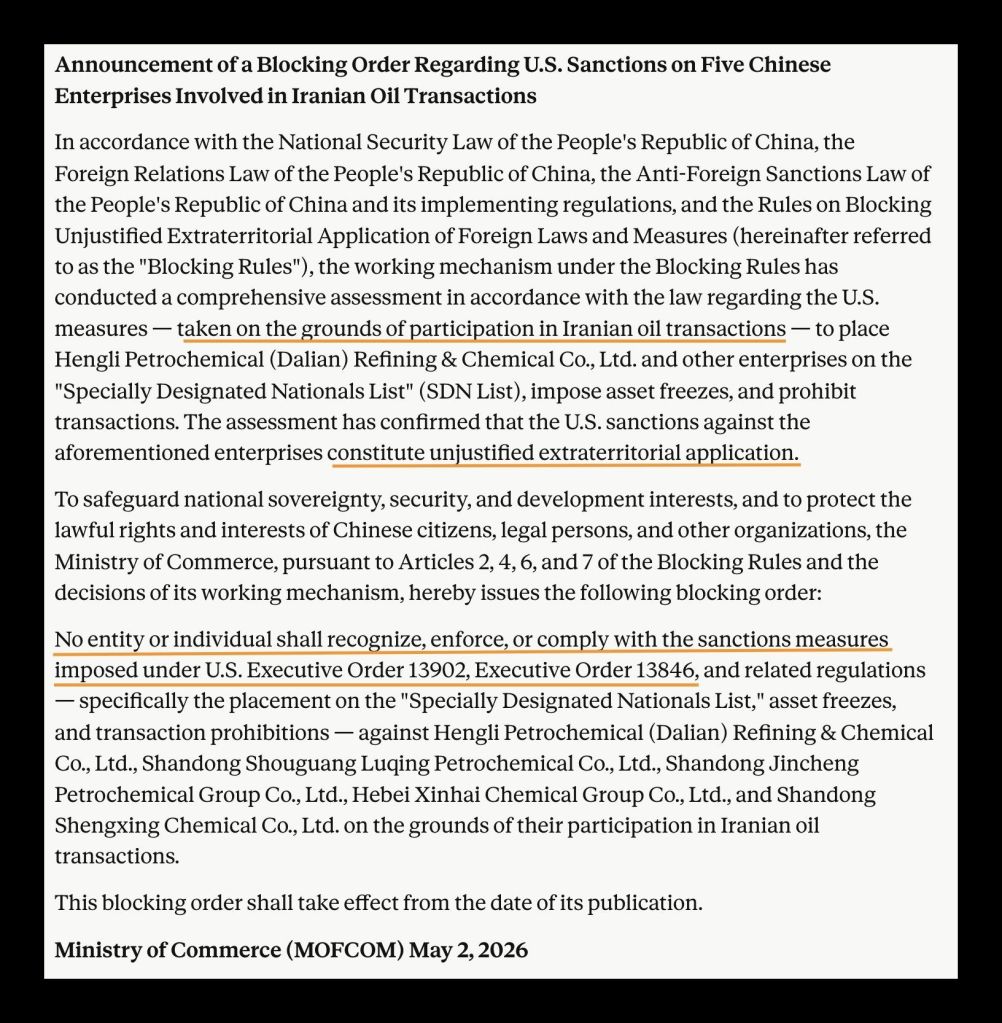
China’s prohibition order, issued on 2 May 2026 under its anti-foreign sanctions framework and blocking rules, declared that American measures against five refineries “shall not be recognised, enforced, or complied with.” The phrase carried unusual legal precision because it mirrored language embedded within China’s 2021 “Measures to Block the Improper Extraterritorial Application of Foreign Laws and Measures,” first promulgated by the Ministry of Commerce under Order No. 1 of 2021. Official wording therefore transformed an abstract legal mechanism into an operational directive. Beijing did not merely criticise sanctions. Beijing activated a dormant instrument of state power. The order applied to Hengli Petrochemical (Dalian) and four independent “teapot” refineries accused by Washington of purchasing Iranian crude. China justified the measure as a defence of sovereignty, development interests, and legal rights under domestic law. The Ministry of Commerce concluded that the sanctions constituted improper extraterritorial application of foreign rules. Official Chinese statements framed the sanctions as incompatible with international legal norms and outside United Nations authority (MOFCOM Announcement No. 21, 2 May 2026).
Magnitude matters because sanctions function through scale rather than symbolism. United States Treasury designations under Executive Orders 13846 and 13902 did not target marginal entities operating beyond industrial significance. Treasury statements identified Hengli Petrochemical (Dalian), Shandong Jincheng Petrochemical Group, Hebei Xinhai Chemical Group, Shouguang Luqing Petrochemical, and Shandong Shengxing Chemical as participants in transactions linked to Iranian crude imports. Treasury’s April notices framed these refiners as nodes supporting sanctions evasion networks, while Beijing framed the same activity as ordinary third-country commerce protected by sovereign jurisdiction. The distinction matters because both parties claim legal legitimacy rather than merely economic advantage. The United States did not sanction marginal actors. Hengli Petrochemical operates one of China’s largest refining complexes, processing roughly 400,000 barrels per day and linked to a Fortune Global 500 parent company. Washington escalated pressure beyond obscure shipping firms and shadow intermediaries toward an industrial node deeply integrated into Chinese energy security. Reuters reported that Chinese independent refiners account for approximately one quarter of national refining capacity, making sanctions against this segment economically meaningful rather than symbolic. American coercion therefore moved from peripheral disruption toward systemic interference inside China’s domestic energy architecture.
Timing defines the significance of the decision. Beijing did not invoke its blocking mechanism during earlier tariff wars, semiconductor restrictions, or financial blacklists. Chinese institutions often complied quietly with American sanctions despite lacking legal obligation to do so. Banks inside China restricted transactions involving sanctioned individuals, insurers avoided designated shipping networks, and commodity intermediaries adapted to dollar-based compliance culture. That tacit accommodation preserved commercial continuity. China benefited from open markets and accepted selective legal asymmetry as the cost of integration.
That period has ended. Chinese compliance with American sanctions had previously extended far beyond formal obligation. Financial institutions operating inside mainland China often adopted dollar-based compliance protocols because access to correspondent banking and settlement infrastructure outweighed domestic legal ambiguity. Arnaud Bertrand documented examples where sanctioned individuals, though unrestricted by Chinese law, faced refusal inside Chinese banks because institutions feared indirect exposure to American enforcement. Such accommodation reflected strategic restraint rather than legal necessity. The current order reverses that pattern through formal state instruction.
The shift emerged because Washington altered the coercive threshold. Treasury sanctions against Hengli Petrochemical formed part of a broader campaign described by American officials as intensified enforcement against Iranian oil flows. Treasury alerts warned banks and trading institutions worldwide that continued interaction with Chinese refiners importing Iranian crude carried sanctions risk. Such warnings transformed a bilateral dispute into a global compliance test. Banks operating in Singapore, Dubai, Hong Kong, and mainland China faced a familiar ultimatum: sever ties with sanctioned entities or risk exclusion from the dollar system. American sanctions historically succeeded because most institutions accepted this calculation.
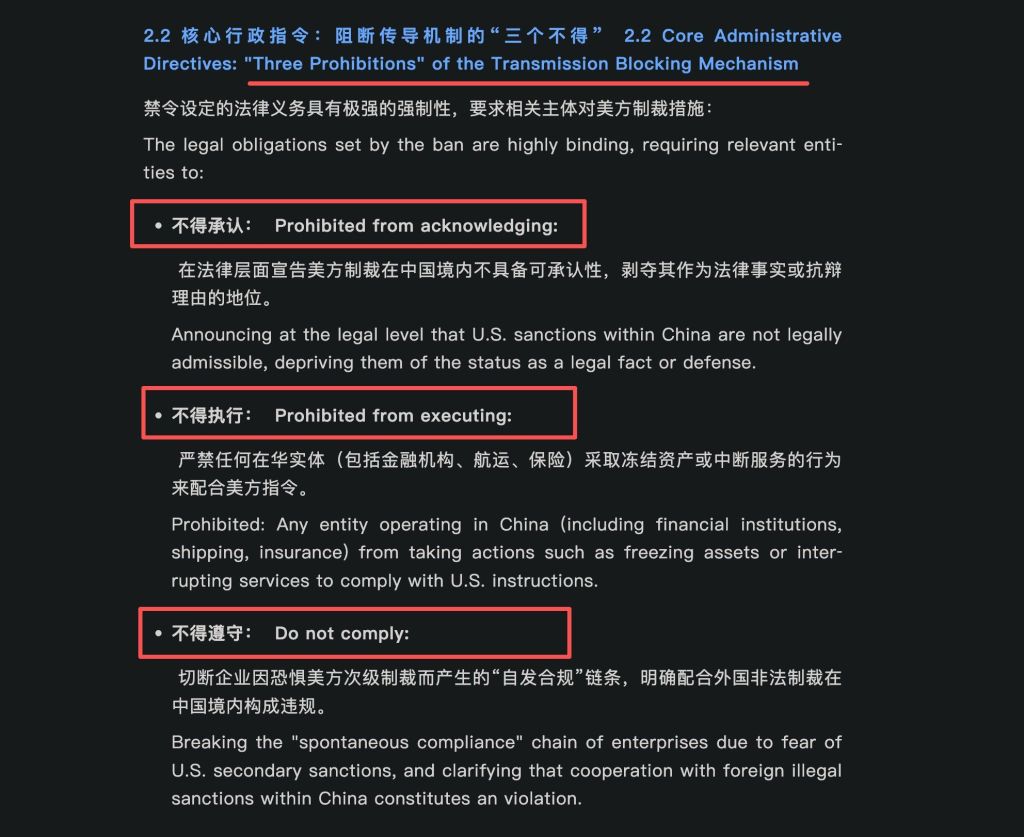
China’s response changed the game by reversing the cost structure. Compliance with Washington now risks violating Chinese law. The legal dilemma matters more than the immediate sanctions themselves. A multinational bank operating in China can no longer obey United States directives without exposure to Chinese penalties, lawsuits, or regulatory retaliation. China’s updated counter-extraterritorial regulations, strengthened through State Council decrees and anti-sanctions mechanisms since 2021, permit entities harmed by foreign sanctions compliance to seek legal remedy inside Chinese courts. The April 2026 revisions expanded enforcement authority and strengthened penalties against firms deemed to cooperate with improper foreign jurisdiction.
A line has hardened.
Energy sits at the centre of this confrontation because sanctions function through chokepoints. American maritime dominance, dollar clearing, insurance control, and correspondent banking created leverage over oil trade for decades. Iran’s export survival increasingly depends on Chinese demand. Analysts tracking tanker flows estimate that China purchases more than 80 per cent of Iranian crude exports through a mixture of direct imports, relabelled cargoes, and shadow fleet logistics. United States sanctions targeted this relationship because Iranian revenue remains dependent on energy exports. China defended it because energy resilience increasingly underpins national strategy.
Rail corridors, logistics diversification, and yuan settlement deepen this structural change. Freight connectivity between Xi’an and Tehran through Kazakhstan and Turkmenistan shortens overland delivery routes to approximately fifteen days, reducing exposure to maritime chokepoints vulnerable to interdiction pressure. The corridor carries importance beyond transport efficiency because overland trade reduces dependence on sea lanes dominated by Western naval surveillance. Pepe Escobar described the network as a sanctions-resistant logistics architecture rather than a simple Belt and Road extension. Whether exaggerated or not, the framing captures a strategic truth: infrastructure reshapes coercive geography. China has expanded overland trade routes connecting western China to Central Asia and Iran through the Belt and Road framework. Freight corridors linking Xi’an with Tehran shorten transit times while reducing exposure to maritime chokepoints vulnerable to naval interdiction. Such corridors matter because sanctions lose potency when transport routes shift beyond traditional maritime surveillance. The old geometry of coercion depended on shipping lanes dominated by Western naval infrastructure. Continental logistics weaken that monopoly.
Financial power rarely collapses through dramatic crisis. Erosion begins when participants discover alternatives. China’s effort to settle commodity transactions in yuan, expand Cross-Border Interbank Payment System infrastructure, and increase bilateral clearing arrangements with sanctioned states reduces dependency on dollar settlement at the margins. Those margins accumulate strategic significance over time. Parallel systems rarely defeat dominant structures immediately. They remove dependence gradually until coercion loses credibility.
Game theory clarifies why this confrontation pushes toward decoupling rather than compromise. The structure resembles a coercive coordination game between two players with incompatible legal obligations. Washington’s strategy depends upon universal compliance because sanctions lose force when major participants defect. Beijing’s strategy depends upon denying legal legitimacy to extraterritorial enforcement. Both actors possess asymmetric leverage. The United States controls reserve currency infrastructure and financial messaging networks. China controls market access, manufacturing capacity, commodity demand, and domestic legal jurisdiction over institutions operating within its borders.
Under previous equilibrium conditions, firms complied with American sanctions because the penalty for exclusion from dollar markets exceeded the cost of losing Chinese business. China tolerated this imbalance because integration delivered growth. That equilibrium no longer holds. Beijing has raised the cost of compliance with Washington. Firms now confront a dual-penalty system where obedience to one authority invites punishment from another. Such environments rarely stabilise through compromise because neutrality becomes impossible.
Realist theory predicts that rising powers reject asymmetric legal authority once material capability permits resistance. Liberal frameworks assumed institutions would moderate rivalry through interdependence. Financial coercion undermined that expectation because sanctions transformed interdependence into vulnerability. China’s blocking order therefore reflects a classical balance-of-power response rather than ideological confrontation. Sovereign actors resist dependence when dependence becomes coercive.
A long-standing doctrine reversed with this decision. China previously absorbed sanctions pressure through adaptation and informal workarounds. Quiet compliance allowed Beijing to avoid direct institutional conflict while preserving access to global finance. Formal prohibition represents a transition from accommodation to counter-coercion. American sanctions once functioned as rules others reluctantly followed. China has redefined them as contested claims of authority.
The Nexperia precedent offers an important comparison because it revealed China’s capacity to apply asymmetric leverage through regulatory mechanisms rather than direct confrontation. When geopolitical pressure intersected with semiconductor ownership disputes, Beijing demonstrated that access to industrial markets, licensing approvals, and legal permissions could become instruments of statecraft. Such cases matter because they reveal a wider doctrine: China rarely escalates symmetrically. Instead, it identifies leverage points where legal jurisdiction and market scale generate disproportionate pressure. The blocking statute follows the same logic. It avoids military escalation while weaponising legal asymmetry. China previously absorbed sanctions pressure through adaptation and informal workarounds. Quiet compliance allowed Beijing to avoid direct institutional conflict while preserving access to global finance. Formal prohibition represents a transition from accommodation to counter-coercion. American sanctions once functioned as rules others reluctantly followed. China has redefined them as contested claims of authority.
The implications extend beyond Iran or oil. Russia already operates under severe sanctions isolation. Gulf producers increasingly accept non-dollar settlement mechanisms. Countries across the Global South observe sanctions not as legal instruments but as tools of hierarchy. Beijing’s move offers an institutional model for states seeking protection from secondary sanctions. European governments possess blocking statutes of their own, though they remain weakly enforced. China demonstrated willingness to operationalise the concept.
The decisive escalation point concerns banking. Sanctioning Chinese refineries imposes manageable friction. Sanctioning major Chinese financial institutions would alter the architecture of global capital flows. Barack Obama warned during earlier debates that broad sanctions against Chinese banks risked weakening sanctions themselves because China remains deeply integrated into Treasury markets and cross-border liquidity. Treasury pressure works most effectively when targets remain isolated. China cannot be isolated without imposing collateral damage on the system enforcing the punishment.
That contradiction defines the next phase. American credibility requires enforcement. Chinese credibility requires defiance. Neither side can retreat without weakening strategic reputation.
A hard verdict emerges from this collision. The issue concerns neither Iranian oil volumes nor isolated refineries. The issue concerns whether one legal order governs global commerce or whether competing jurisdictions divide the system into rival spheres. Parallel compliance regimes force institutions to choose allegiance. Once that choice becomes mandatory, globalisation loses its universal character.
Financial empires decline when obedience becomes negotiable. China has not dismantled dollar hegemony. China has removed the assumption that dollar authority remains uncontested. The significance lies not in immediate rupture but in institutional precedent. Washington built sanctions power through decades of legal extension across foreign markets. Beijing has now built the first formal wall against that extension.
History rarely records the precise moment when integration becomes fragmentation. This order will stand among those moments. The era of passive compliance ended when China transformed resistance from informal evasion into state doctrine.
Authored By: Global GeoPolitics
Thank you for visiting. This is a reader-supported publication. If you believe journalism should serve the public, not the powerful, and you’re in a position to help, becoming a PAID SUBSCRIBER truly makes a difference. Alternatively you can support by way of a cup of coffee:
https://buymeacoffee.com/ggtv |
https://ko-fi.com/globalgeopolitics |
Bitcoin: 3NiK8BoRZnkwJSHZSekuXKFizGPopkE7ns


Leave a comment