
More than 140 drones intercepted on the forum’s final day; airport suspended; Zelensky’s open letter to Putin offers talks but promises more strikes if war continues
Ukraine launched one of its largest drone attacks on Russia’s second city in the early hours of Saturday, striking St. Petersburg as delegates prepared to depart the St. Petersburg International Economic Forum (SPIEF), the Kremlin’s flagship annual showcase for foreign investment and economic partnerships. Russian regional authorities said more than 140 aerial targets were intercepted before dawn, though no fatalities or major infrastructure damage were immediately confirmed from the closing-day raid.
Leningrad Region Governor Aleksandr Drozdenko announced the intercept figures on social media. An air alert was declared overnight and residents across St. Petersburg and the surrounding region were told to remain indoors. Pulkovo Airport suspended all operations, diverting aircraft and leaving dozens of flights delayed as thousands of forum guests found themselves stranded or rerouted.
“Ukraine is ready for a full ceasefire for the duration of the negotiations.”, President Volodymyr Zelensky, open letter to Vladimir Putin, 4 June 2026
Saturday’s strike was the second major Ukrainian drone assault to coincide directly with SPIEF 2026. On 3 June, the forum’s opening morning, a mass Ukrainian attack hit the city’s oil terminal near the Baltic coast and the Kronstadt naval base, home to Russia’s Baltic Fleet, sending columns of black smoke visible to the roughly 20,000 guests gathered for what is often called the ‘Russian Davos.’ St. Petersburg Governor Alexander Beglov confirmed casualties and infrastructure damage from that first wave. Russia’s Defence Ministry said its air defences intercepted 354 drones across at least fifteen regions and annexed Crimea overnight on 3 June alone.
The twin strikes, one on the opening day, one on the closing, bracketed an event designed to project Russian economic resilience and expanding ties with the Global South, BRICS partners, and Asian markets. This year’s forum theme, ‘Pragmatic Dialogue: the Path to a Stable Future,’ carried particular weight given the backdrop: columns of smoke drifting over the Neva River as foreign delegates arrived, and Pulkovo grounded again as they tried to leave.
The attacks carried a pointed political dimension that Kyiv made little effort to conceal. On 4 June, the day after the opening strikes, Ukrainian President Volodymyr Zelensky published a rare open letter addressed directly to Vladimir Putin, proposing a face-to-face meeting in a neutral country and offering a full ceasefire for the duration of any peace negotiations. The letter, released by the Office of the President of Ukraine, acknowledged and appeared to celebrate, the drone raids, stating that the absolute majority of Ukrainians viewed positively the fact that Ukrainian long-range drones had visited the opening of Putin’s forum after covering more than one thousand kilometres, and that this distance was not the limit of Ukraine’s capabilities.
The diplomatic offer and the military threat arrived in the same document. Zelensky called for both sides to set a clear date for direct talks, proposed an all-for-all prisoner exchange as an opening step, and insisted that both the United States and Europe should have a role in any eventual agreement. He ruled out meeting in Moscow, which the Kremlin had suggested as a venue. ‘Ukraine offers to end this war,’ he wrote. ‘We must do it honestly, with dignity, and guarantee that there will be no new outbreak of war.’ He warned that if Putin did not conclude that it was time to stop fighting, Ukraine would continue fighting for its existence.
KEY FIGURES AT A GLANCE
• 140+ drones intercepted over St. Petersburg and Leningrad Region on 7 June (closing day of SPIEF)
• 354 drones downed by Russian defences across 15+ regions on 3 June (opening day)
• 376 drones intercepted overnight 6–7 June across 16 regions, per Russia’s Defence Ministry
• 20,000 guests from 130+ countries attended SPIEF 2026
• Pulkovo Airport suspended twice, on 3 June and 7 June, with dozens of flights disrupted each time
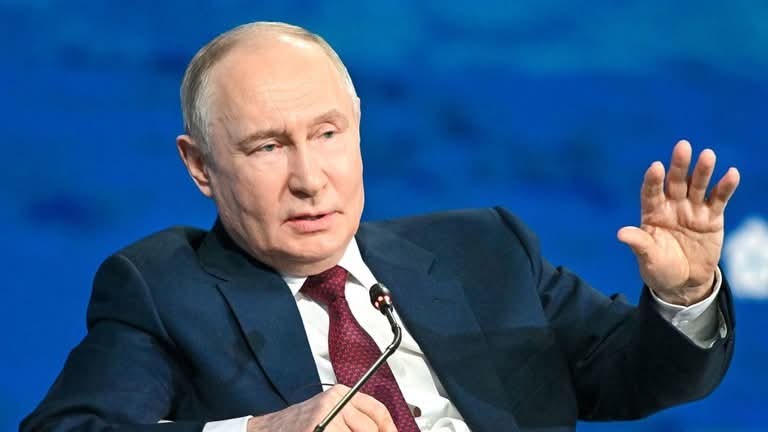
Putin responded publicly at SPIEF’s plenary session on Friday, delivering a 45-minute address followed by a two-hour question-and-answer session in which he addressed Zelensky’s letter directly. He said he saw no sense in a meeting at present, arguing that Zelensky’s own actions had rendered meaningful negotiations impossible. He described the tone of the letter as inappropriate and insolent. Russia remained open to talks, he said, but only if the root causes of the conflict were resolved, language Moscow uses consistently to mean Ukrainian territorial concessions and constraints on NATO enlargement.
The Kremlin’s formal response was delivered by spokesman Dmitry Peskov, who said Zelensky could meet Putin in Moscow ‘any time’, a counter-proposal Zelensky had preemptively ruled out in the letter itself. Putin also used the forum session to disclose that a Russian businessman had recently travelled to Kyiv at Ukrainian invitation for preliminary contact, only for the initiative to collapse after a Ukrainian strike killed students at a dormitory in Starobilsk. The disclosure was framed as evidence of Ukrainian bad faith while simultaneously confirming that informal channels between the two capitals remained active.
Putin conceded publicly that Russia’s air defence network required improvement, an unusual admission. ‘Russia has an air defense system. Yes, we must improve it. Yes, we must strengthen it. And we will do so,’ he told the plenary audience, a day after Ukrainian drones had reached his home city more than 900 kilometres from the front.
Russian officials have pressed a separate argument about Zelensky’s legal standing. His initial five-year presidential term expired in May 2024 without an election, which Ukrainian martial law prohibits during wartime. The Kremlin has repeatedly cited this to question whether Zelensky can conclude any binding agreement. Putin raised the issue again in St. Petersburg, saying the question of legitimacy required analysis. Zelensky’s office rejects the argument, and Zelensky has offered to hold elections or a referendum on any final peace deal once a full ceasefire is in place.
The broader military picture provides context for the diplomatic impasse. Ukraine recaptured more territory than it lost along the front line in May for the second consecutive month, according to an AFP analysis of Institute for the Study of War data, a sign that Russia’s operational tempo has slowed since late 2025. Months of United States-led mediation have produced no framework agreement, and both sides appear to calculate that continued military pressure serves their negotiating positions more effectively than restraint.
Ukraine’s choice to strike St. Petersburg during SPIEF, rather than limiting long-range operations to military targets in the east, reflects a deliberate strategy of imposing political costs on Russia’s international image and its efforts to attract foreign partners. The forum proceeded with its programme unaltered, but the symbolism of opening and closing under smoke from drones that had travelled more than a thousand kilometres cut sharply against the core message SPIEF was designed to project. Whether the combination of military pressure and diplomatic overture in Zelensky’s letter produces any movement toward negotiations or deepens the cycle of escalation further, remained unanswered as the last delegates left and Pulkovo’s runways reopened.
Authored By: Global GeoPolitics
If you prefer to make a one time donation in support of my work, you can do so by clicking any link below:
https://buymeacoffee.com/ggtv |
https://ko-fi.com/globalgeopolitics |
Bitcoin: 3NiK8BoRZnkwJSHZSekuXKFizGPopkE7ns


Leave a Reply