
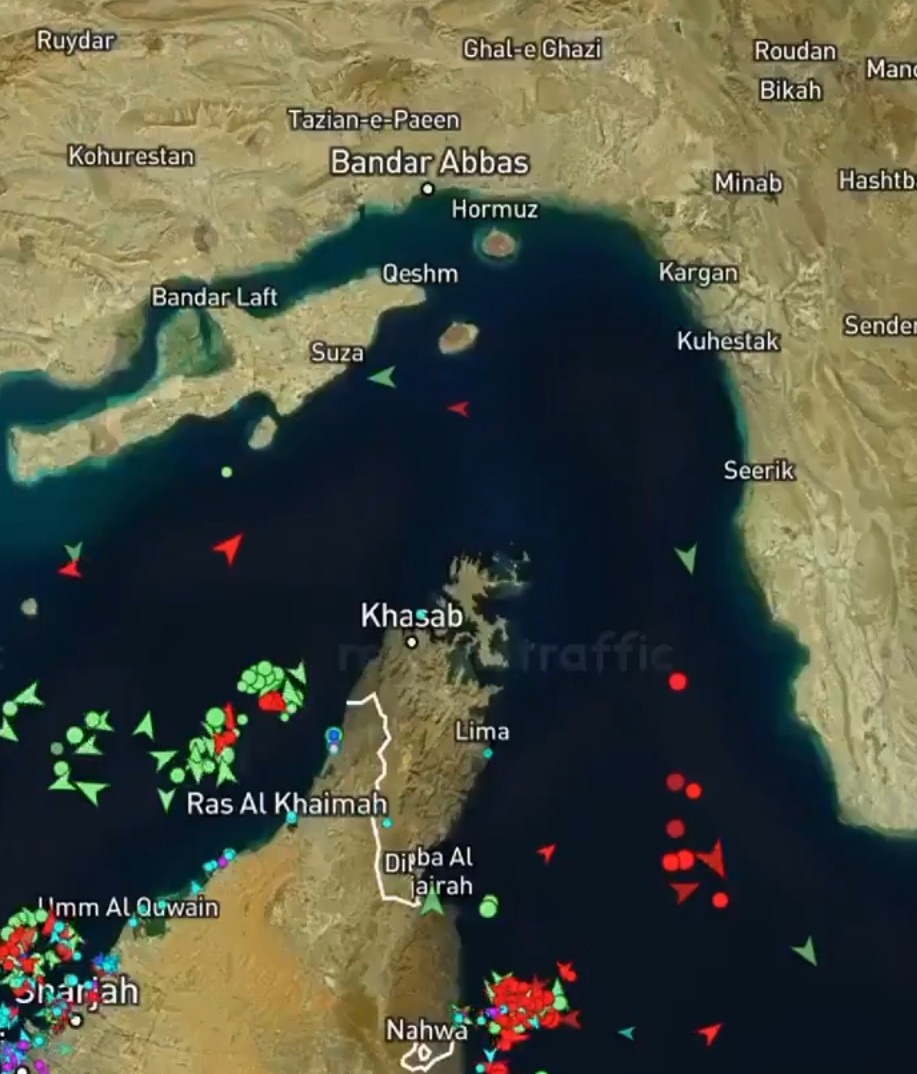
Iran-Oman corridor closes the US-escorted southern route and ties oil transit to Tehran’s political conditions
Iran’s leadership confronts two sharply different readings of the present phase of its confrontation with the United States. One interpretation holds that strategic patience alone can convert military success into lasting political victory. The other warns that the same patience risks turning battlefield advantage into long-term strategic defeat.
In the first reading, Tehran has already absorbed the worst of the combined American and Israeli air campaign and has forced both air forces to operate at greater range and higher risk. Restrictions on traffic through the Strait of Hormuz, reinforced by Houthi pressure on the Bab al-Mandab, have kept oil prices elevated well into August despite repeated Western claims of surplus supply. Brent crude rose steadily from below eighty dollars a barrel in early August to more than ninety-four dollars before easing only on speculation that Iran might revive earlier diplomatic understandings. The economic pressure is visible in Japan’s currency and sovereign yields, in rising United States Treasury yields driven by inflation expectations and competition from corporate debt issuance, and in the repeated, so far unsuccessful, attempts by Treasury Secretary Scott Bessent to stabilise both the yen and the long end of the American yield curve. From this vantage point Iran needs only to maintain discipline: continue interdicting shipping, allow the Strategic Petroleum Reserve to run down, wait for Chinese demand to return, and let the accumulating costs expose fractures in Western financial and alliance systems. Additional sanctions are judged survivable; the alternative of forced unilateral disarmament is regarded as existential.
The second reading accepts the same military facts yet reaches the opposite conclusion. Iran has bloodied American forces, degraded the value of regional bases, and imposed genuine economic costs on the United States and its partners. Central Command has expended large stocks of precision munitions and can no longer prosecute the campaign without accepting markedly higher risks to aircrews and surface forces. In purely kinetic terms Iran has prevailed. The difficulty lies in conflict termination. Allowing the United States to exit under conditions resembling the pre-war status quo, tighter sanctions, a continuing blockade, and unrepaired infrastructure damage, would forfeit the leverage Iran currently holds. Once the immediate rally-around-the-flag effect fades, domestic economic hardship would reassert itself without the compensating gains of recognised control over the Strait and normalised commercial relations. The terms Iran regards as essential, acknowledgement of its position in Hormuz, release of frozen assets, removal of sanctions, and reconstruction capital, were briefly accepted in the Islamabad memorandum yet never enforced. The question therefore becomes whether Tehran can compel adherence to those terms before the siege begins to erode its own position more rapidly than that of its adversary.
Both narratives rest on the same observable realities, a restricted maritime transit, elevated oil prices, strained Western financial markets, and the practical exhaustion of certain American military options. The divergence turns on time and leverage. One view treats time as Iran’s ally; the other treats it as a resource that may already be slipping away. The practical test will remain the same metric that has governed the conflict from the outset, whose authority determines the routes ships may safely travel, and under what political and commercial conditions oil is permitted to leave the Gulf.
The practical test of authority over the Strait of Hormuz is being measured daily by the physical routes ships are permitted to take and by the political conditions attached to those routes.
Iran and Oman have now formalised a temporary joint navigation corridor whose entry lies in Iranian territorial waters and whose exit also passes partly through Iranian waters. The corridor is seven miles wide. Iranian officials have stated that activating this arrangement will close the previous southern passage that hugged the Omani coast, the same passage that United States Central Command has been escorting since May and through which more than 660 million barrels of crude moved under American protection. Iranian Deputy Foreign Minister Kazem Gharibabadi has been explicit: the Strait remains closed in military terms, only commercial vessels will be allowed, and no military vessels of any nationality will be permitted. Full reopening, he added, is conditional on the United States fulfilling its commitments under the June interim understanding.
This geography is decisive. A route whose entrance is controlled by Iran, whose management is negotiated bilaterally with Oman, and whose permanent successor is still to be defined by the two coastal states, places the primary authority over transit in Tehran’s hands. The United States may continue to claim freedom of navigation and may continue to offer escorts, yet the line on the map that ships must follow is no longer the one drawn under American and International Maritime Organisation auspices earlier in the conflict. Oil prices fell for a third consecutive session on the announcement of the Iran-Oman talks, indicating that markets read the bilateral arrangement as more consequential for future supply than the latest round of American sanctions.
The commercial conditions attached to transit reinforce the same metric. Iran has linked any sustained reopening to the release of frozen assets, the removal of sanctions pressure, and recognition of its role in the future administration of the waterway. Oman’s participation gives the arrangement a second coastal-state signature, complicating any American effort to treat the corridor as an external imposition. The joint mine-clearing project further embeds Iranian cooperation as a practical necessity rather than an optional concession.
Authority is therefore being tested not by declarations of principle but by the routes vessels actually follow, the flags of the warships that may or may not accompany them, and the political price exacted for safe passage. As long as the entrance to the only agreed commercial corridor lies in Iranian waters and the permanent management of the Strait remains subject to negotiation between Tehran and Muscat, the map continues to record Iranian primacy over the conditions under which oil leaves the Gulf. That is the measurable outcome against which claims of victory or defeat will continue to be judged.
Authored By: Global GeoPolitics
If you prefer to make a one time donation in support of my work, you can do so by clicking any link below:
https://donate.stripe.com/7sY8wPfvi864don0k3awo07 |
https://buymeacoffee.com/ggtv |
https://ko-fi.com/globalgeopolitics |
Bitcoin: 3NiK8BoRZnkwJSHZSekuXKFizGPopkE7ns


Leave a Reply