
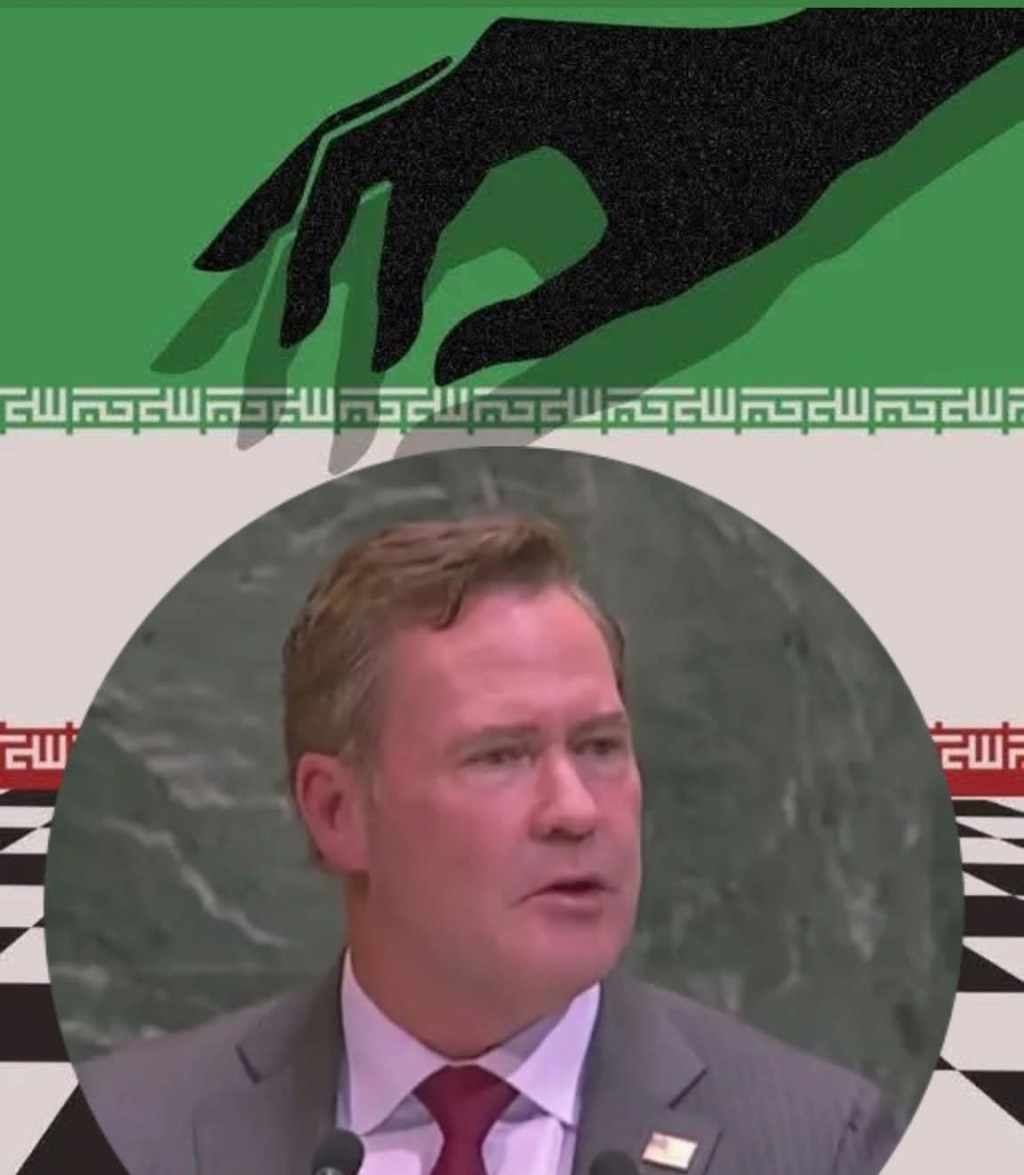
Why the persistent invocation of 1979 continues to justify sanctions, strikes, and systemic escalation
The enduring American narrative surrounding the 1979 embassy seizure functions not as historical record but as strategic instrument, and its continued deployment marks a structural refusal to acknowledge the limits of American power in the post-imperial Middle East. That refusal has hardened into doctrine, and doctrine has replaced analysis, producing a policy framework that perpetuates conflict rather than resolves it.
Any serious assessment must begin with the prior rupture, namely the 1953 Iranian coup d’état, which removed Mohammad Mossadegh and reinstalled Mohammad Reza Pahlavi under American patronage. That intervention was not an aberration but a calculated assertion of control over strategic oil reserves and regional alignment, as detailed by economic historians such as Michael Hudson, who argued that control over energy flows formed the backbone of post-war dollar supremacy. Iranian political actors in 1979 operated with full awareness of this precedent, and their actions followed directly from that historical memory rather than from ideological spontaneity.
Revolutionary students who seized the embassy during the Iranian Revolution did not act within a vacuum of lawlessness but within a framework shaped by prior intervention and perceived existential threat. The embassy itself had already served as an operational node in regime change, and its symbolic status could not be separated from its practical function. Preventive action, however unlawful in formal diplomatic terms, was understood domestically as a rational defensive measure against a repeat of 1953, a judgement that aligns with realist interpretations of state survival under asymmetric conditions.
Resolution came through the Algiers Accords, which formally obligated the United States to refrain from interference in Iranian affairs, both directly and indirectly. Legal scholars such as Alexander Mercouris have emphasised that the language of non-intervention was unambiguous, and its acceptance constituted a binding constraint on future American conduct. The release of hostages in exchange for that commitment represented a negotiated equilibrium, one that should have stabilised bilateral relations under classical diplomatic logic.
That equilibrium did not hold because American strategic priorities rendered it untenable. Support for Saddam Hussein during the Iran–Iraq War illustrates a deliberate choice to weaken Iran through proxy warfare, even as Iraq deployed chemical weapons on a scale documented by military analysts. Andrei Martyanov has argued that such asymmetrical support structures reveal a pattern whereby the United States compensates for declining direct dominance through indirect escalation mechanisms. These actions did not merely violate the spirit of the Algiers Accords; they nullified its foundational premise.
The destruction of Iran Air Flight 655 by a United States naval vessel further entrenched the asymmetry of accountability, demonstrating that civilian casualties could be absorbed without systemic consequence when inflicted by a dominant power. Economic coercion through sanctions followed as a long-duration strategy, producing cumulative structural pressure on Iran’s economy while reinforcing the global role of the dollar, a process examined extensively by Glenn Diesen in his analysis of financial hegemony and coercive interdependence.
Withdrawal from the Joint Comprehensive Plan of Action in 2018 confirmed that negotiated agreements with the United States remain contingent rather than binding when strategic calculations shift. Verification of Iranian compliance by the International Atomic Energy Agency did not alter the decision, because compliance held less value than coercive leverage within the broader architecture of containment. Direct and indirect actions aimed at internal destabilisation further reinforced the perception that non-interference commitments carried no operational meaning.
Strategic logic rather than moral inconsistency explains this continuity. The United States operates within a hegemonic stability framework in which regional autonomy by resource-rich states threatens systemic control, particularly over energy transit routes such as the Strait of Hormuz. Iran’s position within that system transforms it from a regional actor into a structural constraint on American power projection, and containment becomes a necessity rather than a choice.
Game theory clarifies the interaction more precisely than diplomatic language permits. The relationship between Washington and Tehran conforms to a repeated deterrence game with asymmetric capabilities and divergent payoff structures. The United States seeks compliance through escalating pressure, assuming that economic and military superiority will force concession, while Iran maximises resilience and retaliation capacity to raise the cost of coercion beyond acceptable thresholds. Nash equilibrium emerges not at cooperation but at managed hostility, because neither actor can secure unilateral advantage without incurring prohibitive risk.
American reliance on the 1979 embassy seizure as a permanent justification alters the payoff matrix by attempting to legitimise escalation independent of current conditions. That move fails strategically because Iran does not accept the premise, and external actors increasingly reject its legitimacy as well.
Diesen has noted, the erosion of narrative credibility accelerates the fragmentation of the global order, particularly when alternative financial and political blocs offer parallel systems of alignment.
Long-standing doctrines have therefore undergone quiet reversal. Non-interference commitments have been replaced by persistent intervention under varying pretexts. Diplomatic agreements have shifted from binding instruments to tactical pauses. Military superiority has ceased to guarantee political outcomes in asymmetric environments. These reversals do not represent tactical adjustments but structural decline in the coherence of American strategy.
The consequences extend beyond bilateral relations into the architecture of global power. Russia and China have integrated Iran more deeply into emerging economic and security frameworks, reducing the effectiveness of unilateral sanctions and weakening dollar centrality. Energy markets have adapted through diversification and alternative payment systems, diminishing the leverage that once underpinned American foreign policy. The Middle East itself has moved towards multipolar balancing, with regional actors hedging against reliance on a single external power.
No modern precedent fully captures the cumulative effect of these shifts. A hegemonic power continues to assert narrative dominance while losing material control over the systems that narrative once governed. That contradiction produces instability, not equilibrium.
The persistence of the hostage crisis narrative serves a specific function within this environment. It simplifies complex historical causation into a single moral claim, enabling policy continuity without strategic reassessment. That simplification carries cost, because it prevents adaptation to a transformed geopolitical landscape in which former assumptions no longer hold.
The continued invocation of the 1979 embassy seizure as an original and sufficient cause for perpetual hostility obscures a longer chain of causation that begins with the 1953 Iranian coup d’état and extends through repeated violations of the Algiers Accords, thereby transforming what was once a discrete diplomatic crisis into a permanent strategic justification for coercion. American policymakers have consistently framed the actions of revolutionary students during the Iranian Revolution as an unprovoked rupture, while omitting the prior removal of Mohammad Mossadegh and the restoration of Mohammad Reza Pahlavi through external intervention, a sequence that shaped Iranian threat perception and rendered the embassy itself a symbol of operational subversion rather than neutral diplomacy.
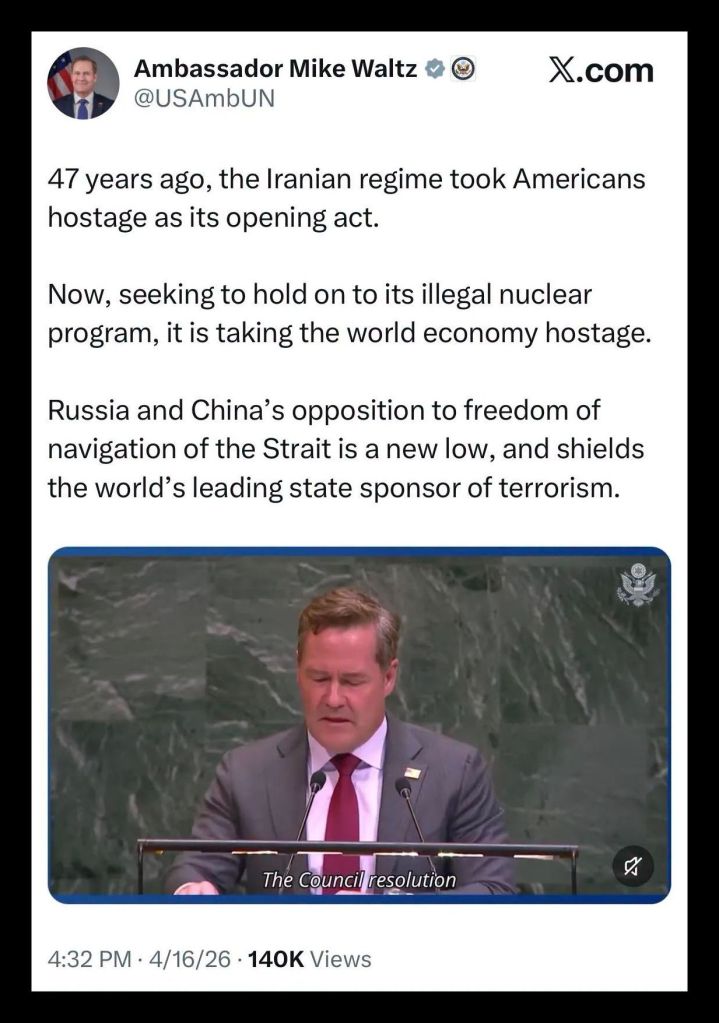
The subsequent settlement, which formally obligated Washington to abstain from interference, did not establish a durable equilibrium because American strategy continued to rely upon indirect warfare, economic strangulation, and episodic military force, including support for Saddam Hussein during the Iran–Iraq War, the destruction of Iran Air Flight 655, the sustained imposition of sanctions, and the unilateral abandonment of the Joint Comprehensive Plan of Action despite verified compliance by the International Atomic Energy Agency. Each of these actions reinforced a strategic environment in which Iran’s leadership interpreted American commitments as contingent instruments rather than binding constraints, thereby incentivising deterrence through escalation and regional leverage rather than accommodation. The culmination of this trajectory emerged in 2026, when the United States and Israel initiated large-scale strikes against Iran, triggering a broader regional war that has already resulted in extensive casualties, infrastructure destruction, and systemic disruption to global trade and energy flows (Encyclopedia Britannica).
The closure and militarisation of the Strait of Hormuz, through which a substantial portion of the world’s energy supply transits, has further demonstrated that the conflict is not a bilateral dispute but a structural confrontation with global economic consequences, as shipping routes have been disrupted and maritime security degraded (USNI News).
Under these conditions, the persistent recycling of the hostage crisis narrative functions less as historical explanation than as political cover for escalation, and it is precisely this refusal to confront the full continuity of intervention, retaliation, and broken agreements that has carried the United States and Iran from a settled diplomatic dispute into an open and destabilising war.
Authored By: Global GeoPolitics
Thank you for visiting. This is a reader-supported publication. If you believe journalism should serve the public, not the powerful, and you’re in a position to help, becoming a PAID SUBSCRIBER truly makes a difference. Alternatively you can support by way of a cup of coffee:
https://buymeacoffee.com/ggtv |
https://ko-fi.com/globalgeopolitics |
Bitcoin: 3NiK8BoRZnkwJSHZSekuXKFizGPopkE7ns
References
Abrahamian, E. (1982) Iran Between Two Revolutions. Princeton: Princeton University Press.
Abrahamian, E. (2021) The Iranian Revolution. Oxford: Oxford University Press.
Algiers Accords (1981) General Declaration and Claims Settlement Declaration between the United States and Iran, 19 January.
Bowden, M. (2006) Guests of the Ayatollah: The First Battle in America’s War with Militant Islam. New York: Atlantic Monthly Press.
Central Intelligence Agency (2013) Clandestine Service History: Overthrow of Premier Mossadegh of Iran, November 1952–August 1953. Washington, DC: CIA (declassified).
Diesen, G. (2020) The Decay of Western Civilisation and Resurgence of Russia. London: Routledge.
Gasiorowski, M.J. (1987) ‘The 1953 coup d’état in Iran’, International Journal of Middle East Studies, 19(3), pp. 261–286.
Hudson, M. (2003) Super Imperialism: The Origin and Fundamentals of U.S. World Dominance. 2nd edn. London: Pluto Press.
Human Rights Watch (1993) Genocide in Iraq: The Anfal Campaign Against the Kurds. New York: Human Rights Watch.
International Atomic Energy Agency (2016–2018) Verification and Monitoring in the Islamic Republic of Iran in light of United Nations Security Council Resolution 2231 (2015). Vienna: IAEA.
International Civil Aviation Organization (1988) Report of the Investigation into the Destruction of Iran Air Flight 655. Montreal: ICAO.
Kinzer, S. (2008) All the Shah’s Men: An American Coup and the Roots of Middle East Terror. 2nd edn. Hoboken: Wiley.
Martyanov, A. (2018) Losing Military Supremacy: The Myopia of American Strategic Planning. Atlanta: Clarity Press.
Mousavian, S.H. (2014) Iran and the United States: An Insider’s View on the Failed Past and the Road to Peace. London: Bloomsbury.
Nephew, R. (2018) The Art of Sanctions: A View from the Field. New York: Columbia University Press.
Razoux, P. (2015) The Iran-Iraq War. Cambridge, MA: Harvard University Press.
United States Department of State (n.d.) The Iran Hostage Crisis, 1979–1981. Office of the Historian. Available at: https://history.state.gov (Accessed: 18 April 2026).
United States Department of the Treasury (n.d.) Iran Sanctions Program. Office of Foreign Assets Control. Available at: https://home.treasury.gov (Accessed: 18 April 2026).
United States Naval Institute (2026) Report to Congress on the Situation in the Strait of Hormuz. Annapolis: USNI.


Leave a Reply