
How the UN Resolution on Iran Omitted the Origins of the Conflict and Reflected the Politics of Power
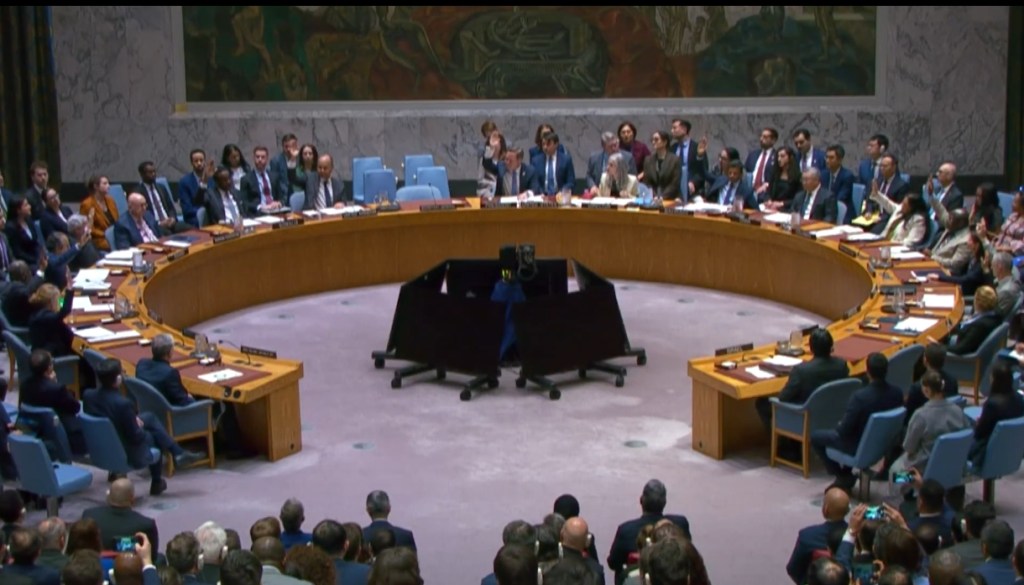
The resolution adopted by the United Nations Security Council condemning Iran’s military actions across the Gulf has been presented as a clear statement in defence of regional stability. Yet the circumstances surrounding the vote raise serious questions about whether the Council’s judgement adequately reflected the origins and legal context of the conflict. By focusing solely on Iran’s retaliation while omitting any reference to the preceding military strikes reportedly carried out by United States and Israel against Iranian territory, the resolution risks presenting a partial and misleading account of events. In doing so, it may undermine the very principles of international law and impartial adjudication that the United Nations was established to uphold.
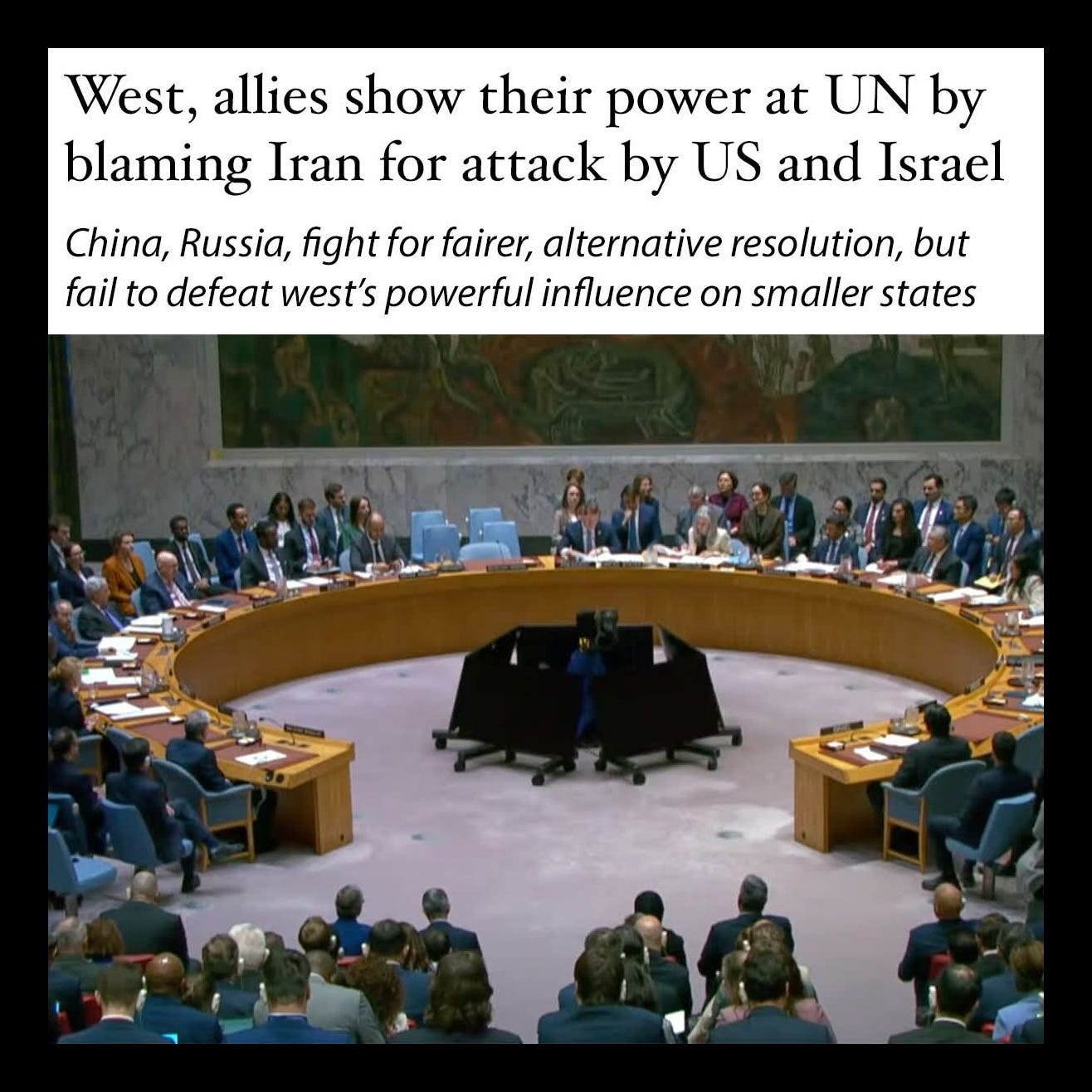
At the centre of the controversy lies the issue of causation. Diplomacy and international law both depend upon an honest recognition of how conflicts begin. In this case, critics argue that the resolution effectively detached Iran’s military response from the events that preceded it. The Iranian ambassador to the United Nations described the measure as a “manifest injustice,” insisting that Iran was the victim of aggression. Whether or not one accepts Tehran’s broader claims, the absence of any reference to the alleged initial strikes by the United States and Israel is striking. Such attacks, if undertaken without authorisation from the Security Council, would themselves raise serious legal questions. Yet the resolution makes no attempt to address them.
International law does not regard the use of force in isolation. The legal framework governing armed conflict is rooted in the United Nations Charter, which places strict limits on when states may resort to military action. Central to this framework is the doctrine of self-defence enshrined in Article 51 of the UN Charter. This provision recognises that states subjected to armed attack retain the right to respond until the Security Council takes measures to restore international peace and security. The implication is not that any response is automatically justified, but rather that the legality of retaliation must be assessed in light of the initial act of force. By omitting reference to the alleged precipitating attacks, the Council’s resolution effectively bypassed this crucial legal context.
The objections raised by China and Russia reflected precisely this concern. Both delegations argued that the resolution failed to capture the broader sequence of events and therefore could not provide a balanced account of the crisis. China’s representative emphasised that the strikes attributed to the United States and Israel had not received Security Council authorisation, while warning that the use of force had historically proved incapable of resolving the political tensions of the Middle East. Russia, for its part, introduced an alternative draft that sought to call for de-escalation by all parties rather than attributing blame exclusively to one side. That proposal, however, failed to attract sufficient support.
The voting pattern itself illustrates the persistent influence of geopolitical alignments within the Council. The resolution passed with the support of thirteen members, while China and Russia abstained. Many of the states named as victims of Iranian attacks, including Saudi Arabia, United Arab Emirates, Qatar, Jordan, Bahrain, Kuwait, and Oman, maintain close security relationships with Washington. In such circumstances it is perhaps unsurprising that Western governments and their partners would favour a resolution emphasising the threat posed by Iran’s regional strikes. Yet this alignment inevitably raises doubts about whether the Council’s deliberations were shaped primarily by legal principle or by strategic solidarity.
These doubts are not new. The structure of the Security Council has long attracted criticism within the field of International Relations. Established in the aftermath of the Second World War, the Council reflects the distribution of power that existed in 1945 rather than the geopolitical realities of the present day. Its permanent members, the United States, the United Kingdom, France, China, and Russia, possess disproportionate influence over the framing and adoption of resolutions. Even when the veto is not exercised, the diplomatic weight of these states can shape outcomes in subtle but decisive ways. The result is an institution whose decisions are frequently interpreted through the lens of great-power politics.
In the present case, critics argue that the Council’s resolution creates the impression that Iran initiated a campaign of attacks across the Gulf without provocation. By neglecting to acknowledge the preceding events alleged by Tehran and others, the resolution simplifies a complex escalation into a narrative of unilateral aggression. Such framing carries significant consequences. Security Council resolutions shape international opinion, influence diplomatic alignments, and help determine the legitimacy accorded to states’ actions. When the narrative presented by the Council appears incomplete, the credibility of the institution itself can be called into question.
Some observers have therefore suggested that a debate within the broader United Nations General Assembly might produce a more representative expression of global opinion. Unlike the Security Council, the General Assembly includes nearly every sovereign state and is less constrained by the strategic alliances that dominate the Council’s smaller membership. While its resolutions lack the binding authority of Security Council decisions, they often provide a clearer indication of how the wider international community interprets a crisis.
None of this implies that Iran’s military actions should be immune from scrutiny or criticism. Strikes against multiple states across the Gulf inevitably raise concerns about regional escalation and civilian risk. Yet the legitimacy of any condemnation depends upon an accurate accounting of the events that produced the confrontation. When a resolution addresses only the response while remaining silent on the precipitating acts of force, it risks appearing less as a neutral judgement than as an expression of geopolitical alignment.
The episode therefore illustrates a persistent dilemma at the heart of the United Nations system. The organisation was conceived as a forum in which disputes could be addressed through collective deliberation and the rule of law. In practice, its most powerful body remains deeply entangled with the interests and alliances of the states that dominate it. Whether the resolution condemning Iran will contribute to de-escalation remains uncertain. What is clearer is that its selective framing has reinforced long-standing perceptions that the application of international law within the Security Council is uneven, shaped as much by power and politics as by principle.
Authored By: Global GeoPolitics
Thank you for visiting. If you believe journalism should serve the public, not the powerful, and you’re in a position to help, becoming a PAID SUBSCRIBER truly makes a difference. Alternatively you can support by way of a cup of coffee:
https://buymeacoffee.com/ggtv |
https://ko-fi.com/globalgeopolitics |
Bitcoin: 3NiK8BoRZnkwJSHZSekuXKFizGPopkE7ns


Leave a reply to albertoportugheisyahoocouk Cancel reply