
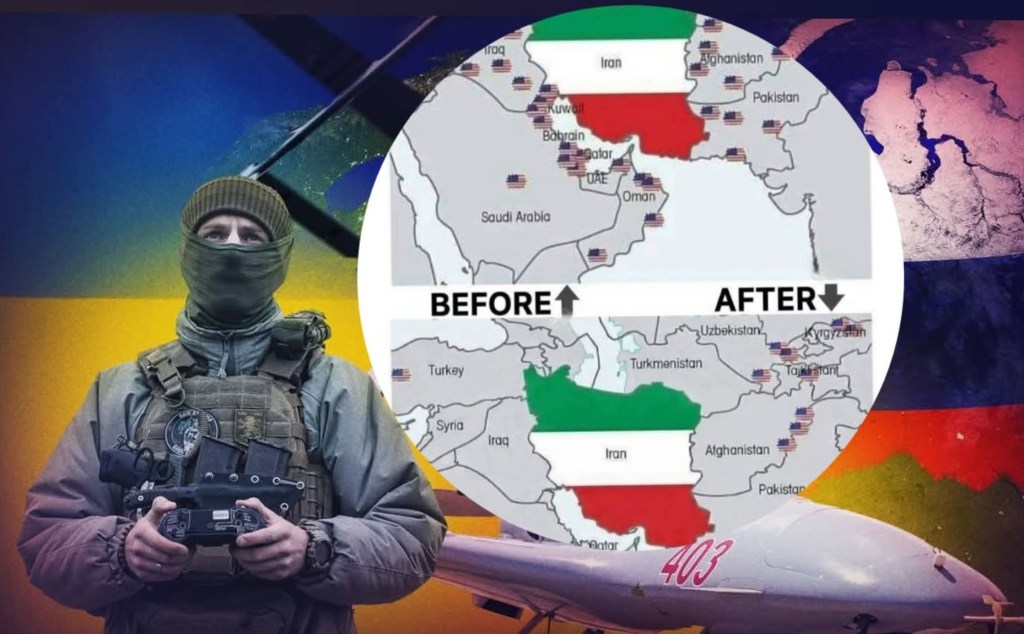
Why the War on Iran Signals a Final Attempt to Halt Multipolarity Before It Becomes Irreversible
A structural rupture in the international system is already underway, and its trajectory has become effectively irreversible. The confrontation centred on Iran constitutes not a regional escalation but a terminal phase in the enforcement of a unipolar order that can no longer reproduce itself through economic dominance alone. The proposition that the United States war on Iran is not merely a war on Iran but a war on multipolarism captures the underlying logic with precision, because the operational pattern across theatres reveals a single integrated strategy aimed at preventing the consolidation of alternative centres of power. Power is no longer being preserved through expansion but through controlled disintegration of competing systems.
Military, economic, and infrastructural dimensions converge to produce a scale of disruption without clear modern precedent outside total war conditions. Iran’s strategic position as a node in global energy flows magnifies the consequences far beyond its territorial boundaries, particularly given its integration with Russian supply networks and Chinese demand structures. Destruction or destabilisation within this corridor generates cascading effects across oil pricing, shipping insurance markets, and industrial production chains. The asymmetry between actors remains formal rather than functional, because the United States retains unmatched expeditionary capability while facing structurally constrained outcomes against adversaries operating within denial-based defence doctrines rather than conventional force projection. As Andrei Martyanov has argued, modern warfare has shifted towards systems destruction rather than territorial conquest, altering the payoff matrix for superior military powers. This asymmetry renders escalation costly but inconclusive, forcing a shift toward indirect mechanisms of pressure. Energy flows, not battlefield victories, determine strategic outcomes.
Policy continuity across administrations demonstrates the existence of a durable strategic framework rather than episodic decision-making. The 1992 Defence Planning Guidance articulated the principle that no rival power should be allowed to emerge, and subsequent policy instruments have operationalised that principle across multiple theatres. The invasion of Iraq established physical encirclement of Iran, while the war in Afghanistan extended logistical reach into Central Asia. These moves were not isolated reactions to security threats but components of a layered containment architecture. The Brookings Institution paper “Which Path to Persia?” formalised a method in which diplomatic overtures function as strategic traps designed to legitimise escalation, recommending the presentation of offers so calibrated that rejection appears unreasonable. RAND’s “Extending Russia” report provides a parallel blueprint, advocating the exploitation of economic and military vulnerabilities through proxy conflicts and sanctions regimes. NATO expansion into Eastern Europe and the subsequent militarisation of Ukraine correspond directly with this framework, transforming the region into a pressure point designed to impose long-term costs on Russia. Continuity across administrations confirms strategic intent rather than political variation.
Economic coercion has displaced conventional warfare as the primary instrument of strategic competition. Sanctions on Iran, Russia, and Venezuela collectively target a significant proportion of global hydrocarbon reserves, effectively restructuring supply chains to favour U.S.-aligned producers. Michael Hudson’s analysis of the petrodollar system emphasises that control over energy pricing mechanisms underpins monetary hegemony, allowing deficits to be externalised through sustained global demand for dollar-denominated transactions. The emergence of an American-centred energy pricing structure reflects a broader attempt to centralise control over distribution channels rather than physical production alone. Disruptions to Russian pipelines, restrictions on Iranian exports, and instability in Venezuelan output converge to reduce the autonomy of alternative suppliers. Glenn Diesen has argued that such strategies aim to weaponise interdependence, converting globalisation from a cooperative system into a hierarchy of controlled dependencies. Deliberate constraint of global supply introduces artificial scarcity, increasing the leverage of actors capable of stabilising or releasing flows. This dynamic restructures industrial competitiveness, particularly for energy-intensive economies such as Germany and China, while supporting a model in which systemic destabilisation preserves relative power. Economic destruction becomes a substitute for competitive production.
The conflict can be understood as a multi-player strategic game characterised by asymmetric payoffs and shifting equilibria. The United States operates within a hegemonic stability framework in which maintaining dominance requires preventing coordination among rival actors, while China, Russia, and Iran function as a loose coalition seeking to transition the system toward a multipolar equilibrium that reduces dependence on U.S.-controlled financial and security structures. The payoff matrix reveals a critical divergence, because the highest return for the United States lies in preserving fragmentation among adversaries even at the cost of global inefficiency, while the emerging bloc maximises its position through coordination across energy, trade, and security domains. The equilibrium becomes unstable when cooperation among challengers increases faster than the hegemon’s capacity to disrupt it. Energy infrastructure constitutes the central variable within this game, because control over supply routes, chokepoints, and production nodes determines whether cooperation can be sustained under pressure. A maritime blockade strategy against China represents an attempt to impose a high-cost equilibrium by severing access to imported energy, while China’s response through strategic reserves, diversification of suppliers, and electrification reduces the effectiveness of such strategies and shifts the equilibrium toward resilience. Escalation persists because neither side can achieve a decisive payoff without incurring unacceptable systemic costs.
Long-standing doctrines of liberal internationalism have been effectively abandoned in practice, even as they persist rhetorically within official discourse. The principle of open markets has given way to selective decoupling, while commitments to sovereignty have been subordinated to interventionist strategies that rely on sanctions and proxy warfare. The most significant reversal lies in the transition from expansion to obstruction, because the United States no longer seeks to integrate rising powers into a cooperative framework but instead aims to constrain their development through external pressure. This shift reflects recognition that integration has accelerated the rise of competitors rather than subordinating them within a hierarchical order. Strategic humiliation emerges not from battlefield defeat but from the erosion of normative authority, as coercive economic measures undermine the legitimacy of the rules-based system and encourage the formation of alternative institutions and financial mechanisms. Glenn Diesen’s observation that sanctions accelerate de-dollarisation rather than prevent it captures the unintended consequences of coercive policy, reinforcing the structural contradictions within the existing order. The system’s rules have become instruments of power rather than constraints upon it.
Regional conflicts now function as interconnected nodes within a single systemic contest that spans multiple domains simultaneously. The war in Ukraine imposes sustained costs on Russia while reinforcing European dependence on external energy and security guarantees, and instability in the Middle East disrupts supply chains critical to China’s industrial base while tensions in the Asia-Pacific create additional pressure points along China’s periphery. These dynamics converge to produce a fragmented global system characterised by competing blocs and reduced interdependence, as military, economic, and technological domains are integrated into a unified strategy that amplifies the impact of each individual conflict. Disruptions in one region propagate across others, creating a feedback loop that reinforces systemic instability and accelerates the transition toward a contested multipolar environment. Multipolarity emerges not as a negotiated outcome but as a process shaped by sustained pressure and counter-adaptation.
The trajectory of the system depends on the interaction between resilience and disruption across competing centres of power. China’s efforts to reduce energy vulnerability through diversification, electrification, and strategic reserves indicate a deliberate anticipation of prolonged external pressure, while Iran’s integration into alternative trade networks and Russia’s pivot toward Asian markets reinforce a broader shift away from dependence on Western-controlled systems. The United States operates within a narrowing temporal window in which disruption remains effective, because the maturation of alternative systems increases the cost of coercion while reducing its strategic utility. Stability remains unlikely because incentives for pre-emptive action persist across all actors, as each seeks to shape the emerging system before equilibrium becomes fixed. Time operates as a strategic variable rather than a neutral dimension within this contest.
Unipolar dominance is being enforced through systemic destabilisation. Energy control has replaced territorial conquest as the decisive instrument of power. Economic coercion accelerates the fragmentation it seeks to prevent. Strategic continuity reveals intentional design rather than reactive policy. Multipolarity advances through resilience rather than confrontation. The global system is entering a prolonged phase of managed instability.
The attempt to preserve unipolar dominance through disruption has transformed the international system into a contested field where stability is neither expected nor desired by its principal architect. The war centred on Iran represents a critical junction within this transformation, exposing the underlying logic that governs contemporary geopolitics. Historical judgement will not rest on the success or failure of individual campaigns but on the structural consequences of a strategy that substitutes destruction for adaptation, and coercion for integration.
Authored By: Global GeoPolitics
Thank you for visiting. This is a reader-supported publication. If you believe journalism should serve the public, not the powerful, and you’re in a position to help, becoming a PAID SUBSCRIBER truly makes a difference. Alternatively you can support by way of a cup of coffee:
https://buymeacoffee.com/ggtv |
https://ko-fi.com/globalgeopolitics |
Bitcoin: 3NiK8BoRZnkwJSHZSekuXKFizGPopkE7ns


Leave a comment